
Sermorelin vs Tesamorelin for Pets: Same Pathway, Different Evidence
Are sermorelin and tesamorelin interchangeable for pets? Compare their human product records, formulations, outcomes and animal-evidence limits.
Direct answer: Sermorelin and tesamorelin should not be treated as interchangeable pet treatments. They are different growth hormone-releasing hormone analogs with different human product records, formulations, named populations and outcomes. A historical FDA record for Geref does not validate a current sermorelin vial, and the current Egrifta WR label does not create a dog or cat indication.
Why compare the record before comparing the peptide?
Pet owners can encounter sermorelin and tesamorelin in the same online category, often beside phrases such as growth hormone support, body composition, recovery or healthy aging. That shared category is only a starting point. It does not establish that the active ingredients are the same, that their finished products can be substituted, or that a result in one human population answers a veterinary question.
The most useful comparison begins with the record attached to each name. For sermorelin, the key FDA record in this review is a 2013 Federal Register determination concerning discontinued Geref products. For tesamorelin, the current record is a specific FDA-regulated human biological product with an active label and a narrowly described indication. Neither record is a companion-animal clinical trial.

Sermorelin and tesamorelin records at a glance
| Question | Sermorelin record | Tesamorelin record | What it means for a pet question |
|---|---|---|---|
| Named product | Geref, a discontinued human sermorelin acetate product | Egrifta SV and Egrifta WR, current human tesamorelin products in the FDA Purple Book | A molecule name does not identify one current veterinary product. |
| Regulatory fact | FDA determined the discontinued Geref products were not withdrawn for safety or effectiveness reasons. | Egrifta WR has a current human label for a specific indication and population. | Neither fact is an animal approval or evidence of dog or cat benefit. |
| Population and purpose | The 2013 determination is an administrative record about discontinued human products. | The current label concerns adults with HIV-associated lipodystrophy and reduction of excess abdominal fat. | Pet body condition, growth, weakness or aging are different questions. |
| Finished formulation | The old brand record does not inspect a modern vial sold under the generic name. | The label says the SV and WR formulations differ and are not substitutable. | Even products with the same active ingredient can require formulation-specific evidence. |
| Clinical pet evidence | Not supplied by the Federal Register determination. | Not supplied by the human label or Purple Book record. | A veterinary claim still needs a defined animal population, product, comparator, outcome and harms record. |
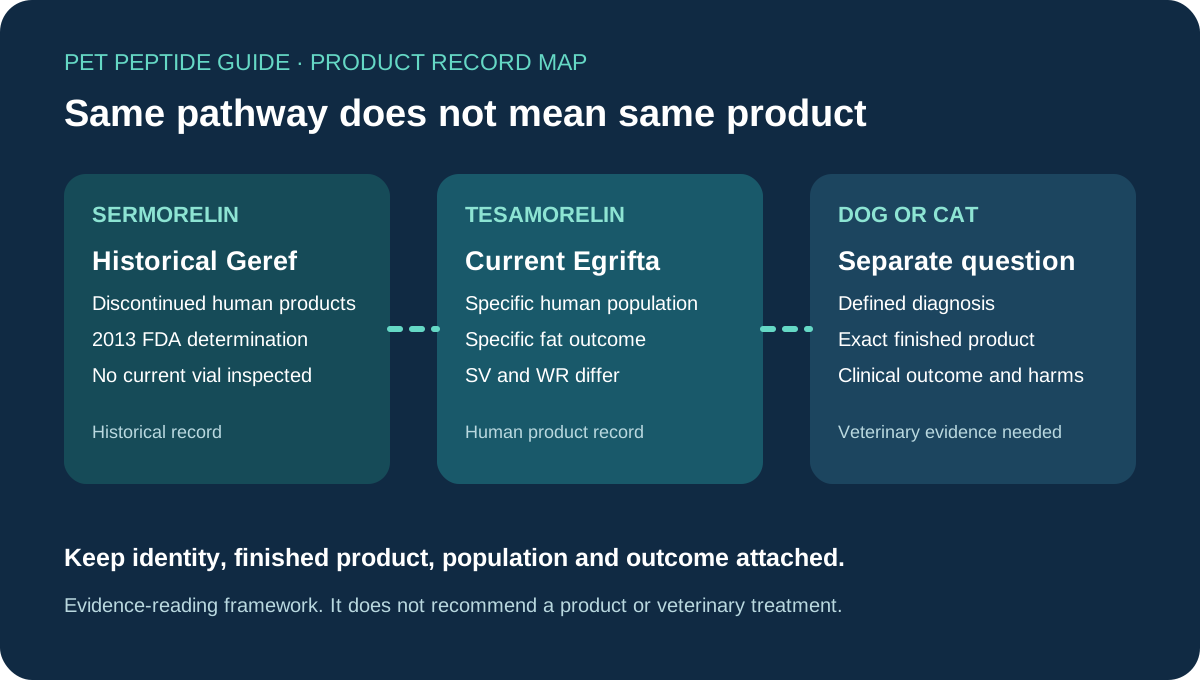
What the Geref record actually says
In March 2013, FDA published a determination concerning discontinued Geref sermorelin acetate injection products. The agency concluded that the named products were not withdrawn from sale for reasons of safety or effectiveness. FDA also said the products would remain in the Discontinued Drug Product List section of the Orange Book.
That is a precise and useful historical fact. It is narrower than several claims an owner may see online. It does not say that Geref remains a currently marketed product. It does not say that every preparation labeled sermorelin matches Geref. It does not inspect the identity, concentration, excipients, sterility, stability or labeling of a current vial. It also does not establish a veterinary indication.
The FDA orphan-drug record provides additional historical context for Geref and sermorelin acetate. That record belongs to the named human product and its historical approval history. It should not be copied onto an unnamed compounded product or converted into a dog or cat claim.
What the Egrifta WR label actually says
The current Egrifta WR prescribing information identifies tesamorelin as a growth hormone-releasing factor analog. Its human indication is reduction of excess abdominal fat in adults with HIV-associated lipodystrophy. The label explicitly says the product is not indicated for weight-loss management. That distinction matters before anyone turns a fat-related human headline into a general pet weight claim.
The label also provides an unusually clear formulation lesson. Egrifta WR and Egrifta SV have the same proper name, tesamorelin, but the label says their formulations and strengths differ and that they are not substitutable. The FDA Purple Book separately lists the current SV and WR products and their marketing status.
For pet owners, the lesson is not to reproduce the human label directions. The lesson is that an active-ingredient name alone is insufficient. If two FDA-regulated human formulations with the same proper name are not interchangeable, a seller's use of a familiar peptide name cannot establish that an unrelated vial matches either product or any cited study.
A shared pathway is not a shared product
Sermorelin and tesamorelin are both discussed in relation to growth hormone-releasing signaling. That shared biological category does not erase differences in molecular identity, finished formulation, product history, studied population or intended outcome. It also does not make either compound interchangeable with CJC-1295, a GHRP variant, growth hormone or natural growth hormone-releasing hormone.
A pathway claim may describe where researchers expect a compound to act. A product claim must identify what is actually in the finished preparation. A clinical claim must then connect that preparation to a defined population and a meaningful outcome. Those are separate links. Skipping from pathway to pet benefit leaves the most important links unverified.
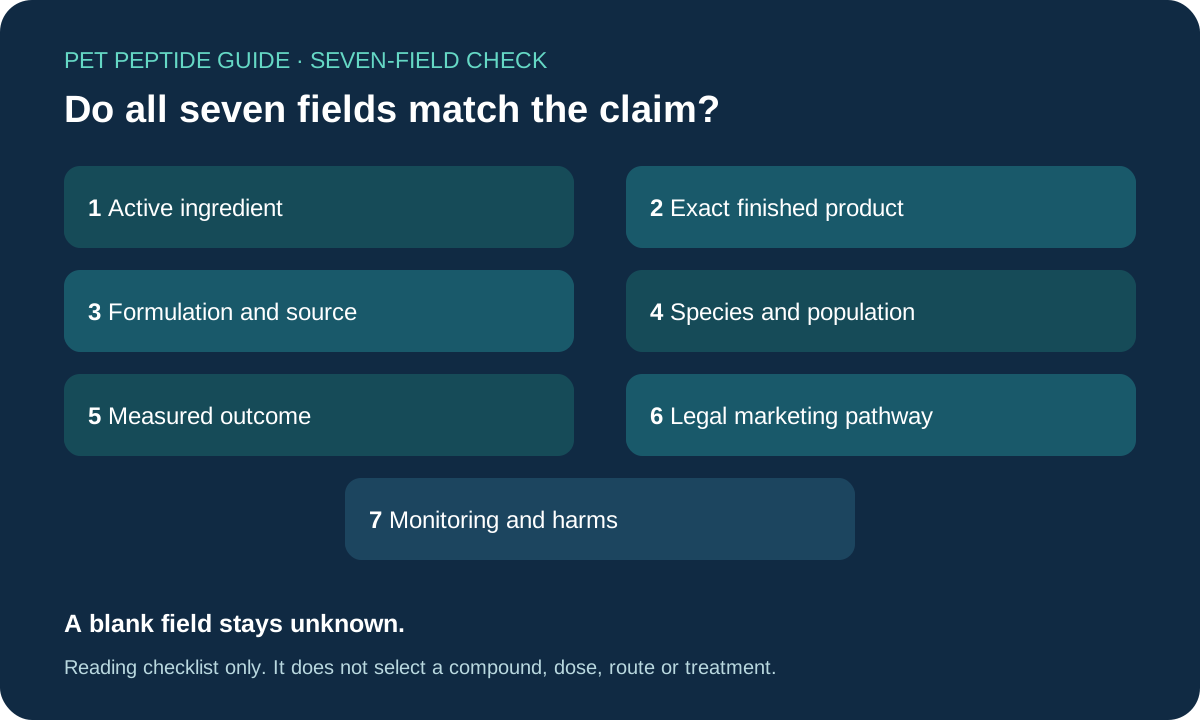
Use the seven-field label and evidence check
- Active ingredient: Is the source about sermorelin, tesamorelin or another analog?
- Exact product: Does the claim name Geref, Egrifta SV, Egrifta WR, a compounded preparation or an unidentified vial?
- Formulation: Do the finished form, excipients and product record match the cited source?
- Population: Was the evidence collected in a named human population, laboratory animals or companion-animal patients?
- Outcome: Did the source measure a diagnostic response, hormone marker, a specific fat compartment, body weight, function or a clinical outcome?
- Legal pathway: Is there a current human label, animal NADA or ANADA record, conditional approval, minor-species index entry, veterinarian-directed extra-label pathway or unapproved compounded preparation?
- Monitoring: Who is responsible for identifying contraindications, collecting adverse events and deciding whether the expected outcome is occurring?
A comparison is incomplete when one column is blank. The blank field should remain unknown rather than being filled with language from a seller, a historical brand or a different analog.
Why a human label does not become an animal label
FDA describes separate legal marketing pathways for animal drugs. A currently approved animal drug normally carries an NADA or ANADA number, while conditional approvals and minor-species index entries have their own records. FDA also cautions that an NDC number, registration statement or veterinary-use caution statement does not itself prove that an animal drug is legally marketed.
Compounding is another distinct question. FDA states that animal drugs compounded from bulk drug substances are not FDA-approved and have not undergone the same premarket review for safety, effectiveness, manufacturing, labeling and packaging. The agency recognizes circumstances in which veterinarian-directed compounding may be medically necessary, but that pathway does not transform the compounded preparation into the human product whose name appears in a search result.
This is why the comparison does not end with “ask a veterinarian.” Bring the exact product record to the discussion. A clinician needs the ingredient, source, formulation, intended use and current patient information to evaluate a real proposal.
Translate three common claims into answerable questions
“They are basically the same peptide”
Ask which exact active ingredient and finished formulation is being proposed. Then ask whether the cited source used that product. A common pathway is not proof of product equivalence.
“Sermorelin was FDA approved”
Ask whether the statement refers to the discontinued Geref human products and the historical record. Then ask what record supports the current preparation and the proposed animal use. The historical fact should remain accurate without being stretched.
“Tesamorelin reduces fat, so it may help an overweight pet”
Keep the population and outcome attached to the Egrifta label. It names HIV-associated lipodystrophy in adults and says the product is not indicated for weight-loss management. A pet weight-management question needs its own diagnosis, appropriate veterinary options and species-specific outcomes.
Questions to bring to the veterinary visit
- What exact clinical problem is the proposed product intended to address?
- Is the active ingredient sermorelin, tesamorelin or another growth hormone-related compound?
- What finished product and formulation are being discussed?
- Which source studied that product in a matching species and population?
- Was the measured outcome a hormone marker, body composition, function or a clinical result?
- What approval, extra-label or compounding record applies to this specific preparation?
- How would effectiveness and unwanted effects be monitored for this animal?
Use the printable veterinary checklist to record these fields. For background on each compound, read the sermorelin guide and tesamorelin guide. The human-label worksheet explains why a human product record does not create an animal indication. If the concern is body condition, compare the exact outcome with the metabolic evidence comparison rather than ranking unrelated compounds by a broad fat-loss headline.
Frequently asked questions
Are sermorelin and tesamorelin the same active ingredient?
No. They are separately named analogs with different product records. A shared growth hormone-releasing category does not make them the same molecule or finished product.
Does the historical Geref approval apply to a current sermorelin vial?
The cited FDA determination concerns named discontinued Geref products. It does not inspect or approve an unnamed current vial. Record the present manufacturer, pharmacy, ingredient source, formulation and applicable legal pathway separately.
Does Egrifta approval mean tesamorelin is approved for pets?
No. Egrifta is a human product with a specific human population and indication. Its label is useful evidence about that product, not an animal approval or a dog or cat treatment recommendation.
Can the peptide calculator compare the two compounds?
No. The amount-to-volume calculator only converts an amount already provided by a veterinarian using a confirmed pharmacy-label concentration. It does not select a compound, product, dose, route or frequency.
Prepared by Pet Peptide Guide from the listed FDA, Federal Register and Purple Book records, checked November 8, 2026. This is AI-assisted editorial research, not veterinary review, product testing, legal advice or a clinical protocol. The source set answers a focused product-record comparison and is not a systematic review of every sermorelin or tesamorelin publication.
Sources and scope
This is an introductory guide or original comparison framework, not a systematic review or a product recommendation.
- FDA: Egrifta WR prescribing information, 2025 — Current human prescribing information checked November 8, 2026. Exact product, human population, indication, formulation and non-substitution language retained; no human dose is reproduced.
- FDA Purple Book: tesamorelin product details — Current FDA biological-product record checked November 8, 2026. Proper name, BLA number, original approval date and listed Egrifta formulations retained.
- Federal Register: Geref discontinuation determination, 2013 — Official historical determination that the named discontinued Geref products were not withdrawn for safety or effectiveness reasons. It does not approve an unnamed current sermorelin product.
- FDA orphan-drug record: Geref (sermorelin acetate) — Official historical product record used to keep the named drug and human context attached. It is not a veterinary approval or current-product inspection.
- FDA Regulation of Animal Drugs — Current official overview of approval, conditional approval, indexing, emergency and investigational animal-drug pathways.
- FDA: How to tell if a drug is legally marketed for animals — Current official record check for NADA or ANADA identifiers and label limits. Registration, NDC or a caution statement alone does not establish animal approval.
- FDA: Animal Drug Compounding — Current veterinarian-directed compounding context. Bulk-drug compounded animal preparations are not FDA-approved finished animal drugs and do not receive the same premarket review.
Source checked November 08, 2026. A general context source does not establish a named product’s benefit.