
How to read a pet collagen supplement label
Learn how to separate package quantity, serving size, blend totals and named collagen amounts on pet powder and chew labels without guessing.
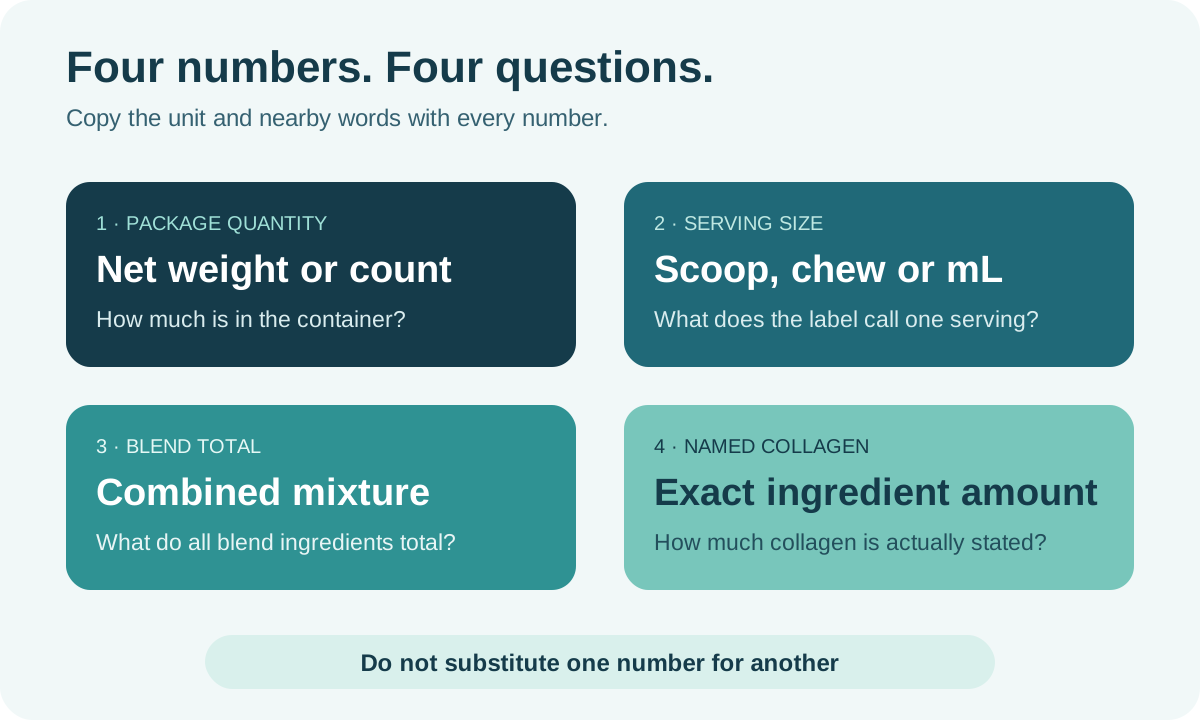
How do you read a pet collagen supplement label? Separate four numbers before comparing products: the package quantity, the labeled serving size, any total blend amount, and the amount of the collagen ingredient you actually want to compare. These numbers answer different questions. A 5-gram scoop is not automatically 5 grams of collagen, and a 3,000-milligram blend does not reveal how many milligrams come from each ingredient.
Start with four numbers that are easy to confuse
The front of a jar may use one large number while the back panel uses several smaller ones. Copy each number with its unit and the words beside it. Do not move a number from one category to another.
| Label number | What it describes | What it does not prove |
|---|---|---|
| Package quantity | The total net weight, volume or count in the container | The amount of collagen in one serving |
| Serving size | The labeled measure used for directions or serving-count language | That the whole scoop or chew is collagen |
| Total blend amount | The combined amount assigned to a named mixture, if disclosed | The amount of every ingredient inside that mixture |
| Named collagen amount | The amount specifically assigned to collagen, collagen peptides or another exact ingredient | That the ingredient is effective for your pet or equivalent to material used in a study |
Federal animal-food rules provide useful context. They require ingredients to be declared by common or usual name in descending order of predominance by weight, subject to stated exceptions. The rules also require the packaged food label to identify the manufacturer, packer or distributor and explain that a claim about the number of servings must appear with the quantity of each serving. Those requirements do not turn ingredient order into an exact amount table.
Ingredient order tells you order, not exact quantity
If collagen appears first in an ingredient statement, it is listed ahead of the ingredients that follow it by weight under the applicable labeling framework. That does not mean collagen is more than half of the product. It also does not reveal whether a scoop contains 500 milligrams, 2 grams or another amount. With several ingredients, the first item can be the largest individual ingredient without being a majority of the finished product.
The reverse is also important. If collagen appears after flavoring ingredients or carriers, do not estimate its amount from its position. Ingredient order gives a relative sequence, not the spacing between ingredients. The second and third ingredients might be close in weight or far apart.
FDA's current animal-food labeling page notes that federal labeling requirements include product identification, net quantity, the manufacturer or distributor's name and place of business, and all ingredients. It also notes that state laws apply. This page is not a fifty-state compliance guide, so record the facts visible on the package and ask the company about any unclear panel rather than declaring a label compliant or noncompliant.
What a blend total can and cannot tell you
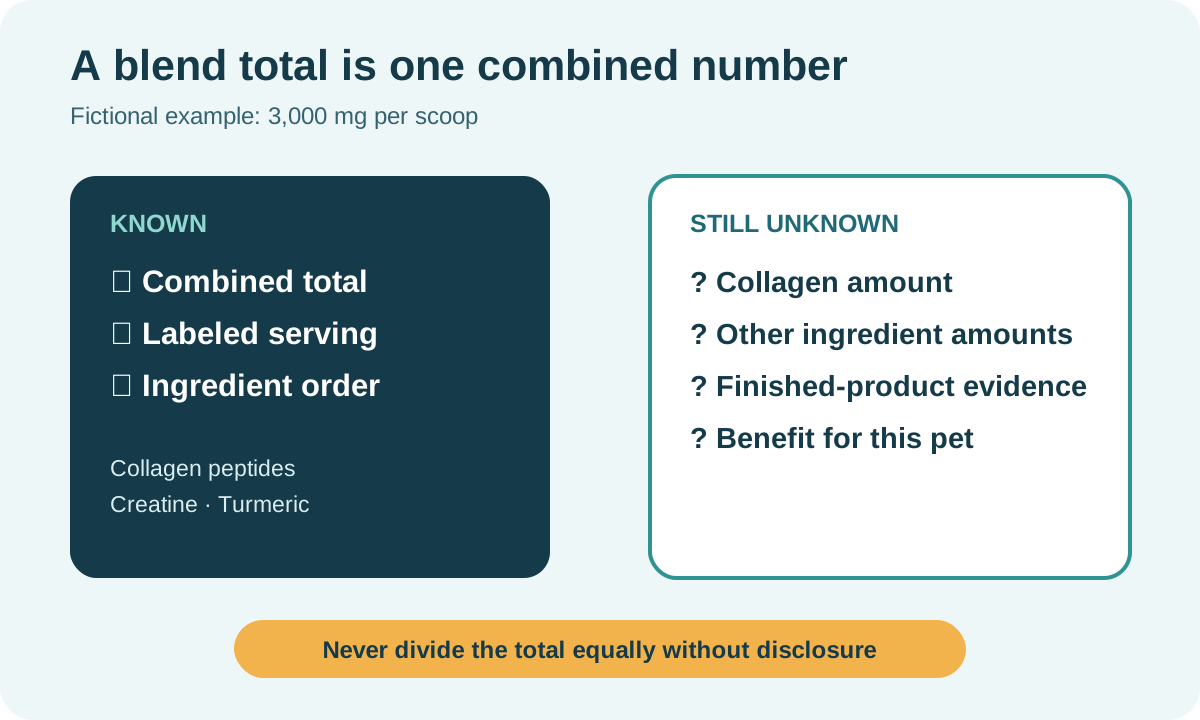
A blend total is one number for the combined mixture. If a fictional label says “Joint Support Blend, 3,000 mg per scoop” and names collagen peptides, creatine and turmeric within that blend, the total tells you that the listed mixture is 3,000 milligrams per labeled scoop. It does not allow you to divide 3,000 by three. It does not establish that collagen is 1,000 milligrams. It does not establish that each ingredient received an equal share.
Keep the phrase “proprietary blend” in context. Human dietary-supplement rules are not a shortcut for reading animal products. FDA states that the Dietary Supplement Health and Education Act of 1994 does not apply to animal food. A pet product's classification, intended use and applicable federal and state labeling framework still matter. Do not assume that a panel styled like a human supplement follows the same rules or has undergone a product-specific FDA review.
| Fictional label wording | Known | Still unknown |
|---|---|---|
| “Hydrolyzed collagen peptides, 2,500 mg per 5 g scoop” | Named collagen amount and scoop mass are separately stated | Suitability, source details, manufacturing quality and clinical benefit |
| “Mobility blend, 3,000 mg per scoop: collagen peptides, creatine, turmeric” | Combined blend amount and ingredient order are stated | Individual collagen, creatine and turmeric amounts |
| “With collagen” on the front; collagen in ingredient list | Collagen is represented as an ingredient | Per-serving collagen amount unless another panel supplies it |
| “60 chews” | Package unit count | Number of labeled servings and collagen amount per chew |
These examples are invented. They do not copy a real label, establish a universal labeling requirement or imply that a product with more disclosed numbers is clinically better. Transparency helps comparison, but it is one dimension. Product identity, testing, evidence, storage, tolerability and veterinary fit remain separate questions.
Translate powder and chew servings without guessing
A powder label may use scoops, teaspoons or grams. A chew label may use one chew, two chews or a weight-range table. Preserve the label's own unit first. If the package says one scoop but does not state the scoop's mass, do not borrow a scoop weight from another product or measure. Ask for the current label or written manufacturer confirmation.
For chews, separate three values: chews per package, chews per labeled serving and named ingredient amount per serving. If two chews provide 150 milligrams of collagen, that statement supports 75 milligrams per chew as arithmetic only when the label clearly defines two chews as one complete serving and the amount applies to that serving. It still does not tell you to change the serving or give the product to a particular dog.
A package count is not automatically a serving count. The current federal rule on serving representations says a label statement about the number of servings must appear with the net quantity of each serving, and that a statement of units in the package is not by itself a statement of servings. That distinction is useful when shopping: “60 chews” and “60 servings” are not interchangeable statements.
Check the units before comparing labels
This original 32-second captioned video demonstrates why grams, milligrams, scoops and chews need their own columns. It uses fictional arithmetic and does not set a feeding amount.
Use a three-column worksheet for weight ranges
When directions vary by animal weight, make one row for the range that actually applies to the current label and your veterinary discussion. Use these columns:
- Labeled measure: the number of scoops, chews or milliliters stated for that range.
- Named collagen amount: the amount specifically assigned to the exact collagen ingredient for that labeled measure, if disclosed.
- Unanswered fields: anything missing, such as scoop mass, individual blend amounts, collagen source or whether the direction is per day.
Do not create a pet-specific schedule from this worksheet. Its job is to expose whether you have enough label information to compare two products using their existing instructions. Your veterinarian should resolve whether either product, schedule or ingredient is appropriate.
Do not confuse the guaranteed analysis with a collagen amount
A guaranteed analysis and an ingredient statement serve different purposes. A percentage for crude protein does not automatically equal the amount of collagen peptides in a serving. Protein can come from several ingredients, and the analysis may describe a broad nutrient category rather than one named collagen material. Likewise, package weight does not establish active ingredient weight.
A front-panel phrase such as “supports mobility” is also not an amount. FDA explains that labeling can include material accompanying the product, and its animal-food business guidance says false or misleading information can include implying that a food contains more of a beneficial ingredient than is actually present. When a headline and the detailed panel seem inconsistent, preserve both and ask the company to connect the claim to the exact ingredient amount and supporting evidence.
Match the disclosed ingredient to the cited study
Even a clear collagen amount does not prove that the product matches a research paper. Record the collagen source, processing description, branded preparation if any, other ingredients, species, route and measured outcomes. Then ask whether the finished product or only an ingredient preparation was studied.
The site's ingredient-versus-finished-product guide shows why a study of a specific canine collagen preparation cannot be transferred to every powder, chew or blend. The testing-report guide explains why a result for one sample or analyte does not establish every product feature.
Calculate cost only after the denominator is clear
Daily cost requires a confirmed container quantity and the confirmed labeled schedule you are comparing. It does not require you to invent a collagen amount. If a product discloses only a blend total, you can sometimes calculate cost per labeled serving while leaving cost per gram of collagen unknown.
Keep those results labeled correctly:
- Cost per labeled serving compares spending for the entered schedule.
- Cost per gram of named collagen is possible only when that exact amount is disclosed and the units are comparable.
- Cost per blend gram is not cost per collagen gram.
- Lower cost does not establish equivalent quality, evidence or benefit.
Use the free daily-cost calculator with the confirmed package and serving information. For dated real-label examples, use the separate dog collagen powder-versus-chew buying guide. For a species-specific research comparison, read what cat collagen studies actually tested. Leave the field blank when the label does not support the denominator.
Seven questions for the manufacturer
- What exact collagen ingredient and source are used in this product version?
- How much of that named collagen ingredient is present per labeled serving?
- If a blend total is shown, are individual ingredient amounts available in writing?
- What is the mass of one scoop or chew, and how many labeled servings are in this package?
- Does the online panel match the physical label for this size and lot?
- Was the finished product studied, or is the claim based on research for one supplied ingredient?
- Which testing report matches this finished product and lot, and what did it actually measure?
Save the answer with the product size, label date and lot when available. A missing answer is not proof of fraud or product failure. Mark it unknown and decide with your veterinarian whether the remaining uncertainty matters.
Frequently asked questions
Does the first ingredient make up most of the product?
Not necessarily. Ingredient order identifies relative predominance by weight under the applicable rule. The first ingredient is not automatically more than half of a product, and the list does not disclose the distance between ingredient amounts.
Can I divide a blend total equally among the ingredients?
No. A 3,000-milligram total for three ingredients does not establish 1,000 milligrams of each. Keep the individual amounts unknown unless the label or manufacturer supplies them.
Does crude protein show how much collagen is present?
No. Crude protein is not automatically a named collagen amount. Several ingredients may contribute protein, and the analysis answers a different label question.
Are 60 chews the same as 60 servings?
No. A unit count states how many chews are in the package. The labeled serving may contain more than one chew.
Does a disclosed collagen amount prove the product works?
No. Amount transparency helps identify and compare the product. Clinical benefit requires evidence that matches the formulation, species, population, route and outcome.
What should I bring to my veterinarian?
Bring photos of every label panel, the lot and expiration details, manufacturer answers, the proposed product purpose, current foods and supplements, and any research or testing document being cited.
The bottom line
Read a pet collagen label by keeping package quantity, serving size, blend total and named collagen amount in separate columns. Ingredient order does not disclose exact quantities. A blend total does not reveal its individual parts. A unit count does not establish serving count. When a denominator is missing, keep the calculation and comparison incomplete rather than guessing.
The most useful next step is not finding the largest front-label number. It is finding the exact amount, unit and product identity behind the claim, then matching that information to the evidence and your pet's veterinary context.
Sources and scope
This is an introductory guide or original comparison framework, not a systematic review or a product recommendation.
- eCFR 21 CFR 501.4: Animal food; designation of ingredients — Current federal context for common or usual ingredient names and descending order by weight; it does not disclose exact quantities.
- eCFR 21 CFR 501.5: Manufacturer, packer or distributor — Current federal context for the responsible business name, place of business and relationship language.
- eCFR 21 CFR 501.8: Labeling with number of servings — Current federal context distinguishing a number-of-servings representation from package unit count.
- FDA: Animal Food Labeling and Pet Food Claims — Official overview of federal label elements, ingredient statements, claims and additional state-law context.
- FDA: Animal Foods & Feeds — Official animal-food scope, including FDA's statement that DSHEA does not apply to animal food.
- FDA: How do I Start an Animal Food Business? — Official labeling and marketing context, including accompanying promotional material and misleading ingredient-amount implications.
Source checked October 01, 2026. A general context source does not establish a named product’s benefit.