
BPC-157 for Cats With IBD: What Gut Studies Actually Show
Does BPC-157 help cats with IBD? Compare rat ulcer research with feline chronic-enteropathy diagnosis, outcomes, safety, and evidence gaps.
Does BPC-157 help cats with IBD? The sources reviewed here do not establish BPC-157 as a treatment for feline inflammatory bowel disease or chronic enteropathy. The commonly cited BPC-157 gut paper used three induced gastric-ulcer models in male rats. Feline studies instead evaluate cats with persistent gastrointestinal signs using exclusion workups, clinical scores, endoscopy or biopsies when indicated, and cat-specific follow-up. Those are different diseases, populations, preparations, and outcomes.
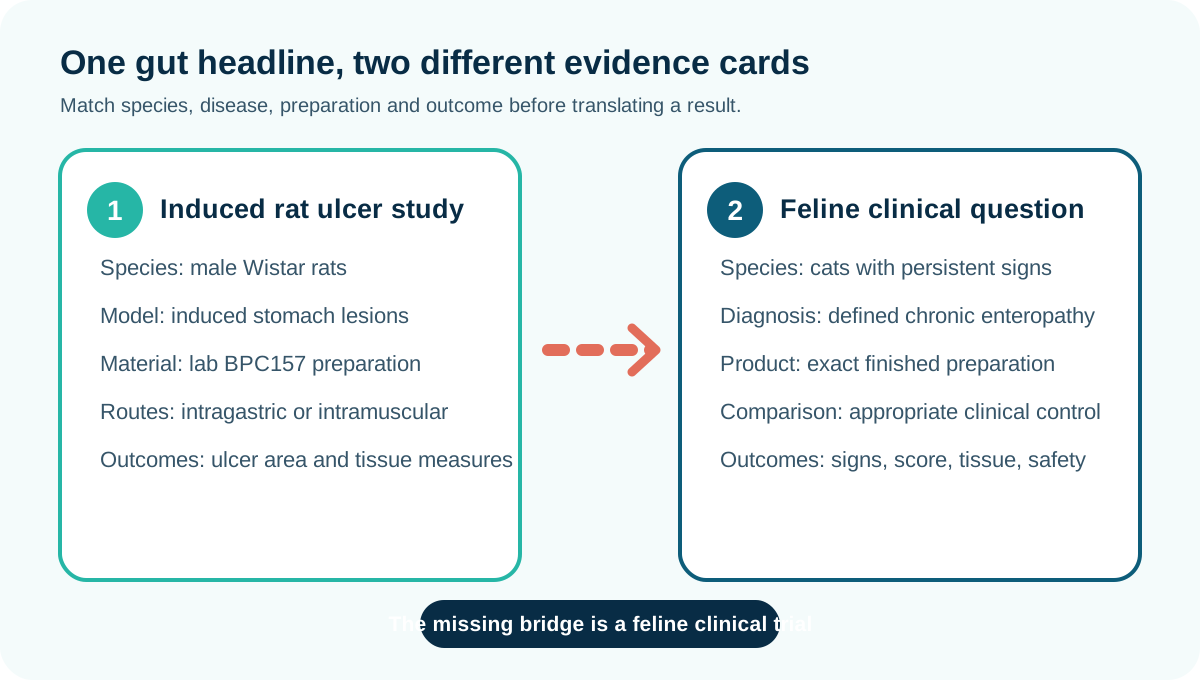
Searches for BPC-157 for cats with IBD often compress several steps into one phrase: a rat ulcer finding becomes “gut healing,” “gut healing” becomes “IBD treatment,” and a laboratory compound becomes an online product. Each step needs its own evidence. This guide keeps the exact animal, disease model, preparation, route, and endpoint attached to the source.
This AI-assisted educational article was source-checked October 6, 2026 and has not been reviewed by a veterinarian. It is a focused claim check, not a systematic review, diagnosis, treatment recommendation, or substitute for care. It provides no cat dose, route choice, injection or mixing instruction, seller, or personalized protocol.
First, define the cat's actual intestinal problem
“IBD” is commonly used as a broad label, but feline chronic enteropathy is an umbrella that can include food-responsive enteropathy, idiopathic inflammatory bowel disease, and alimentary small-cell lymphoma. These conditions can overlap in outward signs and may be difficult to distinguish. A product headline cannot determine which one a cat has.
In a 2010 primary study, Jergens and colleagues developed the feline chronic enteropathy activity index using 82 cats. The retrospective portion included 59 cats diagnosed with IBD, while a prospective pilot included 23 cats with IBD or food-responsive enteropathy. The work linked gastrointestinal signs, endoscopic abnormalities, selected laboratory values, and histopathologic inflammation into a clinical activity score. It shows the level of patient definition behind a feline disease question.
The study also documents diagnostic limits. The authors discuss the challenge of separating IBD from well-differentiated alimentary lymphoma, the possibility of disease in intestinal segments not sampled, and the need to interpret clinical, laboratory, imaging, endoscopic, and histologic findings together. A claim based only on “inflammation” does not resolve those distinctions.
If a cat has ongoing vomiting, diarrhea, weight loss, appetite change, lethargy, or other concerning signs, the first task is veterinary evaluation. Delaying diagnosis to try an unproven product can also delay care for food-responsive disease, lymphoma, pancreatitis, parasites, kidney or thyroid disease, or another condition that may look similar from home.
Three gut studies, three different questions
| Source and population | Preparation or clinical context | What was measured | What it cannot establish |
|---|---|---|---|
| Xue et al., 2004 330 male Wistar rats | Laboratory-synthesized BPC157 in saline or excipient; intragastric or intramuscular administration across indomethacin, pylorus-ligation, and acetate-induced gastric-ulcer models. | Ulcer area, inhibition ratios, glandular epithelium rebuilding, and granulation tissue in induced rat stomach injury. | Diagnosis, symptoms, quality of life, endoscopic response, or long-term safety in cats with naturally occurring chronic enteropathy. |
| Jergens et al., 2010 82 cats with chronic enteropathy | Retrospective IBD cohort plus prospective IBD and food-responsive enteropathy pilot; no BPC-157. | Clinical signs, endoscopic changes, laboratory variables, histopathology, and change in a feline disease-activity score after established diagnostic and treatment pathways. | A BPC-157 effect. Its value here is showing how a feline clinical population and response are defined. |
| Heilmann et al., 2024 17 cats with chronic enteropathy and 18 healthy controls | Clinical investigation and varied dietary and/or immunomodulatory care; no BPC-157. Biopsies were available in a subset. | Feline clinical activity score, fecal calprotectin before and after treatment in available samples, imaging, and pathology context. | That a biomarker change equals mucosal healing, or that BPC-157 treats feline disease. The authors call for longitudinal work on mucosal healing versus clinical response. |
The two feline rows do not prove which treatment is appropriate for an individual cat. They show what a cat-specific clinical question looks like: an identified patient population, a diagnostic pathway, predefined outcomes, and follow-up. The rat row answers an earlier model question under controlled injury conditions.
Why an induced gastric ulcer is not feline IBD
The Xue paper created acute or chronic stomach injury in rats using three different experimental methods. Researchers then measured visible ulcer area and tissue changes after a laboratory preparation of BPC157. This was a real experiment with specific results. It was not a trial in cats, not a chronic-enteropathy diagnostic study, and not a finished veterinary product evaluation.
An ulcer is a tissue lesion. Feline chronic enteropathy is a clinical category that can involve persistent signs, intestinal inflammation, diet response, and important differential diagnoses. The stomach is also not interchangeable with the small intestine or colon. A favorable result in an induced stomach lesion cannot answer whether a cat eats better, stops vomiting, gains weight, has improved stool, enters clinical remission, or shows durable mucosal improvement.
Route does not bridge the gap. The rat study compared intragastric and intramuscular administration under its own conditions. Intragastric delivery into a research animal does not establish that a commercial capsule, chew, liquid, or compounded preparation has the same identity, exposure, quality, or clinical effect in a cat. Intramuscular use in a rat likewise does not create a feline injection protocol.
The article therefore does not reproduce the experimental doses. A weight conversion would not correct the species, disease-model, preparation, route, or endpoint mismatch. The sitewide calculator only converts a veterinarian-provided amount and confirmed pharmacy-label concentration into volume. It does not choose an amount, recommend BPC-157, or make a rat experiment applicable to a cat.
“Gut healing” needs a named outcome
A broad phrase can hide several non-equivalent outcomes. Ask the source to finish the sentence: “Healing means the study measured...”
| Outcome | What it can add | What it cannot prove alone |
|---|---|---|
| Clinical signs | Change in vomiting, diarrhea, appetite, activity, or weight under a defined assessment. | The cause of improvement, tissue healing, or product identity. |
| Feline disease-activity score | A repeatable combination of selected clinical, laboratory, and endoscopic variables. | That every component improved or that one mechanism caused the change. |
| Histopathology or endoscopy | Information about tissue and visible mucosal abnormalities in sampled sites. | Unsampled intestine, every differential diagnosis, or day-to-day quality of life. |
| Biomarker | A measurable signal that may track disease activity or response. | Clinical remission or mucosal healing unless validated for that purpose. |
| Rat ulcer area | Lesion size in the induced model and time point studied. | A feline IBD diagnosis, symptom benefit, durable remission, or safety profile. |
The 2024 feline calprotectin study illustrates this discipline. Concentrations decreased after treatment initiation and correlated with the clinical activity score in the studied cats. The authors still stated that further studies were needed to examine the marker longitudinally in relation to mucosal healing versus clinical response. A biomarker paper did not collapse those outcomes, and a BPC-157 headline should not either.
What a real feline BPC-157 trial would need
A useful trial would begin with cats, not a species-neutral word such as “animals.” It would define the disease population and distinguish, as far as the protocol allows, food-responsive disease, idiopathic inflammatory bowel disease, and lymphoma. It would state the workup, eligibility criteria, concurrent care, rescue rules, withdrawals, and handling of important comorbidities.
The intervention would need exact identity and product controls. That includes the amino-acid sequence, preparation, route, formulation, manufacturer, batch controls, storage, and confirmation that the material used in the study matches the material described in the conclusion. A short name on a seller page is not enough.
The comparison and outcomes would need to match the claim. A clinical-benefit claim requires clinically meaningful cat outcomes, not only exposure or a tissue marker. A mucosal-healing claim requires an appropriate predefined mucosal endpoint. A safety conclusion requires systematic adverse-event collection, relevant laboratory monitoring, sufficient follow-up, and transparent reporting of withdrawals and missing data.
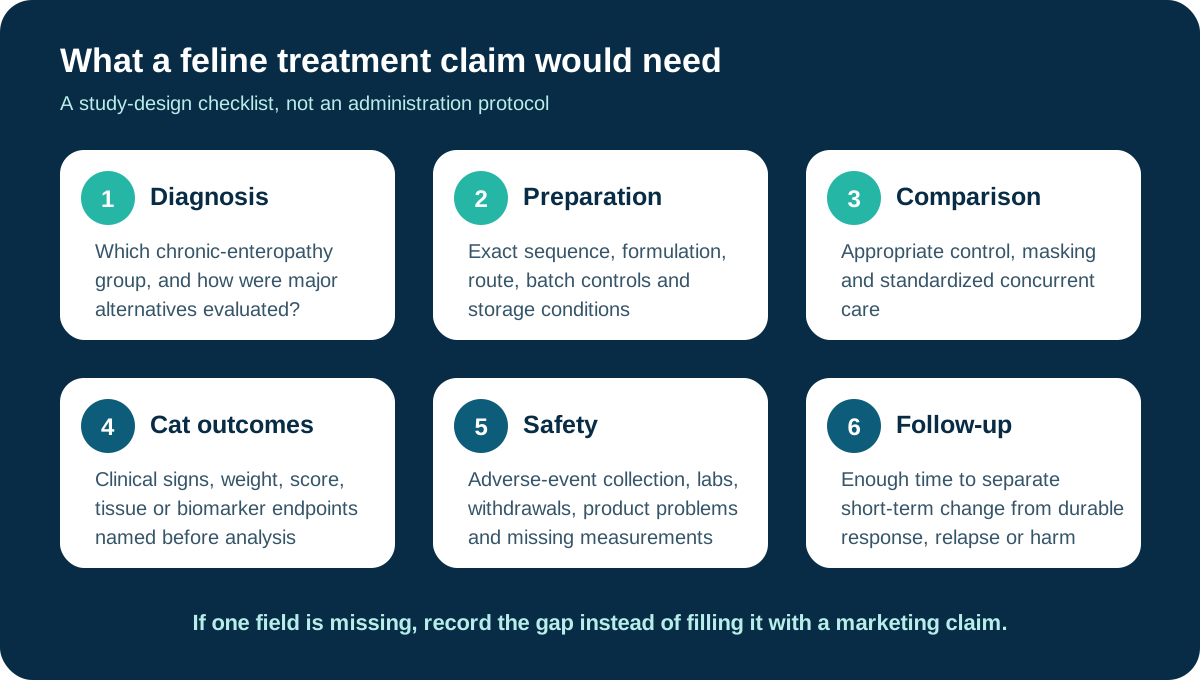
- Diagnosis: Which chronic-enteropathy group was enrolled, and how were major alternatives evaluated?
- Exact preparation: What sequence, formulation, route, and quality controls were used?
- Comparison: Was there an appropriate control and were other therapies standardized?
- Cat outcomes: Were symptoms, weight, activity, validated clinical scores, endoscopy, histology, or biomarkers predefined?
- Safety: How were adverse events, laboratory changes, withdrawals, product problems, and unmeasured risks handled?
- Follow-up: Was the observation long enough to distinguish short-term change from durable response or relapse?
Product and approval questions stay separate from biology
A biological hypothesis does not identify a lawful, quality-controlled veterinary product. FDA's animal-drug compounding Q&A states that compounded animal drugs are not FDA-approved, even when an approved drug is used as source material. FDA also explains that evidence for an approved finished product cannot automatically be applied to a compounded product because formulation, dosage form, and production can change.
The same Q&A recognizes patient-specific circumstances in which a veterinarian may determine that no approved, conditionally approved, or indexed product can appropriately treat an animal. That general policy is not a BPC-157 approval, a cat indication, or a statement that every compounded preparation is equivalent. The exact veterinarian-patient rationale and exact pharmacy preparation remain part of the question.
FDA's July 2026 BPC-157 briefing was prepared for a human-compounding advisory discussion. It reviewed animal safety signals and evidence gaps, including missing longer-duration information and formal immunogenicity studies. That document is not veterinary approval, a feline IBD trial, or a final blanket legal determination. Human compounding, animal compounding, experimental biology, and a cat treatment claim belong on separate evidence cards.
Watch: keep the study, product, and cat on separate cards
This existing original 48-second captioned explainer shows the evidence-card method. It is silent and contains no dose or treatment instruction.
Open the dedicated video page and transcript.
Questions to bring to the veterinarian
- What diagnoses could explain my cat's signs, and which have actually been evaluated?
- Are we using “IBD” precisely, or does chronic enteropathy remain a broader working category?
- What clinical signs, weight changes, laboratory values, imaging, diet response, endoscopy, or biopsy findings should guide the next step?
- What established care options fit the diagnosed condition, and how will response be measured?
- Does the BPC-157 source involve cats with this diagnosis, or only another species and model?
- What exact finished product is being discussed, and what approval, compounding, identity, sterility, stability, and monitoring information applies?
- What signs require prompt reassessment or emergency care?
Open the free vet-visit checklist
Frequently asked questions
Is BPC-157 proven for cats with IBD?
No reviewed source here establishes that. The BPC-157 gut paper used induced gastric-ulcer models in rats. The feline papers describe how chronic enteropathy is defined and monitored, but they did not test BPC-157.
Can a rat ulcer study support a feline research hypothesis?
Yes, it can help frame a research question about a specific biological process. It cannot by itself establish clinical benefit, safety, formulation, route, or a treatment protocol for cats with chronic enteropathy.
What is the BPC-157 dose for a cat with IBD?
This article does not provide one. The reviewed sources do not establish a feline IBD dosing regimen, and copying or scaling an experimental rat amount would not resolve the species, disease, formulation, route, or safety gaps.
Is oral BPC-157 supported because the rat study used an intragastric route?
No. Intragastric administration of a laboratory preparation in rats is not evidence that a commercial oral product works in cats. Product identity, exposure, disease population, outcomes, and safety would all need matched evidence.
Where can I buy BPC-157 for a cat?
This page does not provide a research-chemical seller funnel. A listing is not evidence of approval, identity, quality, suitability, or benefit. Start with the diagnosis and veterinarian, then resolve the exact product and legal or regulatory pathway before any price comparison.
Does improvement in vomiting or stool prove mucosal healing?
Not necessarily. Clinical response, endoscopic or histologic change, and biomarkers are related but distinct outcomes. A useful study defines which one it measures and avoids substituting one for another.
Bottom line: the reviewed BPC-157 gut evidence is an induced rat-ulcer result, not a feline IBD treatment result. A useful cat claim must identify the diagnosis, exact preparation, comparison, clinically meaningful feline outcomes, safety monitoring, and follow-up. Until those fields are supported, the accurate conclusion is “not established,” not a dose or product recommendation.
Sources and scope
This is an introductory guide or original comparison framework, not a systematic review or a product recommendation.
- Xue et al. (2004): BPC 157 in induced gastric-ulcer models in rats — Primary full text; 330 male Wistar rats, laboratory-synthesized BPC157, intragastric or intramuscular administration, and induced gastric-ulcer endpoints. Not feline chronic-enteropathy evidence.
- Jergens et al. (2010): feline chronic enteropathy activity index — Primary full text; retrospective and prospective work in 82 cats defining disease activity and clinical response. Did not test BPC-157.
- Heilmann et al. (2024): feline chronic enteropathy and fecal calprotectin — Primary full text; 17 cats with chronic enteropathy and 18 healthy controls. Separates clinical response, biomarker change, pathology context, and unresolved mucosal-healing validation. Did not test BPC-157.
- Marsilio (2021): feline chronic enteropathy clinical review — Clinical context for the umbrella of food-responsive enteropathy, idiopathic IBD, and alimentary small-cell lymphoma. Review, not BPC-157 treatment evidence.
- ACVIM consensus statement on chronic inflammatory enteropathy in dogs and cats — Authoritative current veterinary diagnostic context. Not a BPC-157 trial or individualized veterinary advice.
- FDA July 2026 PCAC briefing: BPC-157 — Human-compounding advisory background with animal-data appraisal and safety gaps; not veterinary approval, feline IBD evidence, or a final blanket legal determination.
- FDA: Q&A on GFI #256 animal-drug compounding — Finished-product approval, compounding quality, and patient-specific veterinary context. Not a BPC-157 approval record or cat efficacy finding.
Source checked October 06, 2026. A general context source does not establish a named product’s benefit.