
BPC-157 for Cats With Stomatitis: Does the Evidence Match?
Does BPC-157 help feline stomatitis? Compare rat periodontitis research with cat interferon, stromal-cell, dental and compounding evidence.
Does BPC-157 treat stomatitis in cats? The sources reviewed do not establish that. The BPC-157 mouth study used rats with ligature-induced periodontitis, systemic experimental treatment, and tissue and bone measurements. Feline chronic gingivostomatitis is a different clinical disease. Cat studies instead test dental extraction, recombinant feline interferon omega, and several kinds of mesenchymal stromal cells. Those interventions are not interchangeable with BPC-157, and the cell studies do not make “peptides for feline stomatitis” a proven treatment class.
Searches for BPC-157 for cats with stomatitis often join evidence that belongs in separate columns. A rat periodontitis experiment may be described as oral healing. A feline interferon trial may be shortened to peptide therapy. Mesenchymal stromal cells may be called regenerative peptides even though the administered product is a living-cell preparation. Each shortcut changes the question.
This guide checks the exact disease model, species, intervention class, route, study design, and outcome. It does not rank treatments or supply a dose. Feline chronic gingivostomatitis is painful and can affect eating, grooming, weight, and quality of life. A cat with mouth pain, drooling, bleeding, reduced appetite, weight loss, or difficulty eating needs veterinary and dental assessment.
This is an AI-assisted evidence comparison, not veterinary advice or a systematic review. Primary studies, current feline oral-health guidance, and FDA materials were checked October 27, 2026. No research-chemical seller, administration protocol, product ranking, affiliate link, or claim that BPC-157 is safe or effective for feline stomatitis is included.
Start with the disease name
The 2025 FelineVMA oral-health guidelines define feline chronic gingivostomatitis as persistent, painful inflammation that extends beyond the gingiva into oral mucosa and can involve the caudal oral cavity. Cats may also have periodontal disease or tooth resorption, but FCGS is not simply another name for plaque-associated periodontitis.
That difference matters because the BPC-157 oral study did not reproduce feline chronic gingivostomatitis. Researchers placed a silk ligature around a lower molar in rats to promote plaque retention, mechanical irritation, gingival inflammation, and local alveolar bone loss. They then measured vascular permeability, histology, and micro-computed-tomography bone changes. The model can answer a bounded laboratory question about induced rat periodontitis. It does not recreate the distribution, immune features, clinical history, prior dental care, pain, food intake, or quality-of-life outcomes of a cat with FCGS.
The current feline guidelines recommend a complete anesthetized oral assessment and full-mouth dental radiographs, then diagnosis-specific care. For FCGS, surgical intervention remains the most effective management approach described in the guideline, with partial caudal-mouth or full-mouth extraction selected from the pattern of disease and dental findings. That is a clinical framework, not proof that every cat has the same outcome or that other studied options have no role in refractory disease.
One search phrase contains several intervention classes
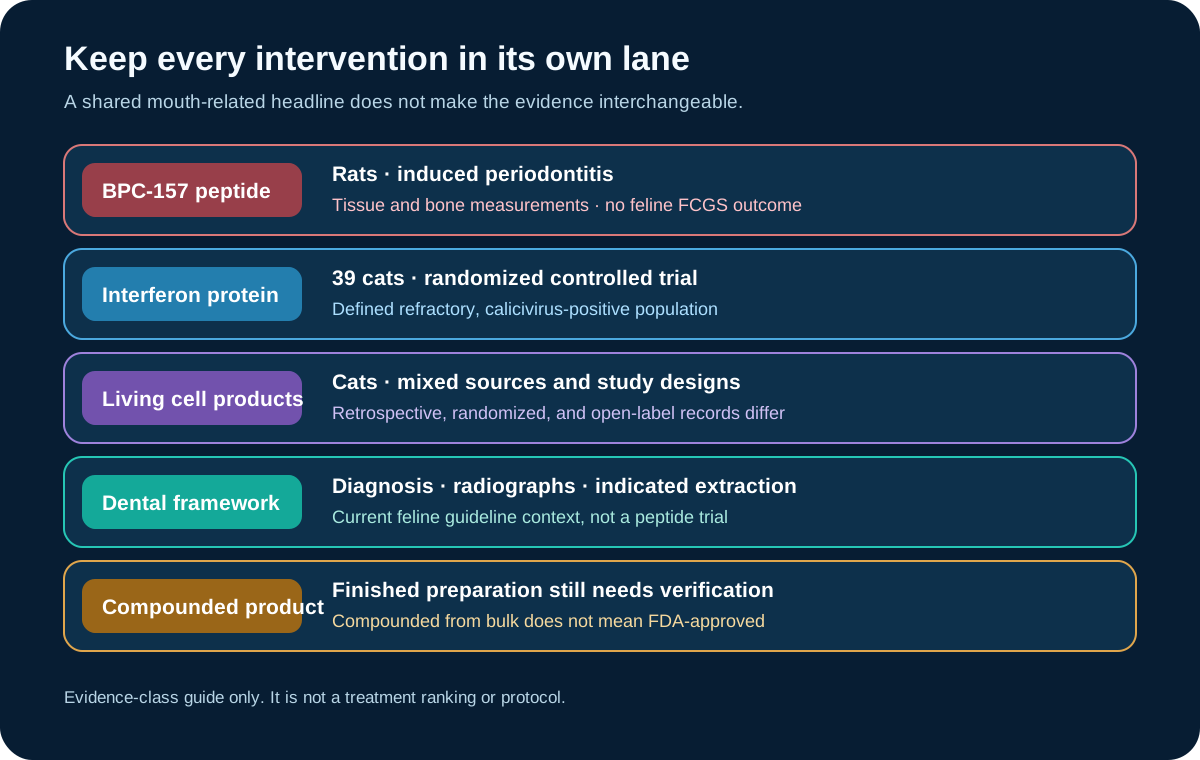
| Record | Exact intervention and route | Species and study | Useful conclusion |
|---|---|---|---|
| BPC-157 periodontitis experiment | Fifteen-amino-acid research peptide, administered systemically in the experiment. | Rats with molar-ligature periodontitis; laboratory tissue and bone outcomes. | Supports a rat-model research rationale. It does not test FCGS, cats, a feline product, oral pain, eating, or clinical remission. |
| Recombinant feline interferon omega trial | Species-specific cytokine protein given oromucosally and compared with oral prednisolone. | Randomized, multicenter, double-blind controlled trial in 39 calicivirus-positive cats with refractory caudal stomatitis after prior dental and medical care. | Product, subgroup, prior-care, route, comparator, and 90-day outcomes must remain attached. This is not BPC-157 evidence. |
| Adipose-derived stromal-cell follow-up | Autologous or allogeneic living-cell preparations administered intravenously. | Retrospective long-term evaluation of 38 cats with refractory FCGS. | Reports response and adverse-event experience over two to nine years, but it is not a randomized peptide trial. |
| Equine stromal-cell trial | Horse-derived living cells, single intravenous application. | Blinded, randomized, placebo-controlled study in 16 cats. | No significant treatment advantage was detected with this design and follow-up. One cell product cannot stand in for another. |
| Uterine stromal-cell extension | Allogeneic feline uterine-derived living cells; two earlier intravenous applications. | Prospective open-label extension in 35 refractory cats, with concurrent medicines allowed. | Primarily informs longer-term safety and descriptive outcomes. It does not establish a general regenerative-peptide effect. |
What the BPC-157 rat study can and cannot say
The 2010 study is the most direct primary source behind a BPC-157 mouth-healing claim. It identifies BPC-157 as a pentadecapeptide and uses a 13-day rat molar-ligature model. The researchers compared saline with experimental BPC-157 groups and assessed Evans-blue extravasation, selected histology, and local bone changes. The higher experimental level reduced several inflammation and bone-loss measurements relative to control.
Those findings are a starting point for research, not a feline clinical result. The animals were rats. The induced disease was periodontal inflammation around a ligated tooth. The intervention was not a verified finished feline product. The endpoints were not pain while eating, caregiver-observed function, oral-lesion remission in a cat, need for rescue care, or durable quality of life.
The authors also reported that the lower experimental level did not significantly prevent the vascular-permeability increase and that the peptide did not completely abolish the ligature effect on local bone loss. These details matter because “reduced selected measurements in a rat model” is narrower than “heals a cat's mouth.”
FDA's 2026 human-compounding review adds an identity caution. It evaluated BPC-157 free base and BPC-157 acetate as different bulk drug substances and described inconsistent naming and characterization in submitted materials. FDA also stated that neither substance was a component of an FDA-approved drug at the time of that review. A bulk-substance name therefore does not confirm the exact active ingredient, formulation, purity, route, or applicability to a cat.
The feline interferon study answers a narrower cat question
The 2011 interferon study enrolled 39 cats with a specific refractory presentation: bilateral caudal stomatitis, positive feline calicivirus RNA, negative FeLV and FIV tests, and persistent clinical signs after prior periodontal treatment, indicated extractions, antibiotics, pain relief, and anti-inflammatory care. Cats with several important concurrent conditions were excluded.
The trial randomized cats by site and kept group identity masked until an independent statistical analysis. It compared an oromucosal recombinant feline interferon omega preparation with oral prednisolone over 90 days, measuring behavioral, clinical, and lesion scores. The published record reports improvement in lesions and pain over time with interferon treatment.
This is companion-animal evidence, but it remains product and population specific. Interferon omega is a cytokine protein. It is not BPC-157, a stromal cell, or evidence for every cat with mouth inflammation. The cats had a defined virus-positive, refractory phenotype and extensive previous care. A search summary that removes those details overstates the trial.
Stromal-cell studies are cell therapy, with mixed designs and results
Feline stromal-cell research is relevant because it directly studies cats with refractory FCGS. It does not validate a peptide product. Mesenchymal stromal cells are living cells with complex secreted signals and immunologic effects. Calling the treatment a peptide erases the administered material, manufacturing questions, route, donor source, and study design.
A 2023 retrospective evaluation combined long-term records from 38 cats that had received autologous or allogeneic adipose-derived stromal cells. Follow-up ranged from two to nine years. The reported overall positive response was 65.5%, with 58.6% showing permanent improvement or cure. Immediate or short-term adverse events were recorded in 34.2% of cases, mostly transient transfusion-like reactions. The analysis did not detect a significant outcome difference between autologous and allogeneic cells.
That long follow-up is valuable, but the study was retrospective and lacked a concurrent randomized control. It combined cell-line types, and treatment selection occurred before the later record review. Association with a durable response does not isolate which element of care caused the outcome.
A 2026 blinded, randomized, placebo-controlled study provides a useful counterweight. Sixteen cats received either a single intravenous equine peripheral-blood-derived stromal-cell product or control. The study did not detect significant differences in the primary disease-activity score, treatment failure time, rescue therapy, biopsy analysis, or average owner reports during the evaluated period. The authors concluded that the single application appeared safe but was not shown to be more effective than control under that design.
A separate 2026 open-label extension followed 35 cats after two earlier intravenous administrations of feline uterine-derived stromal cells. It was designed primarily for long-term safety, allowed concurrent medication, and had no new cell administration during the extension. The record reported no serious adverse event attributed to treatment and descriptive improvement in owner and veterinarian measures at one year. Because it was an open-label extension with concurrent care, it should not be read as a new randomized efficacy comparison.
Use three translation checks before applying a headline
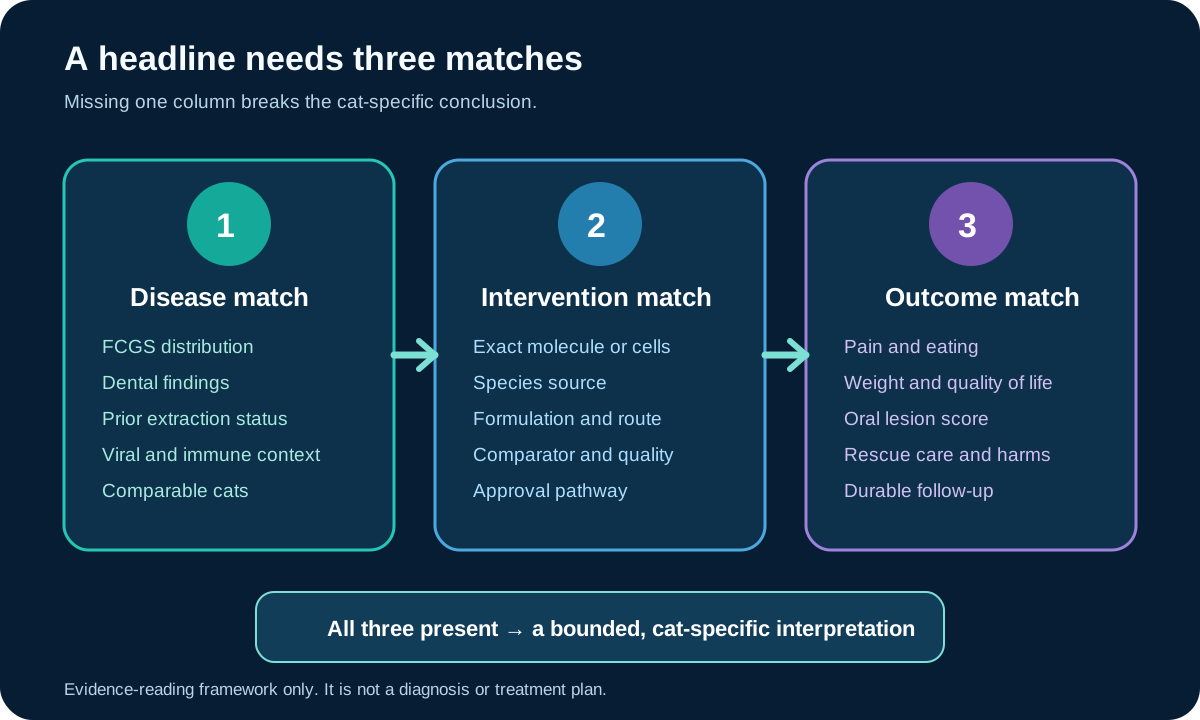
| Check | What must match | Common shortcut |
|---|---|---|
| Disease | FCGS distribution, diagnostic workup, dental findings, prior extraction status, viral context, refractory status, and relevant comorbidities. | Replacing feline gingivostomatitis with any gingival inflammation or wound. |
| Intervention | Exact molecule or cell product, species source, formulation, route, manufacturing status, comparator, and legal pathway. | Calling proteins, living cells, research fragments, and compounded products “peptides” as though they were substitutes. |
| Outcome | Pain, eating, weight, oral-lesion score, rescue care, adverse events, quality of life, remission, and follow-up duration. | Turning a tissue marker or short-term model result into durable clinical recovery. |
A claim fails when any one column is missing. The BPC-157 rat study has an intervention identity and experimental oral-tissue outcomes, but it lacks the cat, FCGS disease model, finished veterinary product, and feline clinical outcomes. The interferon trial has cats and clinical outcomes, but its protein product cannot lend efficacy to BPC-157. The stromal-cell studies have feline relevance, yet each cell source and study design must be interpreted on its own.

Compounded does not mean approved or evidence-matched
FDA explains that animal drugs compounded from bulk drug substances are not FDA-approved and have not undergone the agency's review for safety, effectiveness, manufacturing, labeling, and packaging. GFI 256 describes limited circumstances and enforcement priorities when a veterinarian needs a compounded animal drug from a bulk substance. It does not turn a research chemical or a compounder's label into an approved feline stomatitis product.
The finished preparation still matters. “BPC-157” may omit whether the material is free base or an acetate form, its formulation, source, purity testing, stability, and route. Evidence from a laboratory reagent cannot automatically verify a marketed vial or capsule. A veterinarian considering any compounded preparation needs the exact pharmacy label and patient-specific rationale, plus a plan for monitoring benefit and harm.
Questions to take to the veterinarian or dental specialist
- What is the exact diagnosis? Ask how FCGS was distinguished from periodontal disease, tooth resorption, infection, trauma, neoplasia, or another cause of oral inflammation.
- What dental imaging and examination are needed? Discuss anesthetized oral assessment, full-mouth radiographs, retained roots, resorptive lesions, and the distribution of inflammation.
- What standard care has already been completed? Record extraction extent, healing time, pain control, supportive care, and whether the case meets a study's refractory definition.
- What is the exact proposed intervention? Identify whether it is a peptide, cytokine protein, living-cell product, approved drug, compounded preparation, or experimental material.
- Were comparable cats studied? Match viral status, prior dental care, disease severity, exclusions, route, comparator, and follow-up.
- Which outcome should improve? Agree on pain, food intake, weight, grooming, lesion score, quality of life, rescue medication, and adverse-event monitoring.
- What would trigger reassessment? Ask about worsening pain, reduced eating, dehydration, bleeding, infection signs, weight loss, or lack of meaningful improvement.
Open the free veterinary-visit checklist
The canonical BPC-157 guide reviews broader identity and species evidence. The feline product-class guide explains why an approved protein or polypeptide record cannot be transferred to a research fragment. The amount-to-volume calculator performs arithmetic only after a veterinarian supplies an amount and the actual pharmacy label supplies a concentration. It does not determine whether a product should be used.
Frequently asked questions
Is there a BPC-157 study in cats with stomatitis?
The primary BPC-157 oral study reviewed here used rats with ligature-induced periodontitis. It did not enroll cats or test feline chronic gingivostomatitis.
Does the rat periodontitis study prove BPC-157 heals a cat's mouth?
No. It measured inflammation, histology, and local bone changes in an induced rat model. Species, disease, product, route, and clinical outcomes do not match a cat with FCGS.
Is feline interferon omega evidence for peptide therapy?
It is evidence for one recombinant feline cytokine protein in a defined group of calicivirus-positive, refractory cats after prior dental and medical care. It is not evidence for BPC-157 or a general peptide class.
Are mesenchymal stromal cells peptides?
No. They are living-cell preparations. Cells can release many signaling molecules, but that does not make the administered intervention a peptide product or allow its results to validate a peptide.
Did all feline stromal-cell studies show benefit?
No. Designs and products differ. A 2023 retrospective long-term analysis reported many durable responses, while a 2026 blinded randomized study of a single equine-cell application did not detect superiority over control during the evaluated period. A separate 2026 open-label feline uterine-cell extension primarily assessed long-term safety and allowed concurrent medicines.
Does compounding make BPC-157 FDA-approved for cats?
No. FDA states that animal drugs compounded from bulk drug substances are not FDA-approved. Enforcement guidance for medically necessary compounding does not establish a feline indication or prove that a preparation is safe or effective for stomatitis.
Does this article provide a feline stomatitis dose?
No. It provides no dose, administration protocol, treatment ranking, or research-chemical source.
The bottom line
The BPC-157 mouth evidence reviewed here is a rat periodontitis experiment, not a feline stomatitis trial. Cat studies address different interventions: dental extraction, a recombinant feline interferon protein, and several distinct stromal-cell products. Those feline records are useful when their population, prior care, route, comparator, and outcomes stay attached. They do not combine into proof for “peptides for feline stomatitis.” Start with the dental diagnosis, identify the exact intervention class, and ask whether the study measured a meaningful outcome in comparable cats.
Sources and scope
This is an introductory guide or original comparison framework, not a systematic review or a product recommendation.
- Keremi et al. (2010): BPC-157 in ligature-induced rat periodontitis — Primary 13-day rat molar-ligature periodontitis study. Species, systemic experimental treatment, vascular-permeability, histology and microCT outcomes, incomplete effect and absence of feline FCGS outcomes are retained.
- 2025 FelineVMA feline oral health and dental care guidelines — Current authoritative feline guidance used for the FCGS definition, anesthetized assessment, full-mouth radiographs and extraction-based management context. Guidance, not a BPC-157 trial.
- Hennet et al. (2011): recombinant feline interferon omega trial — Primary randomized multicenter double-blind controlled trial in 39 calicivirus-positive cats with refractory caudal stomatitis. Exact protein, population, prior care, route, comparator and 90-day outcomes remain attached.
- Soltero-Rivera et al. (2023): long-term adipose-derived stromal cells for FCGS — Primary retrospective two-to-nine-year evaluation of 38 cats. Response and adverse-event proportions are reported with the no-concurrent-control, mixed-cell-source and retrospective limits.
- de Bouvre et al. (2026): equine stromal-cell randomized trial in FCGS — Primary blinded randomized placebo-controlled study in 16 cats. Single intravenous equine-cell application did not show a significant treatment advantage on the evaluated outcomes.
- Williams et al. (2026): uterine-derived stromal-cell open-label extension — Primary 35-cat open-label extension after two earlier intravenous feline uterine-derived cell applications. Long-term safety focus, concurrent medication and descriptive outcome limits are retained.
- FDA (2026): BPC-157 Pharmacy Compounding Advisory Committee briefing — Current human-compounding review distinguishes free base and acetate bulk substances, describes naming and characterization uncertainty, and states neither was a component of an FDA-approved drug at review. Human context, not an animal label.
- FDA: Animal drug compounding — Current official context: animal drugs compounded from bulk drug substances are not FDA-approved and have not undergone animal-drug approval review.
- FDA Q&A: GFI 256 and animal drugs compounded from bulk substances — Current official explanation of limited enforcement-discretion policy and veterinarian- and patient-specific compounding context; it does not create an approved feline indication.
Source checked October 27, 2026. A general context source does not establish a named product’s benefit.