
Peptide Therapy for Cats: Approved Product or Experimental Claim?
What does peptide therapy mean for cats? Match the diagnosis, exact molecule, finished product, route and current feline approval record.
Does “peptide therapy for cats” describe one treatment? No. It is an informal phrase that can mix together peptide or polypeptide drugs, larger therapeutic proteins, medicines that act on peptide-hormone pathways, compounded preparations and experimental fragments. For a cat, the useful question is whether the exact finished product is supported for the diagnosed condition, species and route. Approval of one feline medicine does not validate another molecule with a similar biological story.
Sources checked October 25, 2026. This AI-assisted article has not been reviewed by a veterinarian. It is a U.S. product-and-evidence reading guide, not a treatment recommendation, systematic review or protocol. It does not rank products or provide doses. Labels and safety information can change, so use the current label and your veterinarian's instructions for an actual prescription.
The phrase combines several different evidence lanes
A peptide is a chain of amino acids, but that chemical description does not tell you what condition a medicine treats, whether a cat was studied, how a finished product is made or whether its current label covers the intended use. The word “therapy” adds another possible mistake: it can make laboratory or animal research sound like an available clinical product.
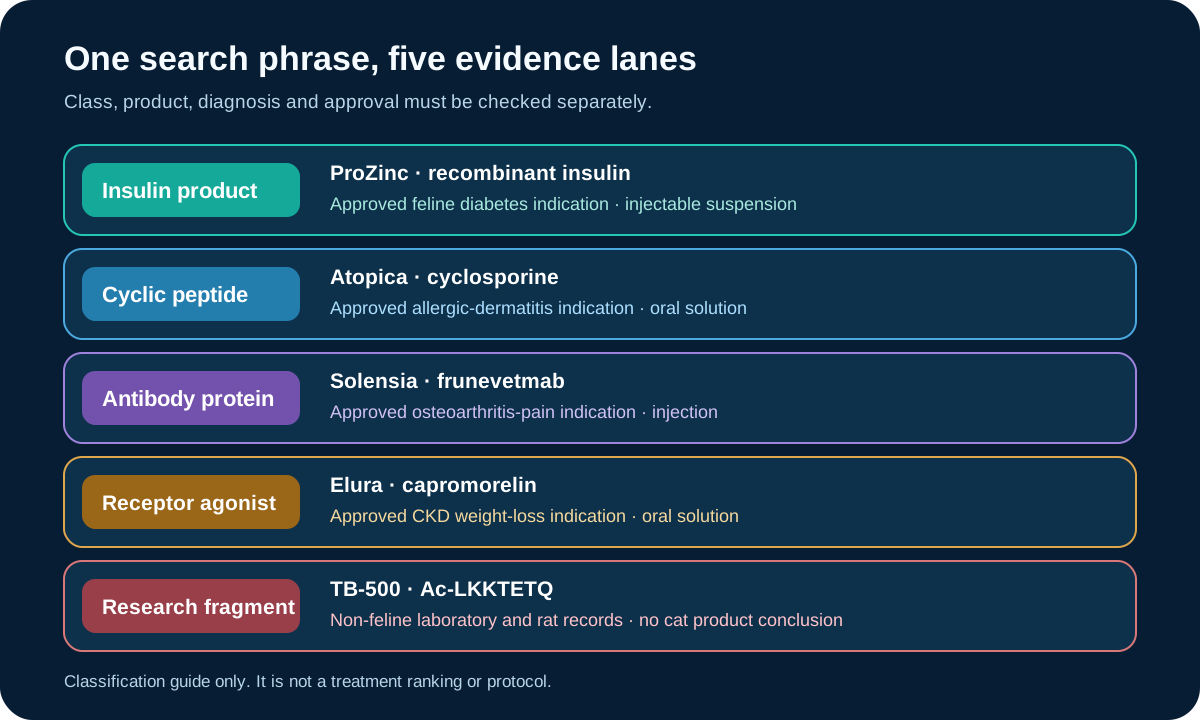
The distinction becomes clear in feline medicine. ProZinc is a protamine zinc recombinant human insulin injectable suspension approved for reducing hyperglycemia and associated clinical signs in cats with diabetes mellitus. Atopica for Cats contains cyclosporine, which its FDA label describes as an 11-amino-acid cyclic polypeptide, in an oral solution approved for control of specified manifestations of feline allergic dermatitis in cats meeting the label's age and weight criteria. These are exact products for different diagnoses, routes and monitoring needs. Their approvals do not create a general approval for “peptides in cats.”
The category grows even wider when owners encounter biological language. FDA describes frunevetmab in Solensia as a felinized monoclonal antibody and a therapeutic protein, not as a small peptide. Elura contains capromorelin, a ghrelin-receptor agonist that mimics signaling associated with the peptide hormone ghrelin. Acting at a peptide receptor does not make capromorelin the hormone itself.
Five records, five different conclusions
| Record | Exact identity and route | What the record supports | What does not transfer |
|---|---|---|---|
| ProZinc, NADA 141-297 | Protamine zinc recombinant human insulin; injectable suspension for cats | FDA approval for reducing hyperglycemia and associated clinical signs in cats with diabetes mellitus | Other peptide products, other diagnoses, or an unlabeled insulin formulation |
| Atopica for Cats, NADA 141-329 | Modified cyclosporine oral solution; immunosuppressant for cats | FDA approval for control of specified feline allergic-dermatitis manifestations in the label population | Generic skin claims, topical cyclosporine, wound healing, or another peptide |
| Solensia, NADA 141-546 | Frunevetmab injection; felinized monoclonal-antibody protein | FDA approval for control of pain associated with osteoarthritis in cats | Cartilage repair, use of any antibody, or proof that all biological products are “peptide therapy” |
| Elura, NADA 141-536 | Capromorelin oral solution; ghrelin-receptor agonist for cats | FDA approval for management of weight loss in cats with chronic kidney disease | Kidney repair, approval of ghrelin, or approval of a different receptor-targeting compound |
| TB-500 research paper | Ac-LKKTETQ fragment; human-serum, enzyme, rat-urine and fibroblast experiments | Identity, metabolism and laboratory-assay observations for the studied material | A feline product, route, safety profile, diagnosis or clinical benefit |
What an approval record actually matches
FDA's animal-drug framework ties approval to a specific product and intended use. The sponsor supplies safety, effectiveness and manufacturing information, and FDA reviews the labeling for the target species, indication, dosage form and route. A New Animal Drug Application number is therefore useful because it points to a defined regulatory record rather than a broad ingredient or mechanism.
The ProZinc approval summary illustrates the difference. The product is an injectable aqueous suspension containing protamine zinc recombinant human insulin. Its original field study treated 176 client-owned diabetic cats, and 151 were included in the effectiveness evaluation. The study measured glycemic control and diabetes-associated clinical signs over a defined period. That record supports the labeled insulin product and outcome. It does not test collagen, TB-500, BPC-157 or another product sold under a peptide label.
The Atopica record follows the same product-specific logic. It identifies cyclosporine oral solution, an oral route, cats as the species and a defined allergic-dermatitis indication. The approval studies excluded some alternative causes of skin disease and used finished oral formulations. A paper about a peptide made by skin bacteria, a copper peptide applied to another species or a supplement marketed for coats cannot inherit that approval.
Protein medicine is not a universal peptide category
Solensia provides a useful boundary example. FDA's approval summary calls frunevetmab a felinized immunoglobulin G monoclonal antibody and a subclass of therapeutic proteins. It is a finished injectable product approved for control of osteoarthritis pain in cats. Its effectiveness record used owner- and veterinarian-reported measures, including activities selected for the individual cat. The approval is about pain control. It is not an approval for joint repair, collagen replacement or a small peptide with an anti-inflammatory claim.
Current labeling matters after approval. FDA's safety-related labeling page records an October 5, 2026 Solensia update that added post-approval experience, information for cat owners and a Client Information Sheet. FDA states that voluntary post-approval reports cannot always establish frequency or causation. The practical lesson is to read the current product information with a veterinarian, rather than rely on an older article, an ingredient nickname or a general statement that a drug is “biological.”
A peptide pathway does not make every agonist a peptide
Elura shows a different category error. Its active ingredient, capromorelin, activates the ghrelin receptor and mimics some effects associated with ghrelin. The FDA approval is for management of weight loss in cats with chronic kidney disease. The field study compared the finished oral solution with a vehicle control in client-owned cats with documented weight loss and CKD. The measured benefit was weight management, not reversal of kidney damage.
A pathway headline can therefore mislead in two ways. It can turn “acts at a receptor for a peptide hormone” into “is peptide therapy,” and it can turn a measured appetite or weight outcome into disease modification. The feline kidney evidence guide keeps those endpoints separate.
Experimental fragments begin in a different lane
Rahaman and colleagues' 2024 TB-500 paper identifies the material as the acetylated seven-residue fragment Ac-LKKTETQ. The experiments used human serum, enzyme systems, urine from treated rats and fibroblast assays. No cats were participants, and the paper did not evaluate a finished veterinary product, feline diagnosis or cat clinical outcome.
That paper is useful for molecular identity and metabolism questions. It cannot be combined with FDA approval of insulin, cyclosporine or an antibody to make TB-500 an approved feline therapy. It also cannot supply a cat dose, route or product-quality conclusion. The TB-500 for cats source guide shows why finding related beta-thymosins in cat tissue is still not an intervention study.
How to check a proposed therapy without ranking products
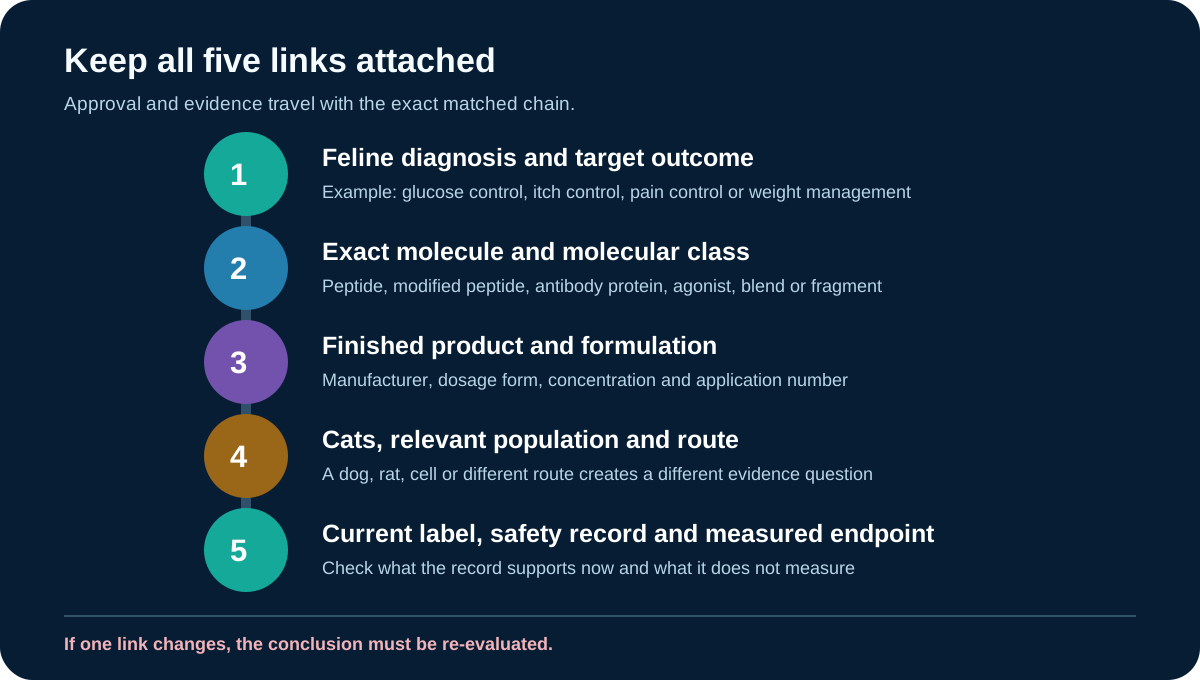
- Name the diagnosis and target outcome. “Skin,” “joints” or “kidneys” is too broad. Ask whether the goal is itch control, pain control, weight management, glucose control or another defined outcome.
- Copy the exact active ingredient. Distinguish a peptide, modified peptide, full protein, monoclonal antibody, receptor agonist, blend and fragment.
- Identify the finished product. Record the manufacturer, dosage form, concentration and NADA or ANADA number when present. A substance name alone does not verify a product.
- Match species, population and route. Confirm that cats with a comparable diagnosis were studied using the same route and formulation. A rat, dog, cell or healthy-cat experiment answers a different question.
- Match the measured endpoint. Weight, pain, itch, glucose, a biomarker and tissue repair are not interchangeable outcomes.
- Read the current label and safety updates. Approval summaries explain the original decision. Current labeling contains the instructions and warnings that apply now.
Open the free veterinary-visit checklist

Where compounded preparations fit
A compounded animal drug is a separate finished preparation. FDA explains that there can be patient-specific circumstances in which a veterinarian identifies a medical need for compounding, including situations where no approved, conditionally approved, indexed or authorized drug can be used for that patient. The compounded preparation itself is not FDA approved merely because it starts with an approved ingredient or resembles an approved product.
This is why “available from a pharmacy” and “FDA approved for cats” should not be used as synonyms. Ask which source ingredient was used, why the approved finished product cannot meet the cat's need, who prescribed it, what quality information applies and how the patient will be monitored. Do not use a research-chemical listing as a substitute for that veterinary and pharmacy record.
Questions for the veterinary visit
- What exact diagnosis and outcome are we treating?
- What is the active ingredient, molecular class, finished product and route?
- Does the product have a current NADA or ANADA number for this feline use?
- If the use is extra-label or the preparation is compounded, what patient-specific reason and monitoring plan apply?
- Were cats with this condition studied, and did the study measure the outcome we care about?
- What current label warnings, safety updates, interactions and stop criteria should I understand?
Bring the exact label, packaging and source paper. The cat peptide-safety guide provides a broader safety checklist, while the human-label worksheet explains why a human product record does not become feline approval.
Frequently asked questions
Are any peptide medicines FDA approved for cats?
Yes. ProZinc is a recombinant human insulin product approved for a defined feline diabetes indication, and Atopica for Cats is a cyclosporine oral solution approved for specified allergic-dermatitis manifestations. Each approval belongs to the exact finished product, label population, route and indication. It is not approval of peptides as a class.
Is Solensia a peptide?
FDA describes frunevetmab, the active ingredient in Solensia, as a felinized monoclonal antibody and a therapeutic protein. It is a different molecular and product category from a small peptide fragment.
Is Elura peptide therapy because it acts like ghrelin?
No. Capromorelin is a ghrelin-receptor agonist, but it is not the peptide hormone ghrelin. Its approval is for management of weight loss in cats with CKD, not for generic peptide therapy or kidney repair.
Does an NADA number approve every use of the ingredient?
No. The number identifies a product application. The approved species, indication, dosage form, route and labeling remain part of the record.
Does a cat study make a research fragment a veterinary product?
No. A study must still match the exact molecular identity, formulation, route, patient population and outcome. Publication is also separate from product approval and manufacturing review.
Do you recommend peptide sellers on this page?
No. The page includes no research-chemical seller, product ranking, affiliate link, dose or administration protocol.
The bottom line
“Peptide therapy for cats” is a search phrase, not one medical or regulatory category. Some feline products contain peptide or polypeptide drugs, some are larger therapeutic proteins, some act on peptide-hormone pathways and some search results describe experimental fragments. Start with the cat's diagnosis, then keep the exact molecule, finished product, species, route, measured outcome and current label connected. That chain tells you what the evidence supports and where a claim has crossed into another category.
Sources and scope
This is an introductory guide or original comparison framework, not a systematic review or a product recommendation.
- FDA FOI Summary: ProZinc original approval, NADA 141-297 — Primary approval record: protamine zinc recombinant human insulin injectable suspension for cats with diabetes mellitus; exact indication, route and 176-cat safety/151-cat effectiveness populations retained.
- FDA FOI Summary: Atopica for Cats original approval, NADA 141-329 — Primary approval record: modified cyclosporine oral solution, cats, oral route and specified allergic-dermatitis manifestations. The product-specific record does not transfer to another peptide or formulation.
- FDA labeling: Atopica for Cats, NADA 141-329 — Current official label identifies cyclosporine as an 11-amino-acid cyclic polypeptide and supplies the exact feline indication, prescription status, warnings and route.
- FDA FOI Summary: Solensia original approval, NADA 141-546 — Primary approval record: frunevetmab is a felinized monoclonal antibody and therapeutic protein; approved for control of pain associated with osteoarthritis in cats.
- FDA: Solensia safety-related labeling changes, October 5, 2026 — Current official update adding post-approval experience, owner information and a Client Information Sheet. Voluntary reports cannot always establish frequency or causation.
- FDA FOI Summary: Elura original approval, NADA 141-536 — Primary approval record: capromorelin oral solution for management of weight loss in cats with chronic kidney disease; distinguishes receptor action and weight outcome from ghrelin identity or kidney repair.
- Rahaman et al. (2024): TB-500 and metabolite analysis — Primary paper identifying TB-500 as Ac-LKKTETQ and reporting human-serum, enzyme-system, treated-rat-urine and fibroblast experiments. No cat intervention, finished feline product or clinical outcome.
- FDA: How to identify a legally marketed animal drug — Current official guidance on NADA, ANADA, CNADA and indexed-product identifiers, Animal Drugs @ FDA and Green Book checks.
- FDA: Journey of an animal drug through approval — Current official explanation of target species, indication, dosage form, route, safety, effectiveness, manufacturing and labeling review.
- FDA Q&A: Compounding animal drugs from bulk drug substances — Current official patient-specific compounding context and the distinction between a compounded preparation and an FDA-approved finished product.
Source checked October 25, 2026. A general context source does not establish a named product’s benefit.