
BPC-157 Oral vs Injection for Dogs: What the Evidence Compares
Is oral or injected BPC-157 better for dogs? Compare the beagle pharmacokinetic study with rat route research without turning either into a canine protocol.
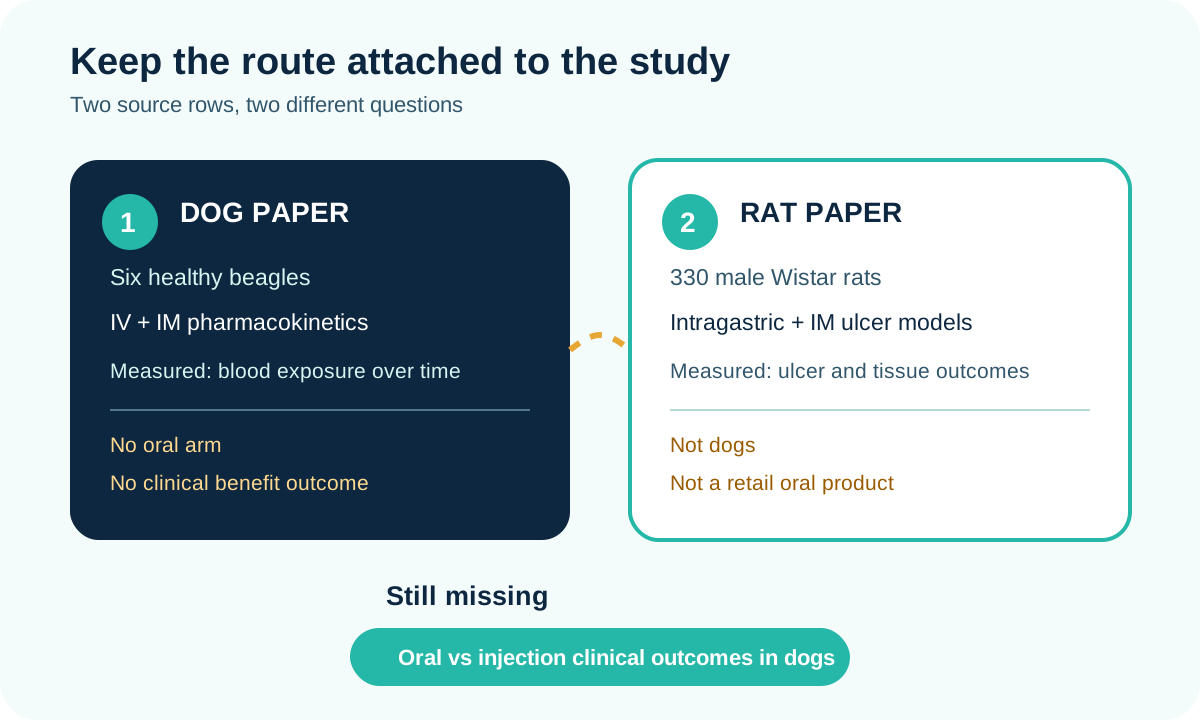
Is oral or injected BPC-157 better for dogs? The reviewed evidence does not establish that either route provides better clinical results in dogs. The primary dog study compared intravenous and intramuscular exposure in six healthy research beagles. It did not include an oral group or measure pain relief, gut improvement, mobility, wound healing, or recovery. A separate oral-versus-intramuscular comparison used induced gastric-ulcer models in rats, not dogs.

Match more than the route name
A useful oral-versus-injection comparison must match the exact compound, formulation, species, condition, outcome, and observation period. Route alone cannot predict benefit.
Why the available dog paper is not an oral-versus-injection trial
He and colleagues' 2022 study examined pharmacokinetics of a laboratory-prepared BPC157 saline solution in six beagles, three male and three female. The dogs received the material intravenously and intramuscularly in a series of experiments. The investigators measured plasma concentration over time and calculated exposure-related parameters.
There was no swallowed capsule, oral liquid, chew, or intragastric dog group. The paper therefore cannot calculate oral bioavailability in dogs, compare oral and injected dog exposure, or determine which route improves a canine health outcome. Its intramuscular bioavailability estimate is relative to the intravenous experiment, not relative to an oral product.
The study also did not enroll dogs with arthritis, inflammatory bowel disease, ligament injury, wounds, or another naturally occurring condition. A concentration curve can answer where and for how long the measured material appeared in blood under the experiment's conditions. It cannot answer whether a patient felt better or healed.
What the oral-versus-injection rat paper can tell you
Xue and colleagues' 2004 study used 330 male Wistar rats across three induced gastric-ulcer models. Researchers synthesized and purified BPC 157 in their laboratory and administered it either intragastrically or intramuscularly. Saline, an excipient, and famotidine were among the comparison conditions.
The paper reported smaller ulcer areas under several experimental conditions and described stronger effects for the intramuscular groups than the intragastric groups. That is a route-related result inside those rat injury models. It is not a clinical comparison in dogs, and it does not show that an injected product is better for every purpose or that an oral dog product is ineffective.
Intragastric administration also should not be rewritten as “a dog took a capsule.” It means the material was delivered into the stomach under a laboratory protocol. A retail capsule, flavored liquid, chew, enteric product, and laboratory intragastric preparation can differ in identity, excipients, release, stability, and exposure. The shared word “oral” does not make them equivalent.
| Source | Species, preparation, and routes | Measured outcome | What it cannot answer for a dog owner |
|---|---|---|---|
| He et al., 2022 | Six healthy research beagles; laboratory-prepared BPC157 in saline; intravenous and intramuscular experiments | Plasma concentrations and pharmacokinetic parameters, including exposure after intramuscular administration relative to intravenous administration | Oral exposure, symptom change, healing, route preference, or clinical benefit in dogs with a diagnosed condition |
| Xue et al., 2004 | 330 male Wistar rats; laboratory-synthesized BPC 157; intragastric and intramuscular administration in three induced gastric-ulcer models | Ulcer area and tissue-healing measures under experimental conditions | Clinical outcomes in dogs, ordinary oral-product performance, finished-product safety, or a route decision for a canine patient |
| FDA 2026 BPC-157 briefing | Evaluation of BPC-157 free base and acetate for proposed human compounding uses; discussed marketed oral and injectable forms | Identity, characterization, effectiveness, safety, and human-compounding evidence gaps | Veterinary approval, dog efficacy, dog oral bioavailability, or proof that a marketed form matches either animal paper |
The third row matters because a route name does not resolve product identity. FDA's July 2026 briefing treats BPC-157 free base and BPC-157 acetate as different active pharmaceutical ingredients and notes inconsistent identity information in the nominations it reviewed. That human-compounding document is not a veterinary approval decision, but it shows why a shopper cannot match a product to a paper using only the short name BPC-157.
“Injection” is not one route
Intravenous, intramuscular, and subcutaneous administration are different routes. The dog pharmacokinetic paper studied intravenous and intramuscular administration. The withdrawn human compounding nominations discussed in FDA's briefing proposed oral capsules and a subcutaneous injection. Those facts do not create a subcutaneous dog study.
Substituting one injection route for another changes the evidence question. A source must identify which route was used, the exact formulation, the study population, and the outcome. The phrase “injected BPC-157” is too broad to carry a pharmacokinetic percentage or a safety conclusion from one route to another.
The same rule applies to the word oral. Swallowed, intragastric, buccal, sublingual, rectal, and nasal delivery should not be grouped as if they create the same exposure. If a product listing does not clearly identify its route and finished formulation, that information remains unresolved.
For a route-neutral worksheet you can apply to other ingredients, use the oral versus injectable pet-product comparison. This BPC-157 page adds the compound-specific dog and rat source rows.
Exposure is not the same as benefit
Pharmacokinetics describes what happened to measured material over time. Common outputs include peak concentration, time to that peak, total measured exposure, and elimination half-life. These can be essential development data, but they do not measure comfort, appetite, stool quality, lameness, wound closure, ligament function, or quality of life.
A route that produces more measurable blood exposure is not automatically the route with more clinical benefit. Some intended effects may be local, some systemic, and some claims may have no demonstrated effect at all. Higher exposure can also change safety questions. A valid clinical comparison must measure the outcome in the relevant dogs instead of using a concentration number as a substitute.
| Question | Possible measurement | What remains separate |
|---|---|---|
| Did measurable material enter blood? | Plasma concentration over time | Whether a diagnosed condition improved |
| How did one route compare with a reference route? | Relative or absolute bioavailability under the study design | Whether either route has a favorable benefit-risk balance for household dogs |
| Did an induced lesion change in a rat model? | Ulcer area or tissue measures | Symptoms, function, and safety in dogs with naturally occurring disease |
| Did a finished product help canine patients? | Predefined clinical outcomes in a controlled dog trial | Results for a different formulation, route, condition, or product |
Product identity comes before route comparison
Before two products can be compared, both must be described completely. Record the exact ingredient form, sequence or chemical identity, concentration, excipients, container, storage instructions, lot information, route, responsible pharmacy or manufacturer, and intended species. Do not assume a certificate showing one chemical attribute proves sterility, potency through storage, freedom from aggregates, or clinical effectiveness.
FDA's current animal-compounding Q&A explains that animal drugs compounded from bulk drug substances are unapproved drugs, while describing circumstances in which FDA may exercise enforcement discretion when a veterinarian determines no approved or indexed product can appropriately treat the patient. That is a product-specific veterinary pathway, not a general endorsement of BPC-157 or permission to select a route from an online claim.
FDA also explains that compounded animal drugs have not gone through the same approval review for safety, effectiveness, manufacturing, labeling, and packaging. Those general facts do not prove that a particular product is defective. They do mean that a dog owner should not treat the word “compounded” as equivalent to “FDA-approved” or treat a research label as a veterinary prescription.
What a useful oral-versus-injection dog trial would need
A meaningful trial would begin with a defined canine condition and a finished preparation for each route. It would not compare a vague oral category with a different injectable ingredient. The oral and injected versions would need verified identity, formulation, quality controls, and a rationale for the comparison.
The study would also need an appropriate comparison group, allocation method, masking where feasible, predefined clinical outcomes, adverse-event collection, withdrawals, follow-up, and enough dogs to support the question. Pharmacokinetic sampling could help explain exposure, but clinical outcomes would still have to be measured directly.
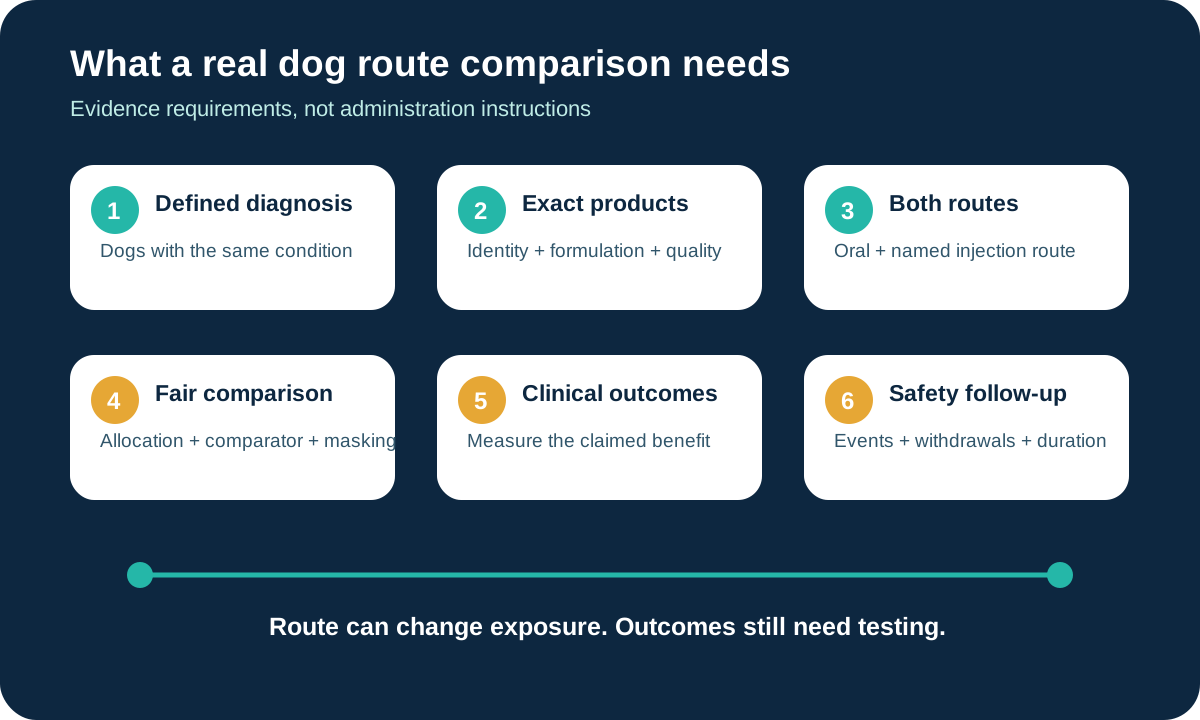
- Defined dogs: the same diagnosed condition, relevant inclusion criteria, and clearly reported concurrent care.
- Exact products: identity, salt or free-base form, formulation, excipients, quality controls, and storage for each arm.
- Route-specific exposure: measurements that actually include both the oral and injection routes being compared in dogs.
- Fair allocation: an appropriate comparator, randomized assignment where suitable, and masking of outcome assessment.
- Clinical outcomes: measures matched to the claim, such as validated pain, mobility, gastrointestinal, or wound outcomes.
- Safety and follow-up: predefined monitoring, all withdrawals and adverse events, and a duration relevant to intended use.
Without those features, an oral-versus-injection claim may be comparing route labels rather than patient results. The absence of a matching source in this focused review is not proof that no unpublished or future study can exist. It is a reason to state exactly what the reviewed evidence does and does not answer.

Questions to bring to a veterinarian
- What diagnosis and practical outcome should guide this discussion?
- Does any reviewed study include dogs with that condition and measure the outcome that matters?
- Was oral BPC-157 actually studied in dogs, or is the claim borrowing a rat intragastric experiment?
- Which injection route does the cited source use, and does it match the proposed preparation?
- Is the exact ingredient BPC-157 free base, an acetate form, or not clearly identified?
- What is the finished product's current regulatory and prescription status?
- What established options address the diagnosed problem, and how are their benefits and risks monitored?
Open the free veterinary-visit checklist
The sitewide amount-to-volume calculator performs arithmetic only from a veterinarian-provided amount and an actual pharmacy-label concentration. It does not recommend BPC-157, choose a route, create a dose, or provide injection instructions.
Frequently asked questions
Was oral BPC-157 studied in dogs?
The dog pharmacokinetic paper reviewed here did not include an oral arm. It studied intravenous and intramuscular administration in six beagles. The oral-route comparison in this article comes from intragastric administration in rat ulcer models, which cannot establish oral exposure or benefit in dogs.
Did injection work better than oral BPC-157?
The rat paper reported a stronger effect for intramuscular than intragastric administration in its induced gastric-ulcer models. That result is limited to the studied rats, laboratory preparation, routes, models, and tissue outcomes. It is not proof that injection is better for dogs or for a different condition.
Does higher bioavailability mean better healing?
No. Bioavailability describes exposure relative to a reference route under a particular study design. Healing, pain relief, function, and quality of life require their own clinical outcomes. The dog paper did not measure those benefits.
Are intravenous, intramuscular, and subcutaneous injections interchangeable?
No. They are distinct routes. A result from one should not be relabeled as evidence for another. The dog paper used intravenous and intramuscular routes; it did not establish a subcutaneous dog outcome.
Can this page provide a BPC-157 dog dose?
No. Experimental amounts are not reproduced as instructions, and this page does not supply a regimen, mixing method, syringe conversion, or route recommendation. Discuss the diagnosed condition and lawful treatment options with the veterinarian responsible for the dog.
Where can I buy oral or injectable BPC-157 for a dog?
This page does not direct readers to research-chemical sellers. Resolve diagnosis, product identity, regulatory status, veterinary oversight, and finished-product quality before any price comparison. A seller listing is not clinical evidence.
The bottom line
The phrase BPC-157 oral vs injection for dogs sounds like a head-to-head canine treatment question, but the reviewed sources do not provide that study. The dog paper measured intravenous and intramuscular pharmacokinetics in six healthy beagles. The intragastric-versus-intramuscular outcome comparison used induced gastric ulcers in rats.
Keep those evidence rows separate. Route can change exposure, but route alone does not predict clinical benefit or settle safety. Ask for the exact compound, finished formulation, dog population, route, and patient-centered outcome before treating a route claim as evidence.
Sources and scope
This is an introductory guide or original comparison framework, not a systematic review or a product recommendation.
- He et al. (2022): BPC157 pharmacokinetics in rats and dogs — Six healthy research beagles received laboratory-prepared BPC157 in intravenous and intramuscular experiments. The study measured plasma exposure and had no oral arm or canine clinical benefit outcome.
- Xue et al. (2004): intragastric and intramuscular BPC 157 in rat ulcer models — Three induced gastric-ulcer models in 330 male Wistar rats. The route-related tissue findings are not a dog trial or evidence for a finished oral product.
- FDA July 2026 briefing: BPC-157-related bulk drug substances — Human-compounding evaluation that treats BPC-157 free base and acetate as different active ingredients and documents route, characterization, safety, and effectiveness gaps. It is not veterinary approval.
- FDA: Q&A on GFI #256 animal compounding — Current general context for unapproved compounded animal drugs and patient-specific veterinary circumstances; not BPC-157 efficacy or route evidence.
- FDA: animal drug compounding overview — Official finished-product approval and quality context for animal drugs compounded from bulk substances.
Source checked October 09, 2026. A general context source does not establish a named product’s benefit.