
BPC-157 for Dogs Side Effects: What Safety Studies Can Tell You
Read BPC-157 dog safety findings, separate study observations from unknown risks, and prepare product-specific questions for your veterinarian.
What are the side effects of BPC-157 for dogs? The sources reviewed here do not establish a reliable side-effect frequency or a long-term safety profile for household dogs. A small canine exposure study and a separate preclinical toxicology report provide useful observations, but neither supplies a finished-product safety label for your dog. A favorable experimental finding should stay attached to the animals, preparation, route and observation period actually studied.

If you are searching for BPC-157 for dogs side effects, the useful question is more specific than whether a peptide sounds natural or promising: what safety information applies to the exact product and situation being considered? This guide shows how to separate a recorded finding, an unmeasured outcome and a product-quality question. For the broader research comparison, start with our canonical BPC-157 guide for dogs and cats.
This is an AI-assisted evidence explainer, not a veterinary safety monograph or systematic review. Updated October 3, 2026 to include FDA’s July 2026 toxicology appraisal. The 2022 paper was available in full; our access to the original 2020 paper remains abstract-only. The FDA review adds information beyond that abstract. No pet dose, treatment protocol, product recommendation or veterinarian review is claimed.
What the dog evidence actually records
Keep the two papers separate. One asks how an experimental compound moves through the body; the other reports preclinical toxicity evaluations. Their study purposes differ.
| Source and access | Species, preparation and route | What was measured or reported | Interpretation limit |
|---|---|---|---|
| He et al., 2022, full text | Six research beagles, three male and three female, aged 10–12 months. Laboratory-prepared BPC157 in saline; intravenous and intramuscular experiments. | Blood-exposure measurements, including a seven-day repeated intramuscular phase. Authors reported no visual toxicity signs in the dogs. | A pharmacokinetic experiment, not a long-term trial in client-owned dogs with illness. |
| Xu et al., 2020, abstract only | Preclinical program includes mice, rats, rabbits and dogs. The abstract omits important dog-study details; FDA’s appraisal below describes free-base BPC-157 in 28-day intramuscular studies. | Dog repeated-dose evaluation reported a creatinine decrease at the highest dose described, with recovery after withdrawal. | Our original-paper access is abstract-only. Read the FDA appraisal below before drawing a safety conclusion; a household-dog event rate remains unknown. |
The 2020 abstract also describes mild local irritation, but does not identify the species and route for that test. We therefore do not label it a demonstrated injection-site reaction in dogs. Its summary of generally favorable tolerability does not erase the recorded laboratory change or fill in the missing methods.
The July 2026 FDA briefing, printed page 40, describes FDA’s reanalysis of Xu’s 28-day intramuscular animal studies: prolonged aPTT in dogs, shortened aPTT in rats, and liver-associated laboratory signals. These suggest clotting and metabolic concerns; they do not establish clinical bleeding, liver injury in dogs, or a household-dog incidence. FDA noted missing longer-duration studies. This is advisory background for human compounding, not veterinary approval or a final regulatory decision. The abstract’s reassuring summary must be read alongside this appraisal.
Why “no signs observed” is a bounded observation
To interpret a safety sentence, ask what an observer could actually detect. An outward change, a laboratory measurement and an owner questionnaire are different forms of observation. Before accepting a headline, look for the method that would reveal the problem it claims to rule out.
Our interpretation of the canine exposure paper is narrow: it does not establish how often adverse events occur during longer use in diverse household dogs, or whether an unrelated preparation shares its findings. That is a limit of the answer, not evidence that every missing outcome must be harmful.
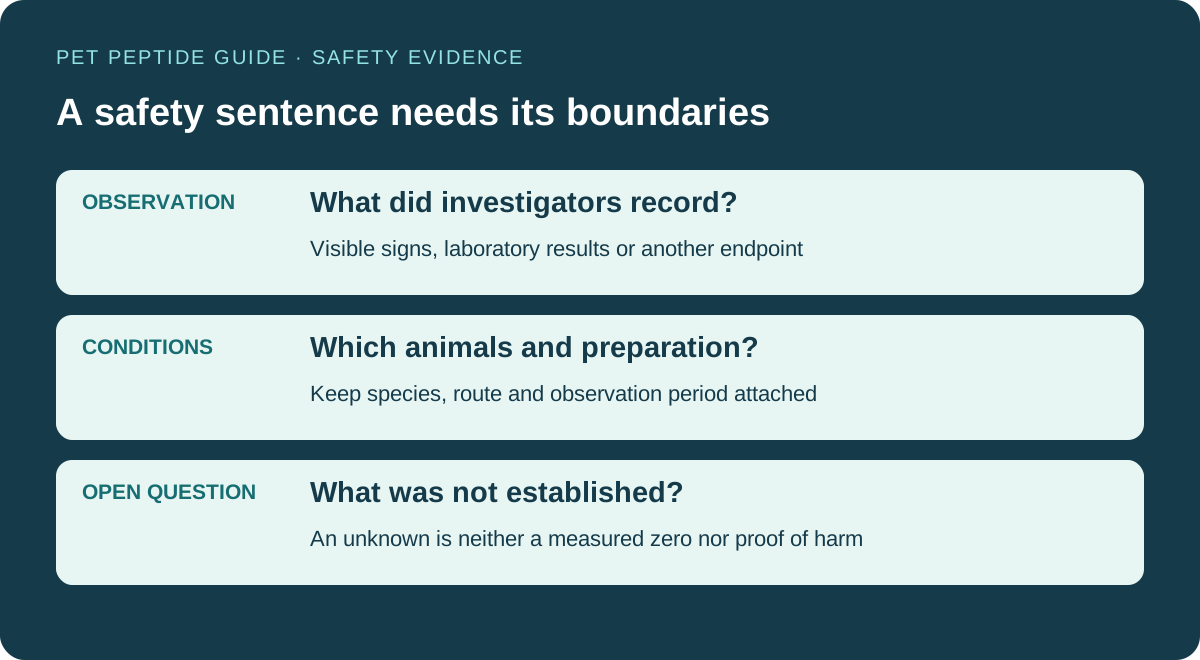
A helpful reading habit is to turn a broad conclusion into a sentence with blanks: “In these animals, using this preparation, during this observation period, investigators recorded these outcomes.” If you cannot complete one of the blanks from a primary source, write “not verified” instead of guessing.
This prevents two common leaps. The first is treating a study’s reassuring conclusion as permission to use any product with the same ingredient name. The second is treating one unreported outcome as a measured absence. The evidence can be useful even when neither leap is justified.
A reported laboratory change is not a ready-made clinical verdict
The creatinine finding needs its experimental context. This article does not interpret it as kidney protection, kidney damage, or a prediction for your dog. The abstract alone is not enough to make those clinical judgments. A veterinarian would need the complete study and the individual patient’s information before deciding what a laboratory change means.
For a source appraisal, request the missing pieces together: how many dogs were in each group, their baseline measurements, the comparison group, the route and preparation, the exposure period, the size of the change and any associated observations. A number detached from those details can sound more clinically conclusive than it is.
The original 2020 full text remains an access gap. FDA’s detailed appraisal now supplements the abstract; we do not claim to have independently reviewed every original table. The remaining question is how the complete evidence applies to a particular patient and preparation.
Three separate safety questions: compound, product and patient
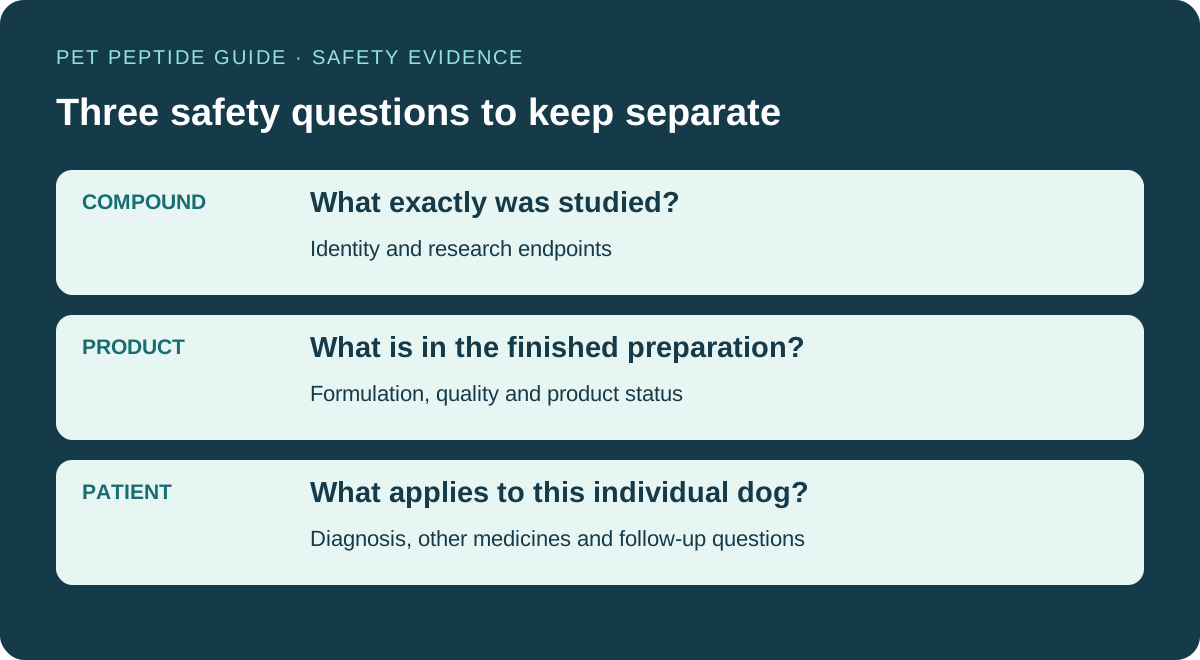
A compound name is the starting point of an evidence comparison. It is not a complete description of something administered to a dog. Keep three questions on separate lines:
- Compound: What did the research test, and what outcomes did it record?
- Product: What exactly is in the proposed finished preparation, and how was it made and checked?
- Patient: What diagnosis, other medicines and follow-up questions are relevant to this particular dog?
For product context, FDA’s animal-compounding Q&A explains that compounded animal drugs are not FDA-approved and that approval evidence for a finished drug cannot simply be applied to a changed compounded preparation. It describes quality concerns including contamination, incorrect ingredient amounts and stability. Those are general compounding issues, not measured BPC-157 side-effect rates. The guidance also recognizes medically necessary compounding circumstances; it is not a finding that every compounded medicine is identical.
Ask the veterinarian and dispensing pharmacy to identify the exact formulation, route, product status and relevant supporting evidence. Record the answer rather than relying on a seller’s use of “veterinary,” “pure” or “research.” This page does not validate any seller, batch, sterility claim or approval application.
If you are comparing oral nutritional products instead, use the separate collagen peptides for dogs buying guide. Its label and cost framework does not make experimental BPC-157 products equivalent to collagen powders or chews. Our Best Peptides for Dogs guide explains why categories and evidence matches matter more than a universal ranking.
What FDA’s human-compounding page adds, and what it cannot answer
On the FDA human-compounding safety-risk page checked October 2, BPC-157 appears in the section for nominations that were withdrawn. FDA identifies potential immune-response concerns for certain routes, peptide-related impurities and difficulties characterizing the active ingredient, alongside limited safety information. This is human-compounding context. It does not provide a canine adverse-event percentage, a veterinary approval record or a list of confirmed dog side effects.
Use the two regulatory sources for their own purposes. The human page describes concerns in its stated setting. The animal page explains finished-product approval and compounding distinctions. Neither should be pasted into a dog-treatment advertisement as if it were a product label. For a worked example of this distinction, read what human peptide approval means for dogs and cats.
Watch: keep the label, study and dog on separate cards
This existing original 48-second captioned explainer illustrates the comparison method. It is silent and includes no dose or treatment instructions.
Open the dedicated video page and full transcript. The animals shown are editorial imagery, not participants in the papers discussed here.
A veterinarian conversation you can prepare

Bring the actual label or dispensing record and the question you want answered. If your concern is joint pain, gut symptoms or recovery from an injury, name that concern rather than asking whether peptides are safe as a whole. You can use these prompts without choosing a compound or regimen yourself:
- What diagnosis and outcome are we trying to address?
- Which evidence applies to dogs with that diagnosis and this exact preparation?
- What does the source measure about safety, and what remains unknown?
- What other options have evidence for this situation?
- Who verifies the product details, and what follow-up would you require?
- Who should I contact if my dog changes after receiving a product?
Print the free veterinarian-visit checklist to keep the product and medical questions together. A calculation is a different task: the amount-to-volume calculator only converts a veterinarian-provided amount using a confirmed pharmacy-label concentration. It does not resolve whether BPC-157 is appropriate or establish a safe dose.
If a change occurs after a product
Contact your veterinarian for assessment of a suspected reaction; a research summary cannot diagnose it. Preserve the label, packaging and a timeline of what was administered and what changed. Do not try to identify the cause from a testimonial or this article alone.
FDA’s animal-drug reporting instructions cover suspected adverse events, medication errors, product defects and lack of effectiveness, including for compounded drugs. Its examples include vomiting, diarrhea and seizures across animal-drug reports generally; they are not a BPC-157-specific dog side-effect list. FDA requests information such as prior health, other products, examination findings and test results. Reporting is separate from obtaining veterinary care.
A useful timeline separates observations from conclusions: “This happened after this product” is an observation. “This ingredient caused it” is a causal claim requiring assessment. Include other medicines and changes rather than removing details that complicate the story.
Questions owners commonly ask
Does this research prove that BPC-157 is safe for dogs?
No. The reviewed sources support narrower experimental observations. They do not establish a general household-dog safety guarantee or validate a retail preparation.
Can I calculate a safe dog dose from the studies?
This guide does not establish a pet dosing protocol. Experimental amounts are not owner instructions, and unit conversion does not supply the missing clinical judgment.
Is oral BPC-157 safer than an injection?
This source comparison does not establish that ranking. A route comparison needs matched preparations, populations and safety outcomes. A route name alone is not enough.
Can I use this page to assess my cat?
No. A dog safety question must not silently become a cat answer. Keep the species visible, and use the main BPC-157 evidence guide to identify what was actually studied.
Does a lack of a known side-effect percentage mean the risk is zero?
No. An unestablished frequency should be recorded as unknown. It is not a measured zero, and it does not prove that every proposed risk will occur.
Your next step: Bring the exact product information and one concrete safety question to your veterinarian. Read the ingredient-versus-finished-product evidence guide if a seller cites a paper without explaining the preparation it tested.
Sources and scope
This is an introductory guide or original comparison framework, not a systematic review or a product recommendation.
- He et al. (2022): BPC157 pharmacokinetics in rats and dogs — Full-text dog methods and observations checked; six-beagle exposure experiment, not a long-term pet safety trial.
- Xu et al. (2020): preclinical safety evaluation, PMID 32334036 — Original abstract reviewed; complete original tables remain unavailable to this article. The separate FDA appraisal below supplies additional toxicology context.
- FDA July 2026 PCAC briefing: BPC-157, printed pages 34–40 — FDA animal-data appraisal for human compounding; advisory background, not veterinary approval or a pet event-rate estimate.
- FDA: human-compounding substances and potential safety risks — BPC-157 entry under withdrawn nominations; human context, not a canine event rate or veterinary approval.
- FDA: Q&A on GFI #256 animal compounding — Finished-product approval, general quality concerns and veterinary compounding context.
- FDA: reporting animal-drug side effects and product problems — Suspected-event reporting, including compounded drugs; general examples are not a BPC-157-specific side-effect list.
Source checked October 03, 2026. A general context source does not establish a named product’s benefit.