
BPC-157 Veterinary Use: What Records Would Support the Claim?
Does a dog study establish BPC-157 veterinary use? Compare research exposure, clinical outcomes, product pathways and patient records.
Does a dog study establish BPC-157 veterinary use? No. A 2022 experiment shows that six healthy research beagles were exposed to laboratory-prepared BPC157 by intravenous and intramuscular routes and had blood concentrations measured. That is a canine research record. It is not an approved animal-drug label, a patient-specific prescription, a clinical outcome study, or proof that a retail product is suitable for a dog. A credible “veterinary use” claim needs a matching product, legal pathway, patient, outcome and monitoring record.

Keep five different meanings of “veterinary use” separate
A compound can appear in an animal experiment without becoming an approved treatment, an appropriate compounded preparation, or a routine clinical option.
What “veterinary use” could mean
The phrase can describe several very different records. A paper may use a compound in dogs for research. A sponsor may investigate a defined product under an animal-drug research file. A finished animal drug may hold an FDA approval, conditional approval or minor-species Index entry. A veterinarian may direct extra-label use of an approved human or animal drug when federal and state conditions are met. A pharmacy may prepare a patient-specific compounded drug under an applicable veterinary compounding framework.
Those meanings are not interchangeable. The presence of dogs in a paper supports only the study described. It does not supply the product and pathway records that a clinical claim still needs.
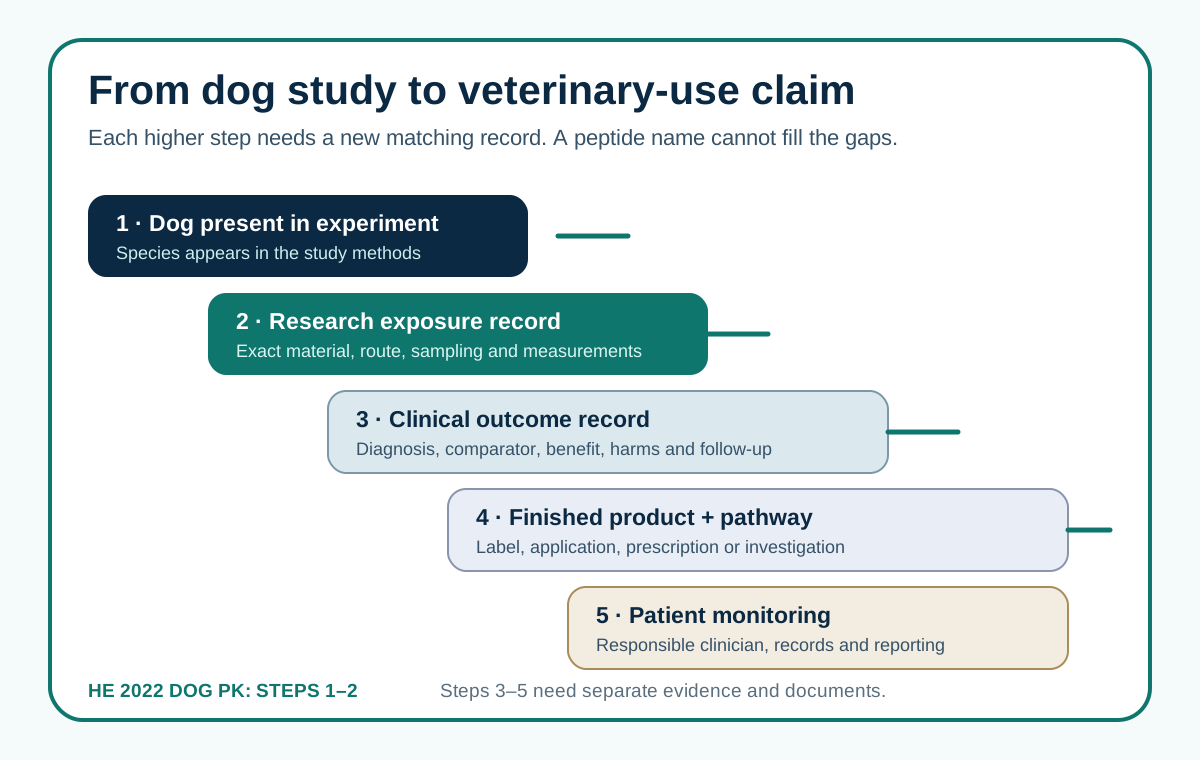
What each BPC-157 record supports
| Record | Exact scope | What it supports | What remains unsupported |
|---|---|---|---|
| He et al., 2022 | Six healthy beagles, three male and three female, aged 10 to 12 months; laboratory-prepared BPC157 in saline; intravenous and intramuscular pharmacokinetics, including a seven-day repeated intramuscular phase | Canine exposure and pharmacokinetic measurements for the exact experimental material and routes | Treatment effectiveness, long-term household-dog safety, oral exposure, a retail product match, or a clinical indication |
| Xu et al., 2020 plus FDA's 2026 appraisal | Multi-species preclinical toxicology program; original abstract available here, with additional dog-study appraisal in an FDA human-compounding briefing | Preclinical observations and important uncertainty signals that deserve product- and species-specific follow-up | A canine adverse-event incidence, a favorable risk-benefit conclusion, a finished-product label, or permission to convert experimental exposures into a pet protocol |
| FDA human compounding safety-risk page | BPC-157 listed under withdrawn human-compounding nominations; limited safety information and concerns about immune response, peptide impurities and active-ingredient characterization | Current federal human-compounding safety context and unresolved substance-characterization questions | Veterinary approval, a dog event rate, or a decision about an individual animal |
| FDA animal-drug compounding framework | General U.S. framework for animal drugs compounded from approved drugs or bulk drug substances | Why patient-specific need, source material, prescription and pharmacy records matter | Approval of a BPC-157 preparation or a finding that any seller's vial is appropriate, stable, sterile or effective |
| FDA animal-drug application framework | NADA, ANADA, CNADA and investigational new animal-drug records for exact products and intended uses | The kinds of product, target-species, manufacturing, safety and effectiveness records that support legal marketing or formal investigation | A BPC-157 application, approval or clinical-use conclusion without an exact matching record |
The six-beagle study answers an exposure question
The 2022 full text identifies BPC157 as the 15-amino-acid sequence GEPPPGKPADDAGLV. Its dog work used a laboratory-prepared compound in saline. Researchers collected blood samples and calculated pharmacokinetic measures after intravenous and intramuscular exposure. The same six beagles participated in four cycles, including a repeated seven-day intramuscular phase. The authors reported no visual toxicity signs in the dogs during that experiment.
Those details matter because they make the research record specific. They also define its limits. The dogs were healthy research animals, not client-owned dogs enrolled for tendon injury, gastrointestinal disease, arthritis or another clinical diagnosis. The study did not test recovery, pain, mobility, quality of life, recurrence, treatment failure or comparison with standard veterinary care. “No visual toxicity signs” during this exposure window is not a long-term safety guarantee.
The paper therefore supports the sentence “BPC157 pharmacokinetics were measured in six beagles under these experimental conditions.” It does not support “BPC-157 is a veterinary treatment” or “this retail product was tested in dogs.” For a fuller explanation of the measurements, use the canonical BPC-157 evidence guide. For the separate safety observations and access limits, use the BPC-157 dog safety guide.
A study material is not automatically a finished product
Matching the peptide name is only the first step. A finished product also has a manufacturer or pharmacy, dosage form, concentration, excipients, container, storage conditions, release specifications, sterility controls when relevant, and a responsible party. A research paper's analytical description does not validate a seller's label or establish that two materials have the same identity, purity, stability or performance.
FDA's July 2026 Pharmacy Compounding Advisory Committee briefing considered BPC-157 in the human-compounding context. It distinguished free-base and acetate materials and discussed substance-characterization uncertainty. That advisory material is useful for understanding identity and safety questions, but it is not an animal-drug approval, a veterinary label, or a clinical conclusion for dogs and cats.
A certificate of analysis can answer only the fields it actually tests for the sampled lot. It cannot create a legal marketing pathway or supply missing canine clinical outcomes. The ingredient-versus-finished-product guide shows how to compare a cited paper with a product claim without assuming equivalence.
Extra-label use starts with an approved source drug
Under the Animal Medicinal Drug Use Clarification Act, federal extra-label use provisions apply to certain FDA-approved human or animal drugs used by or on the lawful order of a licensed veterinarian within a valid veterinarian-client-patient relationship and under the applicable conditions. “Extra-label” does not mean that any unapproved research compound becomes an extra-label drug when someone discusses it with a veterinarian.
The first record question is therefore exact: what approved finished source drug and current label are being used? If that record is absent, do not fill the gap with the phrase “veterinary use.” A veterinarian's patient-specific judgment and records also do not create a new FDA-approved indication.
Animal drugs compounded from bulk drug substances follow a different framework. FDA states that those preparations are unapproved and have not undergone premarket review for safety, effectiveness or manufacturing quality. Guidance describing circumstances where FDA generally intends to exercise enforcement discretion is not product approval. A medically necessary compounding decision remains patient-, prescriber-, pharmacy- and preparation-specific.
Formal investigation has its own documents
A formal animal-drug investigation needs more than a published animal experiment. FDA's development framework uses an Investigational New Animal Drug file for studies intended to support a new animal-drug application. The sponsor defines the product, dosage form, route, target animal and intended use, and investigators keep shipment and study records under the applicable framework.
An investigational record allows controlled research. It does not establish routine clinical use or general retail availability. A page that calls a product “for veterinary research” should still identify the sponsor, investigator, protocol, exact study material and oversight that connect the listing to a real investigation.
Use a seven-field BPC-157 claim check
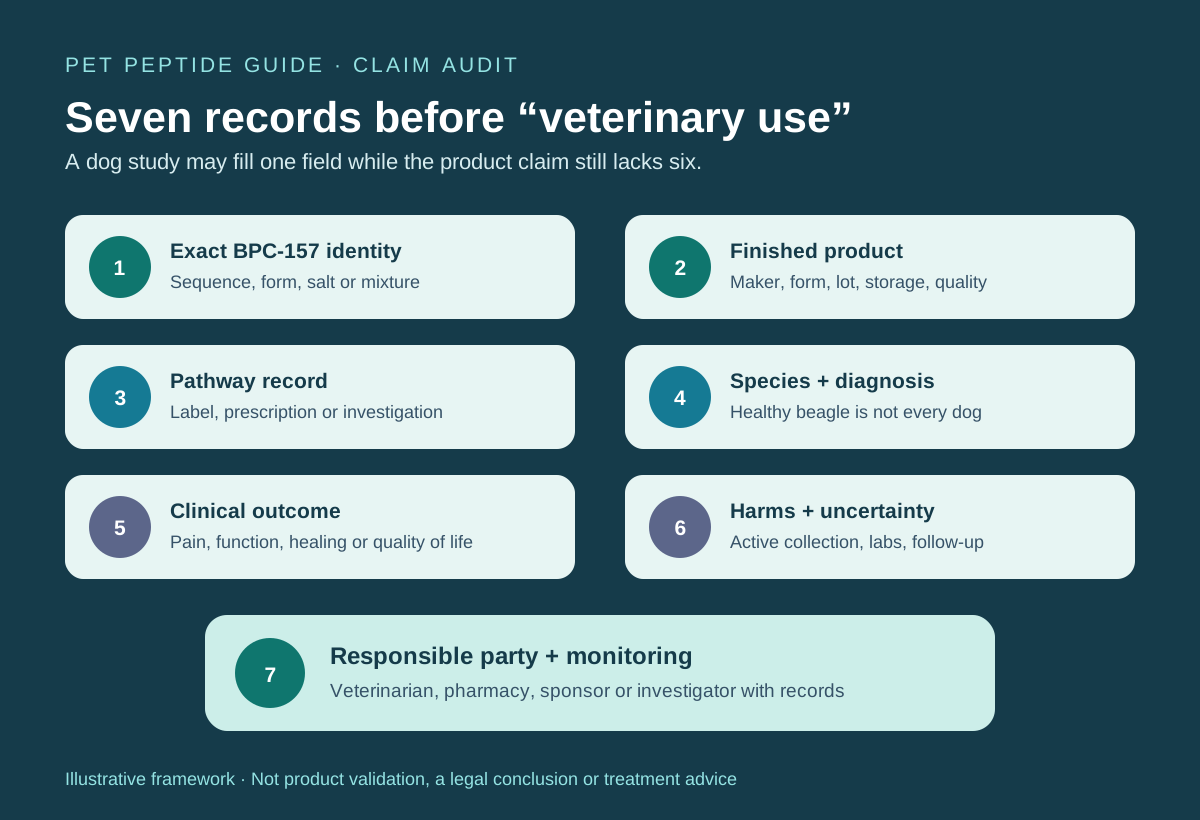
- Exact BPC-157 identity: Record the sequence, salt or form and any mixture. Do not merge free base, acetate, fragments or unnamed blends.
- Finished product: Record the manufacturer or pharmacy, dosage form, concentration, excipients, lot, storage and quality records that actually match the item being discussed.
- Legal or research pathway: Find the application, approved source-drug label, patient-specific prescription or genuine investigational documents. A storefront category is not a pathway record.
- Species and diagnosis: Match the animal population and condition. Healthy beagle pharmacokinetics do not answer a clinical question about an injured or ill household dog.
- Clinical outcome: Look for the outcome that matters, such as validated pain, mobility, healing, relapse or quality-of-life measures. Blood concentration alone is not a treatment benefit.
- Harms and uncertainty: Check active adverse-event collection, laboratory monitoring, exposure duration, withdrawals and follow-up. An unmeasured risk is not a measured zero.
- Responsible party and monitoring: Identify the veterinarian, pharmacy, sponsor or investigator responsible for the product, patient records, follow-up and problem reporting.
If the claim supplies only “BPC-157,” “veterinary,” a purity percentage and dog imagery, most of the record remains missing. Keep the conclusion unresolved rather than treating the marketing description as evidence.
Questions to bring to a veterinarian
- What exact finished product and BPC-157 form is being discussed?
- Which approved-drug, compounding or investigational record applies?
- Does the supporting study match my animal's species, health status, route and diagnosis?
- What patient-centered clinical outcome was measured, rather than only blood exposure or a laboratory marker?
- What adverse events, laboratory changes, withdrawals and follow-up were actively collected?
- Who is responsible for the product quality, prescription, records, monitoring and suspected-problem reporting?
Open the free veterinary-visit checklist
Frequently asked questions
Was BPC-157 tested in dogs?
Yes, in a narrow research sense. The reviewed 2022 paper measured pharmacokinetics after intravenous and intramuscular exposure in six healthy research beagles. It was not a treatment-effectiveness trial in client-owned dogs.
Does a dog pharmacokinetic study make BPC-157 a veterinary drug?
No. It establishes a research record for the exact material and study design. Veterinary product status requires a separate matching product and pathway record.
Can BPC-157 be called extra-label?
Extra-label use starts with an FDA-approved human or animal drug and a veterinarian-directed use that meets the applicable conditions. A research material does not become an approved source drug because a proposed use is outside a label.
Does compounding make BPC-157 FDA approved?
No. FDA states that animal drugs compounded from bulk drug substances are unapproved. A patient-specific compounding decision does not transfer FDA approval to the preparation.
Does the FDA human-compounding briefing decide veterinary use?
No. It provides current substance-identity and safety appraisal in a human-compounding advisory context. It is not a veterinary approval or dog clinical-use decision.
How can I check a current animal-drug claim?
Find the exact finished-product label and application record in the relevant FDA animal-drug sources. Match the product, species, indication, route and status. If a seller cannot provide those records, keep the claim unresolved.
Decision rule
A dog in a study establishes that dogs were studied under the stated conditions. It does not establish a veterinary treatment. For a BPC-157 veterinary-use claim, require matching records for exact identity, finished product, pathway, species and diagnosis, clinical outcomes, harms, and responsible monitoring. Missing fields remain missing.
Sources and scope
This is an introductory guide or original comparison framework, not a systematic review or a product recommendation.
- He et al. (2022): BPC157 pharmacokinetics in rats and dogs — Primary full text for the six-beagle intravenous and intramuscular exposure design, study material, blood measurements and observation limits. This was not a dog treatment-effectiveness trial.
- Xu et al. (2020): preclinical safety evaluation, PMID 32334036 — Original abstract reviewed; complete original tables and methods remain unavailable to this publication. No adverse-event incidence or pet protocol is inferred.
- FDA July 2026 PCAC briefing: BPC-157 — FDA appraisal of identity, characterization and animal toxicology in a human-compounding advisory context. It is not a veterinary approval or dog clinical-use decision.
- FDA July 23–24, 2026 Pharmacy Compounding Advisory Committee meeting — Official meeting record and BPC-157 briefing-package context; advisory materials are not treated as animal-drug approval.
- FDA: bulk substances that may present significant compounding safety risks — Current BPC-157 human-compounding entry under withdrawn nominations, including limited safety information and characterization concerns. Not a dog event-rate estimate.
- FDA: Animal Medicinal Drug Use Clarification Act of 1994 — Federal context for veterinarian-directed extra-label use of certain approved human and animal drugs within a valid veterinarian-client-patient relationship.
- FDA: The Ins and Outs of Extra-Label Drug Use in Animals — Official veterinarian resource used to distinguish extra-label use of an approved source drug from use of an unapproved research material.
- FDA: Animal Drug Compounding — Current official context that animal drugs compounded from bulk drug substances are unapproved and have not undergone animal-drug premarket review.
- FDA: Regulation of Animal Drugs — Current official overview of legally marketed animal-drug pathways and the distinction between approval review and unapproved bulk-substance compounded products.
- FDA: New Animal Drug Applications — Official NADA, ANADA, CNADA and investigational new animal-drug framework used to define the product and research records a claim would need.
Source checked November 03, 2026. A general context source does not establish a named product’s benefit.