
Collagen peptides for dogs: powder vs chews and daily cost
Compare dog collagen powders and chews using real labels, dated prices, canine research, a daily-cost calculator, two short videos, and a printable buying worksheet.
Browse the full guide
Comparing collagen peptides for dogs? Start with the exact collagen ingredient, then compare the format and cost per day. A powder can suit a feeding routine; a soft chew can be easier to count. Neither format is automatically more effective. This guide compares two real listings, separates product facts from canine research, and gives you tools to make a shorter, clearer shopping list.

Find the part you need
Looking for a fast answer? Read the comparison table and its open questions. Want to understand the decision? Work through the ingredient, evidence, routine, and budget sections. You can use every tool without entering an email address.
What should you buy first: a powder or a chew?
First decide what information a product must provide to stay on your shortlist. That includes the complete ingredient list, a clearly identified collagen form, the intended species, a usable serving unit, and a way to contact the manufacturer. A container that fails this basic information check is difficult to compare, however attractive its front label looks. You can ask for clarification before deciding whether it belongs in your cart.
Then think about the routine you already have. If meals are measured and reliably finished, a powder may be straightforward to incorporate according to its instructions. If more than one person handles feeding, individually countable chews may be simpler to record. Those are convenience considerations. They do not tell you which ingredient has stronger research or whether the product fits your dog's health needs.
Our practical starting point is therefore the easiest suitable product to identify, measure, and afford consistently, rather than the one with the longest list of claimed benefits. The word “suitable” matters: a veterinarian who knows your dog can help determine whether a supplement belongs in the care plan at all. The rest of this guide helps you bring a better-defined product and budget question to that discussion.
Do not let format do the work of a label. Some powders contain several ingredients. Some soft chews provide collagen as one part of a broader blend. “Powder” does not necessarily mean a single ingredient, and “chew” does not tell you the collagen amount. Put the two full panels beside each other before deciding which one looks simpler.
Choose your next comparison step
This helper suggests what to inspect next. It does not select a product or serving amount.
Choose a priority to see a practical next step.
Collagen peptides, collagen types, and chews mean different things
The terms on a product page answer different questions. “Collagen” names a protein category. “Hydrolyzed collagen” describes collagen that has been broken into smaller components; collagen peptides is commonly used for those fragments. A collagen type, such as type I or II, refers to a structural category. Powder, liquid, and soft chew describe the format you handle. None of those descriptions, alone, identifies a finished product's performance.
Keep undenatured type II collagen separate from hydrolyzed collagen peptides when reviewing evidence. A study of one is not automatically a study of the other. An original canine trial of an undenatured type II collagen and Boswellia combination, for example, studied that combination, not a generic collagen powder. The published trial record identifies the formulation and crossover design. It is a reason to match ingredients carefully, not a reason to put every collagen product in one effectiveness category.
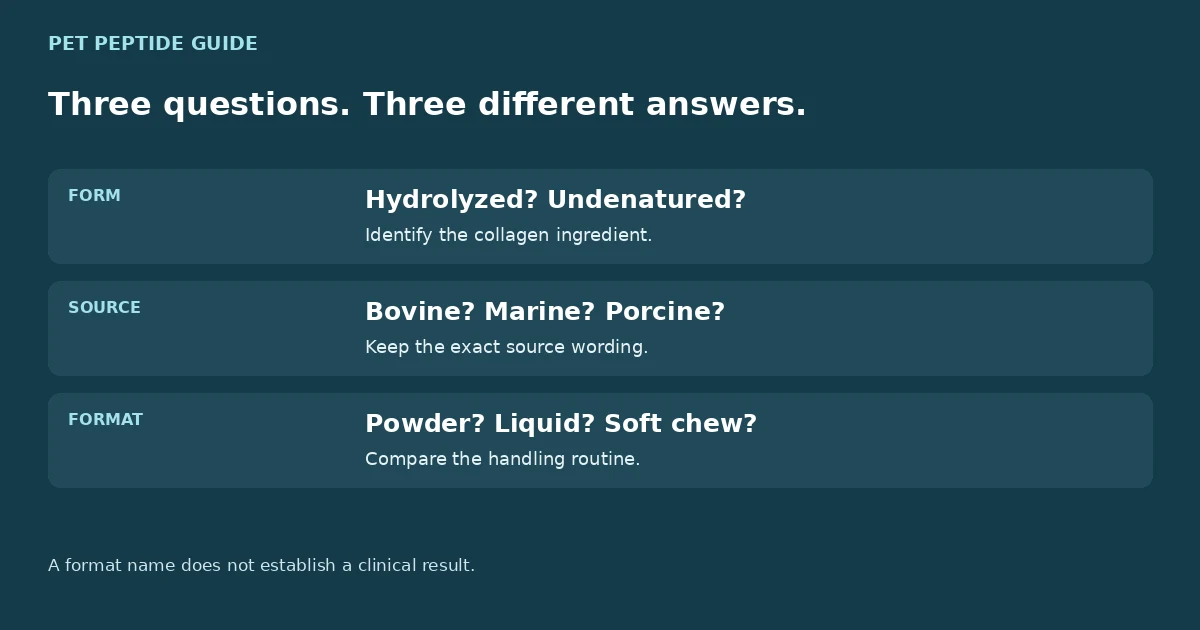
A related source term, such as bovine, porcine, marine, or chicken, identifies an origin rather than a benefit ranking. If source matters for a dog's existing diet or known sensitivities, write the exact wording in your notes. “Natural flavor” is not a complete answer to a source question. The manufacturer's complete information may be needed before a veterinarian can evaluate compatibility.
Do not confuse a nutritional soft chew with a long-lasting collagen chew sold for chewing activity. Package counts, ingredient composition, intended use, and instructions can differ. This guide concerns oral supplement shopping. It does not compare dental chews, prescribe a supplement schedule, or cover injectable collagen preparations. Our separate collagen-label guide walks through the individual panel fields in more detail.
Two real products: what the listings do and do not tell us
| Question | Special Breed Premium 5X Collagen powder | NaturVet Muscle Targeted Care Soft Chews |
|---|---|---|
| Package and price | 4.28-ounce jar; $23.95 at Chewy. | 60-count package; $24.97 on NaturVet's site. |
| Collagen information | Listing names bovine, marine, eggshell-membrane, and chicken collagen. | Panel lists porcine collagen peptides: 150 mg per two soft chews. |
| Other ingredients? | Yes, including vitamin C and bamboo extract. | Yes, a multi-ingredient formula including myHMB, creatine, and other actives. |
| Important unresolved detail | Retrieved text does not clearly establish hydrolysis, scoop mass, or the basis of its ingredient amounts. Daily cost stays uncalculated. | Collagen quantity describes one ingredient, not the entire blend's effect. |
| Read the original | Check powder listing | Check chew label |
These are non-affiliate links to the exact listings reviewed. Confirm the current label, stock, price, and purchase terms with the seller. We have not verified that either finished product matches the formulation in the clinical study discussed below.
The table deliberately leaves an unanswered question visible. It would be easy to convert a jar's net weight into grams and divide by an assumed scoop size. That would give a precise-looking answer built on an unverified denominator. If the mass per scoop or total number of label servings is unclear, the correct shopping result is “ask for the missing information,” not an invented daily price.
There is also a difference between a transparent ingredient amount and a demonstrated benefit. A label can be easy to read while leaving clinical questions unanswered. Conversely, a paper can describe an interesting ingredient without documenting what is inside a retail jar. Our comparison treats label transparency, research applicability, convenience, and cost as separate dimensions so one attractive feature does not hide a gap elsewhere.
Use the listings as two worked examples of how a shortlist should look. They are not the two best products in the market, and the table is not a survey of every available option. We selected them because the exact product pages allowed a concrete powder-versus-soft-chew comparison. Your own shortlist might include a different product after your veterinarian has reviewed its full information.
If either product changes formulation, update your notes instead of carrying the old comparison forward. The product name may remain familiar while the ingredient panel, container size, or serving unit changes. A dated screenshot of the label and a receipt are more useful for your personal records than a copied marketing headline.
What does the canine research actually show?
A 2024 controlled, blinded study reported results from 31 dogs with naturally occurring osteoarthritis over 12 weeks. It compared a specific oral bioactive collagen-peptide preparation with an omega-3/vitamin E comparator and a cellulose placebo. The authors reported improvement in several gait measurements and owner-assessed quality of life in the collagen group; total activity measured by accelerometers did not improve. The study disclosed GELITA funding and relevant author commercial interests. Read the original methods, results, and disclosures.
That is canine evidence worth examining. It does not establish that any collagen powder, chew, or multi-ingredient retail product will give the same result. It also does not answer a general claim about skin, gut health, dental outcomes, or prevention in healthy dogs. Those would require evidence matching the specific question. We have not established a formulation match between the two listings above and this study.
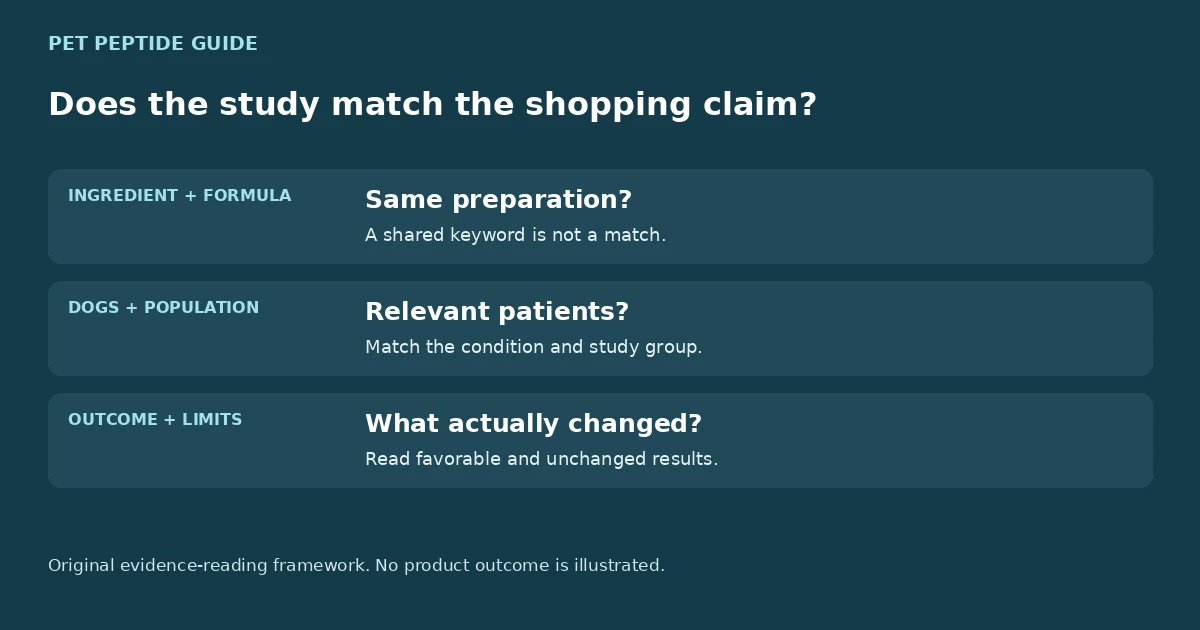
When reading any claim, separate three levels. The first is a possible mechanism, such as how an ingredient might interact with tissue in a laboratory system. The second is an observed result in a study population. The third is a claim that a particular retail product will help your own dog. Moving from one level to the next requires additional information. A product page can cite a paper correctly yet leave that bridge incomplete.
For a practical reading exercise, open the paper and write one sentence under each heading: “Who was studied?”, “What exactly was given?”, “What was compared?”, and “What changed?” Add “What did not change?” as a fifth heading. This last question is especially useful because a promotional summary often concentrates on the favorable result. It helps keep a mixed result from becoming a blanket benefit claim.
Then ask whether the outcome is important to your decision. An ingredient entering the bloodstream, a laboratory marker changing, an owner's observation, and a measured gait difference are different endpoints. Each can have a role in research, but they are not interchangeable answers. Our evidence-reading guide offers a broader framework, and the veterinary-visit checklist helps turn these uncertainties into questions.
Powder versus soft chew: compare the daily routine
| Shopping consideration | Powder question | Soft-chew question |
|---|---|---|
| Measuring | Is the supplied measure clearly defined, including mass if needed? | Does the label use individual chews or a multi-chew serving? |
| Feeding | Can you tell whether the portion containing it was finished? | Can you reliably record how many were given? |
| Shared care | Does everyone use the same labeled measure? | Does a shared record prevent assumptions about who already gave it? |
| Ingredients | Is it single ingredient or a blend? | What else is present besides the featured ingredient? |
| Budget | How many confirmed units are in the jar? | How many confirmed units are in the package? |
Think about the least convenient day in your week. A routine that feels easy on a quiet weekend may be awkward when a pet sitter is helping, you are traveling, or two people are feeding the dog. Write down the actual steps rather than relying on the format's reputation. “Measure using the supplied scoop and record it” is a more useful description than “powder is easy.”
Likewise, do not assume a dog will accept a product because another dog's review says it tastes good. We did not run a palatability test. If you are comparing purchase terms, ask whether a small package or an applicable return policy reduces the cost of finding out. Read the seller's current conditions directly; a statement on this guide cannot substitute for the terms at checkout.
For multiple dogs, keep the confirmed instructions and actual cost calculation separate for each animal. Do not scale from one dog to another by weight or reuse another dog's schedule simply because the package is shared. The household budget can add the separately confirmed costs afterward. Our calculator is intentionally unable to generate a schedule from breed, age, size, or symptoms.
Record the whole formula in your comparison, including ingredients that appear familiar from other supplements already in use. The right question is whether the combined plan makes sense for that dog. Adding up the number of “support” claims across different packages cannot answer that. Bring the complete list to the professional responsible for the dog's care.
The daily-cost calculation that bottle prices miss
Two packages can have almost identical checkout prices and very different running costs. The missing information is how long each container lasts under its own confirmed schedule. First choose a consistent unit for each product. That might be labeled servings, individual chews, or grams. The container quantity and the amount used per day must use that same unit within a product.
Days per container = usable units in the container ÷ confirmed units per day. Then divide the container's allocated total cost by those days. Include shipping and tax if you want a landed-cost comparison. If you exclude them, mark that choice clearly. Product A can be measured in chews and Product B in grams as long as each product's own two quantity fields agree.
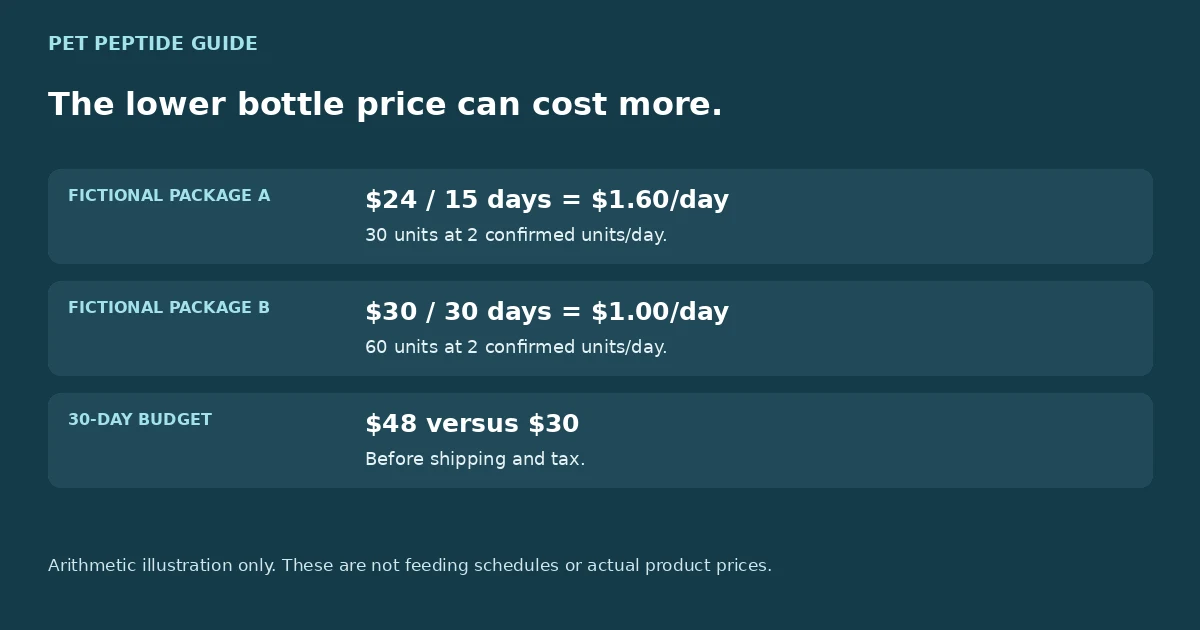
Here is the example in full. Fictional Package A costs $24 and contains 30 units. With an already confirmed example schedule of two units per day, it lasts 15 days and costs $1.60 per day. Fictional Package B costs $30 and contains 60 units. At its separately confirmed example schedule of two units per day, it lasts 30 days and costs $1.00 per day. Over 30 days, the arithmetic totals are $48 and $30 before delivery charges and tax.
This is a budget comparison, not a comparison of ingredient potency or benefit. Equal daily costs do not mean equal collagen amounts. Equal collagen amounts do not establish equivalent formulations or results. Keep the cost answer beside the ingredient and evidence answers rather than turning it into a universal “best value” score.
Compare two confirmed schedules
All fields start blank. Use the current label and a professionally confirmed schedule; this tool does not recommend one. Enter zero for excluded shipping or tax. Entries stay in this page and are not saved or sent to analytics.
How to compare subscriptions, delivery charges, and waste
Write down the first-order price and the ordinary refill price in separate places. A promotion can make the first delivery attractive without establishing the long-term cost. For a monthly budget, the refill terms are usually the more useful starting point. If a discount depends on a minimum order, a subscription, or customer eligibility, record the condition rather than treating the discounted number as universally available.
For shipping, decide whether you are analyzing this product alone or a basket you would buy anyway. If buying the supplement creates an extra delivery charge, allocating that charge to the supplement can be sensible. If it shares an order with several items, document a consistent allocation method. Neither approach is inherently the only correct method; the important point is to apply the same budgeting question to both candidates.
Do not add extra items simply to make a shipping threshold look like a saving. Compare the total spending you would actually incur. A $6 shipping charge and $20 of unneeded products are different costs, even if the second option is described as free delivery. The useful number is your planned basket total, not the word “free” on one line of checkout.
Container life can also differ from useful life. Check the product's storage and after-opening instructions before assuming that every gram or chew will be used. If there is a verified limit that would cause waste under the confirmed schedule, the ordinary daily-cost calculation understates the effective cost. Do not invent a shelf-life value when the manufacturer has not supplied one.
For a transparent waste scenario, use fictional numbers rather than an unsupported allegation about a brand. Imagine a $30 container with 60 units, but only 45 units can actually be used under a documented limit. Dividing $30 by 45 gives about $0.67 per usable unit, instead of $0.50 per packaged unit. This illustrates why usable quantity belongs in a careful comparison; it does not say that any named product here has that limitation.
If instructions change over time, calculate each confirmed phase separately. Do not enter an average schedule guessed from the front label. You can use our separate supplement-cost guide for the broader framework, then return to the calculator once the required numbers are clear.
Watch: the cheaper bottle can cost more
Original 64-second captioned explainer. No audio. Watch with the full transcript.
Read the short transcript
A cheaper bottle can cost more per day. First, identify the collagen form and full formula. Next, confirm the unit on each label. Divide usable container units by the separately confirmed units per day. In our fictional example, a $24 package lasting 15 days costs $1.60 per day, while a $30 package lasting 30 days costs $1.00. Include delivery and tax consistently. Cost does not establish equivalent benefit. Use the comparison tool and take unresolved product questions to your veterinarian.
Five questions that improve a manufacturer's answer
A broad question such as “Is this good collagen?” is likely to receive a broad answer. A precise question produces information you can place in a table. Use the following prompts when a label or product page leaves a gap. They are designed to request facts without assuming that a manufacturer has already established a clinical result.
- Identity: “What is the complete name of the collagen ingredient, its source, and its processing form? Is it hydrolyzed or undenatured?”
- Quantity: “What amount of that ingredient is present per clearly defined unit? Please state whether the panel refers to one scoop, several chews, or another measure.”
- Finished formula: “Can you provide the complete current active and other ingredient lists for this exact size and SKU?”
- Evidence match: “Does the cited canine study examine this finished product, the same named ingredient, or a different formulation? Please link the original paper.”
- Quality scope: “What testing documentation is available for the current product or lot, what did it measure, and which organization performed it?”
Save the response together with the exact product name, package size, and date. If an answer describes a different version, ask for the version you would actually buy. An ingredient supplier's general brochure may be useful background, but it does not necessarily resolve a question about a finished chew, its other ingredients, or the current lot.
A certificate or test report also needs context. Ask what sample it represents, which measurements were performed, and what the results can establish. A measurement of ingredient identity is not a clinical trial. A contaminant panel is not a guarantee that a product is appropriate for every dog. Our manufacturer-question guide gives you a reusable list for these conversations.
Build a shortlist without turning uncertainty into a score
Make three columns headed “confirmed,” “unanswered,” and “not relevant to my decision.” A confirmed fact might be the container count. An unanswered question might be the mass in the supplied scoop. Something not relevant might be a marketing reference to a condition your dog does not have. This structure is more informative than assigning arbitrary stars or points.
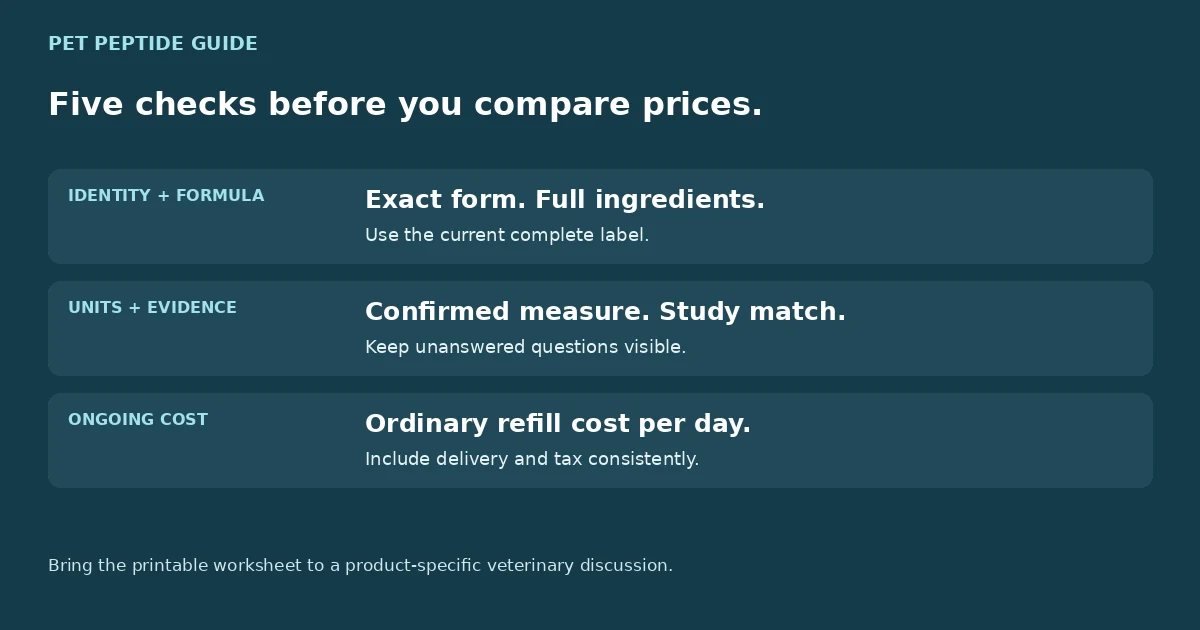
Use a pass-through order. First, can the exact product be identified? Second, is the formula understandable enough for a suitability discussion? Third, does the evidence being presented match the question? Fourth, can the confirmed routine be followed? Finally, what is the ongoing cost? A low price should not make an unresolved ingredient question disappear.
Keep reasons for exclusion factual. “The current scoop mass was not available in the text I reviewed” is specific and revisable. “This company is bad” is a much broader conclusion that the missing field does not support. When the manufacturer supplies the information, you can update the row without rewriting the whole decision.
Consider deciding on a budget ceiling before reading promotional offers. The ceiling does not establish medical suitability, but it gives you a consistent way to compare affordable options once suitability has been addressed. If the ongoing cost exceeds that ceiling, bring the practical constraint into the veterinary discussion rather than silently changing a confirmed schedule to make the container last longer.
At this point your shortlist may contain one product, several products, or none. All three are legitimate outcomes of a useful buying guide. A completed purchase is not the only sign that the comparison helped. Avoiding an unclear choice, discovering the missing question, or agreeing that another care priority comes first can be the more valuable result.
A printable collagen-shopping worksheet
Bring this page to your comparison
Print this blank worksheet and complete it privately. No health information is collected here.
Exact product, size, and date checked: ____________________________________
Collagen form and animal source: ________________________________________
Other ingredients or unresolved formula questions: __________________________
Confirmed container units and units per day: _______________________________
Item cost, delivery, tax, and refill terms: __________________________________
Relevant study and whether the formula matches: ___________________________
Question for the veterinarian or manufacturer: ______________________________
Agreed next step and review date: ________________________________________
Your browser's print dialog can save it as a PDF. A print request does not mean a file was saved.
The worksheet is intentionally short enough to use while looking at a product page. Start with the two columns you can fill from the current label, then flag what needs confirmation. Do not fill a blank just because a similar product uses the same phrase. A missing answer is useful information about the next step.
For a visit, bring the original label photographs as well as the worksheet. The summary helps organize the conversation, while the full label preserves information that may not fit on one line. Use our broader pet supplement checklist if you also need to organize current foods, medications, and the concern that prompted the search.
Watch: one small unit can change the comparison
Original 32-second captioned explainer. No audio. Open the video and complete transcript.
Read the short transcript
One chew is not always one labeled serving. A scoop is not a gram unless the label defines it that way. Match the container quantity and daily quantity within each product. If the measure is unclear, ask for it rather than guessing. The daily-cost tool compares confirmed numbers; it cannot decide what a dog should receive.
Frequently asked questions about collagen peptides for dogs
What is the best collagen powder for dogs?
We have not established a universal best product. A useful shortlist requires the exact collagen form, complete formula, clear units, relevant evidence, and suitability for the individual dog. This guide compares verifiable listing details and open questions; it does not invent a clinical ranking. Start with the product table, then use the worksheet to collect information for your veterinarian.
Are collagen powders better than collagen chews?
Format alone does not establish effectiveness. A powder and a chew can differ in the collagen ingredient, amount, other ingredients, and the evidence being cited. Compare those fields before convenience and cost. If the clinical suitability is already settled, the practical question is which confirmed routine is easier to follow and budget for in your household.
Is hydrolyzed collagen the same as undenatured type II collagen?
No. They describe different forms and should not be treated as interchangeable study evidence. Keep the exact ingredient name in your comparison notes. A paper about an undenatured type II combination does not establish a result for a hydrolyzed powder, even if both product pages use the word collagen.
Can I calculate a serving from my dog's weight here?
No. The tools on this site do not select a supplement or generate a feeding schedule. Enter only quantities already confirmed for the exact product and dog. If the schedule is not known, the next step is a product-specific professional question. A guessed schedule makes the daily-cost output look more certain than its inputs.
Can I use a human collagen product for a dog?
A familiar ingredient name is not enough to assess a complete human formulation for an individual dog. Bring the whole label, including flavorings and other ingredients, to your veterinarian. Do not substitute a human scoop or schedule for the instructions of a dog product. This guide does not approve human products for pet use.
How long does a collagen supplement take to work?
There is no verified universal timetable for all products and all goals. A study's duration describes that research protocol, not a promised response time for a different retail product. Agree on the relevant goal, what to observe, and when to reassess with your veterinarian. Do not interpret a time-limited promotion as a clinical timeline.
Does the product with more collagen types give better results?
A longer type list does not establish a stronger outcome. The comparison still needs the form, amount, formulation, and evidence relevant to the claim. Counting advertised types is a description exercise, not a validated way to rank products. Ask which original study supports the outcome being advertised for the finished formula.
Is cost per gram the fairest way to compare?
It can answer a narrowly defined price question when the relevant gram amount is known and genuinely comparable. It cannot establish equivalent benefit across different collagen forms or blends. Daily cost is useful for budgeting a confirmed routine. Keep both figures in context and leave calculations unfilled when the necessary ingredient or serving information is missing.
Why not use customer star ratings to pick a winner?
Customer reports can describe experiences, but they do not replace a controlled comparison or verify which ingredient caused an observed change. We have not collected original product-testing data and do not assign stars. This guide focuses on facts a reader can check, the applicability of the original research, and the cost of an already confirmed plan.
Can the same comparison be used for a cat?
The arithmetic formula is generic, but a dog's product, schedule, or research result is not automatically applicable to a cat. Keep species-specific questions separate. This page is a dog-focused buying framework; it does not recommend transferring any product or schedule to another species.
Do you earn money if I click a product link?
There are no active affiliate links in this comparison. The links lead to the listings used as sources, and we currently receive no commission. If an approved commercial relationship is added later, the relevant links and nearby disclosure will change. Our disclosure page explains the current status.
What should I do if a key label detail is missing?
Keep that field marked unanswered and request the information for the exact product size and version. Do not borrow a scoop mass or ingredient amount from a different listing. You can still compare the known facts while waiting, but a daily-cost calculation needs its own complete set of inputs.
Your next step: compare one real decision
Choose two exact products already under consideration, not two vague ingredient categories. Gather the current labels, identify the relevant unknowns, and confirm the intended schedule with your veterinarian before using the cost tool. Compare the ongoing total rather than the first discounted delivery. Keep the calculation alongside the source and formulation checks so a low number never stands in for evidence.
Once the information is complete, save the worksheet with a date and the reason for the choice. That record makes it easier to review a refill, notice a changed formula, or have a focused follow-up conversation. It also keeps the process manageable: one clearly defined decision, a short list of reliable facts, and an explicit next action.
Sources and scope
This is an introductory guide or original comparison framework, not a systematic review or a product recommendation.
- Chewy: Special Breed Premium 5X Collagen powder, 4.28 oz — Retail label fields and one-time price. Hydrolysis and serving basis were not established from retrieved text.
- NaturVet: Muscle Targeted Care Soft Chews, 60 count — Manufacturer ingredient panel and one-time price; not clinical evidence.
- Dobenecker et al. (2024), PLOS ONE, e0308378 — Original canine collagen-peptide study. No match to the retail products has been established.
- Stabile et al. (2024), original combination trial record — Undenatured type II collagen plus Boswellia formulation; distinct from hydrolyzed collagen peptides.
Source checked September 13, 2026. A general context source does not establish a named product’s benefit.