
Collagen Peptides for Cats: What Has Actually Been Studied?
Do collagen peptides help cats? Compare the 2026 undenatured type II collagen trial with the 2024 hydrolyzed-collagen diet study and learn how to check a product label.
What do studies say about collagen peptides for cats? Cat-specific research is promising but narrow, and the tested products are not interchangeable. A 2026 trial studied an undenatured type II collagen chew in cats with degenerative joint disease. A separate 2024 trial studied a complete diet that combined hydrolyzed collagen with EPA, DHA, and turmeric extract. Neither study proves that a generic collagen-peptide powder, a dog product, or every cat supplement will help.
Use the exact collagen form
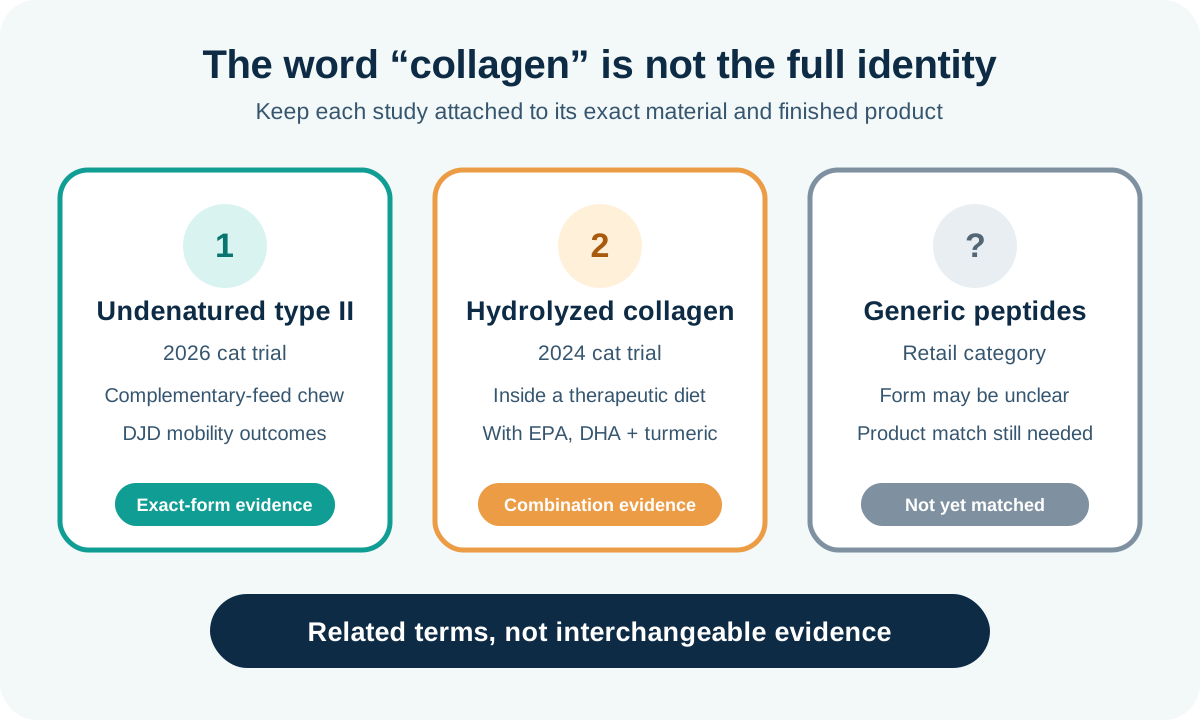
The useful question is not whether “collagen” works as one category. It is whether the exact form, finished product, cat population, and outcome behind a claim match the product you are considering.
“Collagen peptides” can point to different materials
Collagen peptides usually means collagen that has been hydrolyzed into smaller fragments. Undenatured type II collagen is a different material with a different processing description and research rationale. A product can also contain collagen inside a blend or finished diet with other active ingredients. Those are three different evidence questions.
| Label or study term | What it identifies | What it does not establish |
|---|---|---|
| Undenatured type II collagen | A specific collagen form that was tested in the 2026 cat crossover study as a complementary-feed chew | A result for hydrolyzed powder, a mixed diet, or every product using “type II” wording |
| Hydrolyzed collagen | Collagen broken into smaller components; included in the 2024 therapeutic diet | That collagen caused the diet's result separately from EPA, DHA, and turmeric extract |
| Collagen peptides | A common commercial description for hydrolyzed collagen fragments | The animal source, collagen type, amount, finished formula, cat evidence, or suitability |
| Powder, chew, or diet | The delivery format or finished-product category | Equivalent ingredients, exposure, quality, or clinical effect |
A front label can therefore be technically related to a paper while still failing the practical match. “Contains collagen” does not show that the product used the same collagen form, included the same accompanying ingredients, or was the same finished product. Start with the complete current label, not the largest benefit claim.
What the two cat studies actually tested
The current cat-specific evidence is more useful than borrowing a dog or human headline, but it still needs careful boundaries. The following comparison keeps the species, formulation, design, duration, outcomes, and main limitation together.
| Study | Cats and design | Exact intervention | Reported findings | Why the finding stays narrow |
|---|---|---|---|---|
| Piemontese and colleagues, 2026 | Twenty client-owned cats with mild to moderate degenerative joint disease entered a prospective, double-blind, randomized, placebo-controlled crossover study. Fourteen completed all visits. | Undenatured type II collagen or placebo chews for 12 weeks, a six-week washout, then the alternate treatment | The abstract reports improved caregiver-scored mobility, musculoskeletal discomfort, and quality of life during collagen treatment. After 12 weeks, 57% met the study's client-specific meaningful-response threshold versus 28% on placebo. | Small completion group, attrition, caregiver-reported primary measures, one exact collagen form, and a complementary-feed chew. One author affiliation is Vetoquinol Global. The accessible publisher record did not expose a full funding statement. |
| Lefort-Holguin and colleagues, 2024 | Thirty cats with naturally occurring osteoarthritis were randomized between two diets, 15 per group, in a blinded, placebo- and time-controlled study. The treatment period was 13 weeks followed by a four-week recovery period. | A balanced therapeutic diet containing a marine-oil mix providing EPA and DHA, turmeric extract, and hydrolyzed collagen, compared with a control diet | The abstract reports improvements in peak vertical force, stair performance, nighttime activity, and a veterinarian instrument, with no observed side effects in the study. | The diet contained several active components, so the study cannot assign the result to hydrolyzed collagen alone. The cats came from a laboratory colony rather than client homes. Royal Canin funded the study, supplied the diets, and employed two authors. |
The 2026 paper was first published online September 23, 2026, so it is very recent evidence rather than a settled literature base. The abstract began with 20 cats and reports 14 completing all visits. That does not erase the reported signal, but the completion count matters when judging precision, generalizability, and how much confidence to place in percentages.
The 2024 diet study gives a different kind of answer. It used four clinical or functional outcome approaches and reported improvement for the finished diet. Because EPA, DHA, turmeric extract, and hydrolyzed collagen changed together, the design cannot tell a shopper whether a stand-alone collagen-peptide powder would reproduce the result. Calling it “a collagen study” without naming the full diet would overstate what was isolated.
Funding and affiliations do not automatically invalidate a result. They are part of the evidence record, along with randomization, blinding, comparator choice, withdrawals, outcome selection, and whether the finished product matches the reader's question. A useful summary reports all of those features instead of treating disclosure as either proof of bias or something to omit.
What has not been established
- No universal cat result: the studies do not establish a benefit for every age, diagnosis, collagen form, product, or duration.
- No stand-alone hydrolyzed-collagen answer: the 2024 trial changed several diet components together.
- No dog-to-cat transfer: a canine collagen trial cannot supply a feline outcome, schedule, or safety conclusion.
- No prevention claim: both studies concerned cats with diagnosed joint disease, not prevention in healthy cats.
- No skin, coat, gut, kidney, or wound conclusion: the cited cat trials measured osteoarthritis or degenerative-joint-disease outcomes. They did not establish those other uses.
- No retail-category ranking: the studies do not identify the best generic powder, chew, or brand on the market.
This boundary is especially important for searches about collagen for cats' joints. A joint-related outcome in a cat trial is relevant, but it does not turn a nutritional product into a replacement for a diagnosis or a complete osteoarthritis plan. Mobility changes can have several causes, and cats often conceal pain. A veterinarian can connect an observed change with examination, diagnosis, current medicines, nutrition, body condition, and home modifications.
A six-field label check before buying
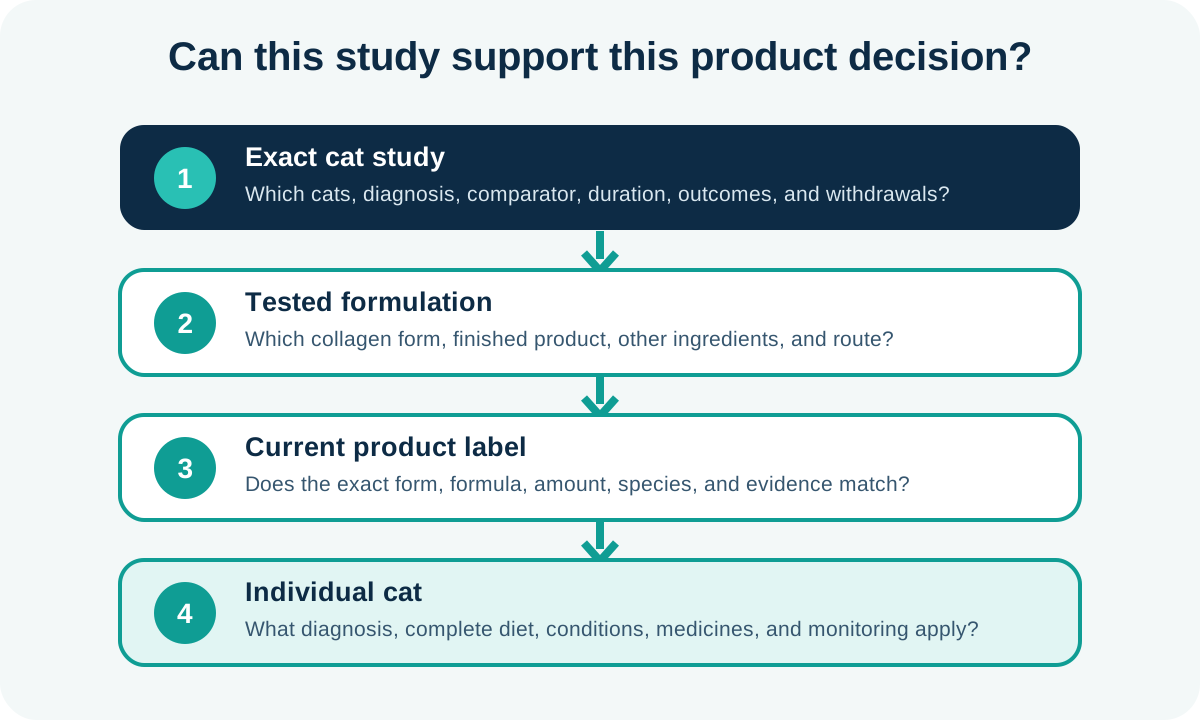
A product page should first let you identify what is actually being sold. Use the following six fields as a pass-or-question screen. A blank field is not a reason to guess from a similar product.
- Intended species and use: Does the current label identify cats, and is the product a complete food, food supplement, treat, or another category?
- Exact collagen form: Does it say hydrolyzed collagen, collagen peptides, undenatured type II collagen, or only “collagen”?
- Source and full formula: Is the animal source identified, and are all other ingredients visible rather than hidden behind a partial marketing panel?
- Amount and unit: Is the named collagen amount stated per defined scoop, chew, packet, or serving, or is only a total blend amount shown?
- Finished-product evidence: Was this exact product studied, the same supplied ingredient tested in another formula, or merely a different collagen material?
- Manufacturer and lot context: Can you identify the responsible company, current label version, lot, storage directions, and a contact for unanswered questions?
The FDA's current animal-food labeling page says animal-food labels should describe the product and provide details necessary for safe and effective use. It also explains that disease-treatment or prevention claims can indicate intended use as a new animal drug. FDA further notes that the human Dietary Supplement Health and Education Act does not apply to animal food. In practical terms, do not assume the familiar human “dietary supplement” category or a human-style panel has the same legal meaning for a cat product.
Our separate pet collagen label guide shows how to separate package quantity, serving size, blend total, and named collagen amount. Use it when a large front-label number does not clearly match the ingredient panel. The manufacturer-question guide helps you ask what a test report actually measured.
Can a dog collagen product be used for a cat?
A dog label is not a cat label. Species wording, flavoring, other ingredients, format, instructions, and the evidence cited can differ even when both packages feature collagen. Do not transfer a dog serving, divide a dog chew, or scale a canine schedule from body weight. This page provides no feeding amount.
The existing dog collagen buying guide compares dog listings and canine evidence for a separate reader question. Its shopping arithmetic can illustrate how denominators work, but its products and research do not become feline evidence. For a cat, start over with the exact feline product and the cat's veterinary and nutritional context.
What about a cat with kidney disease or another condition?
The 2024 diet study included four cats with stable IRIS stage 1 chronic kidney disease, two in each group. One control-group cat was later withdrawn after becoming stage 2. Those details do not establish that a generic collagen product is appropriate for a cat with kidney disease, and they do not answer a kidney-disease treatment question. The intervention was a complete studied diet with a defined research protocol, not an extra powder added to an unrelated diet.
For a cat with kidney disease, pancreatitis, inflammatory bowel disease, food allergy, diabetes, weight change, or multiple medicines, bring the entire label to the veterinarian managing that condition. The relevant review includes the purpose of the product, all ingredients, calories, mineral and nutrient context, palatability, the cat's complete diet, current laboratory findings, and what will be monitored. A collagen headline cannot replace that review.
How to track a veterinary decision without inventing a result
If a veterinarian agrees that a particular product belongs in the plan, define the observation before starting. For a joint question, that might involve the cat's willingness to use specific stairs, reach a favorite surface, enter the litter box, groom, or tolerate handling. Choose behaviors that already matter to the individual cat and record them consistently.
Do not turn an ordinary good day or bad day into proof. Note other changes, including pain medicine, weight, activity opportunities, flooring, ramps, food intake, or household routine. Agree on a reassessment point and what would prompt earlier contact. Keep the package and lot information. This is tracking a professional plan, not running an uncontrolled experiment to validate a marketing claim.
Questions to bring to the veterinary visit
- What diagnosis or functional change are we trying to address?
- Is this exact product a complete diet, a complementary feed, a treat, or another type of product?
- Does the label identify hydrolyzed collagen, undenatured type II collagen, or another form?
- Does the cited paper test this finished product, the same ingredient in another formula, or a different collagen material?
- What other active ingredients, nutrients, flavors, and excipients need review for this cat?
- How should current disease, medicines, body condition, and complete diet change the decision?
- What outcome will we track, when will we reassess it, and what signs should prompt a stop or earlier call?
Open the free veterinary-visit checklist
Frequently asked questions
Are collagen peptides safe for cats?
The current studies reported no observed side effects for the tested 2024 therapeutic diet, while the accessible 2026 abstract focused on mobility outcomes. Those findings do not establish universal safety for every collagen form, formula, duration, or cat. Safety remains product-specific and cat-specific, including the complete ingredient list and concurrent conditions. Review the exact label with a veterinarian.
Do collagen peptides help cats with arthritis?
Two cat studies reported favorable joint-related outcomes, but they tested different finished products. The 2026 trial tested undenatured type II collagen chews. The 2024 trial tested a diet containing hydrolyzed collagen plus EPA, DHA, and turmeric extract. The latter cannot isolate collagen's contribution. These studies are relevant but do not support a class-wide promise.
Is undenatured type II collagen the same as hydrolyzed collagen?
No. They are different material descriptions and should remain separate when matching a product to research. A result for undenatured type II collagen does not establish the same result for a hydrolyzed powder, and a multi-ingredient hydrolyzed-collagen diet does not establish a stand-alone powder result.
Can I give my cat a human collagen powder?
This guide does not approve human products for cats. A familiar collagen name does not resolve the animal source, flavorings, sweeteners, other ingredients, intended use, amount, quality documentation, or fit with the cat's complete diet and health. Bring the entire product label to the veterinarian before considering it.
What is the best collagen supplement for cats?
The evidence does not support a universal best-product ranking. A useful shortlist starts with a cat-labeled product, exact collagen form, full formula, clear amount and unit, relevant finished-product evidence, manufacturer identity, and veterinary fit. This page does not rank sellers or direct readers to research-chemical products.
Does a higher collagen amount mean a better product?
No. A larger number can describe the package, a scoop, a blend, or a named ingredient. Even a clear named amount does not establish equivalent form, quality, evidence, or suitability. Keep amount, formulation, study match, and individual-cat context in separate columns.
Can collagen treat kidney disease, IBD, wounds, or skin problems in cats?
The cat trials reviewed here studied joint-disease outcomes. They do not establish treatment for kidney disease, inflammatory bowel disease, wounds, skin problems, or other conditions. A search result or product claim should be matched to a direct cat study before it is treated as evidence for a different outcome.
Do you earn a commission from products on this page?
No. This page contains no affiliate product links and makes no seller recommendation. If an approved commercial relationship is added in the future, the relevant link and nearby disclosure will identify it.
The bottom line
There is now direct cat research involving collagen, but the useful conclusion is formulation-specific. A recent crossover trial studied undenatured type II collagen chews in cats with mild to moderate degenerative joint disease. A separate study tested a therapeutic diet containing hydrolyzed collagen together with omega-3 fatty acids and turmeric. Neither result can be assigned to every product sold as collagen peptides for cats.
Before comparing prices or package sizes, write down the exact collagen form, finished formula, intended species, amount and unit, study match, and unanswered label fields. Then bring the whole product and the cat's health context to the veterinarian. That process gives the evidence its proper value without turning a promising study into a generic promise.
Sources and scope
This is an introductory guide or original comparison framework, not a systematic review or a product recommendation.
- Piemontese et al. (2026): undenatured type II collagen crossover trial in cats — Twenty client-owned cats with mild to moderate DJD entered a randomized, double-blind, placebo-controlled crossover study; 14 completed all visits. The study tested one complementary-feed chew and undenatured type II collagen, not generic hydrolyzed collagen peptides.
- Lefort-Holguin et al. (2024): multi-ingredient therapeutic diet in cats with osteoarthritis — Thirty cats were randomized between diets. The experimental diet contained EPA, DHA, turmeric extract, and hydrolyzed collagen, so the result cannot be attributed to collagen alone.
- RCVS Knowledge summary of the 2024 therapeutic-diet study — Secondary evidence-appraisal context for group sizes, colony setting, withdrawals, CKD inclusion details, funding, and the inability to isolate one active ingredient.
- FDA: Animal Food Labeling and Pet Food Claims — Current official context for animal-food labeling, common or usual ingredient names, disease-related claims, and veterinarian referral.
- FDA: Animal Foods & Feeds — Official regulatory context, including FDA's assessment that the human Dietary Supplement Health and Education Act does not apply to animal food.
- AAFCO: Supplements — Consumer-oriented animal-food supplement and veterinarian-discussion context; not product-specific proof of safety or benefit.
Source checked October 08, 2026. A general context source does not establish a named product’s benefit.