
GHRP-6 for dogs and cats: evidence and key questions
GHRP-6 explained for pet owners: exact identity, primary evidence, dog and cat relevance, product context, and questions for your veterinarian.
Direct answer: GHRP-6 dog studies demonstrate that a hormonal response must be interpreted in context. They do not establish a general growth, appetite, or recovery regimen for pets.
Why do a dog’s health status and the study route matter?
GHRP-6 is a distinct growth hormone-releasing peptide, not a synonym for GHRP-2 or hexarelin. Oral, nasal, and injected preparations also require separate evidence even when the molecule is named identically.
What the primary source actually establishes
Bhatti and colleagues’ 2002 study compared hormonal responses in healthy dogs and dogs with pituitary-dependent hyperadrenocorticism. The groups differed in their GH response. Earlier dog research also examined intranasal activity. These studies ask physiological and delivery questions, not whether every pet benefits from routine treatment. Read the original source.
Product identity and approval context
Additional primary source: Nelson and colleagues, 1991, intranasal GHRP-6 in conscious dogs. Neither a route experiment nor a hormone-response comparison establishes a veterinary product approval.
How to use this evidence in a veterinary discussion
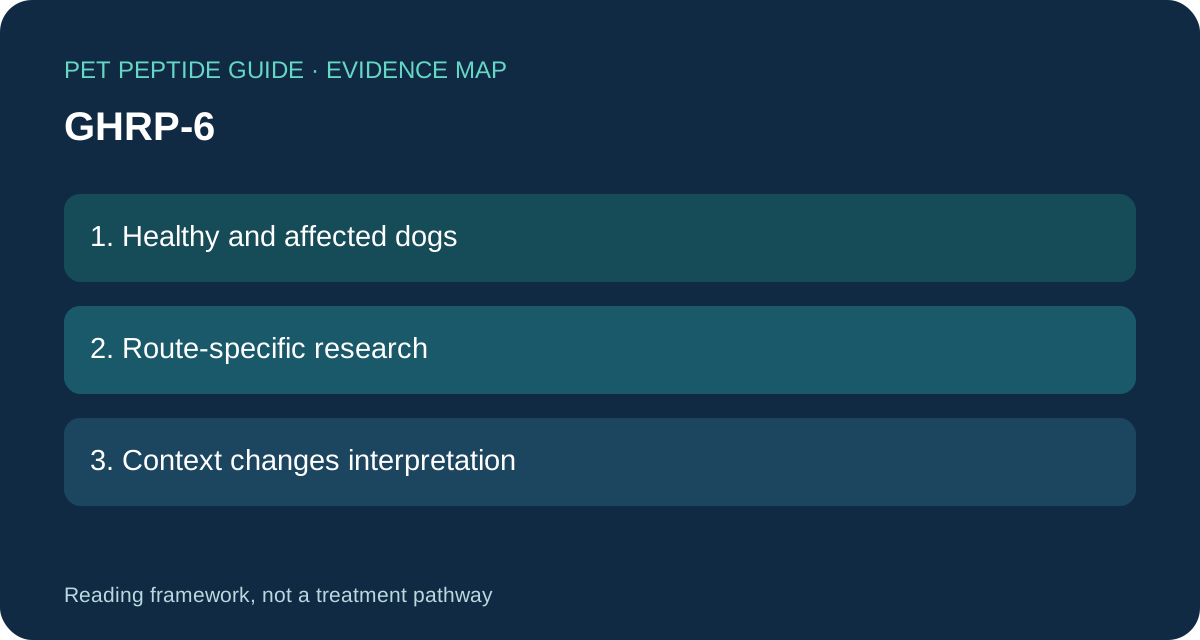
When reading a “studied in dogs” claim, ask whether the animals were healthy or had a specific endocrine condition. Their health status can be central to the research question. Then ask which hormone was measured, over what interval, and whether any clinical benefit was tested. A statement that one marker did not change in one experiment is not a universal safety statement. For delivery comparisons, keep the actual preparation and route attached to the finding; evidence of activity through one route does not validate a retail formulation through another. An owner can use this framework to ask a sharper question without attempting to interpret endocrine testing alone. The relevant next step is a veterinary discussion of the animal’s diagnosis and intended outcome.
Does an unchanged hormone establish that a preparation is safe?
No single unchanged marker establishes an overall safety profile. It answers a narrower measurement question in the studied animals, at the studied times, under the studied conditions. Other outcomes and longer follow-up may remain unaddressed. A useful discussion therefore distinguishes a specific laboratory observation from a broad claim about a product, route, or population.
Questions to take to your appointment
- Did the study population share this animal’s health status?
- Was the outcome a hormone response or clinical benefit?
- Does the proposed preparation match the researched route?
Use the printable product and evidence checklist to record the exact label, the source of a claim, and the unanswered questions. Bring the animal’s current medicines and supplements so a proposed product is not assessed in isolation.
Dogs, cats, routes, and formulations: what remains unresolved?
The source set above is a focused review, not a systematic search of every publication. Evidence from a dog does not automatically answer a cat question, and evidence from a laboratory model does not establish a clinical result in a household pet. Where this review has not verified a relevant preparation, route, or patient outcome, that detail remains unresolved. It should not be filled with instructions from a seller or a human regimen.
Frequently asked questions
Does this guide recommend GHRP-6 for my pet?
No. It explains the evidence question and its limits so you can discuss a specific concern with a veterinarian. A compound’s inclusion in the library is not a product recommendation, and no affiliate offer is attached to this guide.
Can I use a calculator to choose an amount?
The amount-to-volume calculator performs arithmetic using an amount already provided by a veterinarian and a confirmed concentration. It does not select a dose, frequency, route, or product. The concentration calculator likewise uses confirmed final volume; it does not supply mixing instructions.
How should I compare a related compound?
Start with the related evidence guide, then compare exact identity, species, route, and measured outcome. A shared marketing category is not evidence of equivalence. Use the main peptide guide and topic directory to navigate the full collection.
Prepared by Pet Peptide Guide using the sources identified here, checked September 12, 2026. This is AI-assisted editorial research, not veterinary review, product testing, or a clinical protocol. Missing evidence is described as a limit of this review, not proof that no research exists.
Sources and scope
This is an introductory guide or original comparison framework, not a systematic review or a product recommendation.
- GHRP-6: primary research or official product context — Supports the specific source discussion above; does not imply pet suitability.
- GHRP-6: primary research or official product context — Supports the specific source discussion above; does not imply pet suitability.
Source checked September 12, 2026. A general context source does not establish a named product’s benefit.