
Ipamorelin for dogs and cats: evidence and key questions
Ipamorelin explained for pet owners: exact identity, primary evidence, dog and cat relevance, product context, and questions for your veterinarian.
Direct answer: Calling ipamorelin a selective growth hormone secretagogue does not establish that it improves recovery, muscle, or longevity in a dog or cat. Selectivity describes a research question about biological responses; pet benefit needs its own clinical evidence.
Does selective growth-hormone release establish pet benefit?
Ipamorelin is a growth hormone secretagogue investigated as a distinct compound. It is not growth hormone itself, and it should not be treated as another name for CJC-1295 or for every GHRP peptide.
What the primary source actually establishes
Raun and colleagues’ 1998 paper, “Ipamorelin, the first selective growth hormone secretagogue,” is the original research reference identified for this topic. Full methods were not accessible in this review. We therefore do not reproduce species-specific dosing, route details, or blanket claims about an absence of cortisol effects from secondary summaries. Read the original source.
Product identity and approval context
The source-retrieval limit matters: a bibliographic record is enough to identify a paper, but not enough to verify every claim attributed to it. No dog or cat treatment indication, combination protocol, or clinical safety conclusion is established here.
How to use this evidence in a veterinary discussion
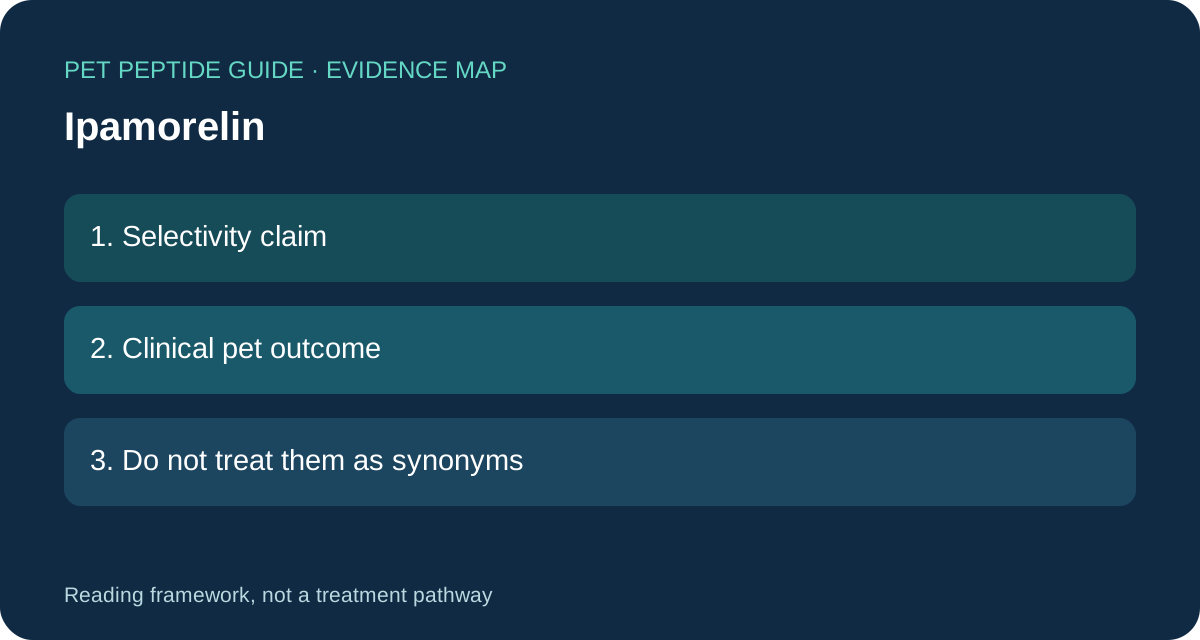
The phrase “selective” is most useful when the comparison is explicit: selective for which measured response, relative to which comparator, under what experimental conditions? Without those details, it can become a vague synonym for safe. Keep hormone measurements separate from outcomes such as comfortable movement, adequate eating, or recovery from a diagnosed illness. A blend with CJC-1295 also needs evidence for the exact components and formulation. Neither a paper on one ingredient nor a favorable account from a human user validates the mixture for a pet. If this is being proposed for an animal, request the original study and ask the clinician to explain which part supports the specific decision. Missing evidence is a reason to clarify the decision, not to fill the gap with a conversion calculator.
What evidence is still needed to complete the selectivity claim?
The next research step is access to the original methods and results, including the comparator, species, administration route, and measured hormones. Those details would allow a bounded account of what selectivity meant in that experiment. Clinical studies would still be needed to answer a separate pet-benefit question. A source can be real while a popular interpretation of its title remains insufficiently checked. This guide makes that distinction explicit rather than presenting an inaccessible paper as fully reviewed.
Questions to take to your appointment
- Can we review the original methods supporting this claim?
- What does selective mean in the cited experiment?
- Was this exact preparation or combination evaluated in the relevant species?
Use the printable product and evidence checklist to record the exact label, the source of a claim, and the unanswered questions. Bring the animal’s current medicines and supplements so a proposed product is not assessed in isolation.
Dogs, cats, routes, and formulations: what remains unresolved?
The source set above is a focused review, not a systematic search of every publication. Evidence from a dog does not automatically answer a cat question, and evidence from a laboratory model does not establish a clinical result in a household pet. Where this review has not verified a relevant preparation, route, or patient outcome, that detail remains unresolved. It should not be filled with instructions from a seller or a human regimen.
Frequently asked questions
Does this guide recommend Ipamorelin for my pet?
No. It explains the evidence question and its limits so you can discuss a specific concern with a veterinarian. A compound’s inclusion in the library is not a product recommendation, and no affiliate offer is attached to this guide.
Can I use a calculator to choose an amount?
The amount-to-volume calculator performs arithmetic using an amount already provided by a veterinarian and a confirmed concentration. It does not select a dose, frequency, route, or product. The concentration calculator likewise uses confirmed final volume; it does not supply mixing instructions.
How should I compare a related compound?
Start with the related evidence guide, then compare exact identity, species, route, and measured outcome. A shared marketing category is not evidence of equivalence. Use the main peptide guide and topic directory to navigate the full collection.
Prepared by Pet Peptide Guide using the sources identified here, checked September 12, 2026. This is AI-assisted editorial research, not veterinary review, product testing, or a clinical protocol. Missing evidence is described as a limit of this review, not proof that no research exists.
Sources and scope
This is an introductory guide or original comparison framework, not a systematic review or a product recommendation.
- Ipamorelin: primary research or official product context — Supports the specific source discussion above; does not imply pet suitability.
Source checked September 12, 2026. A general context source does not establish a named product’s benefit.