
Peptides for Senior Cats: Age, Frailty and the Right Outcome
Do senior cats need peptides? Match age and frailty to a diagnosis, whole-health context, exact product and meaningful feline outcome.
Do senior cats need a peptide? Age alone does not identify a treatment. A cat older than 10 may be healthy, frail, or living with several diagnosed conditions. Start with the change that matters, then match the diagnosis, other diseases and medicines, exact finished product, route, study population, and measured outcome. The feline records below support diagnosis-specific decisions. They do not establish a general anti-aging peptide for senior cats.
A senior label can be useful for planning examinations and watching trends. It is too broad to select a product. Less jumping can reflect osteoarthritis pain, weakness, neurologic disease, vision change, environmental barriers, or several causes together. Weight loss can involve kidney disease, hyperthyroidism, dental pain, gastrointestinal disease, cancer, reduced intake, or loss of muscle. Grooming, sleep, vocalization, and litter-box changes also need their own clinical questions.
That distinction matters when a search result promises “peptides for senior cats.” Some feline products are peptide or polypeptide drugs. Some are much larger therapeutic proteins. Some non-peptide drugs act on receptors for peptide hormones. Experimental fragments begin in a different evidence lane. Molecular category does not replace a diagnosis, and chronological age does not make these products interchangeable.
This is an AI-assisted evidence guide, not veterinary advice or a systematic review. Primary studies, FDA records, and current feline-care guidance were checked October 26, 2026. It contains no dose, administration instructions, product ranking, seller, or research-chemical purchase path. New weakness, pain, weight loss, appetite change, confusion, collapse, breathing difficulty, or other concerning signs need veterinary assessment rather than an assumption of normal aging.
Senior is a life stage, not a diagnosis
The 2021 AAFP Feline Senior Care Guidelines treat cats older than 10 years as senior. The guidance addresses regular assessment, nutrition and weight, pain, chronic disease, behavior, quality of life, and frailty. It also emphasizes that care should be tailored to the individual cat. That is a wider task than choosing an ingredient from an age-related headline.
The 2026 Cat Prospective Ageing and Welfare Study shows why. Researchers followed 209 client-owned cats from middle age for up to seven years and completed 1,241 examinations. During follow-up, 96% developed at least one examination abnormality and 84% developed two or more morbidities. Dental disease, orthopedic abnormalities, and heart murmurs were common. This cohort describes how health problems accumulate. It did not test a peptide or show that one intervention prevents multimorbidity.
Two cats can therefore share a birthday and ask very different questions. One may need routine prevention and observation. Another may have stable osteoarthritis plus kidney disease. A third may be losing weight and muscle while several possible causes are being investigated. The useful starting sentence is “this changed, under these conditions, over this period,” followed by a veterinary examination.
Four layers to keep attached to every claim
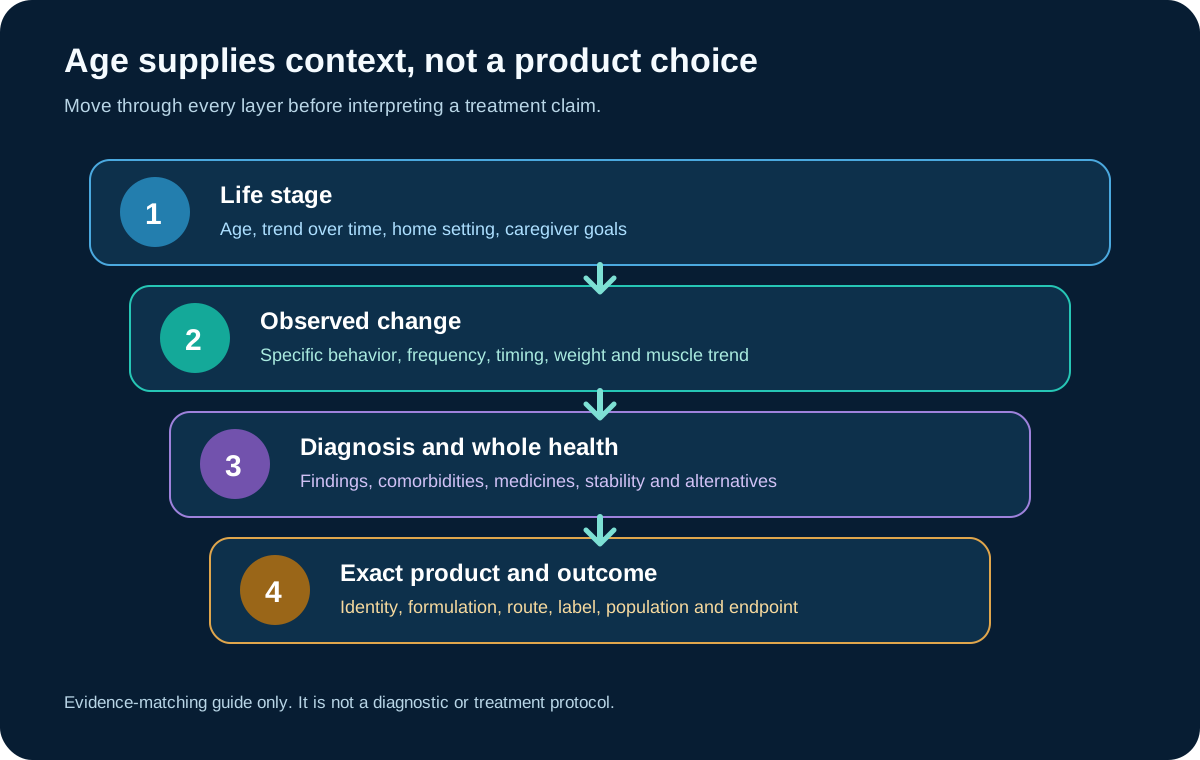
| Layer | What to record | What it prevents |
|---|---|---|
| Life stage | Chronological age, changes over time, home environment, and caregiver goals. | Using “senior” as if it were a single disease. |
| Observed change | Exact behavior or function, timing, frequency, appetite, weight trend, and muscle condition. | Turning “slowing down” into a treatment claim without defining the problem. |
| Diagnosis and whole health | Veterinary findings, other conditions, all medicines and supplements, and relevant laboratory or imaging results. | Importing a result from a stable study population into an unlike or unstable patient. |
| Product and outcome | Exact active ingredient, molecular class, finished product, route, current label, comparable cats, and the endpoint that matters. | Borrowing evidence across proteins, peptides, receptor agonists, fragments, formulations, or outcomes. |
This is an evidence-reading framework, not a prescribing worksheet. If a claim provides only the cat's age and a compound nickname, the missing fields are the main finding.
Frailty is related to age, but it is not the same thing
Frailty describes reduced reserve and vulnerability across several domains. It can include weight or muscle loss, fatigue, activity and mobility changes, grooming, appetite, cognition, and other deficits. It is not a synonym for a birthday, and a frailty score is not proof that a peptide reverses aging.
Colleran and colleagues' 2025 pilot recruited 273 client-owned cats aged 11 to 20 years through feline-focused practices. The available owner questionnaires covered 152 cats, and veterinarian questionnaires covered 171. Owners and veterinarians did not use identical variables or classify exactly the same cats as frail. Among 118 cats with six-month follow-up, veterinarians classified 64 as frail. Thirteen of those 64 died during follow-up, compared with one of 54 cats not classified as frail.
That association supports further study of a brief feline frailty questionnaire. It does not prove the score caused mortality, diagnose one underlying disease, or identify a treatment. The study was non-randomized and designed as a feasibility pilot. A future intervention claim would still need an exact product, a comparison group, a prespecified outcome, sufficient follow-up, and active harm collection.
Frailty can make the veterinary question more specific. It may prompt a closer look at weight and muscle trends, mobility, cognition, nutrition, medications, and caregiver priorities. It should not become a self-service “anti-aging” diagnosis or a marketing endpoint that can be claimed without a trial.
Older cats were included in two product records, but for different problems
FDA's Solensia approval record and Elura approval record both include many older cats. They answer different questions and belong to different molecular categories.
| Record | Cats and problem | Measured outcome | What it does not establish |
|---|---|---|---|
| Feline frailty pilot | Older pet cats, with owner and veterinarian assessments. | Feasibility of questionnaires and association with six-month mortality. | A treatment effect, product choice, or peptide indication. |
| Solensia approval evidence | Cats with diagnosed osteoarthritis pain; broad age range, including many older cats; stable chronic conditions could be included. | Owner-selected activity and pain outcomes, plus field safety observations. | Frailty reversal, cartilage repair, general mobility treatment, or longer life. |
| Elura approval evidence | Cats with chronic kidney disease and documented unintended weight loss; mean age 15 years; several managed comorbidities present. | Body-weight change over the field-study period and safety observations. | Kidney repair, restoration of muscle, treatment of every cause of weight loss, or general anti-aging benefit. |
| Experimental peptide claim | Must identify the exact molecule, formulation, route, feline population, and diagnosis. | Must specify the outcome actually measured in comparable cats. | Cannot borrow approval or benefit from a different product merely because older cats were enrolled. |
Solensia: a therapeutic protein for osteoarthritis pain
Frunevetmab is a felinized monoclonal antibody and therapeutic protein, not a small peptide fragment. FDA's confirmatory field study enrolled 275 cats with osteoarthritis in at least two joints or spinal segments. The age range was 1.6 to 22.4 years. Cats could be generally healthy or have stable chronic conditions that did not interfere with assessment. The primary outcome used owner-selected activities related to osteoarthritis pain.
The broad age range improves relevance to older cats with that diagnosis. It does not turn the study into a trial of healthy aging, frailty, cognition, muscle preservation, or survival. The record also shows why endpoint details matter: the confirmatory comparison met statistical significance at one scheduled assessment and not at two later assessments, and FDA used a weight-of-evidence approach across studies.
FDA approved safety-related labeling changes for Solensia on October 5, 2026. The update added post-approval experience, owner information, and a Client Information Sheet, and directs veterinarians to discuss potential adverse drug events before each administration. FDA notes that voluntary reports cannot always establish frequency or causation. A senior-cat discussion should use the current label and the cat's complete health context, not only the original approval headline.
Elura: a receptor agonist for CKD-associated weight loss
Capromorelin is a ghrelin-receptor agonist. It is not the peptide hormone ghrelin. FDA's pivotal Elura field study enrolled 176 client-owned cats with chronic kidney disease and documented unintended weight loss. Their mean age was 15 years, and the range extended from 4.4 to 22.1 years. Common recorded comorbidities included dental disease, muscle loss, heart murmurs, gastrointestinal history, hyperthyroidism, and hypertension.
The exact indication and endpoint remain narrow: management of weight loss in cats with chronic kidney disease, with body-weight change measured during the study. The record does not show reversal of kidney disease, recovery of lost muscle, improved frailty, or longer survival. It also does not support using capromorelin for an older cat whose weight change has a different or undiagnosed cause.
This example is especially useful because it separates age, comorbidity, mechanism, and outcome. Older cats with several managed conditions were represented, but enrollment still required a defined CKD and weight-loss question. The product record cannot be rewritten as “growth-hormone support for senior cats.”
A useful outcome starts with a useful baseline
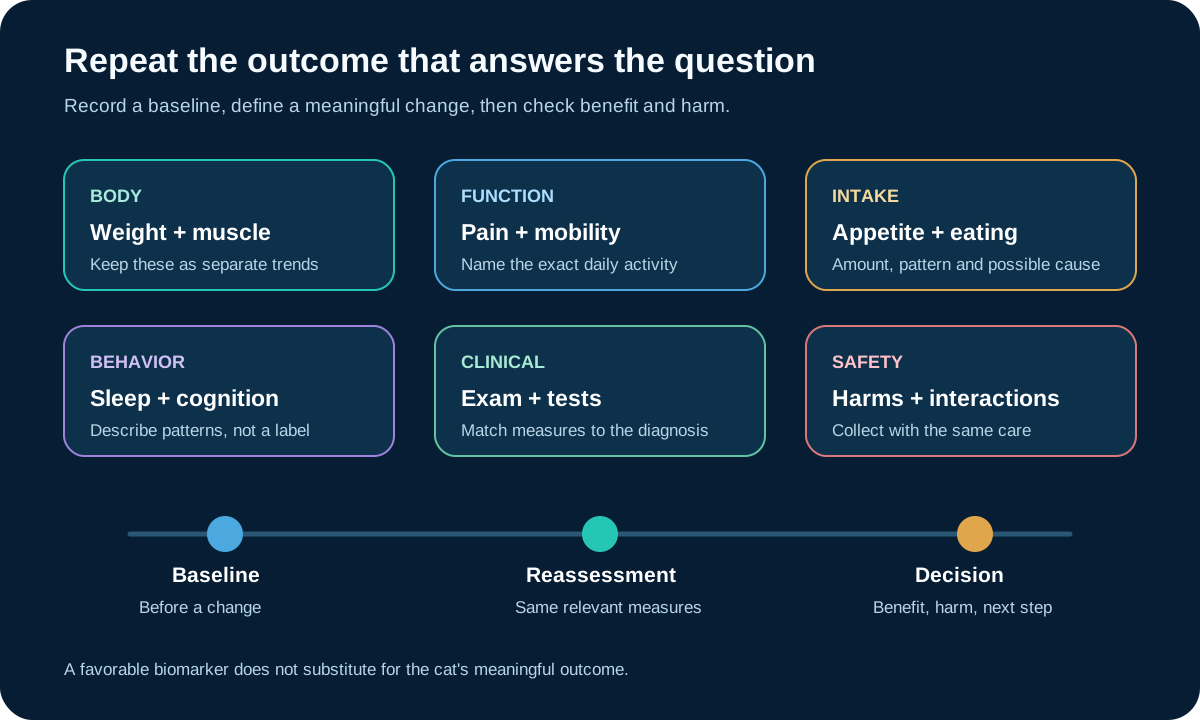
Older-cat claims often combine endpoints that are not interchangeable. Weight gain is not muscle restoration. Less osteoarthritis pain is not joint repair. A hormone or biomarker change is not improved daily function. An owner questionnaire is not the same as survival. Each measure may be useful when it matches the question.
Before a veterinary visit, record what changed in ordinary language. Note the activity, time, frequency, and conditions. A short safe video of jumping, stairs, gait, grooming, or a repeated behavior can help show what happens at home. Record appetite, water intake, elimination, sleep, social interaction, body weight when available, and every medicine or supplement. Do not stop or change a prescribed product solely to create a cleaner observation period.
Then ask what follow-up would count as meaningful. For osteoarthritis pain, this may involve specific activities chosen before care begins. For weight loss, the plan may need weight, muscle condition, intake, nausea, and the underlying disease. For behavior change, the veterinarian may need to separate pain, sensory loss, hypertension, thyroid disease, neurologic disease, sleep disruption, and cognitive dysfunction.
A favorable laboratory value should not silently replace the goal that mattered. The biomarker and surrogate-endpoint guide explains how to keep a mechanism result in its proper column.
Questions to take to the veterinarian
- What problem are we trying to explain? Describe the specific change and ask which diagnoses or environmental causes fit.
- Is this cat frail, or simply older? Review weight and muscle trend, mobility, cognition, appetite, grooming, organ function, other diseases, and resilience as relevant.
- What is the exact intervention? Record the active ingredient, molecular class, formulation, route, finished product, current label, and legal pathway.
- Were comparable cats studied? Match diagnosis, age range, stability, comorbidities, concurrent medicines, exclusions, route, and follow-up.
- Did the study measure the outcome we care about? Keep weight, muscle, pain, activity, appetite, cognition, quality of life, biomarkers, and survival separate.
- What changed in the current safety information? Ask for the current label, owner sheet, known limitations, and signs that require prompt contact.
- How will benefit and harm be reassessed? Agree on a baseline, target outcome, timing, confounding changes, and a stop or reassessment plan.
Open the free veterinary-visit checklist
The amount-to-volume calculator performs generic arithmetic only after a veterinarian provides an amount and the actual pharmacy label provides a concentration. It does not select a product, calculate a dose, or decide whether a senior cat needs treatment.
Frequently asked questions
What are the best peptides for senior cats?
There is no evidence-based class ranking for “senior cats.” The useful comparison begins with a diagnosed problem and an exact product. A product studied for osteoarthritis pain cannot be ranked against one studied for a different feline condition as if both were general anti-aging options.
Does being over 10 make a cat frail?
No. The AAFP uses older than 10 as a senior life-stage category, while frailty describes vulnerability and reduced reserve across several domains. Older cats vary widely, and frailty assessment is still developing.
Does the feline frailty study prove a treatment can extend life?
No. The pilot examined whether owner and veterinarian questionnaires were feasible and whether frailty classification related to short-term mortality. It did not randomize cats to a treatment or test a peptide.
Is Solensia a peptide for senior cats?
FDA describes frunevetmab as a felinized monoclonal antibody and therapeutic protein. Its feline approval is for control of pain associated with osteoarthritis. Older cats were included, but age alone is not the indication.
Is Elura an anti-aging peptide?
No. Capromorelin is a ghrelin-receptor agonist and not the peptide hormone ghrelin. Its FDA approval is for management of weight loss in cats with chronic kidney disease. The measured weight outcome is not proof of kidney repair, muscle restoration, frailty reversal, or longer life.
Does a study in older cats apply to every older cat?
No. Check the diagnosis, stability, other conditions and medicines, exclusions, product, route, and outcome. An age range is only one field in a population match.
Does this page recommend research peptide sellers?
No. It includes no research-chemical seller, product ranking, affiliate link, dose, or administration protocol.
The bottom line
“Peptides for senior cats” is a broad search phrase. Senior status tells you when closer, individualized health assessment matters. It does not identify a diagnosis or a product. Feline frailty and longitudinal aging studies show variation and frequent multimorbidity, while the Solensia and Elura records show how useful evidence remains tied to a specific condition, finished product, population, route, and outcome. Define the change first, bring the whole health context, and ask whether the exact evidence matches the cat in front of you.
Sources and scope
This is an introductory guide or original comparison framework, not a systematic review or a product recommendation.
- AAFP: 2021 Feline Senior Care Guidelines — Current official feline-care framework used for the older-than-10 life-stage definition, individualized assessment, frailty, pain, nutrition, disease, behavior and quality-of-life context. Guidance, not a peptide trial.
- Colleran et al. (2025): feline frailty questionnaire feasibility pilot — Primary non-randomized pilot in client-owned cats aged 11 to 20 years. Questionnaire completion, frailty classification and six-month mortality association are retained; no intervention or peptide was tested.
- Pye et al. (2026): morbidity, multimorbidity and mortality in aging cats — Primary longitudinal CatPAWS cohort: 209 cats, 1,241 examinations, up to seven years, and frequent morbidity and multimorbidity. Observational aging context, not treatment evidence.
- FDA FOI Summary: Solensia original approval, NADA 141-546 — Primary approval record for frunevetmab, a feline therapeutic antibody protein for osteoarthritis pain. Broad age range, stable chronic-condition allowance, exact outcomes and weight-of-evidence limits retained.
- FDA: Solensia safety-related labeling changes, October 5, 2026 — Current official update adding post-approval experience, owner information and a Client Information Sheet. Voluntary reports cannot always establish frequency or causation.
- FDA FOI Summary: Elura original approval, NADA 141-536 — Primary approval record for capromorelin, a ghrelin-receptor agonist, in cats with CKD-associated weight loss. Older study population, comorbidities, weight endpoint and product-specific limits retained.
Source checked October 26, 2026. A general context source does not establish a named product’s benefit.