
Peptide Biomarkers and Surrogate Endpoints: Reading Beyond the Lab Result
Does a peptide biomarker change prove a health benefit? Learn about surrogate validation, study context, human approval, and the separate evidence needed for pets.
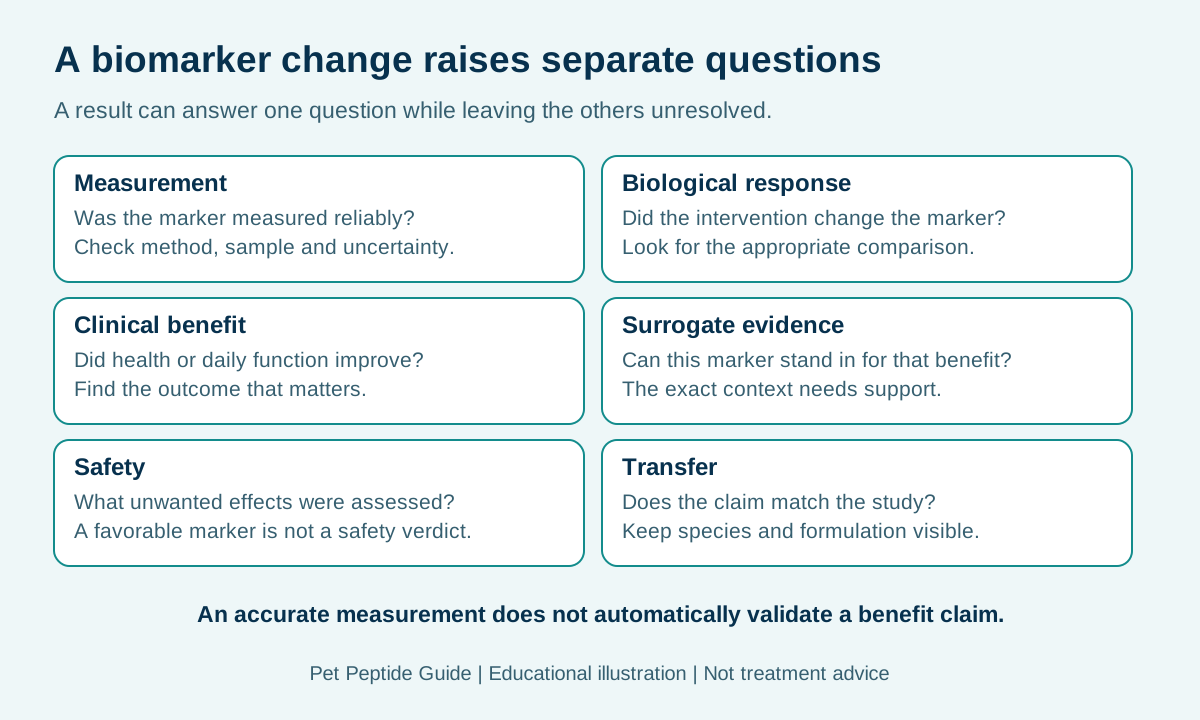
Does a better biomarker result prove that a peptide improves health? Not by itself. A measurement can show a biological response without establishing the benefit a headline promises. To connect the two, look for a directly measured clinical outcome or evidence that the marker reliably predicts that specific outcome in the relevant setting.

Prepared by Pet Peptide Guide with AI assistance; source-checked October 6, 2026. This article has not been reviewed by a veterinarian. It explains research terminology, not individual medical or veterinary care. It does not recommend a peptide, product, laboratory testing plan, dose or treatment. The worked example is invented.
A peptide headline might mention a hormone level, an inflammatory marker, a tissue measurement or a pathway signal. Those details can be scientifically useful. The reading mistake is to silently replace the measurement with a different result, such as less pain, easier movement or longer life. This guide focuses on that specific inference. For the broader reading method, start with Peptide Research Basics.
Separate the measurement from the promised benefit
The FDA–NIH BEST glossary describes a biomarker as a measured biological characteristic. It can reflect a normal process, disease or a response to an intervention. Biomarkers include molecular, tissue, imaging and physiological measurements; they are not limited to blood tests. Direct assessments of symptoms, functioning or survival answer a different kind of question.
For example, a headline about “recovery” needs a definition. Is it referring to a change in a laboratory signal, a person's ability to perform a task, or an animal's assessed pain? Write down the exact result before interpreting it. If the source says only that a marker changed, preserve that narrower wording.
An endpoint is also more specific than a topic. “Inflammation” does not tell you which measurement was analyzed, at what time, or how the groups were compared. A useful reading note names those details. This is an editorial checking method, not a rule that every study must use the same endpoint.
Biological activity can be informative without proving efficacy
BEST's response-biomarker definition explains that a biological response can be beneficial or harmful. A pharmacodynamic biomarker can indicate that an intervention affected biology without establishing its effect on disease or patient health. Whether a response biomarker is being used as a pharmacodynamic marker or a surrogate endpoint depends on its purpose and context.
Applied to peptide research, that distinction lets you recognize useful early work without overselling it. A pathway result may help investigators decide which question to test next. It should not be rewritten as evidence that a patient experienced a benefit the experiment did not assess.
Try completing two sentences: “The investigators measured ___” and “The headline promises ___.” If the blanks contain different things, the missing connection becomes visible. Ask the author to identify the evidence for that connection rather than assuming a technical-sounding marker must settle it.
A surrogate endpoint needs evidence for the prediction
A surrogate endpoint stands in for the outcome researchers ultimately want to understand. FDA's surrogate-endpoint resource distinguishes three levels of evidence:
- Candidate: researchers are still evaluating whether it predicts clinical benefit.
- Reasonably likely: biological or epidemiological support is strong, but clinical evidence is not sufficient for validated-surrogate status.
- Validated: strong clinical evidence and a mechanistic explanation support prediction of a specific benefit.
These terms are not interchangeable. Surrogates can make research more efficient when the clinical outcome takes years to observe or direct-outcome studies would be unethical. FDA uses blood-pressure reduction and stroke prevention as an example supported by many trials. The lesson is that a surrogate needs an evidence base, not that laboratory outcomes should always be dismissed.
When reading a peptide paper, look for the exact status the investigators claim and the supporting references. If a summary uses “validated,” ask what was validated: the laboratory method, the marker's use for a particular purpose, or its ability to predict the benefit in question. Those are different claims.
Correlation does not establish that changing the marker changes the outcome
BEST's validated-surrogate chapter makes an important distinction. People with a certain marker level may have different outcomes, but that association alone does not establish that treatment-induced changes in the marker predict treatment benefit. Supporting evidence often includes multiple randomized trials, although the resource describes exceptions. Observational evidence can contribute without usually being sufficient on its own.
The same chapter gives a historical caution from arrhythmia trials: the studied medicines suppressed ventricular premature beats, yet mortality increased. This was not a peptide trial. It illustrates why a plausible marker can fail to capture the overall consequences of an intervention.
For your reading notes, separate “associated with a better outcome” from “changing this marker with this intervention predicts a better outcome.” If a claim moves from the first sentence to the second, request the missing evidence. Do not assume the finding is false; identify the question that remains open.
A fictional peptide result, rewritten with the right limits
No real peptide, participant group or trial is described below. The example supplies no treatment recommendation and no estimate of benefit or risk.
Imagine a randomized human study comparing an experimental peptide with a comparator. A prespecified blood marker declines more in the peptide group. The report gives the measurement method and uncertainty around the difference. In this fictional setting, the marker has not been established as a surrogate for the health outcome being promoted. Symptoms and everyday functioning were not measured.
| Proposed statement | What the example supports |
|---|---|
| The measured marker changed more in one group. | A bounded description of the reported comparison, with its uncertainty. |
| Participants felt better or functioned better. | Not established; those outcomes were not assessed. |
| The peptide produced an overall health benefit. | Not established by this marker alone; relevant benefits and harms still need evaluation. |
| The same effect would help dogs or cats. | Not established; the example contains no veterinary patient evidence. |
A careful summary would say: “The study reported a difference in the measured biomarker. It did not establish improvement in symptoms or functioning.” That preserves the result without adding an outcome.
Now change the imaginary facts. Suppose investigators also measure a prespecified functional outcome. You would inspect that result, its comparison and its uncertainty separately. Or suppose the marker has strong surrogate-validation evidence in the exact clinical context. That evidence would materially change the interpretation. Neither possibility should be filled in from a headline when the source leaves it unknown.
This exercise is not a scoring system. It does not decide whether a real trial was well conducted. It helps you phrase a more precise question for the original report or a qualified professional.
A reliable laboratory method is not the same as a validated health claim
The BEST validation chapter distinguishes analytical validation from clinical validation. The former concerns whether a measurement method performs acceptably for its intended purpose. The latter concerns whether a test or tool measures or predicts the clinical concept of interest. A technically dependable number therefore does not automatically settle what that number means for health.
For a practical note, use two headings: “How was the result measured?” and “What outcome does the result support?” Under the first, record the method and any reported measurement limitations. Under the second, record the proposed benefit and the evidence linking it to the marker. Write “not reported” where the paper does not answer the question.
Keep product testing separate as well. A chemical identity or purity report addresses different questions from a clinical biomarker study. Our testing-report guide explains that document's scope. Neither document should inherit conclusions from the other simply because both contain laboratory numbers.
An FDA table entry is not a universal endorsement
FDA's surrogate-endpoint table states that acceptability is considered case by case. Relevant context includes the disease, patient population, treatment mechanism and available therapies. The table also includes some endpoints anticipated to be suitable even though they have not yet supported an approved application.
Our interpretation for readers is straightforward: finding a familiar marker in the table does not establish approval of an experimental peptide or validate every claim involving that marker. Read the complete row and notes, then identify the actual product and regulatory record. A cropped cell loses important context.
Likewise, accelerated approval is a real human-drug approval pathway for serious conditions and unmet medical need. It can rely on a surrogate or intermediate clinical endpoint reasonably likely to predict benefit. Adequate, well-controlled evidence is still required, and confirmatory studies are used to verify the anticipated benefit. Failure to verify benefit can lead to withdrawal or a changed indication.
An interesting marker result does not itself confer accelerated approval. Keep that regulatory determination separate from registration, publication and the investigators' interpretation. The trial-record guide explains how to inspect those separate documents.
For pets, the species and intended use stay attached
FDA's final October 2021 veterinary biomarker guidance, GFI #267, specifically discusses using an accepted marker in a different species as a situation that may need further supporting evidence. A human marker's name does not establish its veterinary interpretation.
The guidance also recognizes that animal-drug endpoints can address biological effects as well as clinical benefits, depending on the intended use. Veterinary surrogate endpoints may stand in for either. Its recommendations are nonbinding and concern a specific animal-drug development context; they do not approve any peptide product.
For pet owners, start by naming the actual question: pain, daily movement, a disease-related biological effect or another defined outcome. Then ask whether the cited study addresses that question in the relevant species and population. Laboratory-animal mechanisms, human trials and veterinary patient studies should remain visibly separate. The pet-peptide overview and human-approval guide help organize those distinctions.
Use a six-field claim check
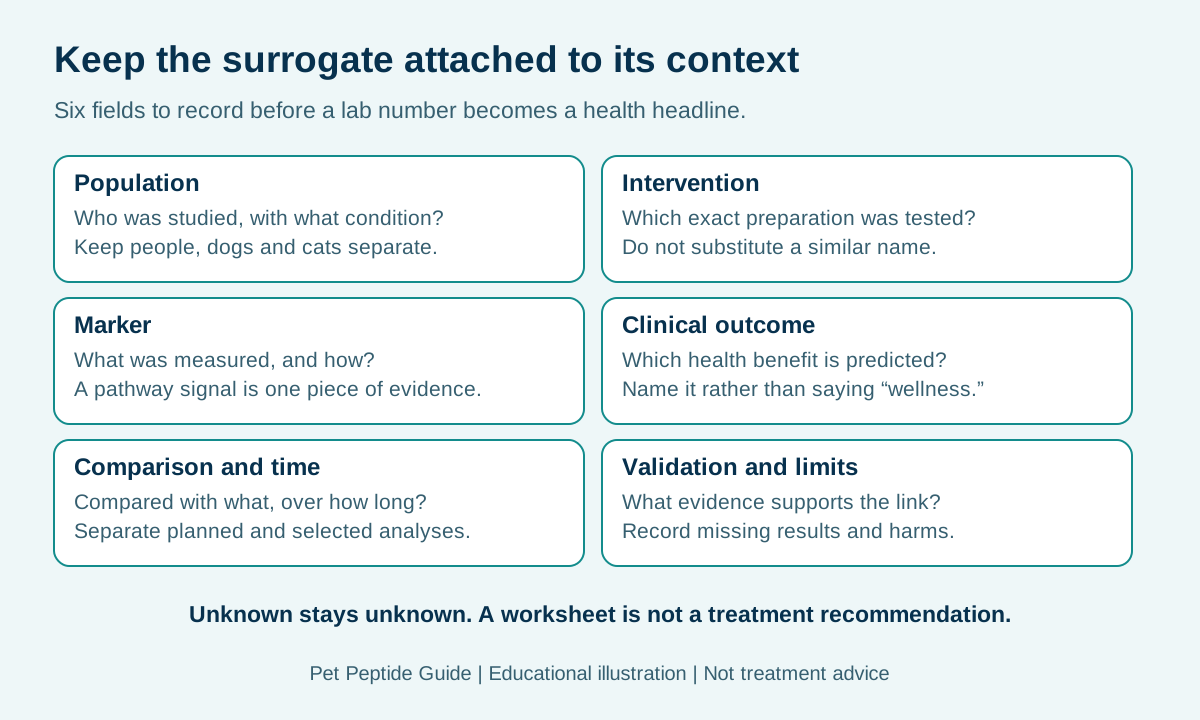
Save this short original template beside the source you are reading:
- Population: Who or what species was studied, with which condition?
- Intervention: What exact preparation was tested?
- Marker: What changed, measured by which method?
- Outcome: What specific health benefit is the headline claiming?
- Comparison and time: Against what comparator, at which planned time point?
- Evidence and limits: What supports the marker-to-benefit link, and what is missing about clinical outcomes or harms?
Do not turn missing fields into a favorable or unfavorable verdict. They identify what you still need to learn. Bring pet-care questions and the original source to your veterinarian using the vet-visit checklist; discuss human care with a qualified clinician. A research-reading exercise cannot tell you whether to start, stop or change treatment.
Bottom line: Name the measurement, name the claimed benefit, and keep the evidence connecting them visible. A biomarker can be valuable without supporting every conclusion attached to it.
Sources and scope
This is an introductory guide or original comparison framework, not a systematic review or a product recommendation.
- FDA–NIH BEST: Glossary — Biomarker and clinical-outcome terminology; official indexed text corroborated by FDA guidance. Direct NCBI access showed a browser check during review.
- FDA–NIH BEST: Response Biomarker — Biological response and pharmacodynamic activity do not by themselves establish clinical efficacy. Indexed official text; direct-page access limitation as above.
- FDA: Surrogate Endpoint Resources for Drug and Biologic Development — Candidate, reasonably likely and validated categories; why surrogate endpoints can be useful.
- FDA–NIH BEST: Validated Surrogate Endpoint — Context-specific prediction, limits of correlation, and the historical non-peptide arrhythmia example. Official indexed chapter last updated November 13, 2020.
- FDA–NIH BEST: Validation — Analytical and clinical validation answer separate questions. Official indexed chapter last updated November 16, 2020.
- FDA: Table of Surrogate Endpoints That Were the Basis of Drug Approval or Licensure — Case-by-case use; population, disease and mechanism matter. The table is not approval of a particular experimental peptide.
- FDA: Accelerated Approval — Human-drug pathway, confirmatory evidence and remaining uncertainty; not a veterinary approval framework.
- FDA CVM: GFI #267, Biomarkers and Surrogate Endpoints in New Animal Drug Studies — Final October 2021 guidance; nonbinding, veterinary-specific recommendations including species-transfer and intended-use limits.
Source checked October 06, 2026. A general context source does not establish a named product’s benefit.