
Selank for dogs and cats: evidence and key questions
Selank explained for pet owners: exact identity, primary evidence, dog and cat relevance, product context, and questions for your veterinarian.
Direct answer: Selank research on brain signaling does not by itself establish treatment of anxiety in dogs or cats. A molecular finding and a meaningful change in an animal’s behavior need to be evaluated separately.
Does molecular anxiety research establish a treatment for pets?
Selank is the named experimental peptide in the source below. It should not be treated as another name for Semax or as a general substitute for a veterinary behavioral assessment.

What the primary source actually establishes
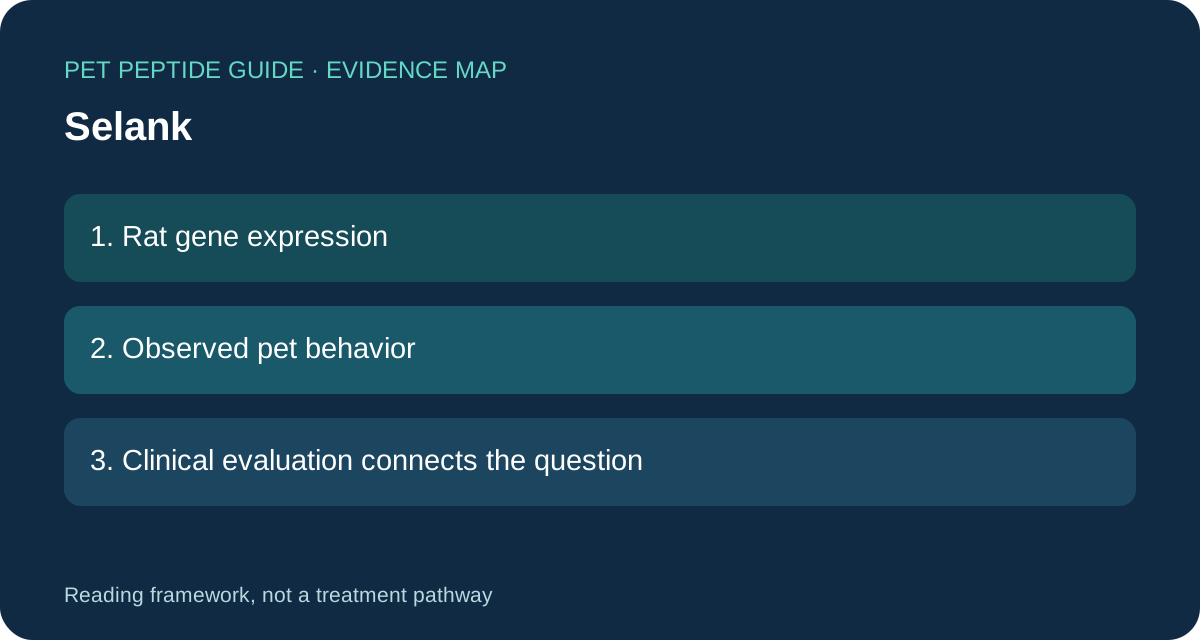
Volkova and colleagues’ 2016 study examined expression of genes related to neurotransmission in rat frontal cortex after Selank or GABA administration. Its molecular measurements at short time points are not a clinical trial of separation anxiety, fear, or household behavior in pet dogs or cats. Read the original source.
Product identity and approval context
This is mechanistic rat research. The abstract-level review here does not establish a pet formulation, route, treatment duration, or approval. It also does not support universal claims of being non-sedating or free of adverse effects.
How to use this evidence in a veterinary discussion
Before comparing a substance, describe the behavior: what happens, what precedes it, how long it lasts, and how it affects the animal’s daily life. A video of the behavior may help a clinician understand the situation, provided it can be obtained without provoking distress. Keep observation separate from a diagnosis. If a proposed treatment is justified by gene-expression research, ask how that finding relates to a validated behavioral outcome. A quiet animal is not automatically an animal whose underlying problem is resolved, and a laboratory marker is not a home behavior score. The evidence needed for a useful decision includes the relevant species and clinical context, with a way to assess both improvement and unwanted effects.
What would a meaningful behavioral outcome look like?
A research outcome should be defined before interpreting improvement. For example, a study might use a specified behavioral assessment under stated conditions and compare changes with an appropriate control. It would need to distinguish the target behavior from general activity or other effects. For an individual pet, the veterinarian can help identify an appropriate assessment. A molecular signal alone does not provide that behavioral evaluation.
Questions to take to your appointment
- What behavior and trigger are we actually evaluating?
- Does the study measure behavior or molecular expression?
- How would progress and unwanted effects be distinguished?
Use the printable product and evidence checklist to record the exact label, the source of a claim, and the unanswered questions. Bring the animal’s current medicines and supplements so a proposed product is not assessed in isolation.
Dogs, cats, routes, and formulations: what remains unresolved?
The source set above is a focused review, not a systematic search of every publication. Evidence from a dog does not automatically answer a cat question, and evidence from a laboratory model does not establish a clinical result in a household pet. Where this review has not verified a relevant preparation, route, or patient outcome, that detail remains unresolved. It should not be filled with instructions from a seller or a human regimen.
Frequently asked questions
Does this guide recommend Selank for my pet?
No. It explains the evidence question and its limits so you can discuss a specific concern with a veterinarian. A compound’s inclusion in the library is not a product recommendation, and no affiliate offer is attached to this guide.
Can I use a calculator to choose an amount?
The amount-to-volume calculator performs arithmetic using an amount already provided by a veterinarian and a confirmed concentration. It does not select a dose, frequency, route, or product. The concentration calculator likewise uses confirmed final volume; it does not supply mixing instructions.
How should I compare a related compound?
Start with the related evidence guide, then compare exact identity, species, route, and measured outcome. A shared marketing category is not evidence of equivalence. Use the main peptide guide and topic directory to navigate the full collection.
Prepared by Pet Peptide Guide using the sources identified here, checked September 12, 2026. This is AI-assisted editorial research, not veterinary review, product testing, or a clinical protocol. Missing evidence is described as a limit of this review, not proof that no research exists.
Sources and scope
This is an introductory guide or original comparison framework, not a systematic review or a product recommendation.
- Selank: primary research or official product context — Supports the specific source discussion above; does not imply pet suitability.
Source checked September 12, 2026. A general context source does not establish a named product’s benefit.