
Semax for dogs and cats: evidence and key questions
Semax explained for pet owners: exact identity, primary evidence, dog and cat relevance, product context, and questions for your veterinarian.
Direct answer: Semax findings in an experimental brain-injury model should not be rewritten as proof that it improves memory or treats cognitive decline in pets. Acute injury research and long-term cognitive care ask different questions.
Does stroke-model research show a cognitive benefit for pets?
The cited study identifies Semax as the synthetic ACTH-related peptide Met-Glu-His-Phe-Pro-Gly-Pro. It is a distinct molecule from Selank, despite their frequent appearance together in nootropic lists.

What the primary source actually establishes
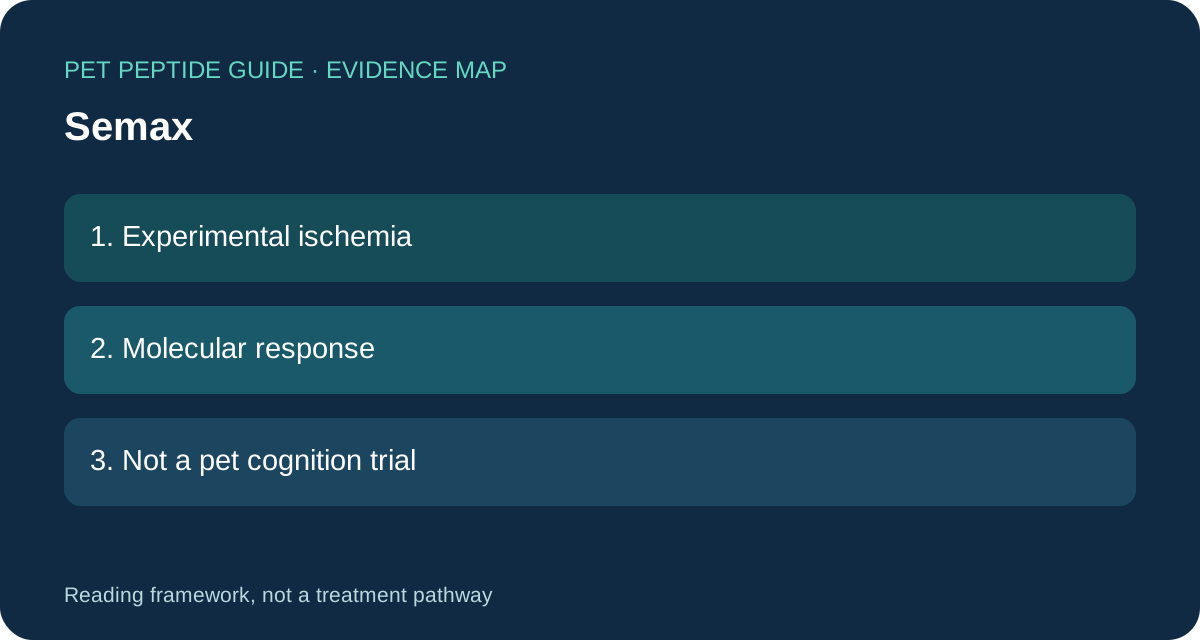
Sudarkina and colleagues’ 2021 study used a rat transient middle cerebral artery occlusion model with reperfusion and measured protein-expression changes after experimental ischemia. It investigated molecular responses to injury, not a clinical trial of aging dogs or cats with cognitive signs. Read the original source.
Product identity and approval context
The primary publication supports the model and molecular question described here. This guide does not derive a pet dose, nasal-product equivalence, or veterinary indication from that experiment.
How to use this evidence in a veterinary discussion
For an owner, the first distinction is whether the concern is a sudden change or a gradual pattern in daily behavior. Describe the actual observations and seek veterinary assessment rather than assigning a nootropic label. A study of an experimentally interrupted blood supply is not a general model for every cause of altered behavior or activity. When evaluating a claim, ask whether the measured result was a protein, tissue injury, a behavioral test, or a meaningful clinical outcome over time. A treatment can affect one of these without establishing the others. Keep concurrent care and the animal’s history visible in the discussion. A website should explain the model honestly instead of turning the word neuroprotective into an all-purpose promise.
Can an acute-injury model answer an aging question?
Only if the connection is demonstrated for the particular claim; it should not be assumed from a shared reference to the brain. The onset, underlying problem, study population, and outcome can differ substantially. A careful guide labels the acute model explicitly and asks what additional research would connect it to long-term cognition. That preserves the value of the experiment without presenting it as evidence for an untested use.
Questions to take to your appointment
- Does the experimental model resemble the actual clinical concern?
- Was cognition measured or inferred from another endpoint?
- What evidence addresses this species and the proposed route?
Use the printable product and evidence checklist to record the exact label, the source of a claim, and the unanswered questions. Bring the animal’s current medicines and supplements so a proposed product is not assessed in isolation.
Dogs, cats, routes, and formulations: what remains unresolved?
The source set above is a focused review, not a systematic search of every publication. Evidence from a dog does not automatically answer a cat question, and evidence from a laboratory model does not establish a clinical result in a household pet. Where this review has not verified a relevant preparation, route, or patient outcome, that detail remains unresolved. It should not be filled with instructions from a seller or a human regimen.
Frequently asked questions
Does this guide recommend Semax for my pet?
No. It explains the evidence question and its limits so you can discuss a specific concern with a veterinarian. A compound’s inclusion in the library is not a product recommendation, and no affiliate offer is attached to this guide.
Can I use a calculator to choose an amount?
The amount-to-volume calculator performs arithmetic using an amount already provided by a veterinarian and a confirmed concentration. It does not select a dose, frequency, route, or product. The concentration calculator likewise uses confirmed final volume; it does not supply mixing instructions.
How should I compare a related compound?
Start with the related evidence guide, then compare exact identity, species, route, and measured outcome. A shared marketing category is not evidence of equivalence. Use the main peptide guide and topic directory to navigate the full collection.
Prepared by Pet Peptide Guide using the sources identified here, checked September 12, 2026. This is AI-assisted editorial research, not veterinary review, product testing, or a clinical protocol. Missing evidence is described as a limit of this review, not proof that no research exists.
Sources and scope
This is an introductory guide or original comparison framework, not a systematic review or a product recommendation.
- Semax: primary research or official product context — Supports the specific source discussion above; does not imply pet suitability.
Source checked September 12, 2026. A general context source does not establish a named product’s benefit.