
Semaglutide for dogs and cats: what pet owners should know
Separate human semaglutide labels, dog absorption research, and studies of other GLP-1 drugs in cats before discussing weight or diabetes care.
Short answer: A study involving dogs does not show that semaglutide treats obesity or diabetes in pet dogs, and a cat study of another GLP-1 medicine does not establish semaglutide use in cats. The most useful next step is to separate the exact compound, species, formulation, route, and study question before discussing your animal's weight or glucose care with a veterinarian.
Watch: the missing species in a headline
48-second original captioned video, no audio. Open the watch page and transcript.
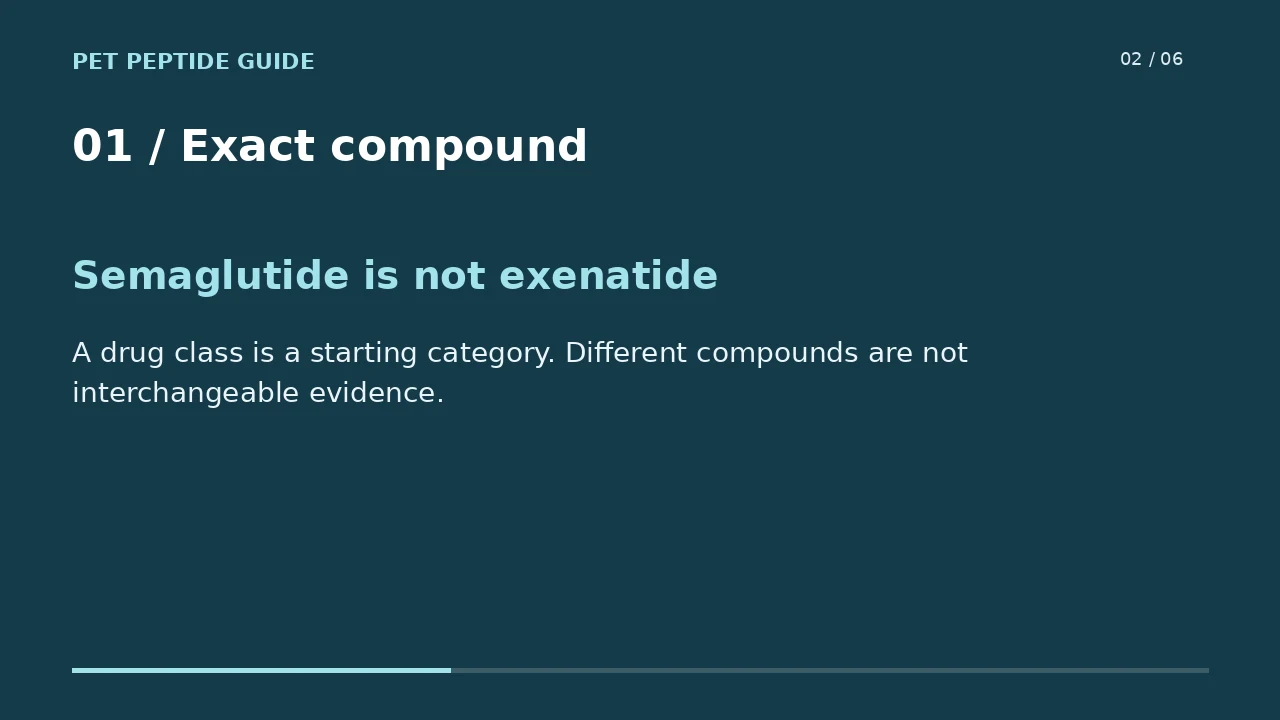
Why the name semaglutide needs context
Semaglutide is a glucagon-like peptide-1 receptor agonist, often shortened to GLP-1 receptor agonist. It appears in current human prescription products, including injectable and oral formulations. The June 2026 U.S. prescribing information for Wegovy describes specific human populations and indications; it is not a dog or cat label.
That distinction matters because four different questions are often compressed into one headline:
- Has semaglutide been studied in any experiment involving an animal?
- Has it been tested as a treatment for a naturally occurring condition in client-owned dogs or cats?
- Has a different medicine in the same broad drug class been studied in cats?
- Is there an approved animal drug containing semaglutide?
Those are not interchangeable questions. A careful comparison starts by answering each one separately.
What the sources actually address
| Source | Exact subject | What it can tell a pet owner | What it does not establish |
|---|---|---|---|
| Wegovy prescribing information, revised June 2026 | Semaglutide tablets and injection for named human indications and populations | Current human product identity, routes, indications, contraindications, and warnings | An approved indication, dose, or expected outcome for a dog or cat |
| Buckley et al., 2018 | Oral semaglutide coformulated with the absorption enhancer SNAC; mechanistic work included preclinical dog studies | How that particular tablet formulation was absorbed through the stomach in the research program | Weight loss, diabetes control, long-term safety, or treatment benefit in pet dogs |
| Klotsman et al., 2021 | Exenatide delivered by an experimental subcutaneous implant in healthy purpose-bred cats | Early safety, tolerability, and proof-of-concept information about a different GLP-1 receptor agonist and delivery system | Semaglutide results, treatment of client-owned cats, or equivalence between the two medicines |
| FDA approved animal-drug ingredient list, checked September 12, 2026 | Active ingredients in FDA-approved animal drug products | The current list checked for this guide did not contain semaglutide | A universal statement about every jurisdiction, every future approval, or whether a veterinarian may consider a lawful product-specific option for an individual patient |
This is a focused source comparison, not a systematic review. The search used for this guide did not retrieve a published semaglutide treatment trial in client-owned dogs or cats. That is an evidence gap, not proof that a particular outcome is impossible.
What was studied in dogs?
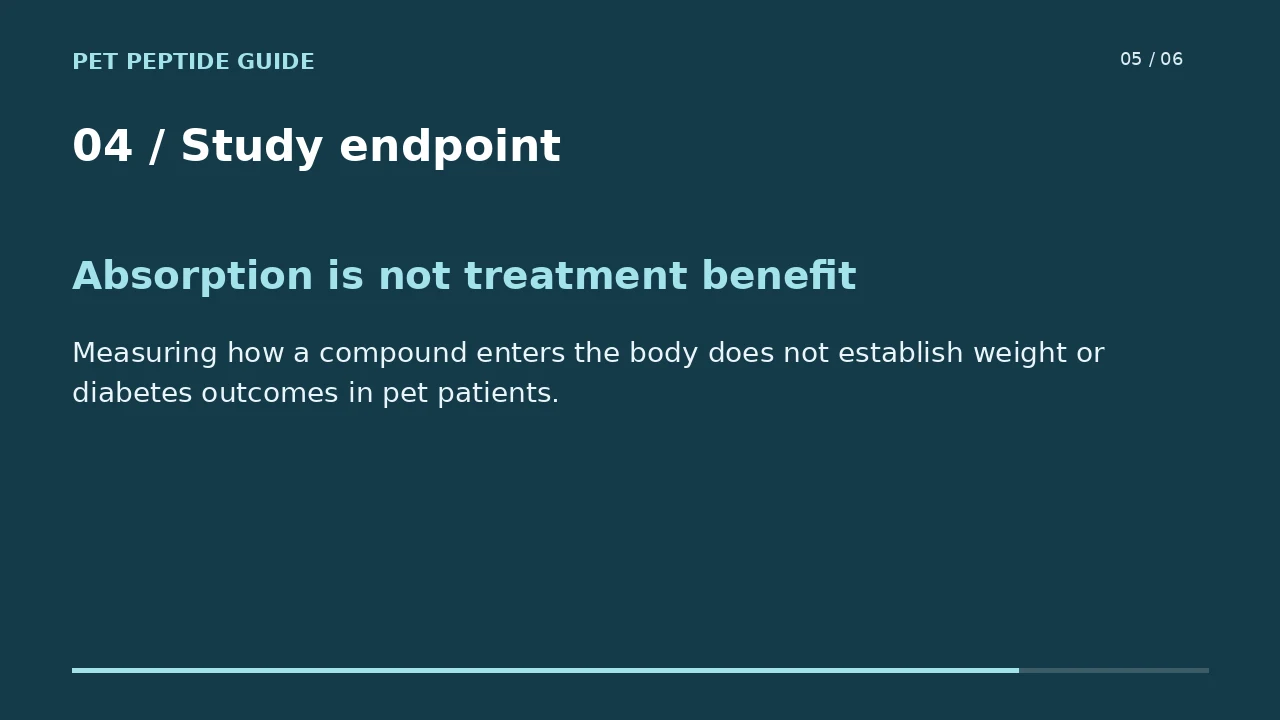
The 2018 paper by Buckley and colleagues investigated how oral semaglutide could cross the stomach lining when it was combined with sodium N-[8-(2-hydroxybenzoyl) amino] caprylate, known as SNAC. The paper reports clinical work and preclinical dog studies supporting localized stomach absorption near the tablet surface.
The exact formulation is central to the result. The study does not mean that any semaglutide product is absorbed the same way, and it does not convert an oral-formulation experiment into a veterinary weight-management trial. The outcome being measured was absorption behavior, not whether client-owned dogs with obesity or diabetes improved.
When someone summarizes this as “semaglutide was studied in dogs,” ask for the rest of the sentence: which formulation, by which route, in what kind of dogs, and for what endpoint? Those details decide how much the paper can answer.
What was studied in cats?
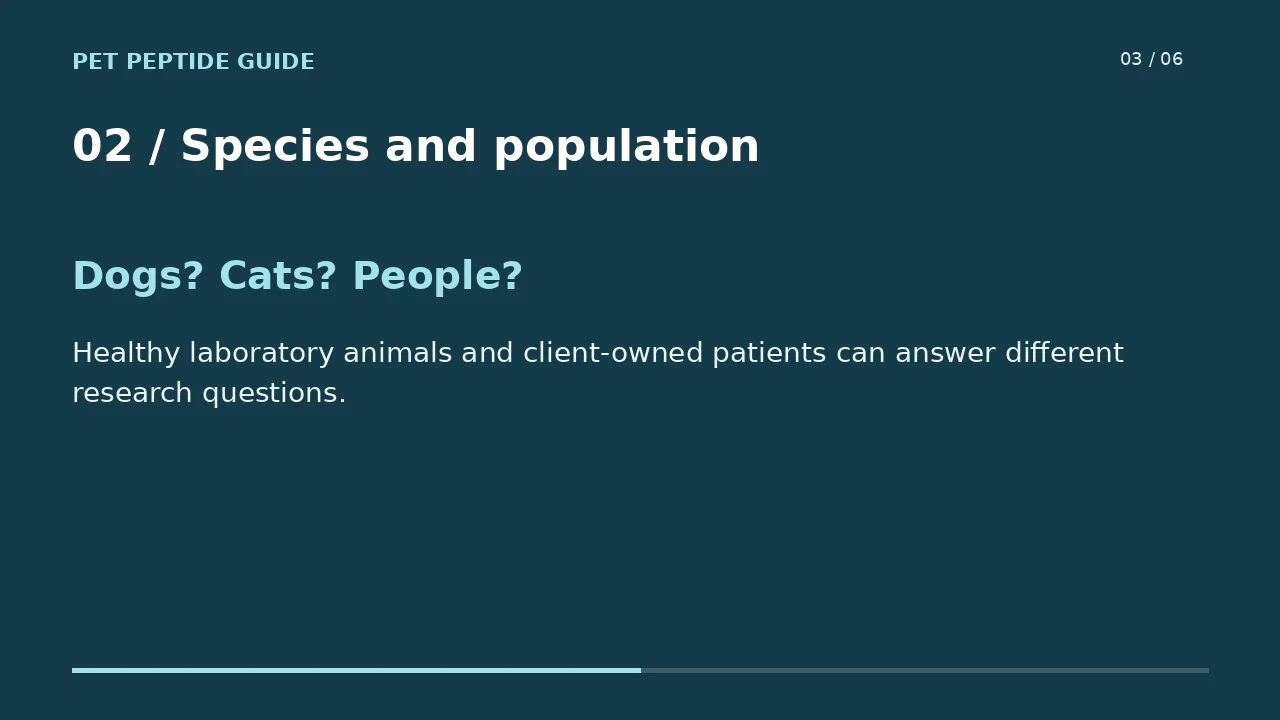
A 2021 veterinary study by Klotsman and colleagues involved two cadaveric and 19 purpose-bred cats. The active drug was exenatide, not semaglutide. It was delivered through an experimental subcutaneous implant called OKV-119. The work included a four-cat safety and tolerability study lasting 62 days and a 15-cat proof-of-concept study lasting 42 days.
The cats were healthy and purpose-bred. The authors described the project as an early study and said future work in client-owned cats was needed. The paper also reports company relationships: several authors had financial ties to Okava Pharmaceuticals, and the implant was manufactured by Nano Precision Medical. A disclosed conflict does not erase a study, but it belongs in the evidence notes alongside the design and sample.
This paper is relevant to understanding that GLP-1 receptor agonists have been investigated in feline research. It is not a semaglutide trial, and it does not show that medicines in the same class can be substituted for one another. Compound identity and delivery system remain part of the question.
Human approval is not a pet indication
The current Wegovy label is a human prescribing document. Its indications, dosing, contraindications, and adverse-event information belong to the human products and populations described in that label. Even the boxed warning has context: the label reports thyroid C-cell tumors in rodents and says the relevance to humans is unknown. That statement should not be turned into a known adverse-event rate for dogs or cats.
For animal-drug status, this guide also checked the FDA's current active-ingredient list for approved animal drug products on September 12, 2026. Semaglutide did not appear in that list. Because regulatory status can change and is jurisdiction-specific, record the date and source rather than repeating an undated claim.
FDA does list two different oral drugs—Bexacat (bexagliflozin) and Senvelgo (velagliflozin)—for certain cats with diabetes. They are SGLT2 inhibitors, not semaglutide or GLP-1 receptor agonists, and their eligibility and monitoring requirements are product-specific. Their existence is useful context for a veterinary conversation; it is not a reason to treat them as interchangeable or suitable for every cat.
Start with the animal's actual problem
“Weight loss” and “diabetes” are not enough information to select a product. A change on the scale can have more than one cause. Diabetes care depends on the species, diagnosis, clinical condition, feeding, other medicines, and monitoring plan. Describe what has changed before leading with a compound name.
Bring a short record of your dog or cat's current food, treats, supplements, medicines, recent weight trend, appetite, drinking, urination, activity, and any symptoms. If you have a semaglutide article or product listing, bring the exact source and label. The goal is to give the veterinary team a complete question, not to reverse-engineer a human protocol.
Questions to take to the veterinarian
- What diagnosis or clinical problem are we trying to address, and what should be evaluated first?
- Is the source I found about semaglutide itself, another GLP-1 medicine, or only the wider drug class?
- Does the evidence match my animal's species, health status, formulation, route, and intended outcome?
- What approved veterinary options are relevant to this specific dog or cat, and what monitoring do they require?
- Could current food, supplements, medicines, or another condition change the decision?
- Which changes or symptoms should prompt an urgent call rather than more online research?
Use the printable vet-visit checklist to organize these details without entering health information on this site.
How to read the next semaglutide headline
- Name the exact compound. Semaglutide, exenatide, tirzepatide, and other metabolic medicines are not synonyms.
- Name the species and population. Human participants, laboratory dogs, healthy purpose-bred cats, and client-owned patients answer different questions.
- Name the formulation and route. An oral tablet with an absorption enhancer is not the same preparation as an injection or an implant.
- Name the endpoint. Absorption, blood concentration, glucose measures, body weight, clinical improvement, and long-term outcomes are different endpoints.
- Check the date and product status. Use a current primary label or official animal-drug source.
The evidence guide expands this framework. For a broader map of semaglutide and the other requested compounds, use the complete peptides for pets guide. If a claim hinges on swallowing versus injection, read the oral versus injectable explainer before comparing results.
Frequently asked questions
Was semaglutide studied in dogs?
Yes, dog studies were part of the oral semaglutide absorption research reported by Buckley and colleagues. The question was how the SNAC-containing tablet formulation was absorbed through the stomach. That does not establish weight-management or diabetes treatment outcomes in pet dogs.
Does an exenatide study in cats count as semaglutide evidence?
No. It is related class evidence, but exenatide and semaglutide are different compounds. The cat paper also used an experimental implant in healthy purpose-bred cats, so its formulation, population, and research question must remain visible.
Is semaglutide FDA approved for pets?
The FDA approved-animal-drug active-ingredient list checked on September 12, 2026 did not contain semaglutide. Current human product approvals do not create a dog or cat indication. Check a current official source and discuss the exact product and jurisdiction with a veterinarian.
Can this page calculate a semaglutide dose for my pet?
No. This guide does not provide a dose, conversion from a human regimen, or a preparation protocol. The site's calculators only perform arithmetic from confirmed instructions; they do not decide whether a medicine is appropriate or choose an amount.
This page compares a focused set of primary and official sources. Pet Peptide Guide did not test a product, conduct a systematic review, or provide veterinary care. No affiliate product is recommended on this page.
Sources and scope
This is an introductory guide or original comparison framework, not a systematic review or a product recommendation.
- Wegovy prescribing information, revised June 2026 — Current U.S. human prescribing information; not an animal-drug label.
- Buckley et al. (2018): oral semaglutide stomach absorption — Mechanistic formulation research that included preclinical dog studies; not a pet treatment trial.
- Klotsman et al. (2021): exenatide implant study in cats — Different GLP-1 compound and experimental delivery system in healthy purpose-bred cats.
- FDA approved animal drug products: active ingredients — Current animal-drug active-ingredient list checked September 12, 2026.
- FDA: two drugs to treat diabetes in certain cats — Product-specific veterinary context for Bexacat and Senvelgo, which are not GLP-1 receptor agonists.
Source checked September 12, 2026. A general context source does not establish a named product’s benefit.