
Are Peptides Safe for Cats? Five Evidence Checks
Are peptides safe for cats? Compare approved feline products, experimental cat studies, non-cat evidence, compounding quality, and five questions for your vet.
Are peptides safe for cats? There is no accurate class-wide yes or no. Safety depends on the exact compound and finished product, the cats studied, formulation and route, purpose, duration, adverse-event collection, manufacturing quality, and veterinary monitoring. An FDA-approved feline monoclonal antibody has product-specific evidence and a label. A small experimental exenatide implant study answers a narrower question. Human, dog, rodent, or cell research cannot supply a feline safety conclusion for BPC-157, TB-500, KPV, or another product.
A search for are peptides safe for cats can mix prescription biologic drugs, experimental small peptides, hormones, food-derived protein fragments, compounded preparations, and loosely labeled online products. The shared word peptide does not make their identity, evidence, risks, quality, or legal status interchangeable.
This AI-assisted educational article was source-checked October 5, 2026 and has not been reviewed by a veterinarian. It is a focused evidence explainer, not a systematic review, diagnosis, treatment recommendation, or substitute for urgent care. It provides no dose, route choice, administration instruction, seller, or personalized protocol.
Start with the exact product, not the category name
“Peptide” describes a broad molecular feature, not one medicine. Even within one drug family, a different sequence, salt, delivery system, inactive ingredient, concentration, storage condition, or manufacturing process can change the question. An oral collagen ingredient is not an injectable research compound. A felinized monoclonal antibody is a much larger biologic with product-specific regulatory review. A study of exenatide does not become a semaglutide study because both act at GLP-1 receptors.
The most useful first question is therefore not “Are peptides safe?” It is “What exact finished product are we discussing, for which cat and purpose, and what evidence matches that product?” If a listing does not clearly establish identity, source, formulation, concentration, sterility when relevant, storage, and prescriber or regulatory context, the safety question is not ready for a conclusion.
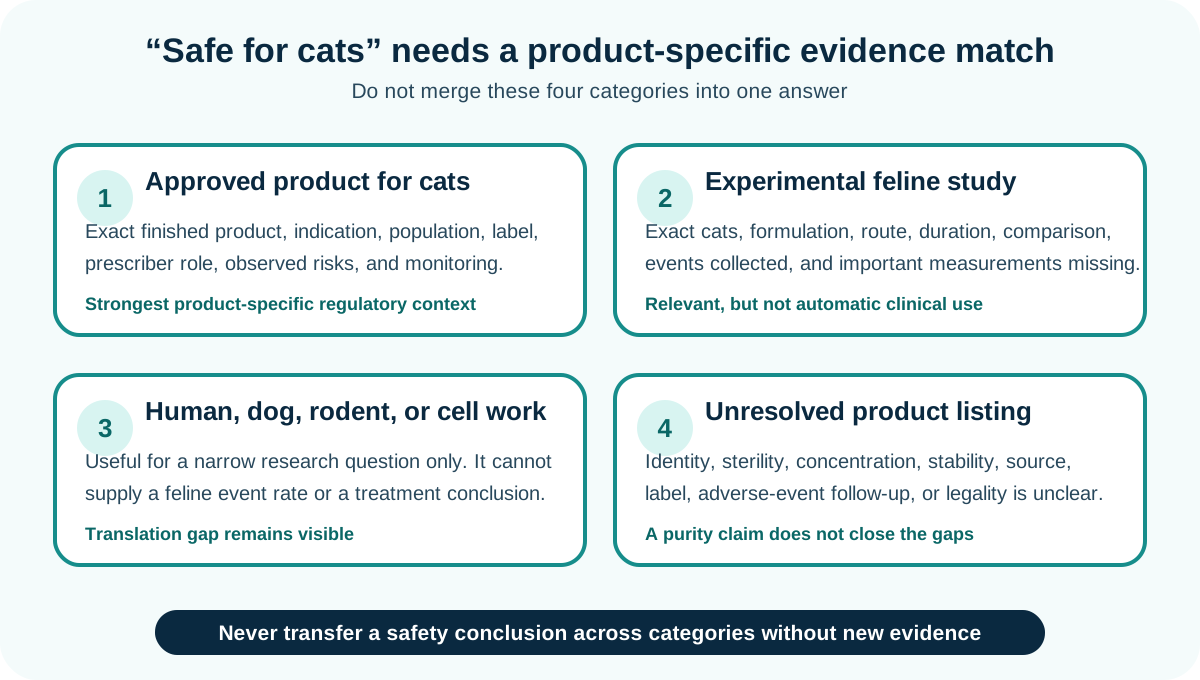
Four evidence levels that should not be merged
| Evidence level | What it can tell you | What remains unresolved |
|---|---|---|
| Approved finished product for cats | The exact indication, labeled population, formulation, route, precautions, adverse-reaction record, prescriber role, and post-market reporting system. | Whether a different compound, compounded version, supplement, or online listing has the same benefit-risk profile. |
| Experimental feline study | What happened in the cats, preparation, route, duration, comparison, and measurements actually reported. | Longer use, broader patient groups, rare events, unmeasured outcomes, and equivalence to another product. |
| Human, dog, rodent, or cell research | A narrow mechanism, exposure, laboratory, or model-specific question that may help frame future feline research. | A cat-specific clinical benefit, event rate, safe dose, monitoring plan, or finished-product decision. |
| Unresolved product listing | At most, what the seller claims on that page. | Identity, potency, contamination, sterility, stability, batch match, lawful veterinary use, adverse-event follow-up, and clinical relevance. |
An approved feline product is evidence for that product
Solensia contains frunevetmab, a felinized monoclonal antibody. Its U.S. label identifies it as an FDA-approved prescription animal drug for control of pain associated with osteoarthritis in cats under NADA 141-546. That record is an example of a safety and effectiveness review tied to an exact finished product, indication, manufacturing program, label, and post-market responsibilities.
It is not proof that “peptides are safe for cats.” A monoclonal antibody is not interchangeable with BPC-157, TB-500, KPV, semaglutide, collagen powder, or a compounded preparation. This article does not decide whether frunevetmab is suitable for an individual cat. The current label, diagnosis, history, concurrent care, and prescribing veterinarian’s monitoring plan remain central.
Post-market reports also need context. FDA published a Solensia adverse-event-report summary covering reports received through June 30, 2024. A report count is not an incidence rate because the number of treated cats is not supplied as a denominator, and a report does not by itself prove the product caused the event. At the same time, reports should not be dismissed. They are signals for review within a product-specific pharmacovigilance system. The accurate question is what the regulator, manufacturer, and veterinarian know about the exact event, exposure, competing explanations, and current label.
What the experimental exenatide cat study can tell us
A 2021 Frontiers in Veterinary Science paper studied an investigational implant called OKV-119 that delivered exenatide. The program involved two cadaveric and 19 purpose-bred cats. A four-cat safety and tolerability study lasted 62 days. A separate 15-cat proof-of-concept study lasted 42 days and examined drug release and body-weight observations.
The paper reported no apparent systemic drug-related adverse events or significant serum-biochemistry and complete-blood-count abnormalities during the small safety study. That finding belongs in a careful summary, but so do the boundaries. These were healthy purpose-bred cats, the safety group contained four cats, the delivery system was experimental, and the observation period cannot settle uncommon or long-term outcomes. The authors wrote that larger and longer studies would be needed to assess biocompatibility and tolerability over longer periods.
The study also did not complete every relevant immune question. Its discussion said future feline studies would need to measure anti-exenatide antibodies to assess possible neutralizing effects or changes in exposure. The authors disclosed company relationships, and the device manufacturer supplied the implant. These disclosures do not erase the work; they belong beside the design, sample size, results, and stated limitations.
Most importantly, the compound was exenatide, not semaglutide. It was not BPC-157, TB-500, KPV, or a retail “peptide for cats.” The implant, route, healthy population, and endpoints must stay attached to the result. Our semaglutide evidence guide explains why related drug-class evidence is not compound equivalence, while the immunogenicity guide separates binding antibodies, neutralization, allergy, and clinical outcomes.
Why “no side effects were reported” can be incomplete
A safety statement is only as informative as the observation system behind it. Ask how many cats were observed, for how long, whether they had the target disease, which laboratory or clinical measures were collected, whether owners and investigators were masked, how withdrawals were handled, and whether the publication reports unchanged as well as unfavorable findings.
Absence of an observed event in a small or short study does not prove that the event cannot occur. It may mean the event was uncommon, developed later, occurred in a population not studied, was not measured, or was difficult to distinguish from the underlying condition. Conversely, an event after exposure does not automatically prove causation. A useful assessment considers timing, dechallenge or discontinuation when available, other medicines and diseases, diagnostic findings, re-exposure if it occurred, and patterns across reports.
Words such as “well tolerated” should therefore stay attached to the exact study. They should not be copied from four healthy purpose-bred cats to senior cats with kidney disease, cats receiving multiple medicines, or a product made by a different process.
Dog, rodent, and cell studies do not settle feline safety
BPC-157 illustrates the species problem. The accessible 2022 paper included six beagles in pharmacokinetic experiments. It measured exposure, distribution, metabolism, and excretion for a laboratory-prepared compound after studied routes. It did not enroll cats, and it was not a clinical safety trial in client-owned animals. The result cannot supply a BPC-157 side-effect rate, benefit, or safe protocol for cats. See the canonical BPC-157 evidence guide for the exact dog and rodent boundaries.
KPV illustrates the model problem. The primary sources in our KPV guide concern human cells and induced mouse intestinal-inflammation models. They can inform a mechanistic research question. They do not establish clinical effectiveness or safety in a cat with inflammatory bowel disease, pancreatitis, allergies, or another condition.
TB-500 adds an identity problem. Analytical and laboratory literature can distinguish an acetylated fragment, a related sequence, and full-length thymosin beta-4. A sequence identified in a laboratory sample does not become a proven feline wound or joint treatment. The TB-500 identity guide keeps molecule, model, and endpoint attached to each source.
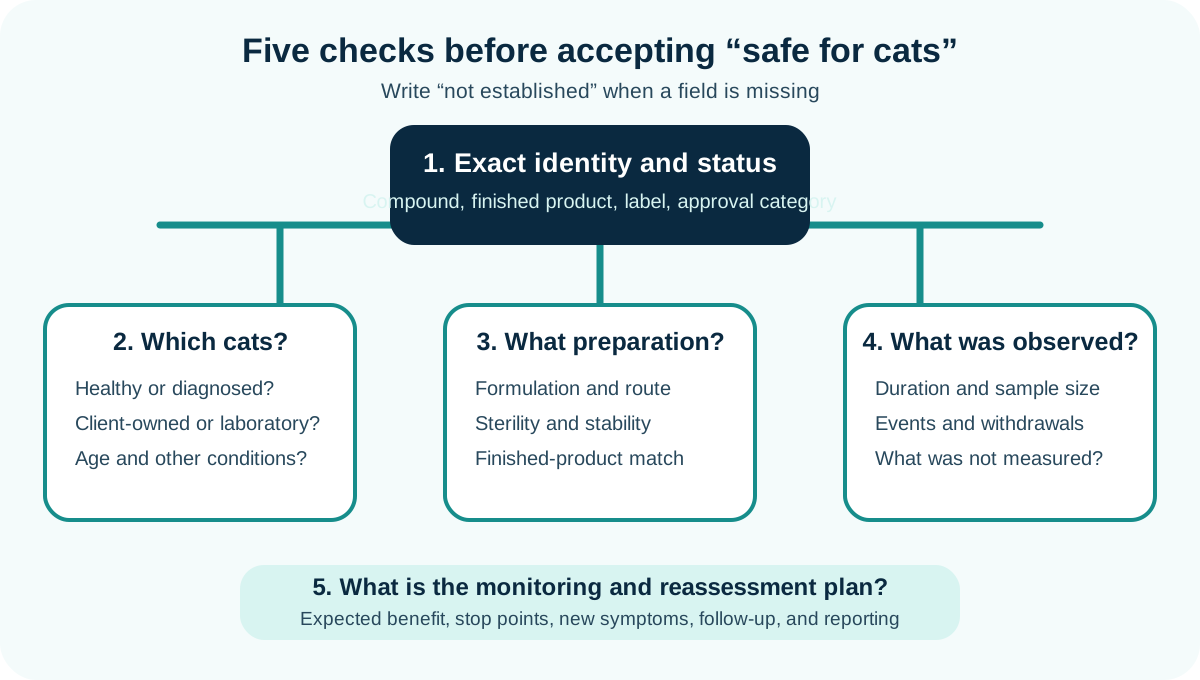
Five checks for any cat safety claim
- Exact identity and status. Name the compound, finished product, formulation, responsible manufacturer or pharmacy, and regulatory category. “Peptide blend” is not enough.
- Which cats? Separate healthy purpose-bred cats from client-owned cats with a diagnosed condition. Record age, disease, concurrent care, inclusion criteria, and important exclusions.
- Preparation and route. Match the studied route and formulation to the exact product. Oral powder, implant, injection, topical preparation, and compounded liquid are different exposure and quality questions.
- Duration and observation. Record sample size, follow-up length, adverse-event definitions, laboratory monitoring, withdrawals, neutral findings, and outcomes that were not collected.
- Monitoring and reassessment. Ask how benefit and harm will be tracked, when the veterinarian will reassess, what new signs require prompt contact, and how a suspected product problem will be reported.
Compounded preparations require their own evidence card
FDA’s animal-drug compounding Q&A says compounded animal drugs are not FDA-approved, even when an approved drug was used as source material. FDA explains that approval evidence for a finished product cannot automatically be applied to a compounded product because formulation, dosage form, and production may change. The agency also describes risks such as contamination, too much or too little active ingredient, and stability problems.
That does not mean every veterinary compounding decision is improper. FDA recognizes patient-specific situations where no approved, conditionally approved, or indexed product can appropriately treat the animal. The treating veterinarian’s medical rationale and the exact pharmacy preparation matter. The accurate comparison is not “approved good, compounded bad.” It is “Which product has which evidence, controls, reason for use, and follow-up?”
A certificate displaying a high purity percentage does not answer sterility, endotoxin, identity of every component, potency at the time of use, container compatibility, stability, clinical safety, or batch-to-document matching. Our testing-report guide explains how to read scope without treating a certificate image as clinical proof.
Watch: keep the study, product, and cat on separate cards
This existing original 48-second captioned explainer demonstrates the evidence-card method. It is silent and contains no dose or treatment instruction.
Open the dedicated video page and transcript.
Questions to bring to the veterinary visit
- What diagnosis or unresolved symptom are we actually trying to address?
- What is the exact compound and finished product, and what is its current regulatory status for cats?
- Has this same formulation and route been studied in cats like mine, or is the evidence from another species or model?
- What adverse events, withdrawals, laboratory changes, and unmeasured outcomes appear in the full source?
- Could age, kidney or liver disease, appetite changes, diabetes, other medicines, or supplements alter the concern?
- What specific benefit are we tracking, when will it be reassessed, and what would make us stop or change the plan?
- Who should I contact for a suspected adverse event or product-quality problem after obtaining veterinary care?
Open the free vet-visit checklist
Frequently asked questions
Are all peptides unsafe for cats?
No. A class-wide unsafe claim is as inaccurate as a class-wide safe claim. Product-specific approved veterinary drugs, experimental compounds, nutritional ingredients, and unresolved online listings require different evidence and regulatory questions.
Does a cat study prove a peptide is safe?
No single study proves universal safety. Check the exact compound and formulation, number and type of cats, duration, comparator, measurements, withdrawals, funding, and limitations. A small study can be relevant without settling rare, long-term, or patient-specific risks.
Does a dog study apply to my cat?
Not automatically. It can frame a research question, but species physiology, product, route, population, and endpoint remain different. A dog pharmacokinetic experiment cannot supply a feline clinical safety conclusion.
Is a compounded peptide FDA-approved for cats?
No. FDA states that the compounded animal drug is not FDA-approved, even when compounding starts with an approved drug. Veterinarians may have patient-specific reasons for compounding, but the exact preparation and rationale need their own evidence and quality questions.
Does “99% purity” mean a product is safe to inject?
No. A reported purity result answers only the analyte, method, sample, limits, and batch described. It does not by itself establish sterility, endotoxin control, potency over time, stability, clinical safety, or suitability for a cat.
What should I do if my cat has a new symptom after a product?
Contact a veterinarian promptly, and use emergency care for urgent signs. Keep the product, packaging, lot information, timing, amount actually given, other medicines, and observations available. FDA provides a route for reporting suspected animal-drug side effects and product problems, but reporting does not replace care.
Food-derived products still need the same identity discipline. The cat collagen evidence guide shows why undenatured type II collagen, hydrolyzed collagen in a multi-ingredient diet, and a generic “collagen peptides” listing answer different safety and benefit questions.
Bottom line: safety is a product-specific, cat-specific, and time-specific question. The strongest answer names the exact preparation, the cats studied, the route and duration, what was observed, what was not measured, and how the animal will be monitored. When any field is missing, the honest conclusion is “not established,” not “safe because it is a peptide” or “unsafe because it is experimental.”
Sources and scope
This is an introductory guide or original comparison framework, not a systematic review or a product recommendation.
- Klotsman et al. (2021): OKV-119 exenatide implant in healthy cats — Two cadaveric and 19 purpose-bred cats; small safety study and proof-of-concept study. Exact experimental implant and exenatide findings do not establish class-wide safety or clinical use.
- FDA label via DailyMed: Solensia (frunevetmab), NADA 141-546 — Product-specific U.S. animal-drug approval and labeling for control of osteoarthritis pain in cats; a monoclonal antibody, not generic evidence for peptide products.
- FDA: Solensia adverse event report summary through June 30, 2024 — Spontaneous report counts are not exposure-adjusted rates or automatic causal determinations.
- FDA: Q&A on GFI #256 animal-drug compounding — Finished-product approval and evidence do not transfer automatically to compounded preparations; current U.S. quality and veterinary context.
- FDA: reporting animal-drug side effects and product problems — Official suspected-event and product-problem reporting route; reporting does not establish causation or replace veterinary care.
- He et al. (2022): BPC157 pharmacokinetics in rats and dogs — Six-beagle exposure study used only to demonstrate why dog research cannot establish feline safety.
- Dalmasso et al.: KPV uptake and intestinal-inflammation research — Human-cell and mouse-model research, not a feline clinical safety study.
- Rahaman et al. (2024): TB-500 and metabolite analysis — Analytical, rat-urine and fibroblast research, not a cat clinical trial.
Source checked October 05, 2026. A general context source does not establish a named product’s benefit.