
Thymosin alpha-1 for dogs and cats: evidence and key questions
Thymosin alpha-1 explained for pet owners: exact identity, primary evidence, dog and cat relevance, product context, and questions for your veterinarian.
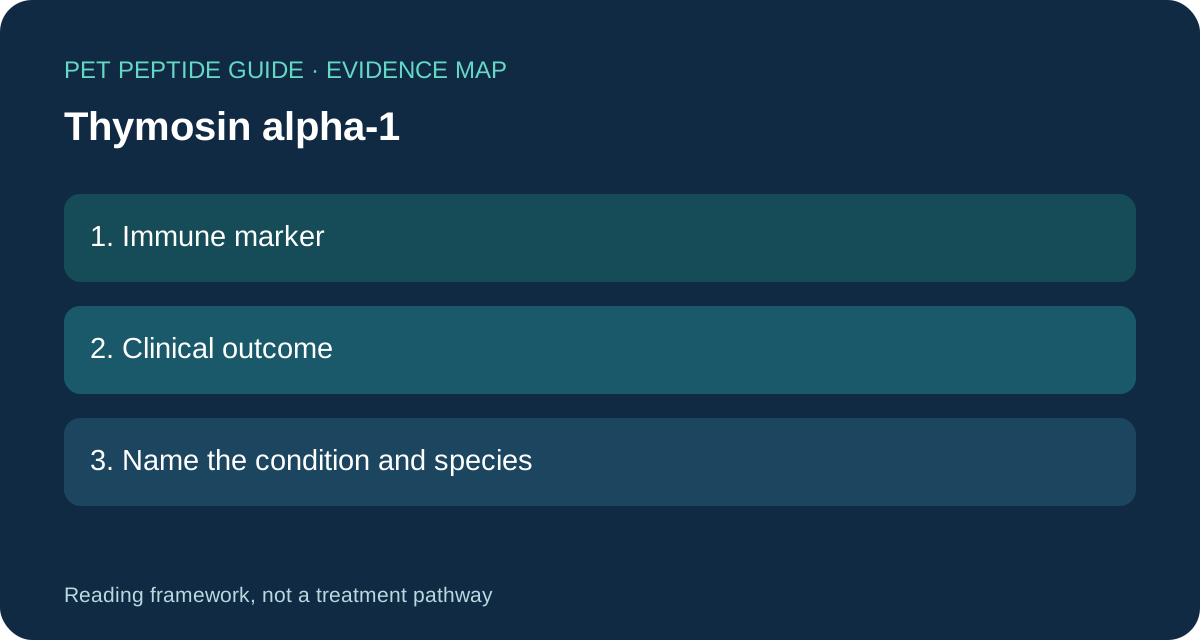
Direct answer: Immune modulation is a biological description, not proof that thymosin alpha-1 improves every illness or “boosts immunity” in pets. A useful claim must name the condition, species, treatment context, and clinical outcome.
What does immune modulation mean for a pet owner?
Thymosin alpha-1 is a different peptide from thymosin beta-4 and the TB-500 fragment. Similar names do not establish similar effects or interchangeable evidence.

What the primary source actually establishes
The TESTS randomized trial published in BMJ in 2025 evaluated thymosin alpha-1 in adults with sepsis. It did not find a significant overall reduction in 28-day mortality compared with placebo. This human trial illustrates why a plausible immune mechanism should not be presented as a guaranteed patient benefit. Read the original source.
Product identity and approval context
The cited human trial does not create an indication for dogs or cats. It also should not be read as proving that every possible use fails. Its conclusion belongs to the population and outcome actually studied.
How to use this evidence in a veterinary discussion
Write the proposed immune claim as a testable sentence: in animals with this diagnosis, using this preparation, does adding it to this care improve this outcome? If those blanks cannot be filled, “immune support” is too broad to guide a decision. A laboratory marker can be useful for understanding a mechanism, while still leaving questions about recovery, comfort, complications, or survival unresolved. Ask whether the evidence concerns prevention, treatment during an acute illness, or long-term management, because those are distinct uses. An owner’s role is to organize the question and the current treatment list, not to decide that more immune activity is always better. Evidence with neutral results belongs in that discussion alongside positive studies.
How should a neutral trial result affect an immune-support claim?
A neutral clinical result should narrow the claim made from that trial. It should not be hidden behind a list of favorable mechanisms, but neither should it be expanded into proof about every other condition or species. Ask whether the proposed use matches the population, timing, background care, and outcome in the study. That approach gives both positive and neutral evidence the same standard of interpretation.
Questions to take to your appointment
- Which specific disease and outcome are being discussed?
- Is there evidence in this species beyond immune markers?
- Does the proposed use match the study’s treatment context?
Use the printable product and evidence checklist to record the exact label, the source of a claim, and the unanswered questions. Bring the animal’s current medicines and supplements so a proposed product is not assessed in isolation.
Dogs, cats, routes, and formulations: what remains unresolved?
The source set above is a focused review, not a systematic search of every publication. Evidence from a dog does not automatically answer a cat question, and evidence from a laboratory model does not establish a clinical result in a household pet. Where this review has not verified a relevant preparation, route, or patient outcome, that detail remains unresolved. It should not be filled with instructions from a seller or a human regimen.
Frequently asked questions
Does this guide recommend Thymosin alpha-1 for my pet?
No. It explains the evidence question and its limits so you can discuss a specific concern with a veterinarian. A compound’s inclusion in the library is not a product recommendation, and no affiliate offer is attached to this guide.
Can I use a calculator to choose an amount?
The amount-to-volume calculator performs arithmetic using an amount already provided by a veterinarian and a confirmed concentration. It does not select a dose, frequency, route, or product. The concentration calculator likewise uses confirmed final volume; it does not supply mixing instructions.
How should I compare a related compound?
Start with the related evidence guide, then compare exact identity, species, route, and measured outcome. A shared marketing category is not evidence of equivalence. Use the main peptide guide and topic directory to navigate the full collection.
Prepared by Pet Peptide Guide using the sources identified here, checked September 12, 2026. This is AI-assisted editorial research, not veterinary review, product testing, or a clinical protocol. Missing evidence is described as a limit of this review, not proof that no research exists.
Sources and scope
This is an introductory guide or original comparison framework, not a systematic review or a product recommendation.
- Thymosin alpha-1: primary research or official product context — Supports the specific source discussion above; does not imply pet suitability.
Source checked September 12, 2026. A general context source does not establish a named product’s benefit.