
Veterinary Peptides: Which Product Pathway Applies?
Does veterinary peptide mean an approved treatment? Compare approval, indexing, extra-label use, compounding and investigational records.
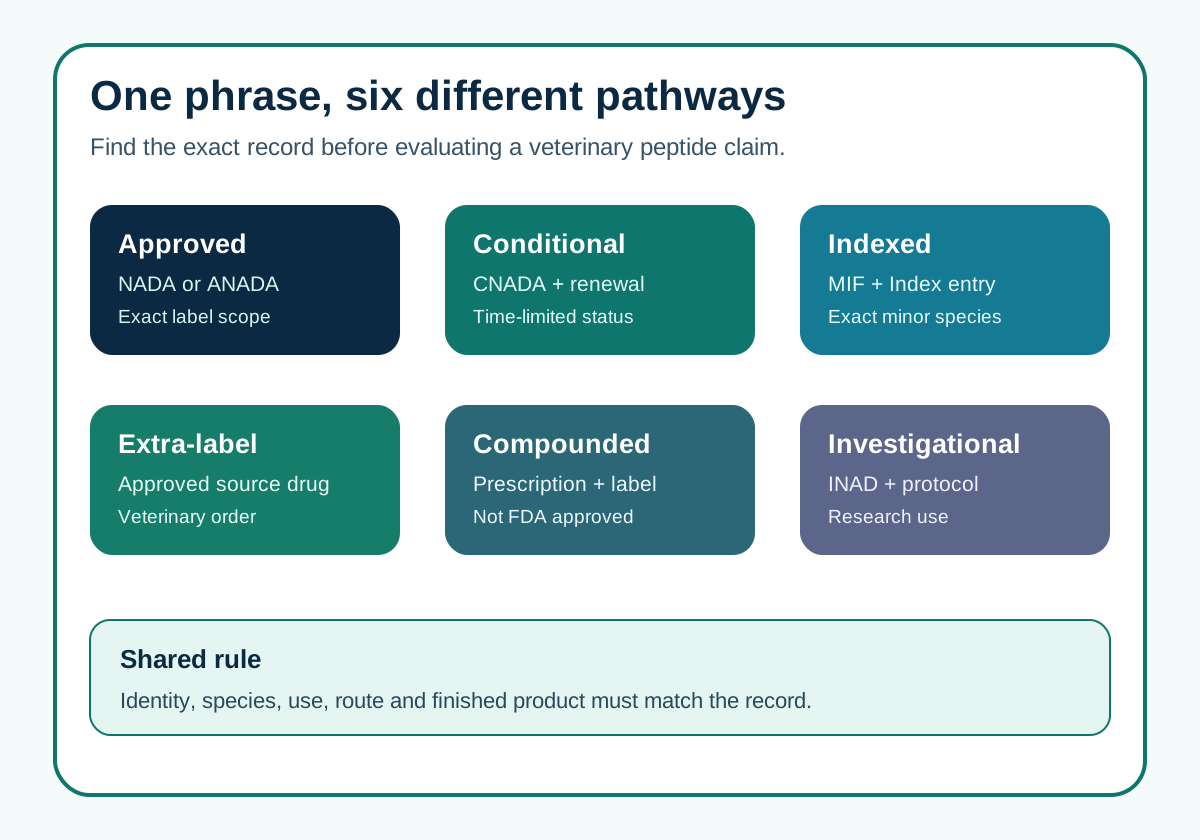
Does “veterinary peptide” identify an approved treatment? No. In the United States, the phrase does not name one regulatory class or care pathway. A peptide or protein product may be an FDA-approved animal drug, a conditionally approved drug, an indexed minor-species drug, an approved drug used extra-label by a veterinarian, a compounded preparation or an investigational material. The useful first step is to identify the exact finished product, species, use, route and document trail. Approval or study findings for one product do not transfer to another material that shares a peptide name.
Identify the record before evaluating the claim
The words on a storefront can sound clinical while leaving the legal status and evidence unresolved. A current label and application record can answer questions that a generic peptide description cannot.
Six pathways that should not be merged
FDA describes three routes that can give a new animal drug legal marketing status: approval, conditional approval and indexing. Those routes are different from a veterinarian's lawful extra-label use of an already approved human or animal drug. They are also different from compounding and from an investigational exemption used to conduct studies before approval.
| Pathway | Record to find | What the record supports | What it does not support |
|---|---|---|---|
| FDA-approved animal drug | Current label with NADA or ANADA number; Animal Drugs at FDA record | The reviewed finished product for the labeled species, indication, route and conditions of use | Approval of every product with the same ingredient, every species or every use |
| Conditionally approved animal drug | CNADA number, current label and annual approval status | Legal marketing for the labeled use while the sponsor completes effectiveness evidence, for up to five years with required renewals | Full approval, substantial evidence of effectiveness or extra-label use |
| Indexed minor-species drug | MIF number, Index entry and indexed labeling | Legal marketing for the exact use in the listed minor species under the Index | FDA approval, use in dogs or cats, or extra-label use |
| Veterinarian-directed extra-label use | Exact approved drug label plus veterinary order, patient record and directions within a valid veterinarian-client-patient relationship | A veterinarian's use of an approved human or animal drug outside its label under applicable federal conditions | A new product approval, layperson-directed use, or extra-label use of conditional or indexed drugs |
| Compounded preparation | Patient-specific prescription and pharmacy label; exact ingredient, concentration, dosage form, storage and prescriber instructions | The identity of a preparation made to meet a veterinary need in its applicable compounding context | FDA approval of the compounded preparation or automatic equivalence to an approved drug |
| Investigational material | Study protocol, sponsor or investigator, INAD documentation when applicable, investigational label and study records | Controlled use to investigate a defined product under the research framework | General retail sale, routine veterinary treatment or evidence that safety and effectiveness have been established |
Approved means product, species and use specific
FDA explains that most current approved animal-drug labels carry a six-digit New Animal Drug Application number, or an Abbreviated New Animal Drug Application number for a generic. The application number is more useful than a storefront category because it connects the exact finished product to its reviewed label.
Vetsulin is one concrete peptide-hormone example. Its current FDA labeling identifies porcine insulin zinc suspension, NADA 141-236, and a labeled use in dogs and cats with diabetes mellitus. That record establishes the status of Vetsulin for the conditions on its label. It does not approve insulin as a class for every animal, another formulation, a compounded version or an unlabeled research vial.
FDA's approval process also keeps the target species and intended use attached. A sponsor must support a specific product for a specific use in a specific animal species. A dog label is not automatically a cat label, and an approved endocrine drug is not evidence for a wound, joint or longevity claim.
Conditional approval is a time-limited legal status
A conditionally approved drug has completed the approval requirements except the full effectiveness demonstration. FDA requires a reasonable expectation of effectiveness, along with the other applicable safety, manufacturing and labeling requirements. Conditional approval lasts one year at a time and can be renewed annually for a total of up to five years while the remaining effectiveness data are collected.
This pathway is limited to certain minor-species drugs and drugs for a minor use in a major species. It is not a lighter label for any experimental peptide. The document check is the current CNADA record and label, including whether the annual conditional approval remains in effect. FDA also states that conditionally approved animal drugs cannot be used extra-label.
Indexing serves defined minor-species uses
An indexed animal drug is legally marketed but unapproved. It appears in FDA's Index of Legally Marketed Unapproved New Animal Drugs for Minor Species and carries a Minor species Index File number. Indexed drugs are not listed in Animal Drugs at FDA or the Green Book, so the Index and product labeling are the relevant records.
The Index supplies a useful peptide example. It lists deslorelin acetate, Suprelorin F, as a subcutaneous implant for management of adrenal gland cortical disease in domestic ferrets. That entry is tied to the exact species, product and intended use. It does not establish use in dogs or cats, and the required indexed-drug label statement says extra-label use is prohibited.
This distinction matters when a page calls something a veterinary peptide based only on use in one animal. A product indexed for ferrets is not an FDA-approved pet drug and does not create a general companion-animal indication.
Extra-label use starts with an approved drug
Under the Animal Medicinal Drug Use Clarification Act and its regulations, a licensed veterinarian can direct certain extra-label uses of approved human or animal drugs within a valid veterinarian-client-patient relationship when the applicable conditions are met. Extra-label use means the approved drug is used in a way that is not on its label, such as for a different species or condition.
The approval still belongs to the original product and label. A veterinarian's extra-label decision does not turn the new use into an FDA-approved indication. FDA also limits the pathway: extra-label use of conditionally approved and indexed animal drugs is prohibited, and food-producing animals bring additional restrictions and recordkeeping.
A pet owner should therefore ask for the exact approved source product, the reason the labeled option does not meet the animal's need, the written directions, the monitoring plan and the patient record. “Veterinary use” by itself does not answer any of those questions.
Compounding can meet a patient need without becoming approved
A compounded preparation may be medically necessary when no suitable approved, conditionally approved or indexed option can meet the animal's need. FDA nevertheless states that animal drugs compounded from bulk drug substances are unapproved new animal drugs. They do not undergo the same premarket product review, and compounders do not have the same federal post-market reporting obligations as approved-drug sponsors.
FDA Guidance for Industry 256 describes enforcement policies for limited bulk-substance compounding circumstances. Enforcement discretion is not approval. A substance appearing on an FDA compounding list is not proof that a preparation is approved, clinically effective for an unnamed pet, stable under any storage condition or interchangeable with a retail research product.
For a compounded peptide or protein, the useful record is the patient-specific prescription and pharmacy label. It should identify the active ingredient, concentration, dosage form, storage, beyond-use information and prescriber directions. A generic purity certificate cannot substitute for the clinical and product information in that record.
Investigational use is a research pathway
An Investigational New Animal Drug file is the FDA file under which studies can be conducted to document a new animal drug's safety and effectiveness. FDA's procedures require product details such as established name, dosage form, route and target animal. For clinical investigations, the investigational label carries a caution that the drug is for investigational animals in clinical trials and is not for human use. Sponsors and investigators also keep shipment and study records.
An INAD exemption permits research shipment and investigation under its conditions. It is not an approval and does not create a consumer-treatment pathway. Likewise, a paper describing a peptide in rodents, cells or purpose-bred dogs does not show that an online vial is an investigational veterinary product. The exact study material, sponsor, protocol, investigator and oversight must match.
The BPC-157 evidence guide shows why a dog pharmacokinetic study answers exposure questions without establishing a marketed dog treatment. The clinical-trial record guide explains how to connect a registry, protocol and results report.
Use a seven-record product check
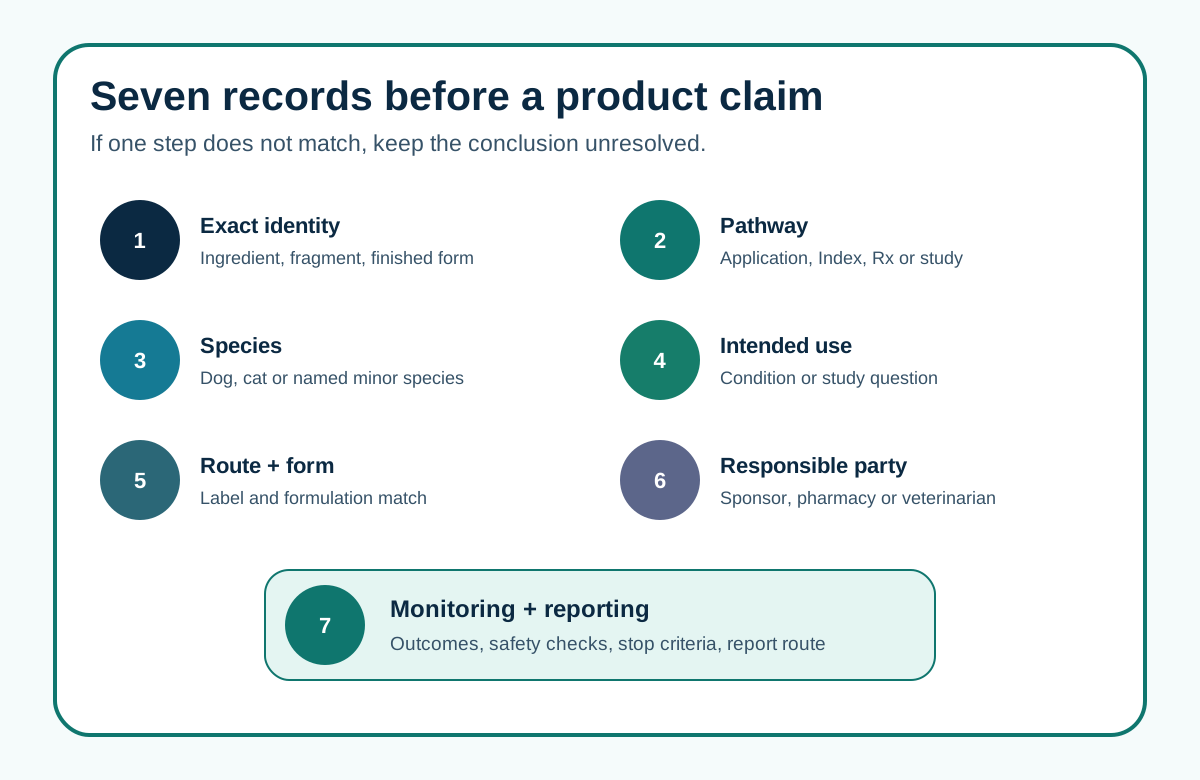
- Exact identity: Copy the active ingredient, salt or fragment, dosage form and finished product name. Do not merge a full-length protein, a shorter fragment and a similarly named blend.
- Pathway: Find the NADA, ANADA, CNADA or MIF number, or identify the extra-label, compounded or investigational record that actually applies.
- Species: Confirm the animal species on the label or protocol. “For pets” is not a species field.
- Intended use: Match the disease, condition or research question. Approval for one use does not validate another claim.
- Route and formulation: Match injection, implant, oral, topical or other routes and the exact formulation. Route changes can change exposure and risk.
- Responsible party: Identify the sponsor, manufacturer, pharmacy, veterinarian or study investigator accountable for the product and records.
- Monitoring and reporting: Record the clinical outcomes, safety checks, stop criteria and route for reporting a suspected product problem or adverse event.
If a seller supplies only a peptide name, claimed purity and broad veterinary benefits, the pathway remains unresolved. Do not assume the product is approved, compounded for a patient or part of a regulated clinical investigation.

Questions for the veterinary visit
- What is the exact finished product, active ingredient and formulation?
- Which legal or clinical pathway applies to this product and use?
- What application, Index, prescription or study record can I read?
- Does that record name my pet's species, condition and route?
- If the use is extra-label, what approved source product and patient-specific rationale apply?
- If it is compounded, what pharmacy label, storage information and monitoring apply?
- If it is investigational, who is the sponsor or investigator and what protocol governs use?
Open the free veterinary-visit checklist
Frequently asked questions
Are veterinary peptides an FDA-approved product category?
No. FDA status attaches to an exact finished animal drug and its pathway. The broad phrase can refer to products and materials with very different records.
Does an NADA number approve every use of the ingredient?
No. It identifies an approved finished animal drug. The label defines the reviewed species, indication, route and conditions of use.
Is a conditionally approved animal drug experimental?
It has legal marketing status for its label and has met the applicable requirements except the full effectiveness standard. It requires annual renewal and cannot be used extra-label.
Is an indexed animal drug FDA approved?
No. It is legally marketed but unapproved for the exact minor-species use in its Index entry. Its MIF number and indexed label identify that status.
Does a veterinarian's extra-label use create a new approval?
No. It is a patient-care pathway for certain approved drugs under federal and state conditions. The original product approval does not expand to the extra-label use.
Does FDA compounding guidance approve a compounded peptide?
No. Guidance 256 describes enforcement policies. A bulk-substance compounded animal drug remains unapproved, even when a veterinarian identifies a medically necessary role.
Does an animal study make a peptide a veterinary product?
No. A study supports only the exact material, species, route, design and outcomes it reports. An investigational record also does not create general retail approval.
Decision rule
Treat “veterinary peptide” as a prompt to find the product record, not as evidence by itself. Match identity, pathway, species, use, route and responsible party. When one field is missing, keep the claim unresolved and bring the exact label or listing to a veterinarian.
Sources and scope
This is an introductory guide or original comparison framework, not a systematic review or a product recommendation.
- FDA: How can I tell if a drug is legally marketed for animals? — Official label and database checks for approved, conditionally approved and indexed animal drugs, including NADA, ANADA and MIF identifiers.
- FDA: New Animal Drug Applications — Official definitions of NADA, ANADA and CNADA pathways and the investigational exemption context.
- FDA: Unapproved Animal Drugs — Current official comparison of approval, conditional approval and indexing, including their species and effectiveness limits.
- FDA: The Ins and Outs of Extra-Label Drug Use in Animals — Official veterinarian resource for extra-label conditions, records and the prohibition on extra-label use of conditional and indexed drugs.
- FDA: Animal Medicinal Drug Use Clarification Act of 1994 — Federal context for veterinarian-directed extra-label use of certain approved animal and human drugs within a valid veterinarian-client-patient relationship.
- FDA: Animal Drug Compounding — Current official explanation that animal drugs compounded from bulk substances are unapproved and that a medically necessary role can still exist in defined circumstances.
- FDA: GFI #256, Compounding Animal Drugs from Bulk Drug Substances — Official enforcement-policy guidance for limited bulk-substance compounding circumstances; it is not treated as product approval.
- FDA: Index of Legally Marketed Unapproved New Animal Drugs for Minor Species — Current Index record used to verify the exact deslorelin acetate, Suprelorin F, domestic-ferret example and its limited intended use.
- FDA: How to Get a New Animal Drug Approved and First Steps — Official INAD file, product-description, shipment and study-record context used to distinguish investigation from routine treatment.
- Animal Drugs at FDA: Vetsulin package insert, NADA 141-236 — Official product labeling used for the exact porcine insulin zinc suspension example in dogs and cats; no administration instructions are reproduced.
- FDA: Animal Drugs at FDA Explained — Official database scope and application-number guide, including the fact that indexed drugs are not listed in Animal Drugs at FDA.
Source checked November 02, 2026. A general context source does not establish a named product’s benefit.