
Peptide Clinical Trial Records: Registration, Results and Approval
Learn to read peptide trial registrations, results, record histories and safety reporting without confusing a human study listing with product or veterinary approval.
Does a peptide's ClinicalTrials.gov listing prove that it works or is approved? No. A registration describes a study; posted results report findings; a regulatory approval is a separate decision about a specific product and use. The useful next step is to connect the record's research question, dated plan, actual results and limitations before repeating a claim.

Prepared by Pet Peptide Guide with AI assistance; source-checked October 5, 2026. This article has not been reviewed by a veterinarian. It explains human clinical-research records and their limits for pet claims. It is not medical, veterinary or legal advice and does not recommend a product, treatment, dose or trial participation.
A trial identifier can make a peptide headline look more convincing. Sometimes the linked record is genuinely useful. Sometimes it describes a question that has not yet been answered. This guide shows how to tell what kind of evidence you are looking at, without treating an administrative label as a clinical result.
Keep four different documents separate
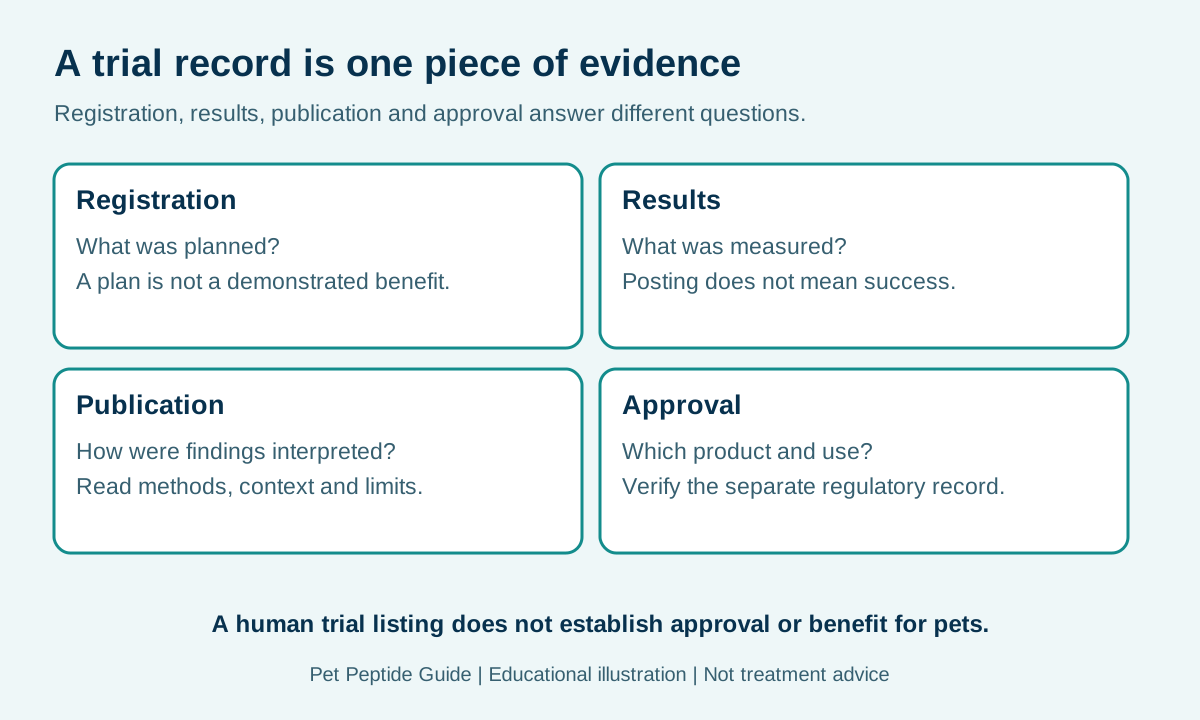
NIH's trial-finding guidance warns that listing a study does not mean the U.S. government has evaluated it. ClinicalTrials.gov contains information supplied by study sponsors or investigators. An NCT number identifies a registered study; it is not a product approval number or a quality seal.
| Document | Useful question | Limit to keep visible |
|---|---|---|
| Registration | What did the researchers plan to investigate? | A plan is not an observed benefit. |
| Results record | What numbers were reported for the groups and outcomes? | Posting is not proof that the intervention succeeded. |
| Research paper | How do the authors explain the methods, findings and limitations? | A paper can describe one analysis rather than the whole evidence base. |
| Approval record and label | What exact product and use did the regulator authorize? | Approval does not automatically extend to another preparation or species. |
These sources can complement one another. A fair summary might say that a study is registered, has no posted results yet and has not established the claimed outcome. That is more informative than calling the molecule either proven or disproven.
First confirm that the record matches the peptide claim
Open the original record rather than relying on a cropped screenshot. Check the compound's name, any aliases, the actual intervention, the participant population and the stated purpose. A similar name can conceal a different formulation. A study of one member of a peptide family does not become a study of every member.
The current ClinicalTrials.gov record guide identifies separate areas for eligibility, study design, interventions, outcomes, dates and publications. Use them to write a short identity note. For example: “This is an interventional study of a specified preparation in adults with a defined condition.” If the record instead describes an observational study, do not describe its participants as randomly assigned to treatment.
Next compare that sentence with the claim you encountered. A headline about general wellness may cite a study in a narrow disease population. A headline about a pet may cite a human trial. Neither mismatch can be repaired by the existence of an NCT number. Our peptide research basics guide explains the broader study-to-claim comparison.
Read recruitment status as status, not success
A recruitment label tells you about the study's operational state. It does not summarize the benefit-risk balance. “Recruiting” cannot mean that the treatment is known to help; the purpose of the research is to investigate unanswered questions. “Completed” does not mean that the primary outcome was positive or that a regulator approved the product.
If a record indicates that a study stopped early, look for the stated reason before interpreting it. Do not invent a safety explanation, a commercial explanation or a successful early result when the record does not provide one. An incomplete explanation is something to mark unknown, not an invitation to fill the gap with a preferred story.
Also note the last update and whether dates or enrollment figures are estimated or actual. A planned enrollment is not the number analyzed. An estimated completion date is not confirmation that data collection is finished. Keep your own access date so a later reader can understand when your summary was checked.
Check whether results exist, then read beyond the headline number
NIH's June 2026 explanation distinguishes registration information from results information. The former summarizes the research plan. The latter includes participant flow, baseline characteristics, outcome data and adverse events. A description of what investigators intend to measure should never be rewritten in the past tense as a finding.
The official results-reading guide explains the Results Posted, Results Submitted and No Results Posted labels. Look at the actual tab and any accompanying notes. The absence of posted results does not establish that a study failed. It also does not support a claim of benefit. Results may be unavailable for several reasons, including an unfinished study or a reporting deadline that has not arrived.
When results are available, start with who entered and who completed each study period. Then check how many people contributed to the particular analysis. Read the outcome's unit, time point and comparison group before interpreting a percentage or average. A result for a selected subgroup should not silently become a result for everybody who enrolled.
Safety information deserves the same attention. An adverse event is an unfavorable health event during a study; its appearance in a table does not by itself prove that the intervention caused it. Conversely, an empty field, missing results or short observation period cannot establish that no harm is possible. Examine the collection period, the groups being compared and the report's limitations.
Quality-control review is not a safety endorsement
NLM's training on clinical-trial transparency describes a limited quality-control review of registry information. That process looks for problems such as missing information or internal inconsistencies. It does not independently establish a study's scientific validity, safety or the accuracy of every submitted number.
An archived 2020 NLM bulletin also documents a posting procedure for certain applicable trials that can make submitted results available before quality-control review is complete, with comments identifying unresolved issues. That historical explanation is a reason to inspect the current record's notices carefully, not to assume that every modern tab follows an old screenshot.
For a peptide claim, the practical distinction is simple: “available in a government-hosted database” and “independently validated as a safe, effective treatment” are different statements. A record with visible review comments needs those qualifications preserved in any summary.
Use the record history to compare the plan with the report
ClinicalTrials.gov's Record History allows readers to inspect dated versions and compare changes. NLM announced side-by-side and merged comparisons in June 2024; its current study-record guide continues to describe this feature.
Choose a version relevant to the question you are asking and compare it with the current record. Look for changes to the primary outcome, measurement time, enrollment or study arms. Then check whether the paper or available protocol explains the difference. Updating a record is normal and necessary. A change alone does not demonstrate misconduct.
The original reading exercise below illustrates why chronology matters. It uses invented details and is not a summary of a real peptide study:
- Earlier plan: a fictional peptide study lists everyday physical function at twelve weeks as its primary outcome.
- Later publicity: a headline emphasizes a blood-marker change after four weeks.
- Question to resolve: was the planned function outcome reported, and what did it show?
- Bounded conclusion: the marker headline alone does not answer the original function question.
Do not assume the unmentioned outcome was favorable, unfavorable or deliberately concealed. Locate the results and explanation. If you cannot, say exactly which result remains unavailable. This is a method for checking a claim, not accusing investigators.
A human trial and a veterinary approval answer different questions
FDA's Investigational New Drug explanation describes the framework for investigating a drug in humans, including nonclinical information, manufacturing information and proposed clinical protocols. Investigational status is not marketing approval. Even an approved human medicine may be studied for a new indication or population.
FDA's drug-development definitions separately describe a marketing application and review of benefits, risks, labeling and manufacturing. Thus a trial's phase, registration or completion cannot substitute for checking the actual approval record and label of the product being discussed.
For dogs and cats, the animal-drug review process addresses a product's intended veterinary use, safety, effectiveness, manufacturing and labeling. Human trial findings do not establish those conclusions for a pet. A study performed in animals to support human development is also not automatically a veterinary clinical trial.
This distinction does not mean that every veterinary decision can be reduced to an approval lookup. It means readers should not claim pet approval or pet benefit from a human registry entry. Our human-approval guide explains that boundary, and the pet-peptide overview keeps the species-specific questions in view.
A compact note you can take to a professional
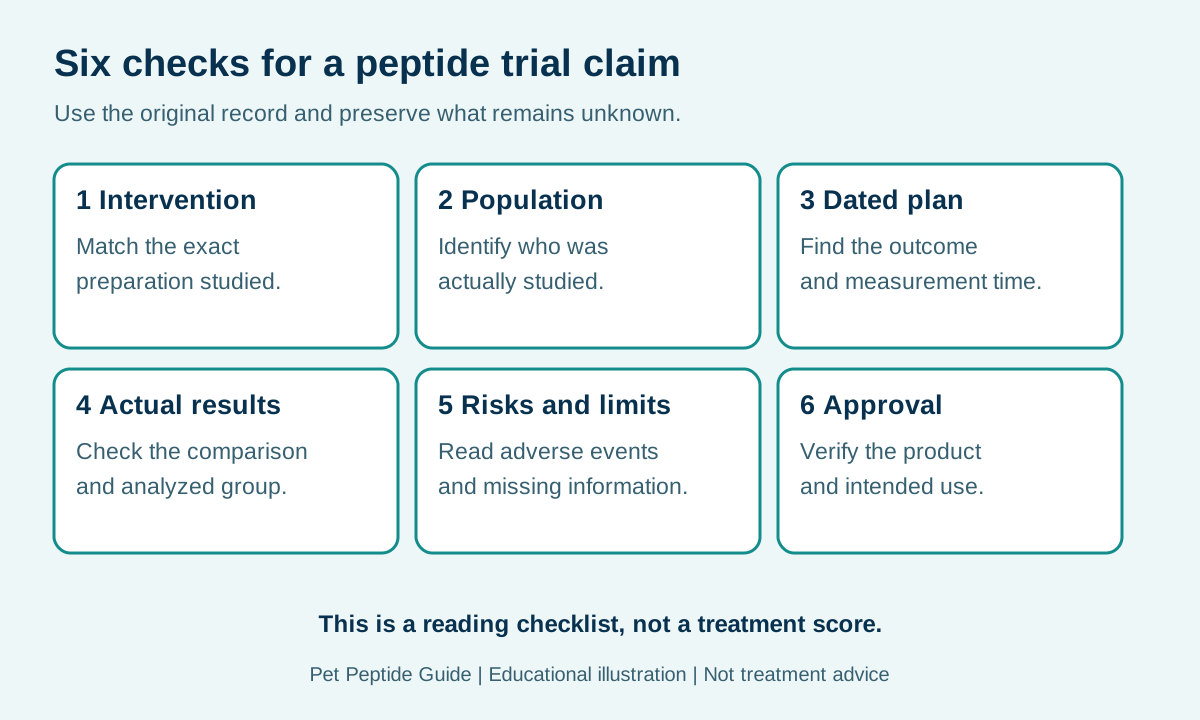
Use this original six-line worksheet when a peptide article cites a clinical-trial record:
- Identity: record URL, NCT number, exact intervention and date accessed.
- Population: who was eligible and whether the claim concerns the same people or species.
- Plan: primary outcome, time point and relevant dated version.
- Results: where findings are available, the comparison and the analyzed population.
- Uncertainty: missing outcomes, adverse-event reporting, review comments and limitations.
- Approval: the separate product-specific record, or a clear statement that approval has not been verified.
Leave unknown fields blank with an explicit “not found” or “not reported.” This is more useful than a homemade credibility score. Take questions about human care to a qualified clinician; pet owners can bring the source and the vet-visit checklist to their veterinarian. Do not change care or obtain an experimental product because a registry entry looks persuasive.
Bottom line: A trial record makes research easier to inspect. Its value comes from the details and the dated evidence trail, not from treating registration, completion, results posting and approval as interchangeable badges.
Sources and scope
This is an introductory guide or original comparison framework, not a systematic review or a product recommendation.
- NIH: Finding a Clinical Trial; listing is not federal evaluation
- ClinicalTrials.gov: How to Read a Study Record; current guide updated August 18, 2026
- ClinicalTrials.gov: How to Read Study Results; participant flow, outcomes, harms and limitations
- NIH: What Study Information Should Be Included; June 29, 2026
- NLM: Getting the Full Picture; registry transparency and quality-control limits
- NLM: Updated Quality Control and Posting Procedures; archived 2020 background, not current interface instructions
- NLM: June 5, 2024 update; record-version comparison feature
- FDA: Investigational New Drug Application; human investigation framework
- FDA: Drug Development and Review Definitions; marketing application and review
- FDA: Animal Development and Approval Process; separate veterinary product review
Source checked October 05, 2026. A general context source does not establish a named product’s benefit.