
Peptide Immunogenicity: Antibodies, Allergy and What Remains Unknown
Understand peptide immune responses, binding and neutralizing antibodies, purity claims, assay limits and why human findings do not establish safety for pets.
Can peptide medicines trigger an immune response? Yes. Some can lead to anti-drug antibodies or other immune reactions, but an antibody result is not automatically an allergy, treatment failure or proof of harm. The useful questions are what the immune response recognizes, whether it changes biological activity, and whether it affects the specific patient's safety or treatment response.

Prepared by Pet Peptide Guide with AI assistance; source-checked October 4, 2026. This educational article has not been reviewed by a veterinarian. It explains human drug-development concepts and a limited feline research example, not medical or veterinary treatment advice. It does not recommend a peptide, product, dose, administration method or self-testing plan.
“It is only a small peptide” and “the report says high purity” sound reassuring. Neither statement answers an immune-safety question on its own. Equally, finding antibodies in a trial does not mean every participant experienced a harmful reaction. This guide explains the distinctions without turning uncertain science into a safety ranking.
What immunogenicity means, and what it does not
Immunogenicity is the capacity of a therapeutic product to provoke an immune response. FDA's 2014 therapeutic-protein guidance considers responses to the product, related proteins and immune-related clinical events. Its formal scope is human therapeutic proteins. The concepts help explain the topic; the document is not a blanket assessment of every peptide or a veterinary approval.
The important consequences can differ. An immune response may have no apparent clinical effect, change drug exposure, reduce activity, or be associated with an adverse reaction. Cross-reactivity with a body's own related protein is a particularly important potential concern in some settings. These are possible outcomes that require investigation, not predictions for every molecule or patient.
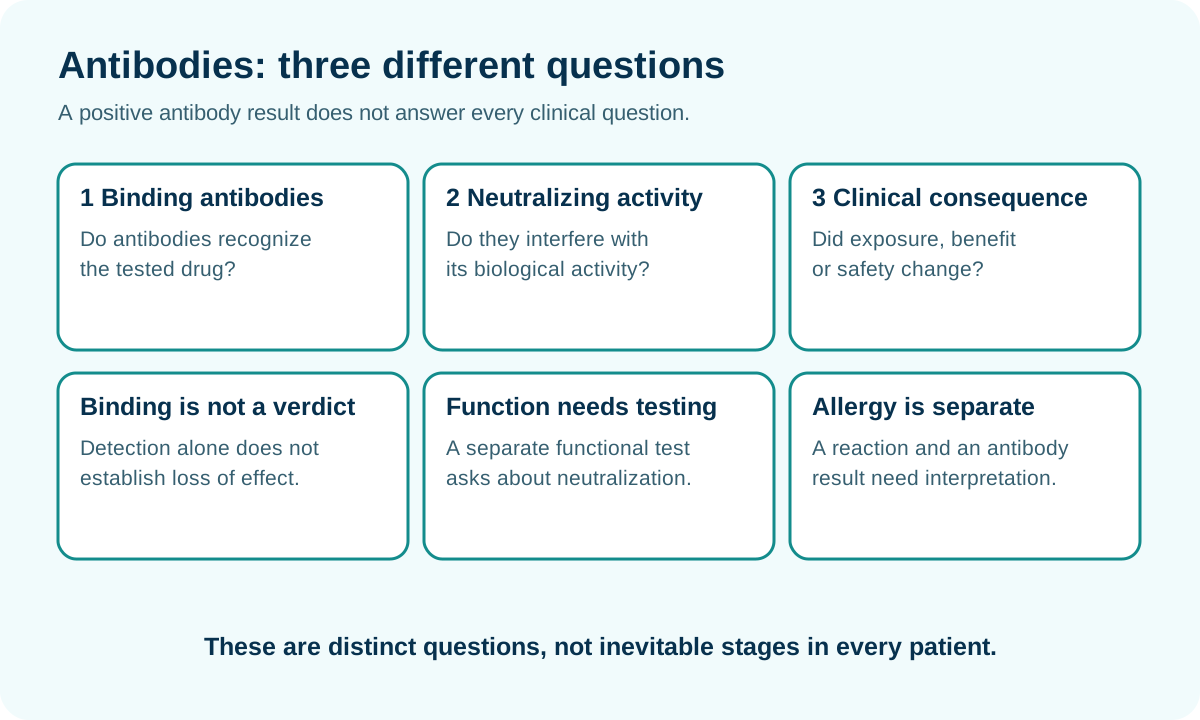
Keep three statements separate in your notes: “antibodies were detected,” “the antibodies interfered with activity,” and “a clinically meaningful change occurred.” Each requires different evidence. If an article uses the first statement to imply either of the others, look for the missing test or clinical observation.
Binding antibodies, neutralizing antibodies and allergy are different questions
| Term | What is being asked? | What the result does not settle |
|---|---|---|
| Binding anti-drug antibodies, or ADA | Does the sample contain antibodies that recognize the drug under the assay's conditions? | Whether drug activity or the patient's health changed. |
| Neutralizing antibodies | Do the antibodies interfere with the drug's biological activity in a functional test? | The full size or clinical importance of any effect in the patient. |
| Clinical immune-related reaction | Did an adverse event occur, and what evidence links it to an immune mechanism? | Whether an unrelated positive antibody result explains it. |
FDA's 2019 antibody-assay guidance separates screening, confirmation, antibody-level characterization and neutralization testing. A screening signal therefore is not the same as a confirmed response, and a confirmed binding response is not the same as demonstrated neutralization.
Allergy is not a synonym for any positive ADA test. Nor should symptoms be dismissed because a research antibody assay was negative. The study question and clinical evaluation are distinct. A reader should not diagnose the mechanism of a reaction from a chart, or change prescribed care on the basis of an antibody percentage in another study.
Why a peptide's size or purity percentage cannot answer everything
FDA's December 2023 draft peptide clinical-pharmacology guidance describes a risk assessment that considers molecular structure, manufacturing, patient characteristics and product-use factors. It remains a draft, explicitly not for implementation. It discusses short peptide size with qualifications about impurities and aggregates; it does not offer a universal “small means immune-safe” rule.
An aggregate is a grouping of multiple molecules. An impurity can be a different chemical species or another material associated with production. Those are different questions from whether the intended sequence appears on a label. The relevant formulation and manufacturing information cannot be replaced by one large percentage printed on a certificate.
This does not mean every impurity is harmful or every aggregate produces an immune reaction. It means the claimed conclusion must match what was characterized. Our separate testing-report guide explains how to read a report's sample, method and scope. An analytical result and evidence about immune responses in patients serve different purposes.
A 2024 salmon-calcitonin study by Roberts and colleagues shows why researchers investigate more than a purity total. The investigators compared the intended peptide with selected sequence-related impurities using computational predictions, binding measurements and human donor-cell assays. Some results differed between the materials, but the higher frequency of donor responses to impurities did not reach statistical significance compared with the active ingredient. The authors also described limitations of laboratory models and formulation effects on cell health.
That is evidence about how to investigate possible immune recognition, not proof that those impurities caused clinical illness. Human cells in a laboratory are not patients, and an immune-system binding prediction is not an allergic reaction. This distinction works in both directions: an interesting signal merits further study, while an inconclusive comparison does not establish that every impurity is harmless. The paper's discussion of regulatory guidance predates FDA's July 2026 update described below.
For an original fictional example, a document could report that a tested sample met a stated chemical-purity specification. A headline saying “therefore it cannot cause antibodies” adds a conclusion the result did not measure. A more accurate summary would preserve the reported test result and leave the clinical immune question open.
A human exenatide example: antibody detection is not a yes-or-no verdict
A 2012 analysis by Fineman and colleagues combined antibody findings from multiple human exenatide trials. The accessible abstract reports that low antibody levels were common without an apparent efficacy effect, while higher levels occurred in smaller groups and were associated with a smaller average glycemic response in some analyses. Injection-site reactions were an important exception when comparing adverse-event patterns.
That is more informative than “antibodies formed, so treatment failed” or “most people did well, so antibodies never matter.” The source distinguishes antibody level, formulation, observation period and clinical outcome. We reviewed its abstract, not a complete independent reanalysis of trial data. Its results concern the studied human medicine and populations; they do not estimate an immune-reaction rate for a research chemical, a different peptide or a cat.
A separate 2011 LEAD-trial analysis measured antibodies in people with type 2 diabetes receiving liraglutide or exenatide. It evaluated binding, cross-reactivity, in-vitro neutralization and glycemic response as distinct outcomes. This is a useful example of asking more than one question about an antibody result. It is not a reason to select or switch medicines from an online comparison.
Why two antibody percentages may not be comparable
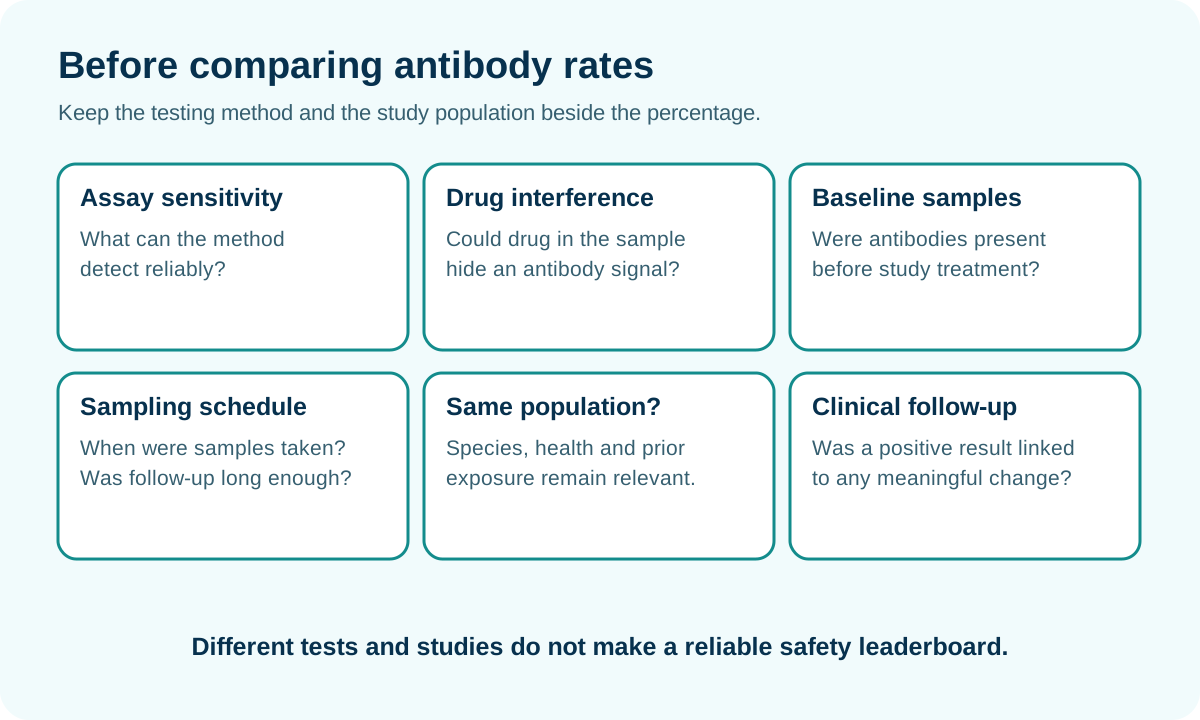
Imagine two fictional reports: one says 5% of participants had antibodies, the other says 15%. You cannot conclude that the first product has one-third the immune risk without knowing how the results were obtained. A more sensitive assay, a different population or a longer sampling period can change what is detected. The denominator also matters: were all enrolled participants tested and interpretable?
Drug remaining in a sample can interfere with antibody detection. A 2012 FDA-scientist survey of biological-product applications identified circumstances where circulating drug exceeded an assay's tolerance and could suppress detected ADA rates. That survey concerns biologics and assay interpretation, not a measured rate for all peptide products. It illustrates why “negative” needs a method and a sampling context.
For your own comparison sheet, use separate columns for the assay, sampling times, baseline antibody status, number with interpretable results, antibody persistence, neutralization and clinical findings. Write “not reported” rather than treating a blank as zero. If methods are not comparable, say that the percentages cannot support the proposed ranking.
The veterinary boundary: what the cat study leaves unanswered
A 2021 proof-of-concept study of an exenatide implant in healthy cats provides a concrete translation limit. Its discussion identifies feline anti-exenatide antibody measurement as needed to understand possible effects on measured exposure and neutralization. The study does not establish that cats share a human antibody rate or that this experimental preparation has a low immune risk.
This is companion-animal research, but it is not an approval record or a treatment recommendation. “Studied in cats” still needs the study's actual purpose beside it. Human antibody findings, a healthy-cat experiment and treatment outcomes in cats with a diagnosed disease are separate bodies of evidence.
Likewise, an immune response in a preclinical animal model may help interpret that experiment without reliably predicting the human response. Conversely, a human medicine's record does not establish its suitability for dogs or cats. Our human-approval guide keeps those regulatory and species questions separate. A pet-specific decision belongs with the veterinarian who knows the animal and exact product.
Unknown immune risk must not hide other safety signals
FDA's July 2026 BPC-157 briefing reported that formal product immunogenicity studies had not been supplied or identified, and discussed concerns about impurities and aggregation. That is an evidence gap and a potential risk, not a measured immune-event rate.
The same briefing's animal-safety appraisal described altered clotting measurements after repeat exposure, with shortened aPTT in rats and prolonged aPTT in dogs, alongside liver-associated laboratory signals. These observations were not proof of an immune mechanism. Longer-duration and other safety gaps remained. The document concerns evaluation for a human-compounding list; it is not veterinary approval or a current blanket legal-status determination. See the fuller BPC-157 dog-safety discussion.
This example matters because an article focused on one risk can accidentally make all other risks disappear. A careful summary distinguishes “this outcome was not studied,” “this concern is biologically plausible,” and “this signal was observed.” None should be rewritten as a guarantee of safety or inevitable harm.
Check the date and status of regulatory guidance
On July 28, 2026, FDA announced 17 revised draft product-specific guidances for generic peptide products and withdrew its May 2021 guidance on certain highly purified synthetic peptides referencing recombinant products. FDA said the withdrawn document no longer reflected its current scientific thinking. The new product-specific documents were drafts when announced.
A saved quotation from the 2021 guidance should therefore not be presented as the current rule. Equally, a revised draft is not the same as a final document, an approval of an unreviewed product or permission to extrapolate to pets. Check the exact document, date, scope and status before repeating a threshold or using regulatory language as reassurance.
For this article, the 2014 and 2019 FDA documents support general human protein-development concepts, the 2023 peptide document is labeled as a draft, and the July 2026 announcement records a specific update. None supplies a veterinary benefit claim. Regulatory precision is part of scientific accuracy, not just a footnote.
A short checklist for the next immune-safety claim you read
- Name the exact finding. Was it a binding antibody, neutralization result, clinical reaction or merely a predicted risk?
- Keep the product attached. Record the molecule and finished preparation. Do not transfer a medicine's data to an unrelated listing.
- Check the test context. Look for the method, baseline, sampling period and interpretable denominator.
- Look for clinical meaning. Ask whether exposure, measured benefit or safety changed, and whether the authors could establish a relationship.
- Preserve the limits. Keep species gaps, missing long-term data and non-immune safety findings visible.
This checklist is an original reading aid, not a home diagnostic tool or treatment-selection score. It works alongside our general peptide-research pillar, which covers study design and endpoints, and the pet-peptide overview. Bring the original source and exact product details to an appropriate clinician; pet owners can use the vet-visit checklist.
Bottom line: A peptide's immune profile cannot be read from its name, size, purity headline or one antibody percentage. Meaningful interpretation connects the product, the immune test and the clinical result, while being explicit about what remains unknown.
Sources and scope
This is an introductory guide or original comparison framework, not a systematic review or a product recommendation.
- FDA: Immunogenicity Assessment for Therapeutic Protein Products (2014) — Final human therapeutic-protein guidance; definitions, possible consequences and risk factors. Scientific concepts do not establish the immune profile of a particular peptide or a veterinary approval.
- FDA: anti-drug antibody assay development and validation (2019) — Final human therapeutic-protein assay guidance; screening, confirmation, characterization, neutralization and assay limitations.
- FDA: Clinical Pharmacology Considerations for Peptide Drug Products (December 2023 draft) — Draft, not for implementation. Human NDA-development discussion of product, process, patient and exposure factors; not a universal peptide-size safety cutoff.
- Fineman et al. (2012): clinical relevance of anti-exenatide antibodies — Primary pooled human-trial analysis. Abstract reviewed; low- and higher-titer findings and injection-site-reaction exception retain their study/formulation limits.
- Buse et al. (2011): antibody findings in the human LEAD trials — Primary human type 2 diabetes trial analysis; abstract describes distinct antibody binding, cross-reactivity, in-vitro neutralization and glycemic-response measurements.
- Wang et al. (2012): drug interference in immunogenicity assays — Primary survey of biological-product applications; abstract supports assay-interference caution, not an immune-event rate for peptides or pets.
- Roberts et al. (2024): immunogenicity risk assessment of salmon-calcitonin impurities — Original computational and human-cell research. Donor-response comparisons were not statistically significant; laboratory findings are not clinical harm rates. Historical regulatory context predates July 2026 withdrawal.
- Klotsman et al. (2021): exenatide implant proof of concept in healthy cats — Original experimental healthy-cat study; authors identify anti-exenatide antibody measurements as future work. Company funding and relationships disclosed; not a veterinary approval or established therapy.
- FDA: July 2026 BPC-157 compounding briefing — Human-compounding advisory briefing, not a final legal determination or pet approval. Printed pages 39 and 42–43 cover animal clotting/liver-associated signals, missing formal immunogenicity studies and duration limits.
- FDA: July 28, 2026 generic-peptide guidance update — Official notice of 17 revised draft product-specific guidances and withdrawal of the May 2021 synthetic-peptide guidance. Announcement does not approve an individual product.
Source checked October 04, 2026. A general context source does not establish a named product’s benefit.