
Peptide Research Basics: How to Read a Study and Check Its Claims
A practical guide to peptide study design, clinical endpoints, controls, uncertainty and the limits of translating research between animals and humans.
How do you tell whether a peptide study supports a claim? Keep the claim attached to the exact substance, population, comparison, measured outcome and follow-up. A change in a cell, a blood concentration or a laboratory marker can be useful research without demonstrating that a person or pet feels better, functions better or lives longer.

Peptide research spans molecular experiments, animal models, exposure studies and clinical trials. The challenge is not to assign every paper a single good-or-bad score. It is to work out which question the design can answer, how uncertain that answer is, and how far the headline has travelled beyond it.
This general research-reading guide was prepared with AI assistance and source-checked October 3, 2026. It is not medical or veterinary advice, a systematic review, or a veterinarian-reviewed article. It does not recommend a peptide, dose, product or experimental treatment. The examples marked fictional teach interpretation; they are not study results.
Start with one sentence you can check
Before opening a long list of references, write down the precise claim you are investigating. “Supports recovery” is too broad to compare with a methods section. Recovery from what, in whom, measured how and over what period? A claim about a molecular pathway is different from a claim about pain, daily activity, disease progression or survival.
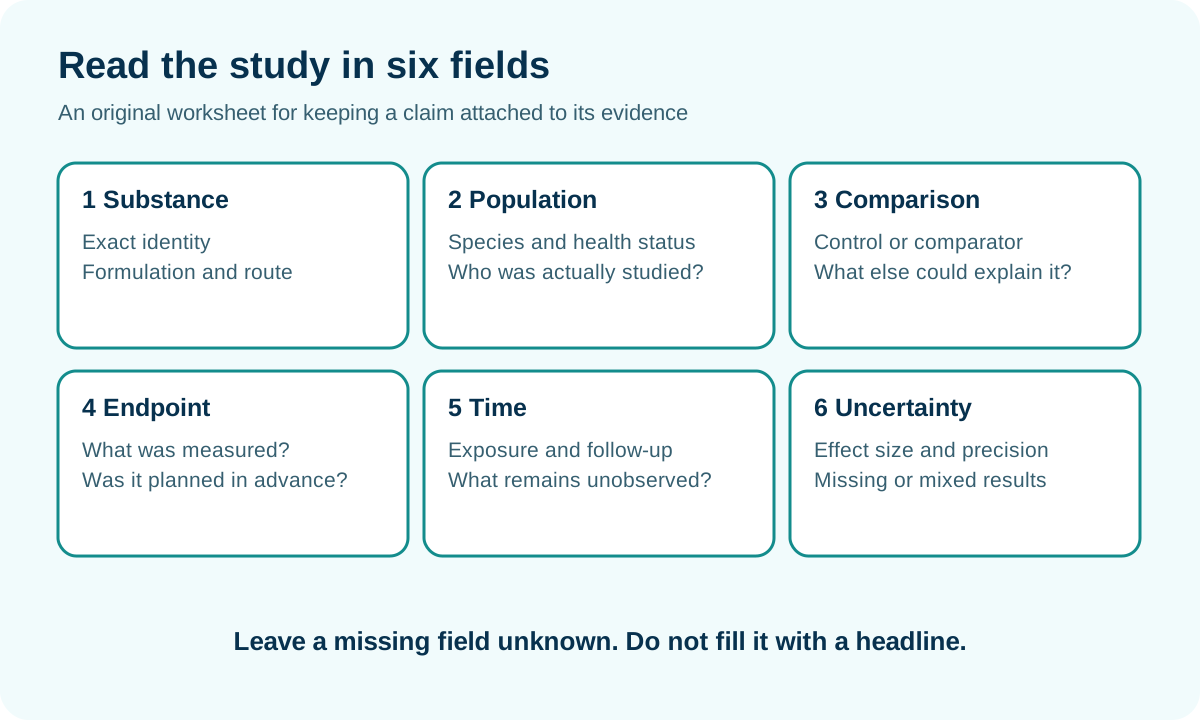
Use this original reading template: In [population], researchers compared [exact preparation] with [comparator], measured [prespecified outcome] over [time], and found [result plus uncertainty]. Leave an empty field visibly unknown. Do not supply the missing species, formulation or outcome from a seller's description.
Then write the proposed conclusion on a second line. Every difference between the two sentences is a question to resolve. Perhaps the experiment involved healthy adults, while the claim concerns older people with a disease. Perhaps it measured absorption, while the headline promises faster healing. This side-by-side exercise makes the leap visible without dismissing the underlying research.
Identify what kind of study you are reading
| Study type | Useful question | What does not follow automatically |
|---|---|---|
| Cell or tissue experiment | Does a defined system show a molecular or cellular response? | A benefit in a whole person or animal. |
| Animal model | What happens in this species and experimental condition? | The same result in another species or a naturally occurring disease. |
| Pharmacokinetic study | How does exposure change over time with this preparation and route? | Relief of symptoms, functional improvement or long-term safety. |
| Clinical outcome study | Does the specified intervention change a defined patient outcome? | Benefit in unstudied populations, other products or every endpoint. |
| Toxicology or safety study | Which observations were made under the tested conditions? | Absence of rare, delayed or unmeasured harm. |
This table is a reading framework, not a ranking of all possible designs. A well-designed exposure experiment can be the right way to answer an exposure question. It becomes misleading when a writer quietly substitutes a treatment question that was never tested.
A real illustration is the 2022 BPC157 pharmacokinetic paper in rats and beagles. Its measurements concern the compound's behavior in the body. The presence of dogs in a paper is not, by itself, evidence that it measured dog comfort or recovery. Our pet-peptide overview explains the broader categories.
Read the endpoint before the conclusion
An endpoint is the specific result a study uses to answer its question. FDA distinguishes clinical outcomes, which directly concern how people feel, function or survive, from surrogate endpoints used to stand in for those outcomes. A biomarker can be informative without being a validated surrogate for a particular benefit. Validation depends on evidence and context; it is not supplied by an impressive-looking laboratory change.
That does not mean surrogate endpoints are worthless. Some are well supported for specific uses, while others remain candidates. The reading task is to identify what the marker is intended to predict and whether that relationship is established for this intervention and setting. See FDA's endpoint resource.
For an original fictional example, imagine a report saying a peptide changed a blood marker after one week. A headline saying “improves everyday stamina” adds an outcome unless stamina was actually measured. If a walking test was also collected but did not improve, that result belongs in the summary too. A favorable marker cannot erase an unfavorable or inconclusive functional outcome.
Write each endpoint on its own line. Record whether it was the main planned outcome, another planned outcome or an exploratory finding. Avoid replacing a mixed set of results with a single word such as “worked.”
Ask what the comparison can rule out
A before-and-after difference is a starting observation. Interpreting its cause requires asking what else changed: time, concurrent care, measurement conditions or selection of participants. A suitable comparator helps separate those possibilities. The ARRIVE study-design guidance explains why the choice of control must match the research question, including vehicle, sham or active-treatment comparisons where appropriate.
A feasibility project can still be useful without a control group. Its conclusion simply needs to stay within that purpose. “The procedure could be carried out” is not the same as “the intervention caused the improvement.” Similarly, an active comparison can address a different question from a placebo comparison.
For a fictional reading exercise, suppose a small group reports better sleep after starting an intervention while changing exercise and bedtime routines. A careful summary preserves all those changes. It cannot isolate the peptide's effect merely because the peptide is the subject of the headline.
Look beyond the words randomized and blinded
Random assignment is meant to reduce systematic differences between groups. Look for how the sequence was generated, what unit was assigned and whether allocation could be predicted. The word “random” alone does not tell you those things. In animal work, several measurements from one animal are not automatically several independent animals. ARRIVE's randomisation explanation provides questions for reading the actual method.
Blinding asks who knew which intervention was assigned. The person delivering it, the person observing outcomes and the person analyzing the data may have different roles. An article can call a study “double blind” while leaving those details unclear. Check the stages rather than counting the word “blind.” ARRIVE describes these stages explicitly.
If masking was impractical, look for the explanation and any safeguards the researchers used. An unreported method is an information gap; it is not permission to invent either a flawless process or misconduct.
Keep effect size and uncertainty together
A statistical test does not tell you by itself whether a difference matters in daily life. Record the estimated size of the effect in its original units, the comparison and the uncertainty interval. A small precise change and a large imprecise change pose different interpretation questions. ARRIVE's results guidance separates statistical significance from biological importance and encourages reporting effect sizes and confidence intervals.
Read how the sample size was chosen and how many independent units contributed to each result. The enrolled number may differ from the analyzed number. Exclusions, withdrawals and missing outcomes can change the picture. ARRIVE's sample-size guidance explains why weak statistical power can both miss effects and exaggerate detected ones.
Do not turn “not statistically significant” into “proven identical.” Nor should a small preliminary sample be presented as a reliable estimate of uncommon harm. Ask whether the study was designed to answer the question the summary assigns to it.
Separate a planned test from a new hypothesis
A study can yield both a test of a planned hypothesis and a promising observation that emerged during analysis. Both can be valuable, but they warrant different language. A dated protocol or preregistration helps readers distinguish them. The Center for Open Science's preregistration guidance explains this separation.
Changes to a plan are not automatically disqualifying. Look for a transparent account of what changed, when and why. Exploratory findings can justify another study; they should not quietly become the original primary result after researchers have seen the data.
A trial-registry record is also not an approval stamp. NIH explicitly cautions that listing on ClinicalTrials.gov does not mean federal approval of the study's safety or science. Check whether the record describes a planned, recruiting, completed or results-reporting study. A plan does not supply a result.
Do not skip the species and preparation gaps
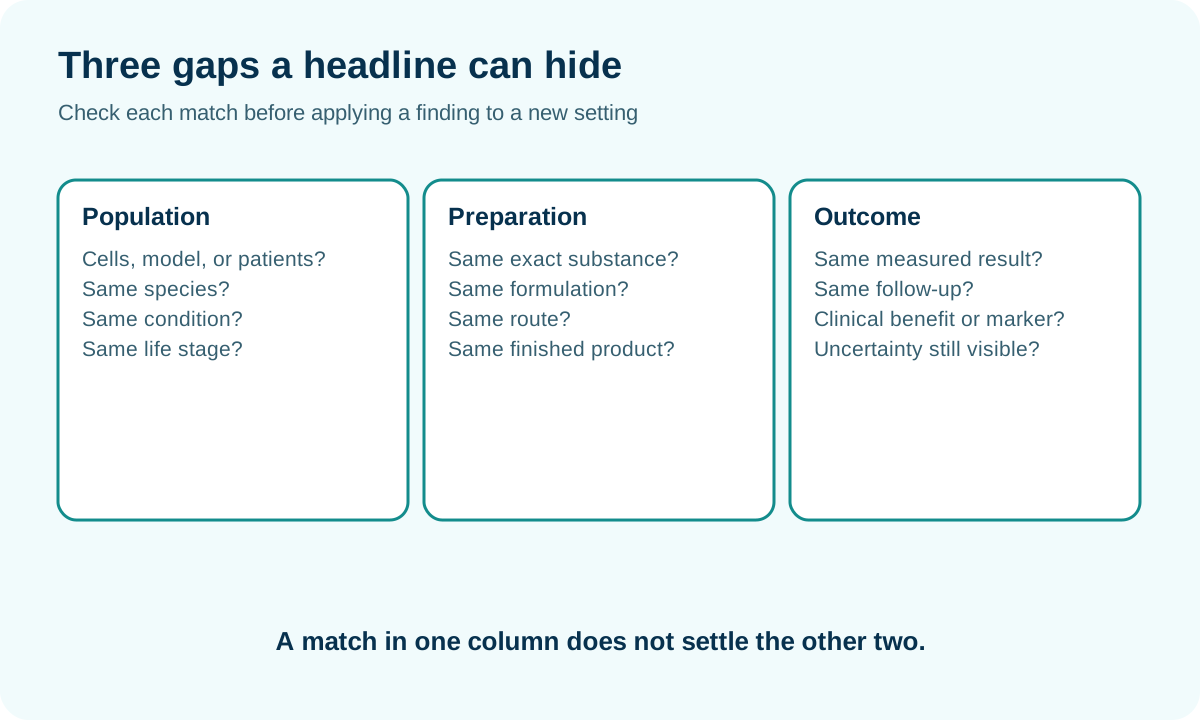
Translation requires more than a shared pathway. Species, age, sex, health status, experimental model, preparation, route and outcome all affect how closely the work matches a new question. ARRIVE's translation guidance asks researchers to discuss those boundaries and supporting evidence.
This applies in both directions. A rat experiment is not a human clinical result. A successful human trial is not automatically evidence for a dog or cat. A healthy research animal is not interchangeable with an older household pet taking other medicines. The existence of an animal model does not mean the model was intended to establish a veterinary treatment.
Likewise, an ingredient name is not a finished formulation. FDA's bioavailability explanation describes why formulation or route changes can require additional exposure studies. A capsule, topical preparation and injection should not inherit each other's conclusions just because the short compound name matches.
For the product-matching step, use our separate ingredient research versus finished-product research guide. For regulatory context, see what human peptide approval means for dogs and cats. These are different questions from whether an experiment was competently performed.
A safety conclusion should describe what was actually assessed
Safety summaries need the same discipline as benefit summaries. Write down the monitored outcomes, observation period, population and preparation. An absence of visible distress is not interchangeable with a comprehensive laboratory assessment. An unmeasured outcome should be called unmeasured; an unknown frequency should stay unknown.
Source access matters too. An abstract is a compressed account, not a substitute for methods and tables. A later regulator's appraisal can add relevant information without turning the appraisal into a clinical event-rate estimate. Our BPC-157 dog safety guide now distinguishes the original abstract from FDA's July 2026 discussion of the animal toxicology data. The guide retains the limits on what that evidence says about household dogs.
Look for contrary observations and limitations with the same care as favorable findings. Neither “no risk” nor “certain harm” is a responsible substitute for a bounded result.
Use a five-minute research note
This original checklist turns reading into a record you can revisit:
- Copy the claim: one sentence, with the proposed benefit or safety assertion.
- Identify the source: original paper, abstract, registry record, regulatory document or commentary; include its date.
- Fill the six fields: substance, population, comparator, endpoint, time and uncertainty.
- Mark the mismatch: underline any change of species, product, route or outcome between study and claim.
- Write the next question: name the evidence needed to close that gap rather than choosing a regimen.
For a pet-care conversation, bring the source and exact product details to your veterinarian using the free visit checklist. For a human health decision, discuss the evidence with a qualified clinician. A stronger reading method improves the question; it does not replace individual clinical judgment.
Explore general peptide science
When a headline highlights a few favorable results, use the multiple-outcomes reading worksheet to find the planned question, complete outcome list and analysis context.
When observations disappear between enrollment and a final graph, use the missing-data and exclusions worksheet to follow each group and outcome without assuming an unobserved result.
For the methods behind a headline, use the randomization and blinding reading worksheet to distinguish group assignment from who knew the treatment during scoring and analysis.
Counting dots in a graph? Use the sample-size and repeated-measurement worksheet to distinguish independent units from additional readings and track the number analyzed for each endpoint.
For a focused safety concept beyond study design, read Peptide Immunogenicity: Antibodies, Allergy and What Remains Unknown. The companion explains why a detected antibody is not automatically an allergy or treatment failure, why assay methods matter, and where human and veterinary evidence diverge.
For a step-by-step guide to registry evidence, read Peptide Clinical Trial Records: Registration, Results and Approval. It explains results tabs, dated record changes and why a trial listing cannot establish pet approval.
For a closer look at marker-to-benefit claims, read Peptide Biomarkers and Surrogate Endpoints. It separates biological activity, reliable measurement and evidence that a marker predicts a specific health outcome.
For interpreting suspected harm, read Peptide Adverse-Event Reports: Signals, Causes and Safety Claims. It explains why report totals are not risk rates and why unrecorded outcomes cannot establish safety.
Before reusing a citation, read Peptide Papers: Preprints, Corrections and Version Checks. It shows how to follow a claim across publication stages and linked notices without counting versions as independent studies.
Quick answers
Does peer review mean a peptide is approved?
No. Publication and product approval serve different functions. FDA describes a separate animal-drug review process that evaluates the intended use, safety, effectiveness and product quality. Check the exact regulatory record instead of treating a journal citation as a label.
Is an animal study useless for people or pets?
No. It can answer an important question about a model, mechanism or exposure. The problem arises when its conclusion is expanded beyond what was tested without the necessary bridging evidence.
What if only the abstract is available?
Record that access limit. Summarize only what it establishes, avoid reconstructing unreported methods, and look for an authorized full text or relevant primary regulatory appraisal before making a stronger claim.
What is the most useful first check?
Find the measured endpoint and compare it with the promised outcome. If those are different, keep the difference visible throughout your summary.
Sources and scope
This is an introductory guide or original comparison framework, not a systematic review or a product recommendation.
- FDA: surrogate endpoint resources — Clinical outcomes, biomarkers and context-specific surrogate validation; human drug-development definitions.
- ARRIVE: study design and controls — Comparator selection must follow the research question.
- ARRIVE: randomisation — Sequence generation and assignment methods in animal research.
- ARRIVE: blinding and masking — Identify masking across allocation, conduct, assessment and analysis.
- ARRIVE: sample-size rationale — Power, independent units and sample-size justification.
- ARRIVE: effect sizes and confidence intervals — Magnitude, uncertainty and biological importance.
- ARRIVE: generalisability and translation — Limits when applying findings across models, populations and settings.
- Center for Open Science: preregistration — Separating planned confirmation from exploration; changes require transparency.
- NIH: finding a clinical trial — A ClinicalTrials.gov listing is not federal approval of safety or science.
- FDA: bioavailability studies guidance recap — Exposure questions when formulation or route changes; no equivalence inferred for pet products.
- FDA: animal-drug development and approval — Product-specific review, separate from research publication.
- He et al., 2022: BPC157 pharmacokinetics — Illustration of an exposure question rather than a clinical benefit endpoint.
Source checked October 03, 2026. A general context source does not establish a named product’s benefit.