
Peptide Injections for Dogs: Approved, Compounded, or Experimental?
Before considering a peptide injection for a dog, distinguish approved animal drugs, extra-label use, compounded preparations, and experimental compounds.
What should a dog owner know about peptide injections? “Peptide injection” is not one treatment category. Before judging a claim, identify the exact active ingredient and finished product, the dog’s diagnosis, the injection route, and the legal veterinary pathway. An FDA-approved canine insulin product, a patient-specific compounded preparation, and experimental BPC-157 material have different evidence, manufacturing controls, labels, and monitoring. Evidence for one does not validate the others.

People searching for peptide injections for dogs may find prescription hormones, monoclonal-antibody biologics, compounded medicines, experimental compounds, and research-chemical listings on the same results page. The injection route tells you how a preparation enters the body. It does not tell you whether the ingredient is approved, effective for a condition, suitable for a dog, sterile, or equivalent to the material used in a study.
This is an AI-assisted evidence and care-pathway guide, not veterinary advice or a systematic review. FDA animal-drug resources and the current Vetsulin label were checked October 10, 2026. This page does not provide a dose, syringe conversion, reconstitution recipe, injection technique, supplier, or recommendation to use any product.
The first question is “which product category?”
Start by putting the proposed injection into the right lane. The lanes can overlap in conversation, but their evidence cannot be pooled. A veterinarian-directed extra-label use of an approved drug is not the same as a compounded preparation. A compounded prescription is not FDA approval. A laboratory paper is not a prescription label. A seller’s “research use” vial is not a veterinary care pathway.
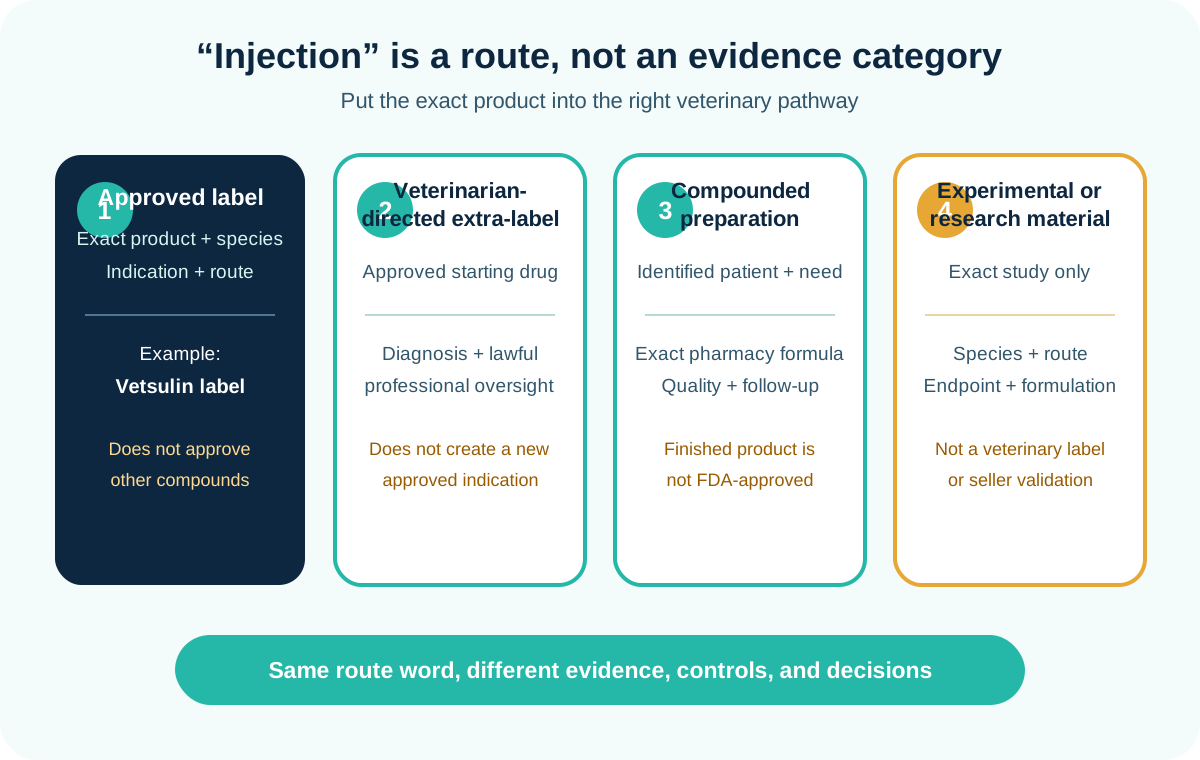
| Pathway | What it means | Evidence or controls attached to it | What it does not establish |
|---|---|---|---|
| FDA-approved animal drug used as labeled | The exact finished product is used for the species, indication, route, and conditions on its approved label. | FDA reviewed the product-specific safety, effectiveness, manufacturing, labeling, and packaging record for that use. The label and ongoing reporting system remain central. | That every injection, related molecule, compounded version, or different use has the same evidence. |
| Veterinarian-directed extra-label use of an approved drug | A licensed veterinarian uses an approved human or animal drug in a way not listed on the label under the conditions of federal law. | The starting product has an approval record, while the veterinarian must establish the diagnosis, lawful conditions, rationale, instructions, and follow-up. | A new FDA-approved indication, owner-directed experimentation, or evidence for a different ingredient. |
| Compounded preparation | A pharmacist or veterinarian combines, mixes, or alters ingredients for an identified animal or limited veterinary need. | Patient-specific rationale, prescription, source material, pharmacy controls, formulation, storage, and monitoring must be evaluated. | FDA approval of the finished compounded product or automatic transfer of the approved source product’s evidence. |
| Experimental or research material | The ingredient may appear in laboratory, animal, or early clinical research, or in an online research listing. | A paper may establish only the exact species, preparation, route, and endpoint it tested. | Veterinary approval, product sterility, finished-product identity, canine clinical benefit, or permission to self-administer. |
The useful comparison is not “approved good, experimental bad.” It is: what has been established for this exact finished preparation and this dog’s diagnosed condition, what remains uncertain, and which lawful professional pathway applies?
An approved example: Vetsulin is product-specific evidence
Insulin is a peptide hormone, and it provides a concrete example of why the exact finished product matters. FDA’s current Vetsulin label identifies the product as a sterile aqueous zinc suspension of purified porcine insulin, approved under NADA 141-236. The label specifies dogs and cats with diabetes mellitus, the subcutaneous route, prescription use by or on the order of a licensed veterinarian, and product-specific warnings and monitoring.
Those facts support one bounded statement: this particular insulin product has an FDA-approved veterinary label for the named species, disease, formulation, and route. They do not show that insulin is a general wellness peptide, that every injectable peptide is approved, or that BPC-157, TB-500, CJC-1295, ipamorelin, or a seller’s unnamed blend shares Vetsulin’s evidence.
The label also illustrates why a route word is not enough. The finished suspension, device compatibility, storage, feeding coordination, glucose monitoring, precautions, and risk of hypoglycemia are product-specific. This article deliberately does not reproduce a regimen or teach administration. A dog’s veterinarian must diagnose diabetes, select a product, provide the current label and hands-on training, and set the monitoring plan.
Extra-label use is a veterinarian pathway, not an owner shortcut
FDA’s extra-label-use resource for veterinarians explains the federal conditions under which an approved human or animal drug may be used differently from its label. The veterinarian-client-patient relationship, a careful diagnosis, and professional supervision are central. Extra-label use does not change the original label or create FDA approval for the new species, route, amount, or indication.
This distinction matters when a human medicine appears in a pet discussion. A human product label can establish the human formulation and approved use. It cannot by itself establish a canine benefit, a dog dose, or a safe route conversion. The veterinarian must decide whether lawful extra-label use is appropriate and what evidence and monitoring support that decision. Our human-label worksheet shows how to keep the human label and the pet question on separate evidence cards.
Compounded does not mean approved, and unapproved does not end the analysis
FDA’s current Q&A on GFI #256 says the finished compounded animal drug is not FDA-approved, even when compounding begins with an approved product. FDA explains that approval evidence cannot automatically be applied after formulation, dosage form, or production changes. The agency identifies concerns such as contamination, incorrect active-ingredient amount, and stability problems.
FDA also recognizes that compounding can serve a real medical need. Its August 27, 2026 animal-drug compounding overview explains that a preparation compounded from a bulk drug substance may be medically necessary when no approved, conditionally approved, indexed, or approved-source option can appropriately treat the animal under the relevant conditions. GFI #256 describes circumstances where FDA may exercise enforcement discretion.
Both sides belong in the summary. “Compounded” is not a quality guarantee or FDA approval badge. “Unapproved” is not proof that a veterinarian lacks a patient-specific reason. Ask what approved options were considered, why a clinical difference is needed for this identified dog, what source ingredient and pharmacy are involved, how the finished sterile preparation is tested and stored, and how response or problems will be tracked.
Experimental BPC-157 is not an approved-insulin analogy
BPC-157 shows the difference between a dog experiment and a canine treatment label. The reviewed 2022 pharmacokinetic paper used laboratory-prepared BPC157 in six healthy beagles and measured blood exposure after intravenous and intramuscular research administration. It did not enroll dogs with joint pain, inflammatory bowel disease, wounds, or ligament injury, and it did not test clinical benefit.
FDA’s July 2026 briefing on BPC-157-related bulk substances was prepared for a human-compounding advisory discussion. It considered identity, characterization, safety, effectiveness, and manufacturing questions for BPC-157 free base and acetate. It was not a veterinary approval, a dog treatment label, or a finding that a marketed vial matches the beagle preparation.
A responsible summary keeps every field attached: exact identity, formulation, species, route, study type, and measured endpoint. “Injected in dogs” is true but incomplete. It does not mean “shown to heal dogs.” The BPC-157 oral-versus-injection guide explains why intravenous, intramuscular, and subcutaneous claims cannot be merged, while the canonical BPC-157 guide keeps dog pharmacokinetics separate from rat outcome models.
A vial listing cannot answer the clinical question
An online listing may show a name, vial size, purity percentage, or certificate. Those fields do not establish a diagnosed use, the sequence or salt form, concentration after preparation, sterile manufacturing, endotoxin control, stability through the claimed shelf life, storage during shipping, or canine clinical outcomes. A certificate can support only the analyte, method, sample, limits, and lot actually described.
Terms such as “research use only” or “not for human consumption” do not transform the listing into a veterinary medicine. This site does not route readers to research-chemical sellers. If a product is presented for injection into a dog, the treating veterinarian should be able to identify the lawful product pathway, responsible prescriber and dispenser, complete label, and monitoring plan before price enters the discussion.
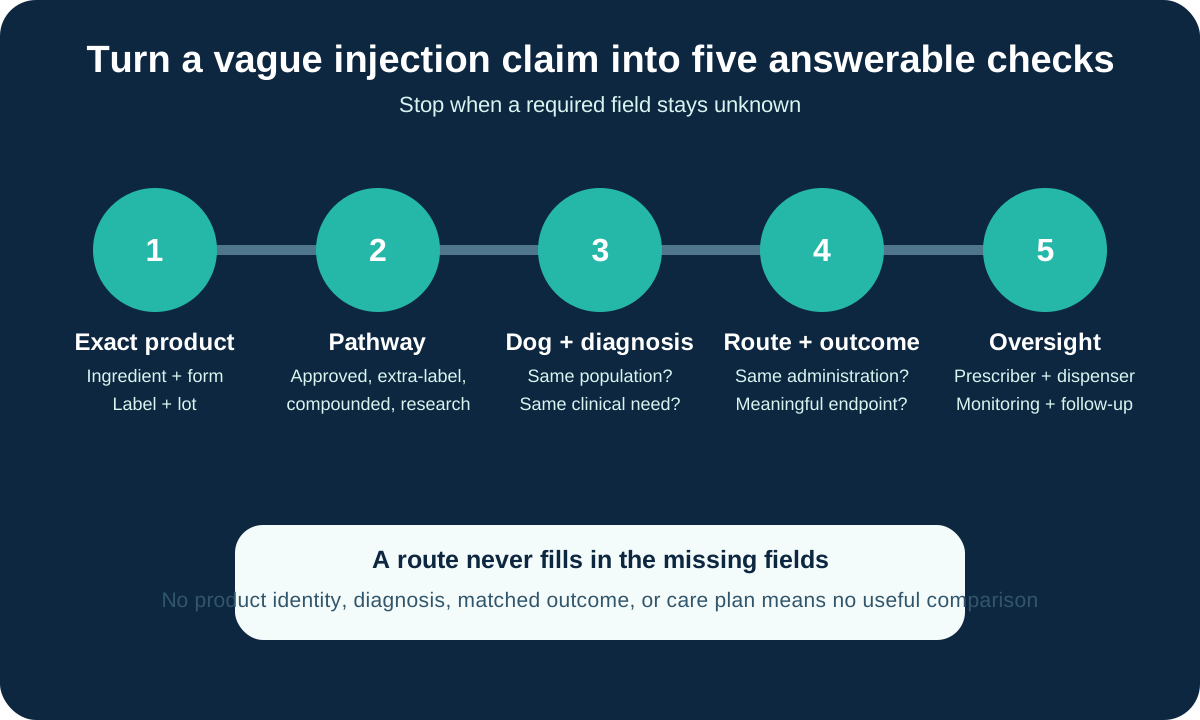
Five checks before treating an injection claim as evidence
- Name the finished product. Record the exact active ingredient, molecular or salt form, concentration, excipients, manufacturer or compounding pharmacy, lot, label date, and storage instructions. A compound nickname is not enough.
- Verify the pathway. Is it an FDA-approved animal drug used as labeled, veterinarian-directed extra-label use of an approved drug, a patient-specific compounded preparation, or experimental material? Do not let the same word “injection” hide these differences.
- Match the dog and diagnosis. Healthy laboratory beagles, dogs with diabetes, dogs with naturally occurring osteoarthritis, and rats with induced injury answer different questions.
- Match route and outcome. Subcutaneous, intramuscular, and intravenous routes are not interchangeable. Pharmacokinetics, glucose control, pain, mobility, wound closure, and adverse events are also different endpoints.
- Confirm professional oversight and follow-up. Identify who prescribes, who dispenses, who teaches product-specific administration when appropriate, what monitoring is planned, what would trigger a change, and how a suspected problem will be reported.
The general injectable veterinary peptide guide provides a brief starting checklist. This dog-specific article adds the concrete approved-product, extra-label, compounded, and experimental comparison. For route comparisons, use the oral-versus-injectable evidence guide.

Questions to bring to the veterinarian
- What diagnosis and measurable outcome are we trying to address?
- What is the exact active ingredient and finished product?
- Is the proposed use on an approved canine label, extra-label use of an approved drug, a compounded preparation, or experimental?
- If compounded, why is the approved or indexed option not medically appropriate for this dog, and what source material is used?
- Does the closest evidence study dogs with this diagnosis, using this formulation and route, and measuring this outcome?
- Who will supply the current label, demonstrate product-specific handling if needed, and answer questions before the first use?
- What baseline information, monitoring, follow-up, and urgent warning signs apply to this exact product?
- How should a suspected adverse event, medication error, or product defect be documented and reported?
Open the free veterinary-visit checklist
The sitewide amount-to-volume calculator performs arithmetic only from a veterinarian-provided amount and an actual pharmacy-label concentration. It does not choose a product, recommend a dose, verify a compounded preparation, or teach injection technique.
Frequently asked questions
Are peptide injections approved for dogs?
Some exact peptide or protein-hormone veterinary products have approved canine labels for specific diseases. Vetsulin is one example for diabetes mellitus. That product-specific approval does not extend to every injectable peptide, a compounded version, or experimental compounds such as BPC-157 or TB-500.
Is a compounded peptide injection FDA-approved?
No. FDA states that the finished compounded animal drug is not FDA-approved, even when the source is an approved drug. Compounding may still serve a patient-specific veterinary need under applicable conditions, so ask for the medical rationale, exact preparation, pharmacy controls, prescription, and monitoring plan.
Does an injection work better because it enters the body directly?
No general ranking follows from the route. Route can change exposure, but benefit and risk depend on the exact ingredient, formulation, condition, and measured outcome. Higher blood exposure is not the same as better pain relief, healing, or quality of life.
Was BPC-157 injected into dogs in research?
The reviewed 2022 paper included intravenous and intramuscular pharmacokinetic experiments in six healthy beagles. It measured exposure, not treatment benefit in dogs with a diagnosed condition. It did not establish a veterinary label or validate an online product.
Can a purity certificate prove an injectable product is safe?
No. A test result answers only the sample, analyte, method, limits, and lot described. Purity alone does not establish sterility, endotoxin control, concentration, stability, shipping integrity, clinical safety, or effectiveness.
Does this guide explain how to inject a dog?
No. Product-specific administration requires a veterinarian’s diagnosis, prescription or lawful treatment plan, current label, and hands-on training when home administration is appropriate. This page supplies evidence and pathway questions only.
The bottom line
The phrase peptide injections for dogs can hide several different medical and regulatory questions. Sort the proposal first: approved labeled animal drug, veterinarian-directed extra-label use, patient-specific compounded preparation, or experimental material. Then match the exact product, dog population, diagnosis, route, outcome, quality controls, and monitoring.
An approved porcine insulin suspension for canine diabetes is not evidence for BPC-157, TB-500, a blend, or an unidentified research vial. A dog pharmacokinetic experiment is not a clinical treatment trial. A compounded prescription is not FDA approval. Keeping those statements separate gives a veterinarian something useful to evaluate without turning a keyword into a protocol.
Sources and scope
This is an introductory guide or original comparison framework, not a systematic review or a product recommendation.
- FDA-approved label: Vetsulin (porcine insulin zinc suspension), NADA 141-236 — Product-specific identity, canine and feline diabetes indication, subcutaneous route, prescription status, warnings, and monitoring. The article does not reproduce dosing instructions.
- FDA: The Ins and Outs of Extra-Label Drug Use in Animals — US veterinarian-directed conditions for extra-label use of an approved human or animal drug; not a new FDA-approved indication.
- FDA: Q&A on GFI #256 animal compounding — Compounded animal drugs are not FDA-approved; current patient-specific rationale, quality, and enforcement-discretion context.
- FDA: Animal Drug Compounding — Current August 27, 2026 overview of animal compounding, review gaps for bulk-substance preparations, and medically necessary context.
- He et al. (2022): BPC157 pharmacokinetics in rats and dogs — Six healthy research beagles received laboratory-prepared BPC157 in intravenous and intramuscular pharmacokinetic experiments; no canine clinical benefit or approved-product conclusion.
- FDA July 2026 briefing: BPC-157-related bulk drug substances — Human-compounding evaluation of free-base and acetate identity, characterization, safety, effectiveness, and manufacturing questions; not veterinary approval.
Source checked October 10, 2026. A general context source does not establish a named product’s benefit.