
Peptides for Cat Arthritis: Pain, Mobility or Joint Repair?
Do peptides help cats with arthritis? Compare frunevetmab, exact collagen products and experimental peptide claims by feline pain, mobility and joint outcomes.
Do peptides help cats with arthritis? The evidence does not support one interchangeable “peptide therapy” category. A feline monoclonal antibody has product-specific FDA approval for controlling osteoarthritis pain, but it is a large protein biologic, not a peptide supplement, and its current label says it does not slow or reverse arthritis. Two feline nutrition studies reported mobility-related findings for exact collagen-containing products, but neither proves that every collagen peptide product works. The reviewed sources do not turn BPC-157, TB-500, or another experimental peptide into a proven feline arthritis treatment.
Ask which outcome changed
Pain control, easier movement, daily activity, and structural joint repair are different outcomes. A useful claim names the exact intervention, cat population, comparator, timepoint, and outcome instead of using “healing” as a catch-all.
Start with feline osteoarthritis, not a molecule name
Less jumping, hesitation on stairs, changes in grooming, difficulty entering a litter box, irritability, or reduced play can be important observations, but none identifies the cause by itself. FDA’s feline osteoarthritis overview notes that physical examination, imaging, owner observations, and cat-specific pain or behavior questionnaires can contribute different information. It also explains that painful joints and radiographic change do not always line up neatly in cats.
That is why a search for “peptides for cat arthritis” should begin with a diagnosis and a meaningful baseline activity. A cat avoiding a favorite surface might have osteoarthritis pain, another musculoskeletal problem, neurologic disease, weakness, vision change, fear, or a household barrier. Research relevance comes after the clinical question is defined.
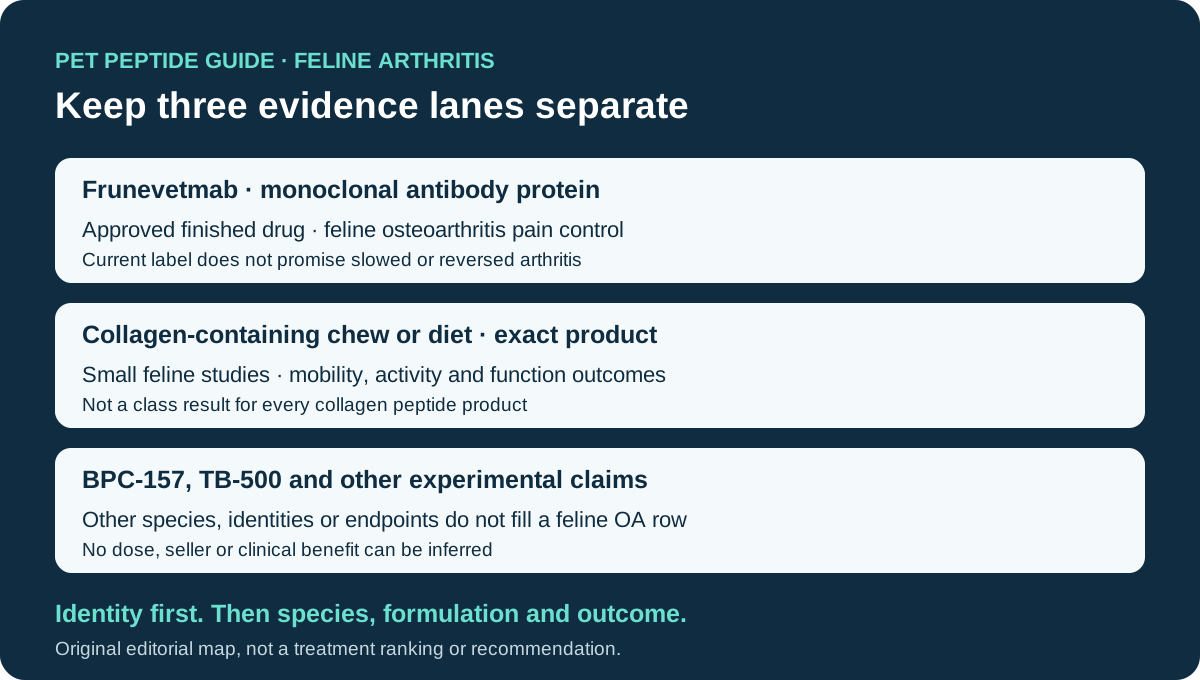
Three evidence lanes that should remain separate
| Evidence lane | Exact identity and setting | What was measured | What it does not establish |
|---|---|---|---|
| Approved protein biologic | Frunevetmab is a felinized anti-nerve growth factor monoclonal antibody. The U.S. finished drug is prescription-only and administered by a veterinarian. | FDA evaluated two controlled feline field studies using owner-selected activities, global assessment, and veterinary orthopedic pain examination. | Cartilage repair, slowed disease progression, proof for a supplement, or proof for another injectable compound. |
| Exact collagen-containing products | One 2026 crossover study tested an undenatured type II collagen complementary-feed chew. A 2024 study tested a complete diet containing hydrolyzed collagen, EPA, DHA, and turmeric extract. | Caregiver-rated mobility and quality of life in the chew study; force-plate, stair, activity, and veterinarian measures in the diet study. | A class result for every powder, chew, collagen form, amount, blend, or brand. The multi-ingredient diet cannot isolate collagen. |
| Experimental peptide claims | Names such as BPC-157 or TB-500 can appear beside arthritis searches, but the site’s reviewed records concern other species, models, identities, or exposure questions. | Those records can support narrow questions about molecular identity, experimental models, or measured exposure. | A matched feline osteoarthritis clinical outcome, safe owner-administered dose, retail-product equivalence, or veterinary approval. |
This is not a ranking of treatments. It is a category correction. Frunevetmab is a large therapeutic protein reviewed as one finished animal drug. Collagen products belong to food or complementary-feed questions whose evidence follows the exact preparation. BPC-157 and TB-500 remain their own experimental identities. Evidence cannot move across those rows simply because all ultimately involve amino acids.
What the Solensia approval record actually says
FDA’s original Freedom of Information summary describes two controlled studies supporting approval of Solensia, the frunevetmab finished product. The larger confirmatory study enrolled 275 client-owned cats with osteoarthritis in at least two joints or spinal segments. Cats were randomized two to one: 182 received frunevetmab and 93 received vehicle control. Owners selected three impaired activities and scored them with a Client Specific Outcome Measure.
The confirmatory study’s prespecified primary success comparison did not reach statistical significance at day 56. Least-squares success estimates were 75.1% for frunevetmab and 64.8% for control at that timepoint. The difference was significant at day 28, but not at days 56 or 84. FDA’s summary explicitly says the study failed to demonstrate treatment success on the established primary effectiveness outcome by itself.
Approval did not rest on hiding that result. FDA used a weight-of-evidence assessment across the exploratory and confirmatory studies, noting consistent direction in owner and veterinary assessments and substantially different control-group success between studies. In the exploratory study, day-56 CSOM success estimates were 80.0% for frunevetmab and 47.1% for control. Reporting both studies prevents the approval headline from becoming a simplified claim that every timepoint or trial comparison was positive.
The distinction between pain control and structural repair is equally important. FDA’s October 5, 2026 Client Information Sheet says Solensia can alleviate arthritis pain for one month after an injection, while also stating that it does not treat, slow, or reverse arthritis progression. A cat moving more comfortably is a clinically meaningful outcome, but it is not proof that cartilage regenerated or radiographic disease reversed.
Why the October 2026 label update belongs in the decision
FDA approved safety-related labeling changes for Solensia on October 5, 2026. The revision added post-approval experience, an information section for cat owners, and a Client Information Sheet that veterinarians are directed to review before each injection. FDA’s post-approval section lists reported events by body system and warns that serious reactions can occur.
Those reports do not provide incidence rates and do not automatically prove causation. FDA states that not all events are reported and that frequency or causal relationship often cannot be reliably established from these data. They still matter because the current label, not an older article or package image, is the right product-specific safety reference. The label asks owners and veterinarians to discuss current medical problems, all medicines and supplements, prior monoclonal antibody therapy, and the cat’s response before continued treatment.
The original approval summary and post-approval update answer different questions. Controlled preapproval studies estimate effects under defined protocols. Voluntary post-approval reports can surface patterns from wider use but lack a randomized denominator. Neither should be discarded, and neither should be converted into a universal safety percentage.
Where feline collagen studies fit
The existing collagen peptides for cats guide examines two product-specific feline studies in depth. They add direct cat evidence, but they do not create a generic “peptide therapy” result.
Piemontese and colleagues enrolled 20 client-owned cats with mild to moderate degenerative joint disease in a randomized, double-blind, placebo-controlled crossover study of an undenatured type II collagen chew. Fourteen cats completed all visits. The accessible report describes caregiver-scored mobility, discomfort, and quality-of-life findings. Its relevance belongs to that collagen form, complementary-feed chew, population, crossover design, attrition, and owner-reported outcomes.
Lefort-Holguin and colleagues randomized 30 cats with naturally occurring osteoarthritis between two diets. The experimental diet contained hydrolyzed collagen together with EPA, DHA, and turmeric extract. Force-plate, stair, nighttime activity, and veterinarian measures add a useful mix of outcomes, but changing several components together means the result cannot be assigned to hydrolyzed collagen alone.
These studies are closer to a feline arthritis question than rodent tissue experiments, but they answer narrower product and formulation questions than an approved prescription drug record. A cat owner comparing labels should keep undenatured type II collagen, hydrolyzed collagen, a multi-ingredient diet, and a generic collagen-peptide powder in separate rows.
Use an outcome ledger instead of the word “healing”
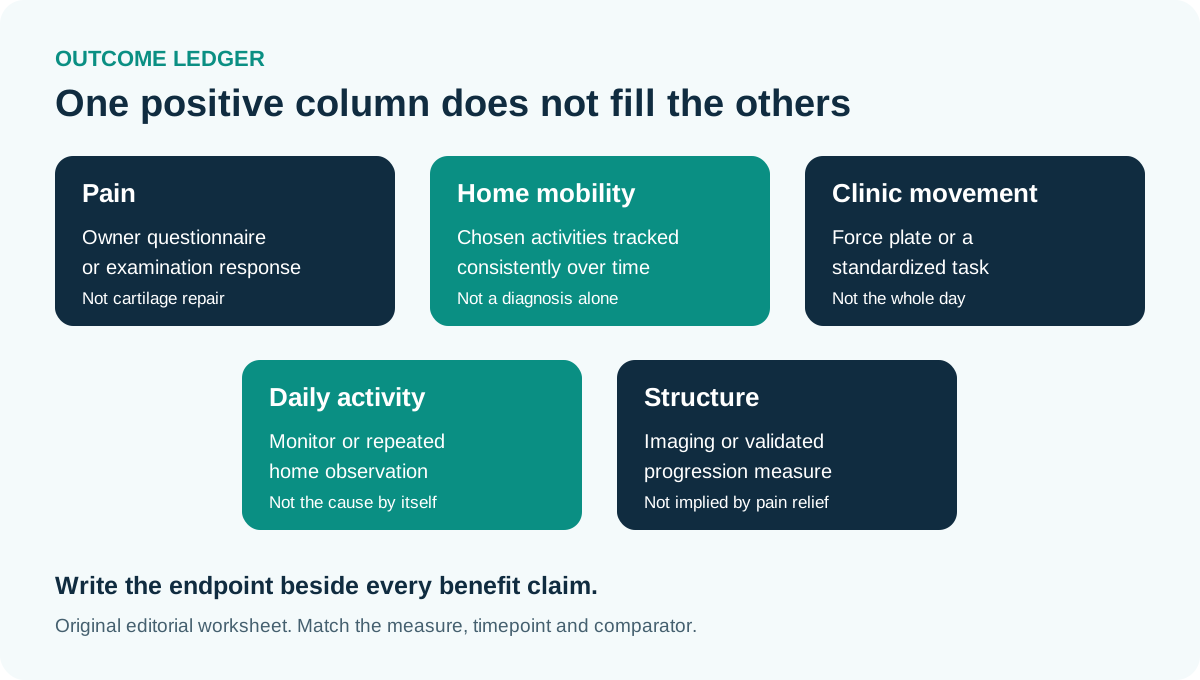
| Outcome | Example measure | Useful interpretation | Does not establish alone |
|---|---|---|---|
| Pain and interference | Owner questionnaire or veterinary palpation score | Whether pain-related behavior or examination response changed | Cartilage repair, cause of every mobility change, or a permanent effect |
| Owner-selected mobility | Jumping to a chosen surface, stairs, grooming, or litter-box access | A personally meaningful activity tracked consistently over time | Blinded mechanism, universal response, or structural joint change |
| Clinic movement | Force-plate or standardized movement task | Objective movement under a defined test condition | Comfort throughout the day or behavior in the home |
| Daily activity | Activity monitor or repeated home observation | Movement beyond a brief clinic visit | Why activity changed or whether more movement is always better |
| Structural progression | Imaging or validated structural endpoint over time | Whether joint anatomy changed under the study definition | Pain relief by itself. None of the approval language cited here promises reversal. |
A 2023 blinded study of early owner-reported mobility change helps explain why this separation matters. The Feline Musculoskeletal Pain Index and orthopedic examination differentiated cats with early reported mobility changes from controls, while different subjective and objective measures did not become identical. An owner’s observation is valuable clinical information, not a substitute for examination or a standalone proof of treatment effect.
A claim-check exercise
- Name the exact intervention. Was it frunevetmab, undenatured type II collagen, a multi-ingredient diet, or an unrelated research compound?
- Name the product category. Prescription biologic, complete diet, complementary feed, supplement-style product, compounded preparation, or research listing are not interchangeable.
- Name the cats. Client-owned cats with diagnosed osteoarthritis are more relevant than healthy animals, another species, cells, or an induced injury model.
- Name the endpoint. Jumping, owner-scored difficulty, force-plate movement, pain, activity, and imaging answer different questions.
- Check the comparator and timepoint. Placebo response, crossover periods, washout, attrition, and prespecified analysis change interpretation.
- Read current safety information. For an approved product, use the latest label and Client Information Sheet. For a food or supplement-style product, inspect the complete current label and finished-product evidence.
The corrected statement would be narrower: “One exact intervention changed one defined outcome in a specified feline study under stated conditions.” That is less dramatic, but it is the level at which evidence can be checked.
Questions to bring to the veterinary visit
- Does the examination support osteoarthritis pain, or could another condition explain the change?
- Which two or three home activities should we record before changing the care plan?
- Is the proposed option a prescription protein biologic, food, complementary feed, compounded preparation, or experimental material?
- Does the cited study test this exact finished product in cats with a matching diagnosis?
- Was the reported outcome pain, mobility, activity, gait, quality of life, or structural progression?
- What did the control group do, which timepoint was primary, and how many cats completed the study?
- What current label, adverse-event, disease, medicine, nutrition, and monitoring information applies to this cat?
- When should response be reassessed, and what new signs should prompt earlier contact?
Open the free veterinary-visit checklist
The cat peptide safety guide provides a separate product-specific safety framework. The evidence-matching guide helps compare a study ingredient with a finished product. Neither supplies a dose or replaces veterinary assessment.
Frequently asked questions
Is Solensia a peptide?
No. Frunevetmab is a monoclonal antibody, a large therapeutic protein. It is relevant to an arthritis evidence map because it is an FDA-approved feline product for controlling osteoarthritis pain, but its evidence and label do not validate peptide supplements or research compounds.
Does Solensia repair arthritic joints?
The current FDA Client Information Sheet says it can alleviate arthritis pain for one month after an injection and does not treat, slow, or reverse arthritis progression. Pain control and structural repair are different claims.
Do collagen peptides help cats with arthritis?
Two feline studies reported favorable joint-related outcomes for different exact products. One tested an undenatured type II collagen chew; the other tested a multi-ingredient diet containing hydrolyzed collagen. They do not establish a class-wide result for generic collagen peptide products.
Is BPC-157 proven for cat arthritis?
The reviewed feline arthritis records in this comparison do not provide a matched BPC-157 clinical trial in cats with osteoarthritis. Research from another species, injury model, route, or endpoint cannot fill that clinical evidence row. This is a bounded source review, not a claim that no record could exist anywhere.
Why can a placebo group improve in a cat pain study?
Osteoarthritis signs can vary, owner-scored outcomes are subjective, study participation can change observation and routine, and regression toward typical behavior can occur. FDA’s approval summary discusses a high control-group response and therefore considers results across both field studies and supporting endpoints.
What changed on the Solensia label in October 2026?
FDA added post-approval experience, an owner-information section, and a Client Information Sheet emphasizing risks and the need to review current information before each injection. Voluntary reports do not establish event frequency or causation by themselves.
What should I track at home?
Choose a few ordinary activities that matter to the individual cat, such as reaching a favorite surface, using stairs, grooming, or entering the litter box. Record the baseline consistently and note other changes in medicine, food, weight, flooring, ramps, routine, or health. Agree with the veterinarian on reassessment and stop criteria.
Do you recommend a product or earn a commission here?
No. This page does not rank products, link to research-chemical sellers, or contain affiliate offers. If an approved commercial relationship is added later, it will be identified beside the relevant link.
The bottom line
“Peptides for cat arthritis” is not one evidence category. Frunevetmab is an approved prescription monoclonal antibody with feline pain-control evidence and current product-specific safety information. Feline collagen studies concern exact chews or diets and limited mobility-related endpoints. Experimental peptide names require their own matched feline osteoarthritis studies before a treatment claim can be made.
The practical next step is to name the diagnosis, the exact intervention, and the outcome that matters. Then compare the current label and primary study with this cat rather than borrowing a result from another molecule, species, route, or endpoint.
Sources and scope
This is an introductory guide or original comparison framework, not a systematic review or a product recommendation.
- FDA FOI Summary: Solensia original approval, NADA 141-546 — Primary approval record: two controlled feline field studies, exact CSOM analyses, supporting endpoints, adverse reactions and weight-of-evidence rationale. Pain-control approval kept separate from structural repair.
- FDA: Solensia safety-related labeling changes, October 5, 2026 — Current official label update adding post-approval experience, owner information and a Client Information Sheet. Voluntary reports do not establish incidence or causation.
- Gruen et al. (2021): randomized frunevetmab feline OA trial — Original multisite randomized placebo-controlled double-blind study. Exact cat population, owner-selected activity outcomes, funding and author relationships retained.
- Piemontese et al. (2026): undenatured type II collagen crossover trial in cats — Twenty client-owned cats entered and 14 completed all visits. The exact complementary-feed chew and caregiver outcomes do not establish generic collagen-peptide equivalence.
- Lefort-Holguin et al. (2024): multi-ingredient therapeutic diet in feline OA — Thirty cats were randomized between diets. EPA, DHA, turmeric extract and hydrolyzed collagen changed together, so collagen cannot be isolated as the cause.
- Clark et al. (2023): owner mobility reports and feline DJD measures — Primary blinded measurement study comparing owner questionnaires, orthopedic examination and other outcomes; no peptide treatment was tested.
- FDA: Osteoarthritis in Cats, More Common Than You Think — Current official diagnosis, imaging, observation and approved-product context; supporting explanation rather than intervention efficacy evidence.
Source checked October 22, 2026. A general context source does not establish a named product’s benefit.