
Peptides for Cat Kidney Disease: What Do Feline Studies Measure?
Do peptides treat kidney disease in cats? Compare a feline amino-acid blend, an approved non-peptide weight-loss drug and experimental rAIM by exact renal endpoint.
Do peptides treat chronic kidney disease in cats? The feline evidence reviewed here does not support a general peptide-treatment claim. One controlled cat study tested an oral seven-ingredient amino-acid blend that included the dipeptide carnosine, not an isolated peptide. A separate approved ghrelin-receptor drug manages weight loss rather than kidney function and is not itself a peptide. A 2026 recombinant-protein study is promising but explicitly exploratory and non-pivotal. The exact preparation and exact outcome must stay attached to every claim.
This AI-assisted article has not been reviewed by a veterinarian. It is a focused interpretation of two feline intervention studies, one current FDA approval record and current renal-care guidance, not a systematic review, diagnosis or treatment plan. It supplies no dose, mixing or administration instructions.
Start with the kidney question, not the word “peptide”
Cat owners can be asking at least four different questions: Does something slow loss of kidney function? Does it change one laboratory value? Does it help appetite or body weight? Does it improve comfort or survival? Those outcomes matter, but they are not interchangeable.
A product can act on a pathway associated with a peptide hormone without being a peptide. A blend can contain one dipeptide without showing that the dipeptide caused the result. A recombinant protein is also not automatically equivalent to a short synthetic peptide sold under a research label. Our feline peptide-safety guide explains why class-wide conclusions fail; this page asks the narrower renal-endpoint question.
What the AB070597 cat study actually tested
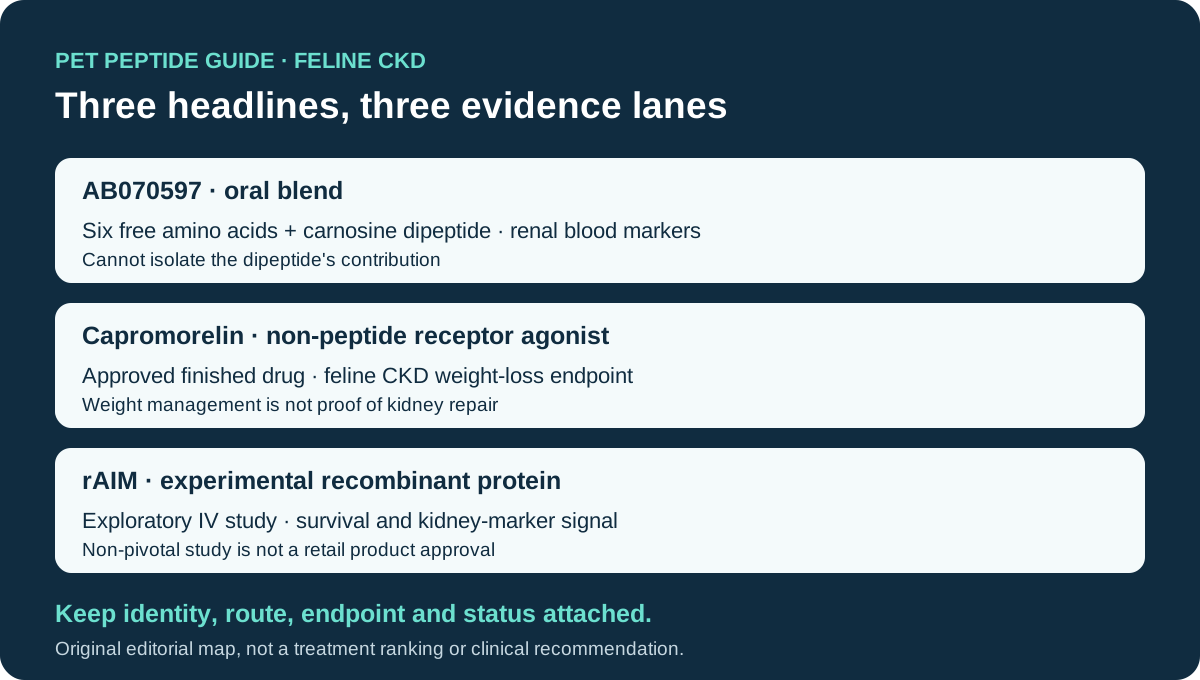
Tsunekawa and Sato's 2024 paper describes a prospective, double-blinded, randomized, starch-placebo-controlled study conducted through 13 veterinary practices in Japan. The enrolled pets had clinically stable chronic kidney disease classified as stage 2 or 3 using the study's criteria. The research preparation was taken orally for 180 days while existing renal diets, fluids and several other treatments could continue without changes.
The exact formulation matters. AB070597 contained six free amino acids plus L-carnosine. Carnosine is a dipeptide, but the intervention was a seven-component combination. The study cannot tell readers whether carnosine, one free amino acid, their combination or another aspect of care produced any observed difference. It is inaccurate to rename this as a trial of BPC-157, SS-31, MOTS-c or a generic “kidney peptide.”
Forty-seven cats were randomized, while the reported analysis included 35: 20 in the AB070597 group and 15 in the placebo group. Ten were excluded for insufficient blood data or owner withdrawal, and two more were excluded after a later creatinine change suggested acute kidney injury rather than stable CKD. The authors had estimated that 25 cats per group were needed, then identified the smaller final sample as a limitation.
Which renal outcomes changed, and which did not?
Over six months, the paper reports that blood urea nitrogen, creatinine and phosphorus increased from earlier visits in the placebo group but did not significantly change within the AB070597 group. Based on creatinine staging, four of 15 placebo cats moved from stage 2 to stage 3, while none of the 20 analyzed AB070597 cats moved to the next stage. Body weight, body-condition score, muscle-condition score, urine specific gravity and blood pressure did not significantly change within either group. SDMA also did not significantly change in either group.
That is a more informative result than a vague “supports kidneys” phrase, but it still needs careful reading. The published analyses compare repeated values within each group. A significant change in one group and a nonsignificant change in another does not, by itself, prove that the changes differ between groups. The study did not measure glomerular filtration rate, and the authors noted substantial disagreement between creatinine-based and SDMA-based stages.
Concurrent care also varied. Some cats ate renal diets; some received fluids or other medications. Counts did not differ significantly between groups, and established treatments were not changed during the study, but the authors correctly listed inconsistent background care as a limitation. Six months does not establish an effect on survival or long-term progression. The paper reported no financial support and no declared conflicts, while also stating that the selected amount followed manufacturer recommendations.
| Question | What this study contributes | What remains unresolved |
|---|---|---|
| Was a peptide tested in cats? | A mixed oral preparation included carnosine, a dipeptide, alongside six free amino acids. | The effect of carnosine cannot be separated from the blend. |
| Was kidney disease represented? | Client-owned cats with stable CKD entered a randomized placebo-controlled study. | The final analysis was smaller than planned and excluded 12 randomized cats. |
| Was renal function directly measured? | Several blood and urine measures were tracked repeatedly. | GFR was not measured; creatinine and SDMA staging disagreed. |
| Was long-term benefit shown? | The observation period covered six months. | Survival and longer-term progression require further study. |
Why the approved weight-loss drug is a different evidence lane
FDA's approval summary for Elura covers capromorelin oral solution for management of weight loss in cats with CKD. The pivotal field study enrolled 176 client-owned cats with documented unintended weight loss and CKD, then compared the finished product with its vehicle over 56 days. The approval endpoint was weight management, not reversal of kidney damage or preservation of renal function.
Capromorelin is a ghrelin-receptor agonist. Scientific literature describes it as a non-peptide small-molecule agonist even though it mimics signaling associated with ghrelin, a peptide hormone. FDA's approval therefore should not be counted as approval of “peptide therapy for feline kidney disease.” It is product-specific evidence for a narrower indication in a defined species and formulation.
The distinction is current, not historical trivia. FDA's October 7, 2025 label-change record retains the weight-loss indication and adds post-approval experience and safety warnings. Reported events cannot always establish frequency or causation, but the current label record matters more than an old marketing summary. Owners should use the actual current prescription label and veterinary direction, not convert a research paper or a pathway name into home instructions.
The 2026 rAIM study is a protein study, not a finished peptide option
Tezuka and colleagues' 2026 open-access study evaluated recombinant apoptosis inhibitor of macrophage, also called AIM or CD5L. AIM is a circulating protein. The experimental preparations were mouse or feline recombinant AIM delivered intravenously to cats with advanced CKD in an exploratory, non-pivotal study.
Investigators screened 216 cats, enrolled 35 after applying criteria and used serum indoxyl sulfate to divide a higher-risk subgroup. Six cats received mouse rAIM, five received feline rAIM and 15 were untreated controls; nine lower-risk cats were also observed without rAIM. The treatment groups were not created through a single conventional randomized placebo-controlled allocation: eligible higher-risk cats were alternated by enrollment order, and mouse and feline preparations were used in different calendar periods as they became available.
The authors reported higher 360-day survival in both treated groups than in untreated higher-risk controls, along with kidney-marker and metabolomic observations. Those findings deserve further research, but the sample was small, treatment and control were not masked with a placebo, two different recombinant proteins were used, and background care continued. The paper discloses that two authors own stock in a company that may benefit. None of those facts erases the signal; together they explain why the authors call the study exploratory and non-pivotal.
This study does not validate a retail “AIM peptide,” an SS-31 vial or another product with a kidney-related headline. A later clinical claim would need a defined feline formulation, controlled allocation, appropriate comparator, prespecified outcomes, adverse-event reporting, manufacturing evidence and current regulatory status.
A practical claim check for cat owners
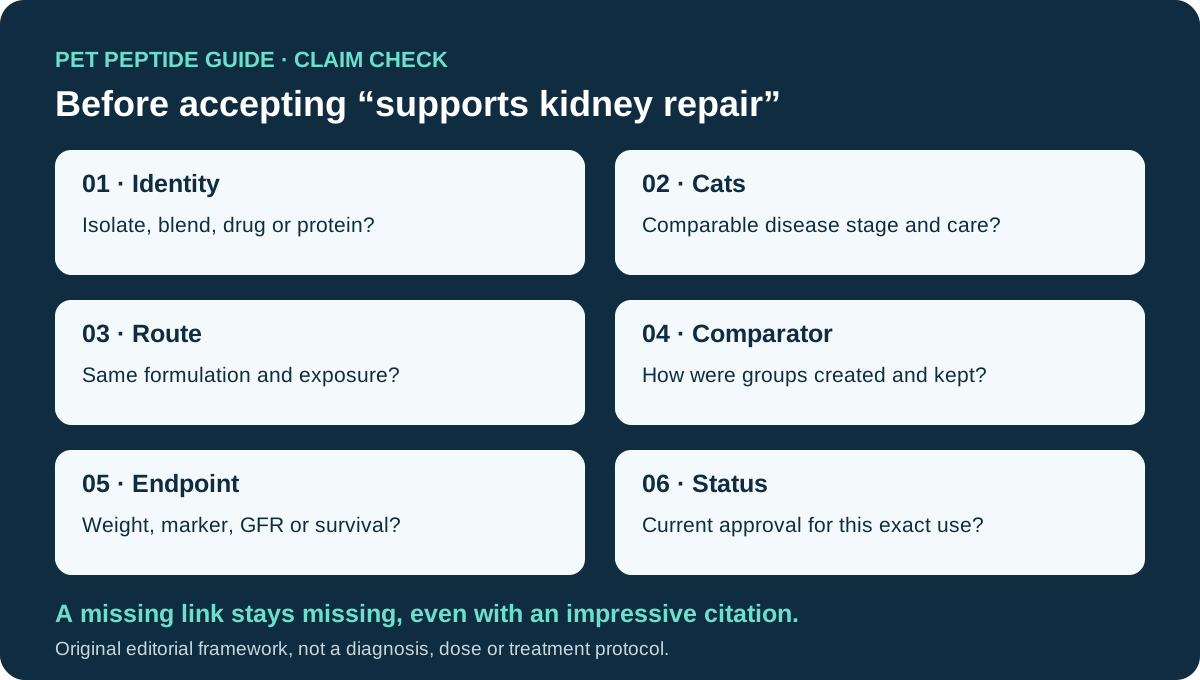
When a seller says a product “supports kidney repair,” keep the following chain intact:
- Exact identity: Is the evidence about an isolated peptide, a blend containing a dipeptide, a small-molecule receptor agonist or a recombinant protein?
- Cat population: Were they household cats with naturally occurring CKD, experimental animals, healthy cats or another species?
- Formulation and route: Did the study use the same finished product and route as the claim?
- Comparator: Was there a placebo, vehicle, usual-care or untreated group, and how was allocation handled?
- Outcome: Did researchers measure body weight, a laboratory marker, GFR, quality of life, disease progression or survival?
- Status: Does a current regulator approve that exact product for that exact feline use, or is it an experimental preparation?
Do not treat one favorable marker as proof of kidney repair. Do not treat an appetite or weight endpoint as a renal-function endpoint. And do not replace an exact study formulation with a similarly named product. The biomarker and surrogate-endpoint guide provides a reusable worksheet for this distinction.
Questions for the veterinary visit

- What confirms that this is chronic kidney disease rather than an acute change, and what stage or substage applies?
- Which change are we trying to improve: appetite, weight, hydration, blood pressure, proteinuria, anemia, laboratory markers, comfort or progression?
- Does the proposed product match a study in cats with comparable disease and background care?
- Which outcome will be monitored, on what veterinary schedule, and what result would change the plan?
- What current label, known adverse effects, interactions and product-quality information apply?
Bring the full product label, the original paper and a list of current food, medicines and supplements. Use the printable evidence checklist to organize the discussion. Current IRIS feline CKD recommendations show why treatment is organized around stage, substage and the cat's specific clinical problems rather than one universal “kidney peptide.”
Common questions
Does the AB070597 study prove that carnosine slows feline CKD?
No. Carnosine was one part of a seven-component blend, so the study cannot isolate its contribution. The final analysis was also smaller than planned, and several background treatments varied.
Is Elura a peptide treatment for kidney disease?
No. Capromorelin is a non-peptide ghrelin-receptor agonist. Its FDA indication is management of weight loss in cats with CKD, not repair of kidney tissue or prevention of CKD progression.
Does the rAIM paper make recombinant AIM available as a proven cat treatment?
No. It reports an exploratory non-pivotal study of laboratory-produced recombinant proteins in small groups. Publication is not the same as approval, availability or a validated substitute product.
Can dog, mouse or human kidney-peptide research fill the gap?
No. Those studies may help form a research question, but they do not establish the same identity, route, disease stage, safety profile or clinical benefit in cats.
Sources and scope
This is an introductory guide or original comparison framework, not a systematic review or a product recommendation.
- Tsunekawa and Sato (2024): Oral AB070597 in cats with CKD — Original open-access paper and full methods/results: 47 randomized, 35 analyzed; oral seven-component blend including carnosine; 180-day blood, urine, body-condition and staging outcomes. Study limits and disclosures retained.
- FDA FOI Summary: Elura original approval, NADA 141-536 — Primary approval record: capromorelin oral solution, cats with CKD and unintended weight loss, randomized masked vehicle-controlled field study; weight-management indication distinguished from renal-function treatment.
- FDA: Elura safety-related labeling changes — Official October 7, 2025 safety-label revision and post-approval experience; checked October 21, 2026. Reports do not necessarily establish frequency or causation.
- Tezuka et al. (2026): Exploratory recombinant AIM study in cats with advanced CKD — Original open-access non-pivotal study: mouse/feline recombinant protein, intravenous route, small alternately allocated groups, untreated control, survival and biomarker outcomes. Funding and stock-ownership disclosures retained.
- IRIS: Treatment Recommendations for CKD in Cats (2026) — Current specialist guidance for stage- and substage-specific clinical context. No dosing instructions reproduced and no endorsement of a generic peptide category inferred.
- FDA: Animal Drug Development and Approval Process — Current U.S. product-specific approval framework; publication, pathway similarity or experimental access is not approval.
Source checked October 21, 2026. A general context source does not establish a named product’s benefit.