
Peptides for Senior Dogs: Match Age, Diagnosis and Meaningful Outcomes
Do senior dogs need peptides? Match age and frailty context to a diagnosis, exact product, comparable dogs, baseline function and meaningful follow-up.
Do senior dogs need a peptide? Age alone does not identify a treatment need. “Senior” covers healthy dogs, dogs with one diagnosed condition, and dogs with several interacting problems. Before any peptide claim can be useful, match it to a defined diagnosis, the dog’s other conditions and medicines, an exact finished product, a meaningful outcome, and a plan to measure benefit and harm. The available research does not support ranking experimental peptides as general anti-aging treatments for household dogs.

A dog may be called senior because it has reached the last part of its expected lifespan, but that label says little about the problem an owner hopes to solve. Slower stairs can reflect osteoarthritis, neurologic disease, weakness, pain, vision change, an unsafe floor, or several factors together. Weight change can involve appetite, dental disease, muscle loss, endocrine disease, cancer, kidney disease, feeding changes, or medication effects. Sleep or behavior changes can have medical, sensory, environmental, or cognitive explanations.
A peptide headline often skips those distinctions. It moves from “aging involves hormones, inflammation, or mitochondria” to “this compound helps senior dogs.” That jump changes a biological idea into a treatment claim without first identifying the patient, condition, product, route, outcome, or safety evidence. This guide shows how to keep those fields visible.
This is an AI-assisted evidence guide, not veterinary advice or a systematic review. Primary studies and current AAHA and FDA sources were checked October 13, 2026. It provides no dose, administration instructions, product ranking, seller, or research-chemical purchase path. A veterinarian should investigate new pain, weakness, appetite change, confusion, collapse, breathing difficulty, or other concerning signs rather than assuming they are normal aging.
Senior is a life stage, not one diagnosis
The 2023 AAHA Senior Care Guidelines define a senior dog in relation to expected lifespan, not one birthday shared by all breeds. The guideline also stresses that old age is not a disease and that senior care should be individualized. It discusses healthy and unhealthy senior patients, diagnostics, pain, nutrition, dentistry, behavior, comorbidities, environment, quality of life, and caregiver goals. That broad scope is the opposite of a single anti-aging product shortcut.
Two dogs of the same age can have very different physiological reserve and daily function. One may walk comfortably, maintain weight, sleep normally, and need routine preventive care. Another may have osteoarthritis, kidney disease, hearing loss, and several medicines. A third may look healthy at home while an examination reveals a problem that changes the risk-benefit question. Their chronological ages do not make them interchangeable treatment candidates.
This is why a useful first sentence is not “my dog is old.” It is: “My dog has this observed change, and the veterinarian is evaluating these possible explanations.” Once the clinical question is defined, an owner can ask whether a proposed product was studied in comparable dogs and whether it measured the outcome that matters.
Five fields that belong with every senior-dog claim
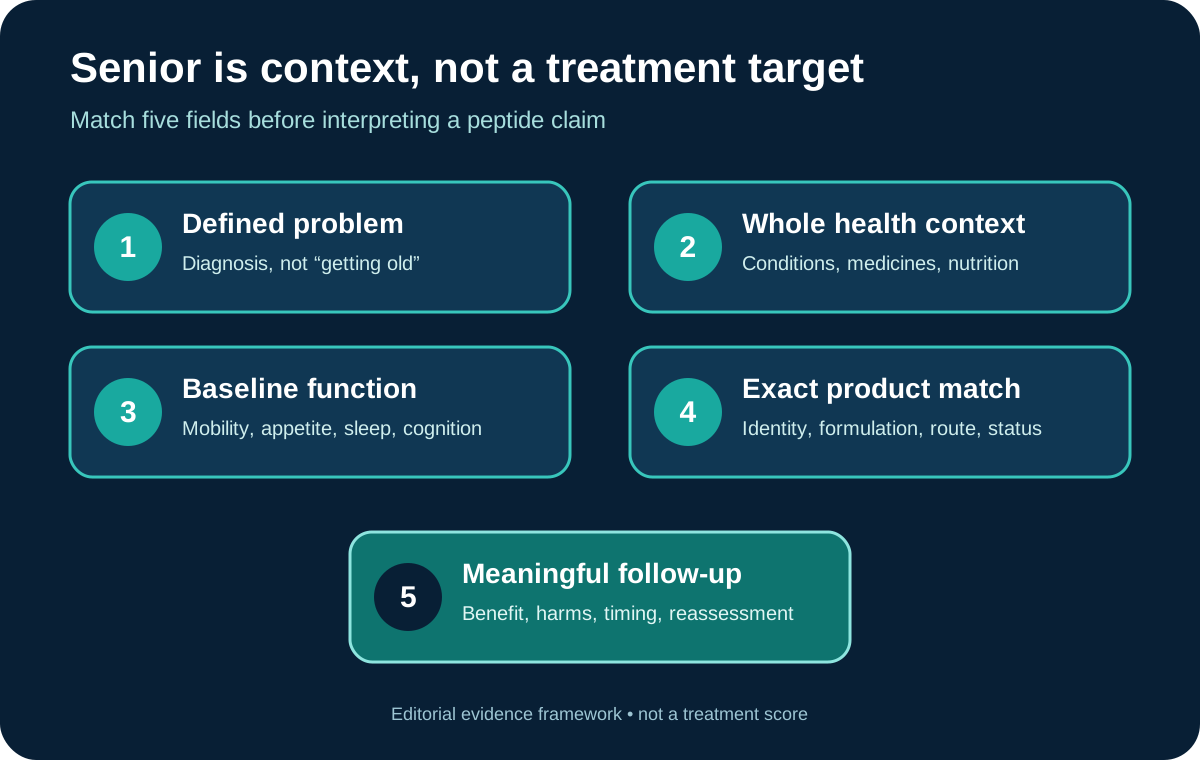
| Field | What to record | What the field prevents |
|---|---|---|
| Defined problem | Observed change, veterinary findings, working diagnosis, severity, and plausible alternatives. | Turning age, weakness, stiffness, appetite change, or “low energy” into a diagnosis by headline. |
| Whole health context | Other conditions, all medicines and supplements, nutrition, prior reactions, kidney and liver status when relevant, and caregiver priorities. | Importing a result from healthy research dogs into a dog with multimorbidity or interacting products. |
| Baseline function | Mobility, comfort, appetite, body condition, sleep, cognition, daily activities, quality of life, and condition-specific clinical measures. | Calling ordinary fluctuation or a laboratory change a meaningful improvement. |
| Exact product match | Molecule, formulation, route, concentration, manufacturer or pharmacy, intended use, current legal status, and evidence for the finished product. | Borrowing evidence across nicknames, fragments, blends, routes, or unverified retail vials. |
| Meaningful follow-up | Expected benefit, timing, repeated measure, adverse-event collection, other changes made, and a veterinary reassessment or stopping plan. | Continuing an uncertain intervention because “something might be happening.” |
These fields are not a prescribing checklist. They are an evidence-matching tool. If a claim cannot identify the problem or product, the correct conclusion is not that it works broadly. The correct conclusion is that the claim is too incomplete to evaluate.
Frailty shows why chronological age is not enough
Frailty research offers a useful example. Frailty is intended to describe reduced physiological reserve and vulnerability across several domains. It is not simply another name for old age, and it is not itself evidence that a peptide reverses aging.
Banzato and colleagues analyzed routinely collected clinical data from 401 dogs aged 2 to 19 years. Their frailty index accumulated multiple deficits. The average score increased with age, but older dogs also showed substantial variation. The index was strongly related to short-term mortality, while chronological age contributed little after frailty and age were considered together. The study supports multidimensional assessment and risk research. It does not show that lowering the index with a product would improve survival.
A 2024 cross-sectional study examined 88 apparently healthy senior pet dogs using questionnaires, veterinary assessment, body and muscle condition, blood and urine testing, pain and cognitive instruments, and frailty tools. Recruitment focused on older, mainly larger dogs whose owners reported no overt health problem. The study still found variation and emphasized a holistic view. Its observational associations cannot prove a treatment effect, and the authors noted selection and size limitations. The work is useful precisely because it shows how much information hides behind “apparently healthy senior dog.”
Frailty scores may help researchers describe populations and may help veterinarians structure assessment. They should not become a self-service diagnostic label or a sales target. A seller cannot establish “frailty reversal” by pointing to a study that only associates a score with risk. Evidence for a treatment would need an exact intervention, an appropriate comparison, relevant dogs, prespecified outcomes, adequate follow-up, and active harm collection.
What the aged-beagle hexarelin study measured
Hexarelin is sometimes grouped with growth-hormone secretagogues and marketed with rejuvenation language. It is a distinct compound, not a synonym for GHRP-2, GHRP-6, CJC-1295, growth hormone, or an unnamed “peptide blend.” Product identity and route must remain attached to the evidence.
Cella and colleagues’ 1996 experiment followed six aged beagles during 16 weeks of subcutaneous hexarelin exposure. The paper measured growth-hormone responses and bone and muscle variables. The growth-hormone response changed over the treatment period, and circulating IGF-I did not increase. This is direct dog research, but it is also a small experimental study with narrow endpoints.
The study did not establish that household dogs lived longer, climbed stairs more easily, felt less pain, slept better, maintained independence, or experienced an overall quality-of-life benefit. It did not create an approved veterinary anti-aging indication or validate a retail product. An endocrine response can be biologically interesting without being a functional benefit.
The small sample matters too. Six dogs can describe observations within that experiment. They cannot provide a dependable rate for uncommon harms, interactions, long-term outcomes, or diverse breeds and comorbidities. The page on hexarelin for pets keeps the compound-specific evidence and identity separate from related GHRPs.
One condition-specific study does not become general senior care
Some older dogs have diagnosed osteoarthritis, so canine joint research can be relevant to a senior-care question. Relevance still depends on the diagnosis, product, and outcome. It does not arise from age alone.
A 2024 controlled study tested one specific oral bioactive collagen peptide preparation in dogs with naturally occurring osteoarthritis. Thirty-one dogs completed the 12-week study. Several force-plate kinetic measures and a quality-of-life component improved, while accelerometer-measured activity did not. The study also disclosed manufacturer funding, company employment, and patent interests, which belong beside the results rather than being omitted.
This evidence concerns eligible dogs with osteoarthritis, one defined preparation, an oral route, and particular outcomes. It does not establish that every senior dog needs collagen, that another powder or chew is equivalent, or that a favorable gait measure proves longer life. A dog without an osteoarthritis diagnosis asks a different question. A dog with neurologic weakness, heart disease, cancer, or cognitive change asks several different questions.
The peptides for dog arthritis guide compares diagnosis-specific evidence and keeps BPC-157 pharmacokinetics and TB-500 identity research out of the canine arthritis efficacy column. Use that page when arthritis is the defined problem. Use this page when the challenge is deciding whether “senior” is enough information. It is not.
Keep endpoints in their own columns
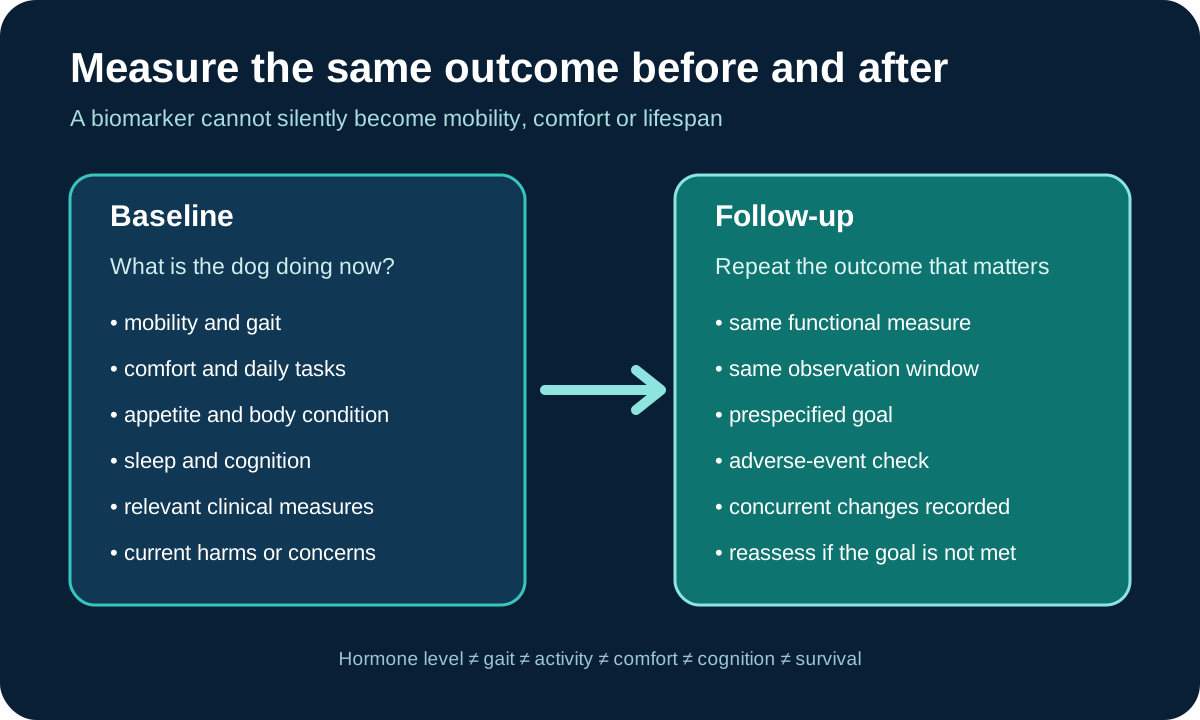
Senior-dog claims often combine endpoints that are not interchangeable. Growth-hormone release is not muscle strength. A force-plate gait measure is not spontaneous daily activity. Owner-reported quality of life is not the same as survival. A blood marker is not cognition. Each may be valuable, but each answers a different question.
| Outcome type | Example question | Do not silently rewrite it as |
|---|---|---|
| Hormone response | Did a defined exposure change circulating growth hormone at sampled times? | The dog became stronger, younger, more comfortable, or longer lived. |
| Kinetic gait measure | Did force distribution change under a standardized test? | Every dog became more active at home or no longer had pain. |
| Accelerometer activity | Did recorded movement change across the observation window? | The cause of low activity was diagnosed or quality of life improved. |
| Owner questionnaire | Did a validated reported score change? | An objective laboratory or survival result was demonstrated. |
| Frailty measure | How many deficits or phenotype features were present? | A peptide indication was diagnosed or a treatment effect occurred. |
| Adverse-event collection | What harms were actively sought, over what time, in how many dogs? | No unmeasured, delayed, uncommon, or interaction risk exists. |
The most useful outcome is the one tied to the dog’s defined problem and daily life. If the goal is easier rising, record how the dog rises under similar conditions before the visit and after any veterinarian-directed care. If the concern is confusion, describe the exact behaviors, timing, sensory changes, sleep pattern, and environmental context. Do not let a favorable laboratory value replace the reason care was sought.
Comorbidities and concurrent products change the evidence question
Older dogs are more likely to have multiple conditions and a longer product list. That list can include prescription medicines, preventives, diets, treats, supplements, topical products, and recently stopped items. The relevant question is not only whether a compound has ever been studied in dogs. It is whether the exact finished product has evidence and a lawful pathway for a dog with this combination of conditions and exposures.
A study may exclude dogs with kidney disease, liver disease, cancer, endocrine disease, recent surgery, certain medicines, or unstable weight. Those exclusions help define the study population. They do not prove the intervention is unsafe in every excluded dog, but they do mean the study does not answer the same question for that population.
Changing several products at once also makes outcomes difficult to interpret. Improvement or harm may be wrongly assigned to the most novel item. A complete product inventory, dates, and baseline observations give the veterinarian a clearer starting point. The dog peptide safety guide explains why safety belongs to the exact product, population, exposure window, harm collection, and monitored pathway.
Approval and product quality remain product specific
FDA explains that animal-drug approval generally evaluates a particular product for its intended use, including safety, effectiveness, manufacturing, labeling, and packaging. Dogs are a major species under this process. A published dog experiment does not by itself create an approved animal drug, and a human approval does not become a veterinary approval because a dog is old or has a similar biological pathway.
Likewise, a certificate, purity percentage, vial photo, or “for research only” disclaimer does not establish that a product is suitable for a patient. It does not replace evidence for the finished formulation, sterility where relevant, concentration, stability, storage, traceability, adverse-event response, or veterinary oversight.
This guide does not recommend a research-chemical seller or compare experimental vials. A commercial comparison would require legitimate pet-suitable products, exact formulation and intended-use evidence, lawful merchant and product pathways, and an accepted affiliate relationship disclosed near any tracked link. Those conditions are not created by keyword demand.

A baseline note that makes follow-up more useful
Before a veterinary visit, write a short observation log in ordinary language. Record the task that changed, when it happens, how often, and what else changed at the same time. A short video of walking, rising, navigating stairs, or a concerning behavior may help when it is safe to capture. Include appetite, water intake, elimination, sleep, interactions, and current products when relevant.
A good baseline does not need a homemade medical score. It needs consistency. “Paused twice on the same four steps on three mornings this week” is more useful than “seems older.” “Finished half the usual meal on four of seven days” is more useful than “appetite is low.” The veterinarian can decide which clinical examination, tests, or validated instruments fit the concern.
Then identify the outcome that would matter. For pain, that may involve comfort and specific activities. For appetite, it may involve intake, weight trend, muscle condition, and the underlying cause. For cognition, it may involve specific behavior patterns and exclusion of sensory or medical explanations. Record adverse changes with the same care as hoped-for benefits.
Questions to take to the veterinarian
- What problem are we trying to explain? Ask which diagnoses fit the observed change and which should be ruled out before comparing products.
- How healthy is this dog beyond chronological age? Review frailty, mobility, cognition, nutrition, organ function, other diseases, and caregiver goals as relevant.
- What is the exact intervention? Record the molecule, formulation, route, finished-product source, intended use, and current regulatory status.
- Which study dogs are most comparable? Compare age, breed or size, diagnosis, health status, concurrent medicines, exclusions, and whether they were household patients or research animals.
- Did the study measure the outcome we care about? Keep hormone, biomarker, gait, activity, comfort, cognition, quality of life, and survival in separate columns.
- What does the study leave unknown? Include sample size, duration, withdrawals, active harm collection, interaction questions, and product equivalence.
- How would benefit and harm be assessed for this dog? Agree on the baseline, meaningful goal, follow-up timing, concerning signs, and reassessment plan.
Open the free veterinary-visit checklist
The amount-to-volume calculator performs generic arithmetic only after a veterinarian supplies an amount and the actual pharmacy label supplies a concentration. It does not decide whether a senior dog needs a peptide, select a product, diagnose a condition, recommend a route, or replace follow-up.
Frequently asked questions
What is the best peptide for senior dogs?
There is no evidence-supported class-wide ranking. Senior status is not a diagnosis, and the compounds grouped under peptide marketing have different identities, routes, products, evidence, risks, and legal contexts. Define the dog’s problem and meaningful outcome before comparing any intervention.
Does the hexarelin beagle study prove an anti-aging effect?
No. The study followed six aged beagles and measured hormone responses plus bone and muscle variables. It did not establish better household function, comfort, quality of life, or lifespan, and it did not validate a retail veterinary product.
Can a frailty score show which peptide a dog needs?
No. Frailty tools combine several health or function domains and may help describe vulnerability or research populations. They do not identify a peptide indication, prove that a score can be reversed by a product, or replace diagnosis.
Are collagen peptides an anti-aging treatment for older dogs?
The cited canine study concerns one specific oral preparation in dogs with diagnosed osteoarthritis. Its findings do not apply to every senior dog or every collagen product, and the study did not test general rejuvenation or lifespan.
Does a dog study mean the product is approved for dogs?
No. FDA animal-drug approval is product and intended-use specific. An experiment can inform research while leaving approval, finished-product quality, labeling, manufacturing, safety, effectiveness, and lawful clinical use unanswered.
Should normal aging changes be ignored?
No. The AAHA senior-care guidance emphasizes that old age is not a disease and that age-related changes should not be dismissed with a catch-all label. A new change deserves a specific description and appropriate veterinary assessment.
The bottom line
“Senior dog” is an important clinical context, but it is not a peptide indication. Dogs of the same age can differ substantially in frailty, diagnoses, concurrent products, function, and goals. Start with the problem and the whole dog. Then match the exact product and study population to an outcome that matters.
The available examples show why this discipline matters. Frailty studies describe multidimensional vulnerability rather than a treatment. Six aged beagles can reveal a hormone response without proving rejuvenation. A product-specific osteoarthritis study can inform one diagnosed condition without becoming general senior care. Keeping those claims separate is more useful than a ranked anti-aging list.
Sources
- Dhaliwal R, et al. 2023 AAHA Senior Care Guidelines for Dogs and Cats. J Am Anim Hosp Assoc. 2023. Checked October 13, 2026.
- Banzato T, et al. A Frailty Index based on clinical data to quantify mortality risk in dogs. Scientific Reports. 2019. Checked October 13, 2026.
- Blanchard T, et al. Exploring frailty in apparently healthy senior dogs: a cross-sectional study. BMC Veterinary Research. 2024. Checked October 13, 2026.
- Cella SG, et al. Sixteen weeks of hexarelin therapy in aged dogs: effects on the somatotropic axis, muscle morphology, and bone metabolism. 1996. Checked October 13, 2026.
- Dobenecker B, et al. The oral intake of specific Bioactive Collagen Peptides improves gait and quality of life in canine osteoarthritis patients. PLOS ONE. 2024. Checked October 13, 2026.
- U.S. Food and Drug Administration. Animal Drug Development and Approval Process. Checked October 13, 2026.
Sources and scope
This is an introductory guide or original comparison framework, not a systematic review or a product recommendation.
- 2023 AAHA Senior Care Guidelines for Dogs and Cats — Senior status varies by species and breed; older dogs require individualized assessment rather than an age-only treatment assumption.
- Banzato et al. (2019): Frailty Index and mortality risk in dogs — Clinical-data analysis of 401 dogs showed age-related but heterogeneous deficit accumulation and a relationship between frailty and short-term mortality; it was not a treatment study.
- Blanchard et al. (2024): Frailty in apparently healthy senior dogs — Cross-sectional assessment of 88 apparently healthy older pet dogs illustrates multidomain variation and observational limits.
- Cella et al. (1996): Sixteen weeks of hexarelin in aged dogs — Six aged beagles, repeated subcutaneous exposure, and hormonal, bone and muscle measures; not a household-dog function or lifespan demonstration.
- Dobenecker et al. (2024): Specific collagen peptides in canine osteoarthritis — Product-specific, diagnosis-specific oral study with 31 completers and distinct gait, quality-of-life and activity outcomes; not evidence for general aging.
- FDA: Animal Drug Development and Approval Process — Current product-specific review context for intended use, safety, effectiveness, manufacturing, labeling and packaging.
Source checked October 13, 2026. A general context source does not establish a named product’s benefit.