
Are Peptides Safe for Dogs? Five Product-Specific Evidence Checks
Are peptides safe for dogs? Check the exact product, comparable dogs, duration, adverse-event collection, withdrawals and monitored veterinary pathway.
Are peptides safe for dogs? There is no accurate class-wide yes or no. “Peptide” can describe a licensed veterinary insulin, a defined collagen preparation, an experimental research compound, or an unapproved compounded product. Safety belongs to the exact finished product, formulation, route, dog population, duration, monitoring plan, and intended use. A study that reports no visible problem in six healthy beagles does not establish a side-effect rate for household dogs or prove that an online product is safe.

The word “safe” is often asked as if it were an ingredient property. In practice, it is a conclusion bounded by evidence. A product can have known risks that are manageable for a diagnosed condition under veterinary supervision. A different product can have too little information to estimate risk at all. “No adverse events reported” may mean no events occurred, but it can also mean the study was small, short, narrowly observed, or not designed to collect them.
This is an AI-assisted evidence guide, not veterinary advice or a systematic safety review. Primary papers and current FDA sources were checked October 12, 2026. It provides no dose, route recommendation, administration instructions, product ranking, seller, or research-chemical purchase path. Contact a veterinarian or emergency service promptly if a dog may have received the wrong product or is showing concerning signs.
Five checks before accepting a dog-safety claim
A useful safety statement should answer five questions. Missing information is uncertainty, not reassurance.
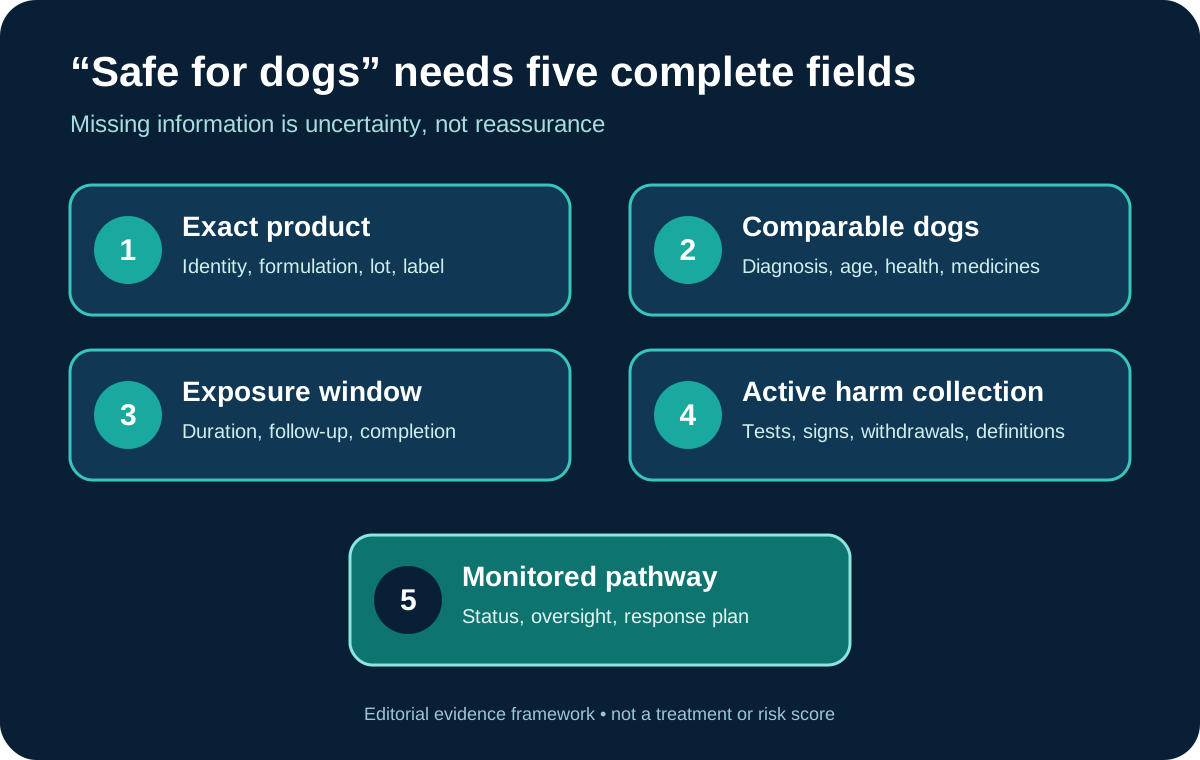
| Check | What to verify | Why it matters |
|---|---|---|
| Exact product | Active ingredient, molecular form, concentration, excipients, formulation, route, manufacturer or pharmacy, lot, storage, and current label. | A paper about one laboratory preparation does not authenticate or qualify another finished product. |
| Comparable dogs | Age, health status, diagnosis, breed or size range, concurrent conditions, other medicines, and whether the dogs were client-owned patients or healthy research animals. | Healthy beagles may not represent older dogs with kidney disease, diabetes, cancer, or multiple medications. |
| Exposure window | Single use or repeated exposure, study duration, follow-up after stopping, and the number that began and completed. | Immediate tolerance cannot rule out delayed, cumulative, reproductive, immune, or disease-specific harms. |
| Harm collection | Physical examinations, clinical signs, owner diaries, laboratory tests, withdrawals, serious events, predefined definitions, and who assessed causality. | “No visual signs” is narrower than an organized safety assessment with active monitoring. |
| Product pathway | Approved label, veterinarian-directed extra-label use, patient-specific compound, food or supplement-style product, or experimental material, plus a response plan. | Premarket review, manufacturing controls, labeling, adverse-event reporting, and oversight differ. |
These checks do not produce a universal score. They prevent unlike evidence from being merged. A licensed insulin label, a nutrition study, and a short pharmacokinetic experiment can all be informative while answering different safety questions.
“Peptide” is too broad to be a safety category
Peptides and peptide-related products are not interchangeable simply because their names contain similar language. Insulin is a peptide hormone. Hydrolyzed collagen contains mixtures of smaller protein fragments. BPC-157 is a named experimental peptide used in preclinical research. A monoclonal antibody is a much larger biologic and should not be relabeled as a peptide merely because marketing pages place it nearby.
Each category brings a different product question. For an approved animal drug, the current label is the starting point. For a food or supplement-style product, the exact ingredients, intended use, formulation, lot controls, and matching finished-product evidence matter. For a compounded prescription, the veterinarian’s clinical rationale and the pharmacy’s exact preparation matter. For research material, a seller’s purity statement does not create a reviewed veterinary product.
The existing peptide therapy for dogs guide starts with diagnosis and treatment evidence. This page starts at a different point: what information is needed to interpret a safety claim once the exact product and use have been identified.
Example one: an approved insulin label defines specific risks
FDA’s current label for Vetsulin identifies a sterile aqueous suspension of purified porcine insulin approved under NADA 141-236 for dogs and cats with diabetes mellitus. It names the product, species, disease, formulation, prescription status, precautions, contraindications, adverse reactions, and monitoring context. That specificity is what makes its safety information usable.
The label reports results from a field effectiveness and safety study in which 66 dogs received the product and 62 were included in the safety assessment. It describes hypoglycemia, associated clinical signs, injection-site observations, withdrawals in a separate pen study, and limits in populations that were not evaluated. Those details do not mean the product has no risk. They make the known risk more interpretable for the indicated condition and veterinary monitoring plan.
This example also shows why “approved” is not a synonym for “harmless.” Approval is a product-specific benefit-risk and quality decision for an intended use. FDA explains that animal-drug review evaluates the submitted product’s safety, effectiveness, manufacturing, labeling, and packaging. The result cannot be transferred to a different molecule, formulation, use, or unverified vial.
Example two: six beagles cannot supply a household-dog incidence rate
The 2022 BPC157 pharmacokinetic paper included three male and three female healthy beagles. The researchers used a laboratory-prepared peptide in intravenous and intramuscular experiments, including a repeated seven-day phase. The article reports that administration was well tolerated and that no visual signs of toxicity were observed.
That statement is worth recording exactly, but it is a narrow observation. The main study purpose was pharmacokinetics: plasma concentration, exposure, bioavailability, and elimination. Six healthy research dogs observed during a short preclinical experiment cannot provide a reliable frequency for uncommon events, delayed problems, interactions, or risks in dogs with naturally occurring disease. It also cannot establish that a commercially listed product contains the same material or has appropriate sterility, concentration, stability, or packaging.
“No visual signs of toxicity” should therefore remain in the observation column. It should not be upgraded to “safe for dogs,” “safe long term,” or “safe at home.” The BPC-157 dog side-effects guide examines that compound-specific evidence in more depth. This article uses it only to demonstrate the limits of a small, short safety window.
Example three: withdrawals belong in the safety reading
A 2024 controlled study of a specific oral bioactive collagen peptide preparation enrolled 41 privately owned dogs with chronic osteoarthritis; 31 completed the 12-week study. Ten were excluded for reasons including skin problems, gastrointestinal problems, a malignant tumor requiring pain medication, and unknown reasons. The exclusions occurred across study groups rather than only in the collagen group.
The paper reported favorable findings for several kinetic measures and a quality-of-life component, while accelerometer-measured activity was unaffected. The authors also described the preparation as safe. A careful reader should still keep completion, exclusions, duration, outcome collection, and disclosed funding or patent interests beside that conclusion. The reported events do not automatically prove the intervention caused them, and the study was not large or long enough to settle every safety question.
This is not a reason to dismiss the study. It is a reason to avoid extracting one reassuring adjective while dropping the rest of the design. It also prevents transfer to a different powder, chew, flavor system, blend, serving, or dog population. The collagen peptides for dogs buying guide shows how to compare a product label with the studied preparation without assuming equivalence.
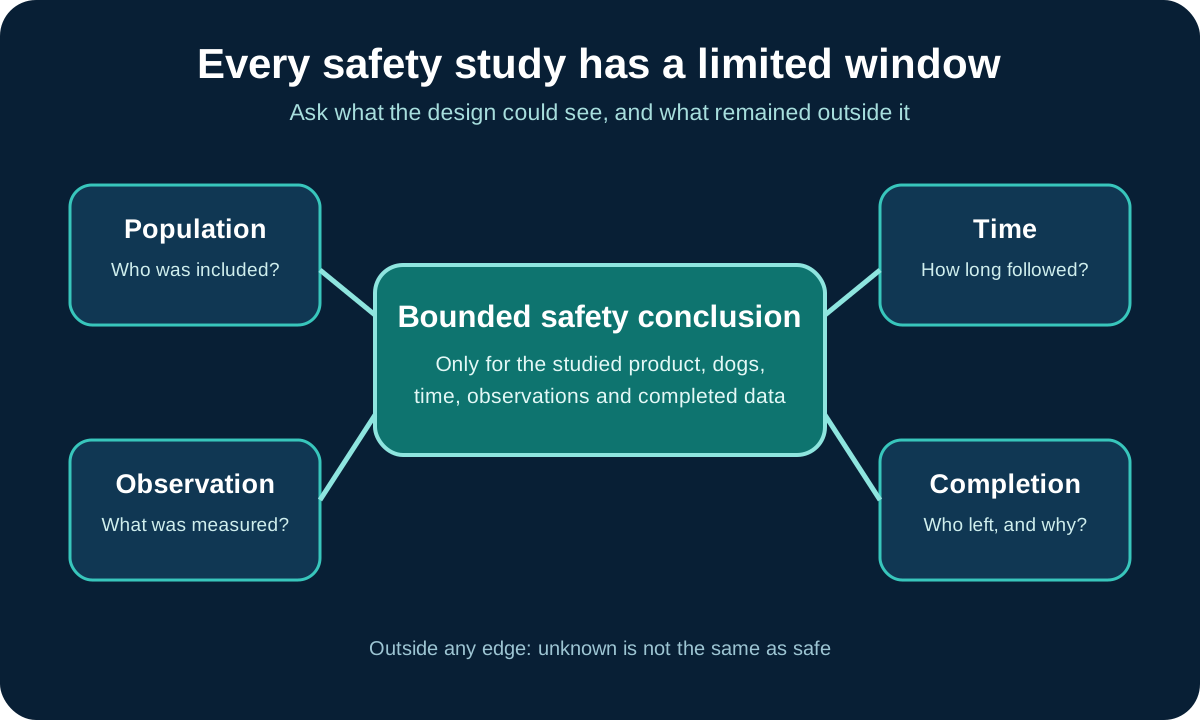
A safety window has four edges
Every study sees through a limited window. The population edge asks which dogs were eligible and which were excluded. The time edge asks how long exposure and follow-up lasted. The observation edge asks what investigators actively measured. The completion edge asks what happened to every enrolled dog and which data reached the final analysis.
| Source | What it can show | What remains outside the window |
|---|---|---|
| Approved Vetsulin label | Product-specific precautions, contraindications, field-study adverse reactions, monitoring, and unevaluated populations for the labeled use. | Safety of unrelated peptides, unapproved formulations, different indications, or use outside the veterinarian-directed label context. |
| BPC157 dog pharmacokinetics | Short experimental exposure and observed tolerance of one laboratory preparation in six healthy research beagles. | Clinical-patient risk, uncommon or delayed events, long-term use, interactions, treatment benefit, and retail-product equivalence. |
| Canine collagen study | Twelve-week outcomes, completion, and reported exclusion reasons for one oral preparation in eligible dogs with mild to moderate osteoarthritis. | Long-term risk, other formulations, more severe disease, dogs unable to stop other treatments, and attribution of every exclusion. |
A small study can still be useful. The mistake is not smallness itself. The mistake is claiming the study measured more dogs, more time, more conditions, or more outcomes than it did.
Unreported is not the same as absent
Safety wording should distinguish at least four states:
- Actively assessed and not observed. The paper defines the outcome and shows how investigators looked for it.
- Observed but not attributed. An event occurred, but the available design does not establish that the intervention caused it.
- Not described. The report does not say whether the outcome was collected or occurred.
- Not estimable. The sample, duration, population, or reporting system cannot support a useful frequency estimate.
Those states should not be collapsed into “no side effects.” The distinction matters especially when summaries omit withdrawals, combine treatment and comparison groups, or use “well tolerated” without explaining the examination schedule and laboratory monitoring.
Product pathway changes the safety information available
FDA states that animal drugs compounded from bulk drug substances are not FDA-approved and have not undergone FDA review for evidence that they are safe, effective, properly manufactured, accurately labeled, and adequately packaged. FDA also says these compounded drugs lack post-market controls and that compounders are not required to report adverse events and product defects in the same way as sponsors of approved animal drugs.
The same FDA page recognizes that compounding from bulk substances may be medically necessary when no medically appropriate approved, conditionally approved, indexed, or approved-source option can treat the animal under the applicable circumstances. Both parts matter. Patient-specific veterinary necessity does not create approval, and lack of approval does not prove that a veterinarian can never have a legitimate reason to prescribe a compound.
A research-chemical listing sits in a different lane again. It does not become suitable for a dog because the seller posts a certificate, uses a familiar nickname, or says “not for human consumption.” The relevant questions are whether a veterinarian has identified a clinical need, whether a lawful product pathway exists, and whether the finished preparation has adequate identity, quality, labeling, traceability, and monitoring.
The dog peptide injection-pathway guide compares approved, extra-label, compounded, and experimental routes without teaching injection. The adverse-event report guide explains why a report can be a signal without proving causation or estimating incidence.

Questions to take to the veterinarian
- What diagnosis are we treating? Ask what evidence supports it and what alternatives could explain the signs.
- What is the exact finished product? Record the active ingredient, molecular form, formulation, manufacturer or pharmacy, lot, current label, and storage requirements.
- Which dogs provide the closest safety evidence? Compare age, diagnosis, health status, concurrent medicines, route, duration, and follow-up.
- How were harms collected? Ask about physical examinations, laboratory tests, owner observations, withdrawals, and serious-event definitions.
- What remains unknown for this dog? Include other diseases, pregnancy or breeding status, age, prior reactions, and medicine interactions when relevant.
- What will be monitored? Agree on baseline information, expected benefit, concerning signs, follow-up timing, and a stopping or reassessment plan.
- How would a problem be reported? Keep the product name, lot, pharmacy or manufacturer, dates, observations, and veterinary records available.
Open the free veterinary-visit checklist
The amount-to-volume calculator performs generic arithmetic only after a veterinarian provides an amount and the actual pharmacy label provides a concentration. It does not determine whether a product is safe, select a dose, recommend a route, or replace monitoring.
Frequently asked questions
Are all peptides dangerous for dogs?
No class-wide conclusion is accurate. Some defined peptide drugs have product-specific veterinary approvals and known monitoring requirements. Other compounds have only preclinical evidence or an uncertain finished-product identity. The exact product and use determine the question.
Does “no side effects reported” mean a product is safe?
No. Check whether harms were actively collected, how many dogs were observed, the duration and follow-up, withdrawals, excluded data, and which populations were not studied. Not reported, not observed, and not estimable are different findings.
Does a beagle study prove safety for pet dogs?
No. The BPC157 pharmacokinetic paper observed six healthy research beagles during short experimental exposure. It cannot estimate uncommon or long-term risks in diverse household dogs or validate a different finished product.
Is an FDA-approved peptide risk free?
No. Approval provides product-specific review and labeling for an intended use, not zero risk. The current label, veterinarian supervision, contraindications, monitoring, and the individual dog still matter.
Is a compounded peptide FDA-approved?
A compounded animal drug made from a bulk drug substance is not FDA-approved. FDA recognizes medically necessary veterinary circumstances for such compounding, but that does not replace product-specific approval review or create a class-wide safety conclusion.
Can a certificate of analysis prove a peptide is safe for my dog?
No. A document may address selected identity or purity tests for a sample, but it does not by itself establish lawful veterinary use, sterile manufacture, accurate final concentration, stability, clinical effectiveness, or safety for a particular dog.
The bottom line
“Are peptides safe for dogs?” is not one testable question until the exact finished product and intended use are named. Then look for comparable dogs, a relevant exposure window, active harm collection, complete accounting of withdrawals, and a lawful monitored product pathway.
The Vetsulin label shows product-specific known risks and monitoring. The BPC157 beagle paper shows a narrow short-term observation window, not a household-dog safety rate. The collagen study shows why completion and exclusion reasons belong beside reassuring conclusions. Keeping those sources separate is more useful than a universal safe or unsafe label.
Sources and scope
This is an introductory guide or original comparison framework, not a systematic review or a product recommendation.
- FDA-approved label: Vetsulin (porcine insulin zinc suspension), NADA 141-236 — Product-specific indication, field-study adverse reactions, contraindications, monitoring and unevaluated populations. Label dose and administration instructions are not reproduced.
- FDA: Animal Drug Development and Approval Process — Current product-specific review context for intended use, safety, effectiveness, manufacturing, labeling and packaging.
- He et al. (2022): BPC157 pharmacokinetics in rats and dogs — Six healthy research beagles, laboratory-prepared BPC157, intravenous and intramuscular pharmacokinetics, including seven-day repeated exposure; visual tolerance is not a household-dog incidence estimate.
- Dobenecker et al. (2024): specific collagen peptides in canine osteoarthritis — Forty-one enrolled and 31 completed the 12-week study; exclusion reasons, outcomes, formulation, funding and patent interests remain visible.
- FDA: Animal Drug Compounding — Current approval, product-review, post-market and adverse-event reporting limits for animal drugs compounded from bulk substances, with medically necessary veterinary context.
Source checked October 12, 2026. A general context source does not establish a named product’s benefit.