
Peptides for Dog Arthritis: What Has Actually Been Studied?
Can peptides help dog arthritis? Compare product-specific collagen research, an approved veterinary antibody, and the missing canine evidence for BPC-157 and TB-500.
Can peptides help a dog with arthritis? “Peptides” is too broad to answer as one treatment category. A 2024 blinded study reported some pain and gait improvements for one specific oral collagen peptide preparation in dogs with naturally occurring osteoarthritis, while daily accelerometer activity did not change. That result does not validate every collagen powder or chew. The BPC-157 dog paper measured exposure in six healthy beagles, not arthritis relief, and no reviewed canine osteoarthritis trial establishes TB-500 benefit. Bedinvetmab is different again: it is an FDA-approved, prescription monoclonal antibody for control of osteoarthritis pain in dogs, not a collagen supplement or a small experimental peptide.

Search results for peptides for dog arthritis can place food-derived collagen peptides, experimental research compounds, and veterinary biologic drugs beside one another. Their names may all refer to amino-acid-based molecules, but their regulation, formulation, evidence, risks, and clinical roles are not interchangeable. This guide sorts the categories before comparing the evidence.
This is an AI-assisted evidence explainer, not a systematic review or veterinary treatment recommendation. Primary papers and the current FDA approval page were checked October 4, 2026. No dose, route choice, injection instruction, research-chemical seller, or personalized treatment plan is provided.
Start with the diagnosis, not the molecule
Osteoarthritis is a degenerative joint disease. Stiffness, reluctance to rise, slower walks, limping, or avoiding stairs can also have other causes. Hip dysplasia may contribute to secondary arthritis. A cranial cruciate ligament injury can change joint stability and later arthritis risk. Spinal, muscle, paw, neurologic, and systemic problems can look like “joint trouble” at home.
That distinction matters because evidence follows a defined population. A study in client-owned dogs with diagnosed osteoarthritis asks a closer question than an experiment in healthy laboratory animals. A tissue-healing model does not become an arthritis trial because both topics mention recovery. A useful comparison begins only after a veterinarian identifies the likely condition and the outcome that matters.
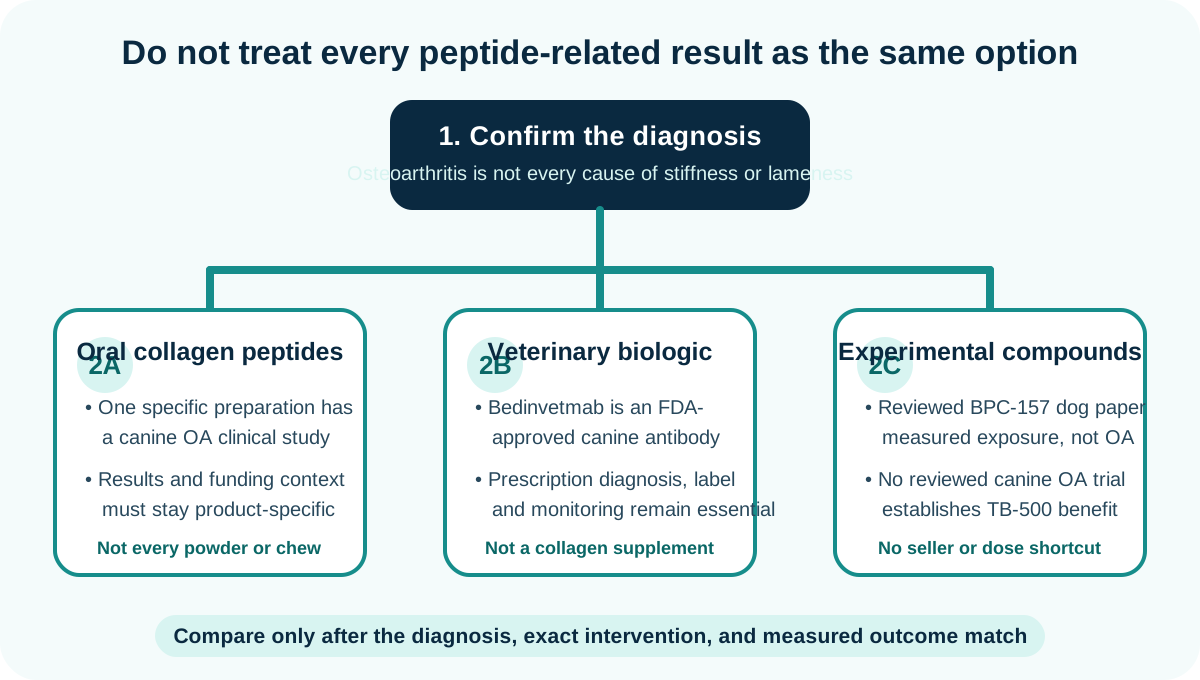
Three categories owners see under one search phrase
| Category | What has actually been studied | What the evidence can support | What it cannot support |
|---|---|---|---|
| Specific oral collagen peptides | A 12-week blinded, placebo-controlled study in 31 dogs with naturally occurring osteoarthritis compared a specific bioactive collagen peptide intervention with two other groups. | Product-specific questions about the reported pain and gait outcomes, plus direct inspection of neutral results and funding context. | A class-wide claim for every collagen source, molecular profile, powder, chew, blend, serving, or retail product. |
| Prescription veterinary monoclonal antibody | FDA reviewed bedinvetmab injection for control of pain associated with osteoarthritis in dogs. The approval record describes two field studies in client-owned dogs. | A product-specific regulatory and veterinary-care discussion using the current label and veterinarian monitoring. | A supplement recommendation, an experimental peptide protocol, or proof that all amino-acid-based products have similar effects. |
| Experimental compounds such as BPC-157 or TB-500 | The reviewed BPC-157 dog study was pharmacokinetic research in six beagles. The site’s TB-500 identity review separates a short fragment from full-length thymosin beta-4 and related laboratory work. | Narrow questions about exposure, exact molecular identity, and what future canine trials would need to measure. | Canine arthritis pain relief, improved mobility, cartilage repair, a safe pet dose, or equivalence to an approved veterinary drug. |
What did the canine collagen study find?
In the 2024 PLOS ONE paper, Dobenecker and colleagues studied client-owned dogs with naturally occurring osteoarthritis over 12 weeks. The design was randomized, double-blind, and placebo-controlled. The paper describes three groups: a specific bioactive collagen peptide intervention, an omega-3 fatty acid plus vitamin E intervention, and placebo. Thirty-one dogs completed the study.
The researchers did not rely on one outcome. They used force-plate treadmill measurements, the Canine Brief Pain Inventory, and accelerometers. The authors reported improvement in several kinetic measures and in the quality-of-life component they evaluated for the collagen peptide group. Accelerometer-measured activity was unaffected. That neutral result belongs beside the favorable results because different outcomes answer different questions.
The study is closer to a pet-owner arthritis question than a cell experiment or a healthy-dog exposure study, but it remains bounded. It tested a particular intervention under defined conditions in a small sample. The paper reports that GELITA funded the work, one author was a company employee, and another author was a co-inventor on collagen peptide patents. Disclosure does not automatically invalidate a study. It tells readers to preserve the exact intervention, design, endpoints, effect sizes, funding, and need for independent replication.
Before connecting that paper to a retail product, compare the finished product with the studied preparation. “Hydrolyzed collagen,” “collagen peptides,” gelatin, undenatured type II collagen, and a multi-ingredient joint chew are not automatic substitutes. The label must identify enough information to make a meaningful match. Our collagen peptides for dogs buying guide walks through formulation, label, evidence, and cost questions without claiming that price predicts benefit.
Why BPC-157 and TB-500 do not fill the arthritis gap
The accessible 2022 BPC157 paper included six young beagles in intravenous and intramuscular pharmacokinetic experiments. Investigators measured plasma concentration, total exposure, half-life, bioavailability, distribution, metabolism, and excretion questions. The dogs were not enrolled because they had osteoarthritis. The paper did not compare arthritis pain, lameness, weight bearing, everyday activity, or quality of life with placebo.
That is why “studied in dogs” is incomplete. A dog exposure experiment establishes that exposure was measured under those laboratory conditions. It does not establish a clinical benefit for a dog with arthritis. The dedicated BPC-157 for dogs joint pain guide compares that paper with the outcomes an actual canine pain study would need.
TB-500 creates an additional identity problem. Commercial and research discussions can blur a short acetylated fragment, a related unacetylated sequence, and full-length thymosin beta-4. Evidence for one identity cannot silently transfer to another. The TB-500 and thymosin beta-4 guide keeps sequence and study model attached to each source. No reviewed canine osteoarthritis clinical trial on that page establishes TB-500 as an arthritis treatment.
Neither keyword should lead to a research-chemical purchase funnel. When identity, finished-product quality, approval context, dog-specific benefit evidence, and veterinary monitoring are unresolved, shopping links do not solve the evidence problem.
Where bedinvetmab fits, and why it is a separate class
On May 5, 2023, FDA announced approval of Librela, bedinvetmab injection, for control of pain associated with osteoarthritis in dogs. FDA describes bedinvetmab as a canine-specific monoclonal antibody that binds nerve growth factor. The agency’s approval page reports two field studies in client-owned dogs diagnosed with osteoarthritis and use of the Canine Brief Pain Inventory. It also states that the product is prescription-only because diagnosis, administration, monitoring, and management of adverse reactions require professional expertise.
This approval is relevant to a dog-arthritis evidence map, but it should not be used to market collagen supplements or experimental compounds. A monoclonal antibody is a large biologic with its own product-specific regulatory review and label. It is not evidence that an oral collagen powder, BPC-157 preparation, or TB-500 listing works by the same mechanism or has the same benefit-risk profile.
This article does not compare treatments or advise whether bedinvetmab is appropriate for a particular dog. That decision belongs with the prescribing veterinarian using the current label, the dog’s diagnosis and history, other care, and a monitoring plan.
Read every outcome, not just the favorable one
Dog osteoarthritis studies may combine owner observations, clinic-based movement measurements, daily activity data, and safety follow-up. These outcomes complement one another, but they are not substitutes.
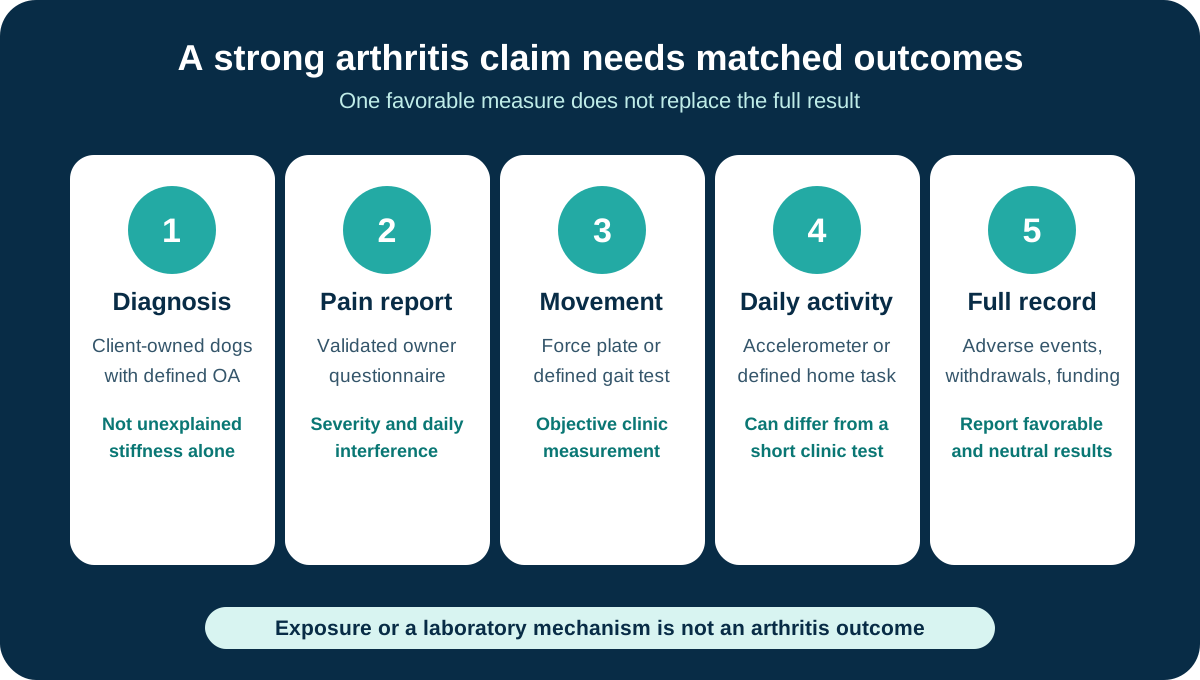
| Outcome | Example | Useful for | Does not establish alone |
|---|---|---|---|
| Owner-reported pain and function | Validated Canine Brief Pain Inventory domains. | Changes noticed in ordinary life, including pain severity and interference. | Exact joint mechanics, structural repair, or why the change occurred. |
| Gait and weight bearing | Force-plate measures during standardized movement. | Objective kinetic changes in a controlled setting. | Comfort across the whole day or a universal clinical benefit. |
| Daily activity | Accelerometer measurements over time. | Movement outside a brief clinic test. | A diagnosis or a complete explanation for more or less activity. |
| Pharmacokinetics | Plasma concentration and exposure over time. | What happened to a studied preparation after a studied route. | Arthritis pain relief, mobility improvement, or tissue repair. |
| Safety and follow-up | Adverse events, withdrawals, laboratory findings, and duration. | Interpreting the observed benefit-risk record within the study. | Safety for every dog, formulation, duration, or combined care plan. |
Brown and colleagues’ 2008 randomized canine osteoarthritis trial is useful here because it evaluated whether the Canine Brief Pain Inventory could detect treatment response. It did not test collagen peptides, BPC-157, or TB-500. Its role in this guide is methodological: it shows why a validated pain measure is different from a blood-exposure curve or a general “mobility” claim.
A five-step arthritis claim check
- Name the condition. Is the dog diagnosed with osteoarthritis, or is the search starting from an unexplained sign?
- Name the exact intervention. Record the ingredient identity, finished product, route, and regulatory category.
- Match the population. Client-owned dogs with naturally occurring osteoarthritis are not equivalent to healthy beagles, rodents, cells, or tissue explants.
- Match the endpoint. Pain, force-plate movement, daily activity, imaging, and exposure are separate outcomes.
- Keep the complete record. Read neutral results, adverse events, withdrawals, funding, conflicts, and follow-up length with the favorable result.
If a marketing page skips any field, write “not established” instead of filling the gap with testimonials or a seller’s category label. The ingredient research versus finished-product guide provides a longer matching worksheet.
Watch: keep the study, label, and dog on separate cards
This existing original 48-second captioned explainer demonstrates the evidence-card method. It is silent and includes no dose or treatment instruction.
Open the dedicated video page and transcript. The animals shown are editorial imagery, not participants in the sources reviewed here.

Questions to bring to the veterinary visit
- What diagnosis best explains the stiffness, lameness, or activity change?
- Which outcome should we track at home, and which will be reassessed in the clinic?
- Does the cited research study dogs with this diagnosis using this exact intervention?
- Is the option a food or supplement-style product, a compounded prescription, an approved veterinary drug, or a research listing?
- What does the complete label say about indications, precautions, adverse reactions, and monitoring?
- Could the proposed product duplicate ingredients, calories, or risks in the current care plan?
- When should a lack of improvement or a new problem trigger reassessment?
Open the free vet-visit checklist
The amount-to-volume calculator only performs arithmetic from a veterinarian-provided amount and confirmed pharmacy-label concentration. It does not choose an arthritis treatment or provide a dose.
Frequently asked questions
What are the best peptides for dog arthritis?
There is no evidence-based class ranking called “best peptides.” One specific oral collagen peptide preparation has a small canine osteoarthritis study with mixed endpoints. Bedinvetmab is a separate prescription monoclonal antibody with product-specific FDA approval. Reviewed BPC-157 and TB-500 sources do not establish canine arthritis benefit.
Do collagen peptides work for every dog with arthritis?
No. One product-specific study cannot establish benefit for every dog or every collagen product. Diagnosis, formulation match, other ingredients, medical history, concurrent care, and the full study result matter.
Is BPC-157 proven for canine osteoarthritis?
No. The accessible dog paper measured pharmacokinetics in six healthy beagles. It did not test pain or mobility in dogs with osteoarthritis.
Is TB-500 the same as thymosin beta-4?
Not reliably. The nickname can blur a short acetylated fragment, a related unacetylated sequence, and full-length thymosin beta-4. Exact molecular identity must be established before research can be compared.
Is Librela a peptide supplement?
No. Librela contains bedinvetmab, a canine-specific monoclonal antibody and prescription veterinary drug. Its approval and label are product-specific and should not be transferred to supplements or experimental compounds.
Can I use a keyword search to decide why my dog is stiff?
No. Arthritis is one possible cause among several. A diagnosis-first veterinary evaluation is necessary before research relevance or treatment options can be judged.
Bottom line: the useful question is not “Which peptide is best?” It is “What is the diagnosis, what exact intervention was studied, in which dogs, and which outcomes changed?” Specific oral collagen peptides have limited direct canine osteoarthritis research. An approved monoclonal antibody belongs to a separate prescription category. Experimental compounds remain experimental unless their own canine arthritis trials establish benefit and safety.
Sources and scope
This is an introductory guide or original comparison framework, not a systematic review or a product recommendation.
- Dobenecker et al. (2024): specific collagen peptides in canine osteoarthritis — Twelve-week blinded, placebo-controlled study in client-owned dogs; product-specific results, neutral accelerometry finding, and funding context retained.
- FDA: bedinvetmab approval for canine osteoarthritis pain — Official product-specific veterinary approval context; monoclonal antibody, not a collagen supplement or experimental peptide.
- He et al. (2022): BPC157 pharmacokinetics in rats and dogs — Six-beagle exposure study, not a canine osteoarthritis efficacy trial.
- Brown et al. (2008): Canine Brief Pain Inventory treatment response — Canine osteoarthritis outcome-method comparison; did not study collagen, BPC-157, or TB-500.
Source checked October 04, 2026. A general context source does not establish a named product’s benefit.