
BPC-157 for Dogs’ Gut Health: Ulcer Models vs Canine Disease
Does BPC-157 gut-healing research apply to dogs with chronic digestive disease? Compare rat ulcers, beagle exposure and meaningful canine clinical outcomes.
Does BPC-157 improve dogs’ gut health? The sources reviewed here do not establish that BPC-157 treats chronic digestive disease in dogs. A rat gastric-ulcer experiment and a healthy-beagle drug-exposure study answer different questions from whether a dog with persistent vomiting, diarrhea or weight loss improves. The useful next step is to identify the diagnosis and ask for evidence measuring that condition in comparable dogs, not to translate “gut healing” into a dose.

Sources checked October 14, 2026. This AI-assisted educational comparison has not been reviewed by a veterinarian and is not a systematic review or treatment plan. It supplies no dose, administration instructions, seller recommendation or claim of proven benefit. Persistent or recurrent digestive signs deserve veterinary assessment; this article cannot diagnose their cause.
“Gut health” needs a more specific question
For an owner, the hoped-for benefit may be fewer vomiting episodes, more predictable stools, restored appetite, stable weight or a dog that seems comfortable again. Those are understandable goals. But “gut health” can hide several different claims: preventing an experimentally induced stomach injury, reducing a measured lesion, changing a laboratory marker, improving daily symptoms or maintaining remission of a diagnosed disease. One result cannot silently stand in for all of them.
Start by finishing this sentence: “I want to know whether this exact product improves ___ in dogs diagnosed with ___.” If the second blank is still unknown, the product discussion is ahead of the clinical question. A testimonial that simply says a dog’s stomach was better cannot fill in the missing diagnosis, comparison or follow-up.
The 2026 ACVIM-endorsed canine guideline favors the term chronic inflammatory enteropathy (CIE) over “inflammatory bowel disease” to distinguish canine disease from a similar but not identical human condition. CIE remains a diagnosis of exclusion. The guideline considers history, examination, diagnostic testing and, where appropriate, response to treatment or endoscopy with histopathology. It also recommends grading clinical severity and assessing body and muscle condition. This is a veterinary assessment framework, not a home diagnostic checklist.
That terminology matters for searches such as “BPC-157 for dogs with IBD.” A human ulcerative-colitis discussion, a rat stomach experiment and a canine CIE question should not be merged just because all concern the digestive tract.
Three evidence rows that should stay separate
| Study and subjects | Exact intervention and route | Question measured | Limit for a dog gut-health claim |
|---|---|---|---|
| Xue et al., 2004 330 male Wistar rats across three induced gastric-ulcer models | Laboratory-synthesized BPC157; intragastric or intramuscular administration; saline, excipient and famotidine comparisons. | Ulcer area and tissue-healing measures. | Induced stomach injury in rats is not naturally occurring canine intestinal disease. |
| He et al., 2022 Six research beagles, three male and three female | Laboratory-prepared BPC157 in saline; intravenous and intramuscular exposure, including a seven-day repeat arm. | Drug concentrations and pharmacokinetics. | No canine chronic-enteropathy treatment comparison or oral dog arm. |
| Mandigers et al., 2010 26 dogs with naturally occurring chronic small-bowel disease | Orally fed hydrolyzed-protein diet versus highly digestible control diet; no BPC-157. | Clinical response, disease-activity score, weight and need for other therapy. | A canine clinical-outcome example, not evidence that BPC-157 or any peptide supplement works. |
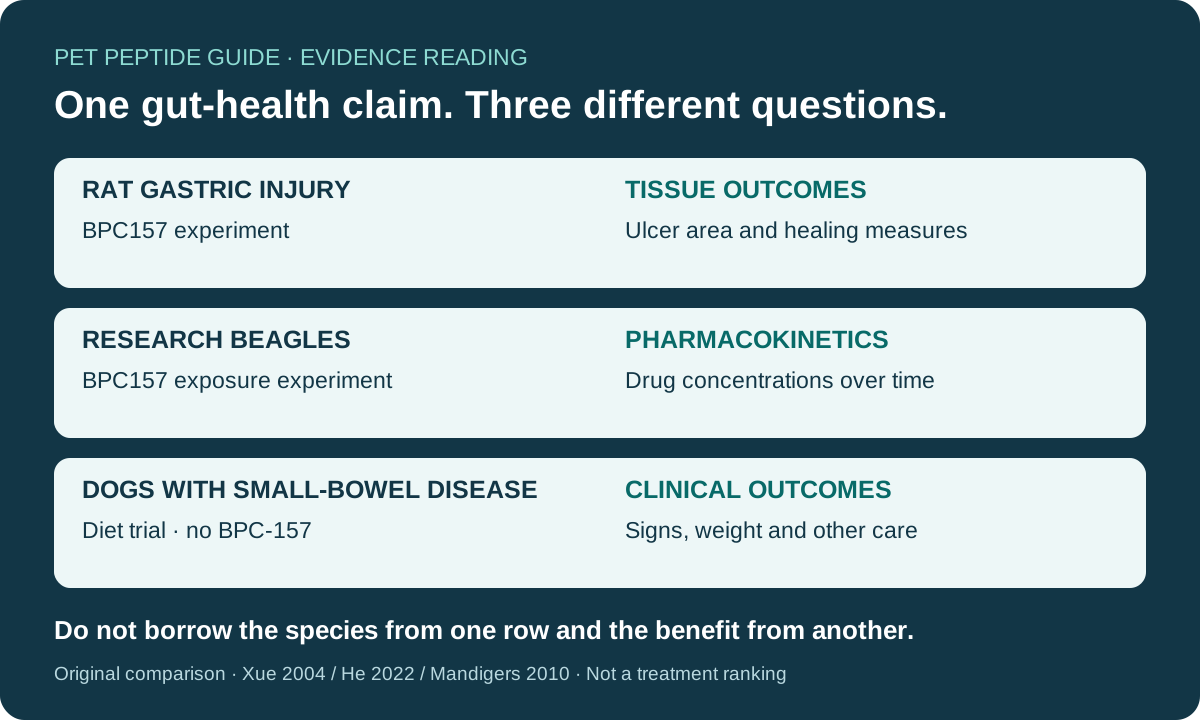
What the BPC-157 studies actually contribute
Xue and colleagues identify BPC157 as the 15-amino-acid sequence GEPPPGKPADDAGLV. Their laboratory preparation reduced ulcer areas and improved tissue measures under the tested conditions. The models involved indomethacin, pylorus ligation or an acetate challenge. Some arms examined protection before induced injury; another examined healing after injury. Those distinctions matter: prevention of an experimental lesion is not automatically treatment of established chronic disease. The study did not test a finished dog supplement. Read the rat methods and results.
He and colleagues’ beagle experiment measured how the compound moved through blood over time. Those dogs were not enrolled as patients with CIE, and the experiment did not measure remission, stool improvement or weight recovery from digestive disease. Its brief observation that no visible toxicity occurred cannot establish long-term safety in ill household dogs. See the dog methods in section 4.4.
The original contribution of this comparison is the missing intersection: a relevant dog population, the proposed finished BPC-157 preparation, a fair comparator and a meaningful digestive outcome would need to occur in the same study. Combining the species from one paper with a benefit from another does not create that study. This focused source review did not retrieve a matching canine clinical trial; that is not proof that no other or unpublished research exists.
For the separate route question, use BPC-157 oral versus injection for dogs. For the broader compound context, use the canonical BPC-157 evidence guide. Neither page supplies an administration plan.
What a canine clinical-outcome paper looks like
The Mandigers trial randomly allocated 18 dogs to the hydrolyzed diet and eight to the control. It was open-label, not blinded, and baseline clinical-activity scores differed despite randomization. Most dogs initially responded without a between-group difference; more test-diet dogs remained asymptomatic at later assessments. Rechecks extended from roughly three months to three years. A coauthor had a Royal Canin affiliation, and another author’s lectureship was company-funded; the paper reports no research grant. These details limit interpretation. Read the trial and disclosures.
The point is not to select food from an old paper. It is to recognize a question asked in affected dogs with outcomes that owners and clinicians can interpret. A complete hydrolyzed diet is also a different intervention from an isolated experimental peptide. Shared language about proteins or peptides does not establish equivalence.
Ask the veterinarian how any proposed option compares with condition-appropriate care, and which outcome would justify continuing it. A product should not receive an evidentiary shortcut because its advertising uses the same words as a dietary or veterinary study.
A worked “gut repair” claim check
Fictional example, not an actual advertisement or patient: an owner finds the claim “BPC-157 repairs the gut, with animal research and dog studies.” The listing links a rat ulcer paper and a beagle exposure paper. Here is a useful way to evaluate the claim without inventing a clinical conclusion.
- Rewrite the promise. Does “repair” mean a smaller stomach lesion, fewer digestive signs, sustained remission or something else? Ask the advertiser to choose an outcome.
- Keep each paper intact. Do not move a result into a different species, disease, route or formulation. A combined bibliography is not a combined experiment.
- Locate the missing comparison. Which source tests the exact proposed product in dogs with the relevant diagnosis against a credible comparator?
- Inspect the follow-up. Which subjects remained in the analysis, what additional care was given, and were unwanted effects and relapse tracked?
- State the conclusion narrowly. “These citations do not establish this dog-disease claim” is justified when the required match is missing. “It cannot ever work” is a different claim that this exercise does not establish.
If several interventions change at once, a before-and-after story also cannot isolate which change caused an improvement. Keep food, medicines, supplements and the observation period visible when asking about evidence. The biomarker guide explains why a favorable laboratory change needs its own link to meaningful benefit.
Choose outcomes before reading the result
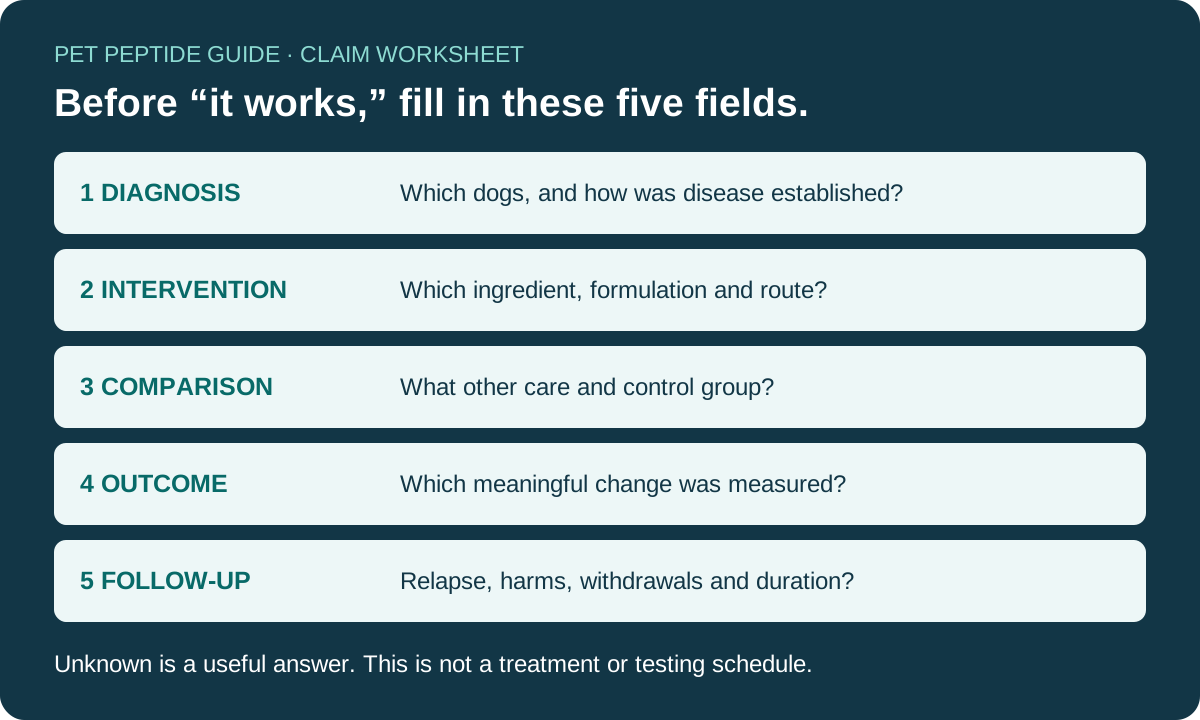
- Diagnosis: Who was eligible, and how was the condition established? Were the subjects healthy research animals or affected dogs?
- Intervention: What exact ingredient, formulation and route were tested? Is it the same preparation under discussion?
- Comparison care: What did the other group receive, and what concurrent food or medicines were allowed?
- Meaningful outcome: Did researchers define success before seeing results? Keep symptoms, body weight, clinical scores, tissue findings and laboratory markers separately named.
- Follow-up and harms: How long was improvement sustained? Were relapse, withdrawals, additional treatment and adverse events accounted for?
A clear answer in one field does not erase an unknown elsewhere. A well-characterized ingredient can still lack a relevant clinical comparison; a meaningful outcome can still be measured in an unsuitable population. Mark the unknowns instead of converting them into a numerical “evidence score” that suggests more precision than the information supports.
Safety and approval are separate questions
The FDA July 2026 BPC-157 briefing, retrieved October 14, evaluates free base and acetate separately for human compounding, including human ulcerative-colitis context. It states neither was a component of an FDA-approved drug at that evaluation. It also discusses altered clotting measures and liver-associated signals in animal toxicity work, with limited longer-term evidence. This is not a canine approval, a dog side-effect frequency or a veterinary treatment recommendation. Read the dog safety-evidence guide for the separate safety question.
FDA’s current animal-compounding information explains that drugs compounded from bulk substances are not FDA-approved and have not undergone its approval review for safety, effectiveness or product quality. It also recognizes medically necessary circumstances addressed by its guidance. Neither a prescription nor a compounding label is equivalent to approval. This article has not established an approved BPC-157 product for canine CIE. Ask the responsible veterinarian and pharmacy to identify the exact product and current lawful pathway.
Bring a clearer question to the appointment

Bring a short history of the concern, the current food and medicine list, the complete proposed product label and the exact paper behind the claim. Keep personal health information on your own device or paper; this site does not need it.
- What diagnosis are we investigating, and what else needs to be ruled out?
- Does the cited research involve dogs with that condition?
- Which result would matter for this dog, and what baseline should we use?
- What evidence supports the exact preparation, rather than an ingredient name?
- What are the established options, uncertainties and monitoring needs?
- When should we reassess, and which changes should prompt earlier contact?
Open the veterinary-visit checklist
There is no BPC-157 shopping list or affiliate offer here. Compare costs only after suitability and a lawful product pathway are settled. Our cost-comparison tool cannot supply a treatment plan. The sitewide amount-to-volume calculator likewise performs arithmetic only; it does not establish a safe or effective amount.
Quick answers
Does “gut healing” mean remission of canine IBD?
No. Ask what the authors actually measured and which disease the subjects had. A tissue result and a sustained clinical outcome are different claims.
Can a human colitis discussion establish use in dogs?
No. Human clinical or regulatory context must remain labeled as human. It does not replace a canine diagnosis, a matching product or dog-specific benefit and safety evidence.
Is a hydrolyzed diet evidence for BPC-157?
No. It is a different intervention. This article uses a dietary trial to illustrate patient-centered research, not to endorse an experimental peptide or recommend a particular food.
What would change this assessment?
A retrievable, well-reported trial of a clearly characterized preparation in comparable affected dogs, with meaningful outcomes, appropriate controls and adequate safety follow-up, would warrant a new assessment. New evidence would still need critical review rather than automatic acceptance.
Sources and scope
This is an introductory guide or original comparison framework, not a systematic review or a product recommendation.
- Xue et al. (2004): Protective effects of BPC 157 on gastric ulcer in rats — Laboratory identity, induced stomach-injury models, routes and tissue endpoints; not canine chronic enteropathy.
- He et al. (2022): BPC157 pharmacokinetics in rats and dogs — Methods sections 4.1–4.4 and dog results; exposure, not treatment of canine digestive disease.
- Mandigers et al. (2010): Hydrolyzed-protein diet trial in canine chronic small-bowel enteropathy — Primary clinical-outcome comparator and disclosed limitations; not a BPC-157 trial or food recommendation.
- Heilmann et al. (2026): ACVIM-endorsed canine chronic inflammatory enteropathy statement — Official consensus and systematic-review context for terminology, diagnosis and clinical severity; not an original BPC-157 experiment.
- FDA (July 2026): BPC-157 free-base and acetate briefing — Human-compounding evaluation, distinct substance forms, approval context and animal safety signals; not canine approval or a veterinary protocol.
- FDA: Animal Drug Compounding — Current bulk-compounding approval and review limits, with medically necessary circumstances kept separate.
Source checked October 14, 2026. A general context source does not establish a named product’s benefit.