
BPC-157 for Dogs Joint Pain: What the Studies Actually Measure
Does BPC-157 help dogs with joint pain? Compare dog exposure research, rat tendon findings, and the pain and mobility outcomes a canine trial would need.
Does BPC-157 help dogs with joint pain? No reviewed dog study establishes that BPC-157 reduces joint pain or improves mobility. The accessible 2022 beagle study measured how an experimental BPC157 preparation moved through the body after intravenous and intramuscular administration. It did not enroll dogs with osteoarthritis, compare pain treatment with placebo, or measure lameness, force-plate movement, daily activity, or owner-reported pain.

People searching for BPC-157 for dogs joint pain often encounter a dog pharmacokinetic paper beside rat tendon research. Those sources can answer narrow research questions, but neither is a clinical trial showing that a household dog became more comfortable or mobile. This guide keeps exposure, tissue experiments, and canine pain outcomes in separate columns.
This is an AI-assisted evidence explainer, not a systematic veterinary review or treatment recommendation. Primary papers were checked October 3, 2026. No pet dose, route choice, injection instruction, product, seller, or clinical protocol is provided. For the complete compound overview, read the canonical BPC-157 guide for dogs and cats.
What did the BPC-157 dog study actually measure?
He and colleagues’ 2022 paper included six purpose-bred beagles, three male and three female, aged 10 to 12 months. Investigators used laboratory-prepared BPC157 in saline in intravenous and intramuscular experiments, including a seven-day repeated intramuscular phase. Blood sampling and analytical methods were used to estimate pharmacokinetic measures such as peak plasma concentration, time to that peak, total exposure, half-life, and bioavailability.
Those measurements help describe exposure under the experimental conditions. They do not answer whether an arthritic dog hurts less, bears more weight on an affected limb, climbs stairs more easily, or returns to normal activity. The dogs were not presented as canine osteoarthritis patients. There was no joint-pain treatment group, placebo pain comparison, validated pain inventory, force-plate gait endpoint, or rehabilitation outcome.
The authors’ report of no visual signs of toxicity in the dog experiment is also not a mobility result. It is a bounded observation from a small exposure study. The separate BPC-157 dog side-effects guide explains why that sentence does not establish a long-term safety profile.
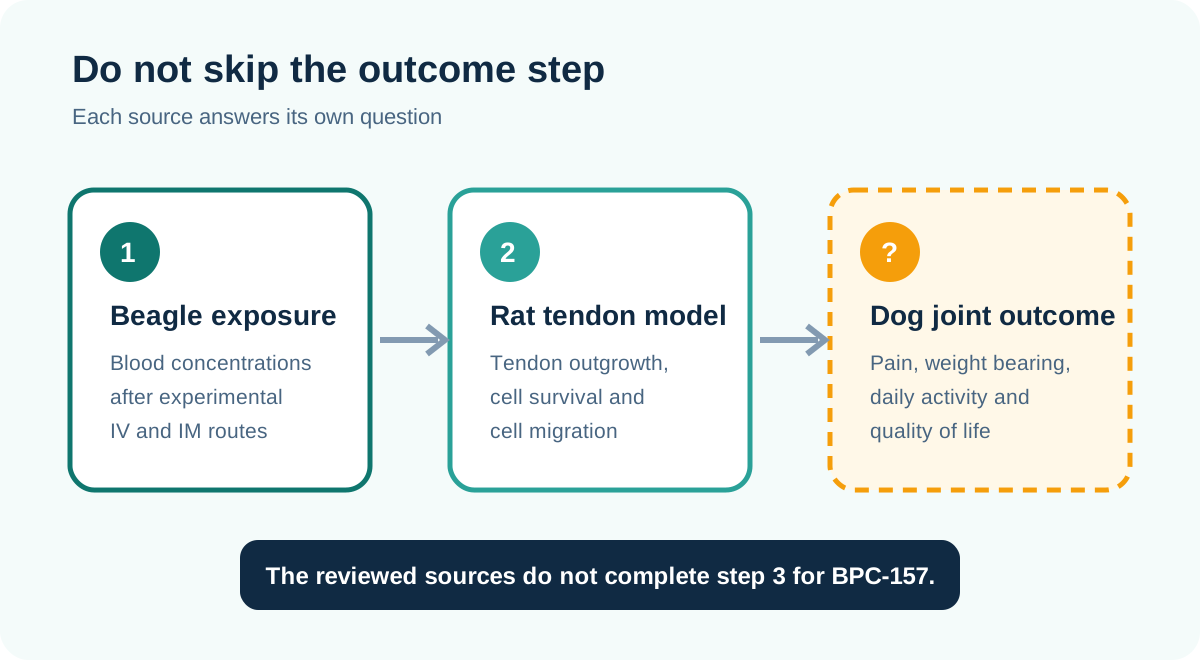
Exposure, tendon biology and joint pain are different questions
| Source | Species, preparation and study type | Measured outcome | What remains unanswered for a dog with joint pain |
|---|---|---|---|
| He et al., 2022 | Six research beagles; laboratory-prepared BPC157 in saline; intravenous and intramuscular pharmacokinetic experiments. | Plasma concentrations, exposure, route-related pharmacokinetic parameters, distribution and metabolism work across the paper. | Change in pain, lameness, weight bearing, activity, function or quality of life in dogs with a diagnosed joint condition. |
| Chang et al., 2011 | Rat Achilles tendon explants and tendon fibroblasts; laboratory work studying BPC 157 in a tendon-healing model. | Tendon outgrowth, cell survival and cell migration under experimental conditions. | A clinical outcome in dogs, a naturally occurring joint disease, a finished product, or a comparison of pain treatment. |
| Brown et al., 2008 | Seventy dogs with osteoarthritis; randomized, double-blind, placebo-controlled clinical trial of a different intervention. | Whether the Canine Brief Pain Inventory detected treatment response over 14 days. | It did not study BPC-157. Its value here is showing the kind of validated dog pain outcome an efficacy claim would need. |
| Dobenecker et al., 2024 | Client-owned dogs with naturally occurring osteoarthritis; 12-week blinded, placebo-controlled oral study of specific collagen peptides, not BPC-157. | Force-plate treadmill measures, Canine Brief Pain Inventory components and accelerometer activity. | It cannot be transferred to BPC-157. It illustrates product-specific clinical endpoints and why mixed results must stay visible. |
The last two rows are not evidence for BPC-157. They are outcome-design comparisons. Brown and colleagues tested a validated owner-completed pain instrument in an actual canine osteoarthritis trial. Dobenecker and colleagues combined owner reports with gait and activity measures for a specific collagen preparation. A BPC-157 dog joint-pain claim would need its own study of the exact compound and preparation, not borrowed outcomes from those interventions.
Why rat tendon findings do not prove canine joint-pain relief
The 2011 Chang paper is often summarized with a broad word such as “healing.” Its model was narrower: rat Achilles tendon explants and fibroblasts. The investigators examined tendon outgrowth, cell survival and migration. This is mechanistic and tissue-model research. It did not enroll dogs, diagnose osteoarthritis, measure pain behavior in household pets, or test a commercial veterinary product.
A tendon is also not a synonym for a joint, ligament, meniscus, articular cartilage, or painful nervous-system response. A dog can appear stiff or lame because of osteoarthritis, a cruciate ligament problem, hip dysplasia, spinal disease, muscle injury, paw disease, or another condition. The same outward sign can lead to different diagnostic and evidence questions.
That is why the proposed benefit must be written precisely. “Makes tendon cells migrate in one laboratory model,” “changes weight bearing in dogs with osteoarthritis,” and “reduces owner-observed pain interference” are three different statements. Replacing all three with “helps joints” removes the information needed to judge relevance.
What a useful canine joint-pain study would measure
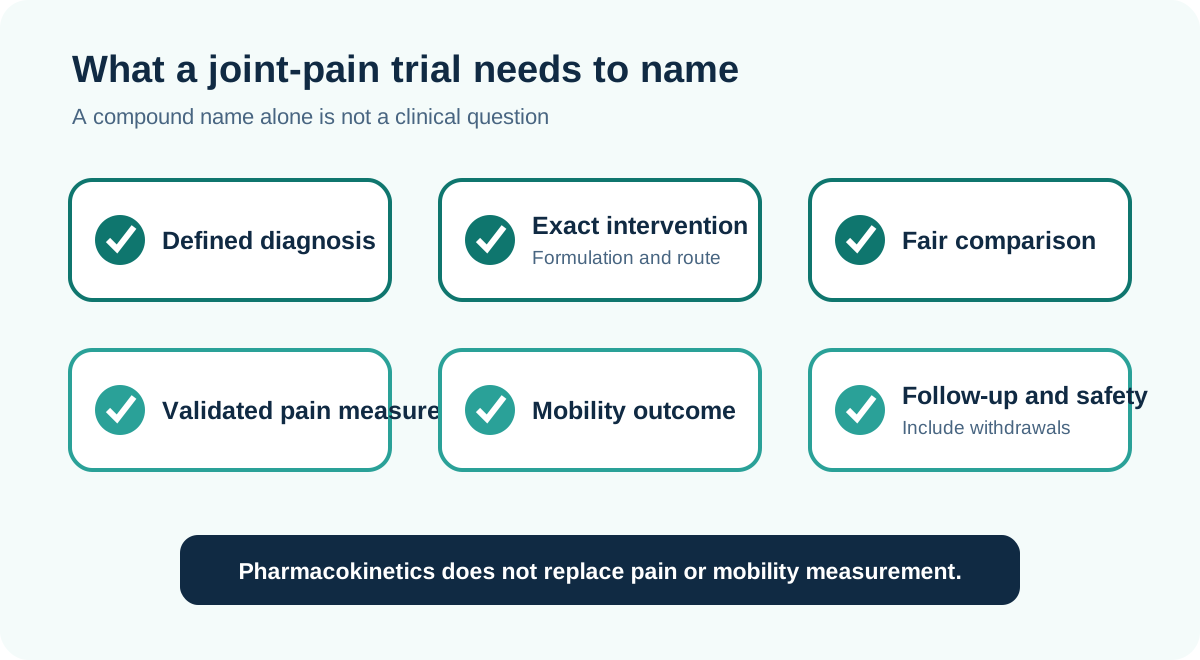
A future trial would first define the condition and population. Dogs with radiographically and clinically diagnosed osteoarthritis are not interchangeable with young dogs after acute ligament surgery or animals with unexplained lameness. Eligibility criteria, concurrent care and withdrawal rules would need to be stated.
The exact intervention would need its own identity: sequence, formulation, route, finished-product controls, comparison group and observation period. A laboratory preparation in saline does not automatically establish the contents, quality or behavior of something sold under the same short name.
Then the study would need outcomes matched to the claim. A pain-relief claim should use a validated pain measure. A mobility claim should define the movement outcome. A structural-healing claim needs an appropriate structural endpoint. Researchers may combine outcome types, but a favorable result in one does not erase a neutral result in another.
| Outcome type | Example | What it adds | What it cannot establish alone |
|---|---|---|---|
| Owner-observed pain and function | Validated Canine Brief Pain Inventory domains. | Changes noticed in ordinary life, including pain severity and interference. | Exact joint mechanics, product identity or structural tissue repair. |
| Gait or weight bearing | Force-plate measures such as peak vertical force and vertical impulse. | Objective movement data under standardized conditions. | Every aspect of comfort at home or the mechanism causing a change. |
| Daily activity | Accelerometer measurements across days. | A view of activity outside a short clinic test. | A diagnosis or a complete explanation of why activity changed. |
| Pharmacokinetics | Plasma concentration over time. | Exposure after a studied preparation and route. | Pain relief, mobility improvement, tissue repair or quality of life. |
The 2024 collagen paper is useful because it makes mixed endpoints visible. The authors reported improvement in several kinetic measures and the quality-of-life component they evaluated, while accelerometry was unaffected. That does not validate BPC-157 or every collagen product. It shows why a complete result is more informative than a single favorable phrase.
Joint pain, arthritis, hip dysplasia and ACL injury should not be merged
“Joint pain” describes a symptom, not a single diagnosis. Osteoarthritis is a chronic joint disease. Hip dysplasia describes abnormal hip development and can contribute to secondary arthritis. In dogs, the cranial cruciate ligament is the structure commonly discussed when owners use the human phrase “ACL.” Acute injury, postoperative recovery and chronic degenerative pain involve different populations and outcomes.
This article therefore does not use rat Achilles tendon work as proof for canine arthritis, hip dysplasia or cranial cruciate injury. Separate future pages can ask separate questions, but they should not repeat the same exposure paper with a new disease word in the title. Each needs an original evidence comparison and a direct answer about its diagnosis.
If a dog is newly lame, reluctant to rise, less active, or showing behavior that may signal pain, obtain veterinary assessment rather than using a keyword to identify the cause. The useful research question comes after the clinical problem is defined.
Watch: keep the study, label and dog on separate cards
This existing original 48-second captioned explainer shows the evidence-card method. It is silent and includes no dose or treatment instructions.
Open the dedicated video page and transcript. The animals shown are editorial imagery, not participants in the papers discussed here.
A better way to read a joint-pain headline
Copy the exact sentence and test it in four passes:
- Diagnosis: Does the source concern the same condition as the dog, or only an induced tissue model?
- Species and setting: Is it a cell experiment, a rat model, a purpose-bred exposure study, or a clinical trial in client-owned dogs?
- Intervention: Does the paper identify the same compound, preparation and route as the proposed product?
- Outcome: Did researchers measure pain and mobility, or something earlier in the evidence chain?
If any field is missing, write “not established.” Do not fill the gap with a testimonial, a seller’s category label, or an experimental dose copied out of context. Our ingredient-versus-finished-product guide provides a seven-step version of the same exercise.

Questions to bring to a veterinarian
- What diagnosis best explains my dog’s pain or mobility change?
- What outcomes should we track at home and in the clinic?
- Does any evidence study dogs with this diagnosis using this exact preparation?
- Does the cited paper measure pain and mobility, or only exposure or a laboratory mechanism?
- What established care options apply to this condition, and how will response be reassessed?
- What product-identity, quality and monitoring information would be required before discussing any compounded preparation?
Open the free vet-visit checklist
The sitewide amount-to-volume calculator only performs arithmetic using a veterinarian-provided amount and confirmed pharmacy-label concentration. It does not decide whether BPC-157 is appropriate, supply a dose, or turn exposure research into a joint-pain protocol.
Frequently asked questions
Was BPC-157 tested in dogs?
Yes, the reviewed 2022 paper included a small beagle pharmacokinetic experiment. That means BPC157 exposure was studied under those conditions. It does not mean joint pain relief or mobility improvement was demonstrated.
Does rat tendon research prove BPC-157 works for dog arthritis?
No. Rat tendon explants and fibroblasts are not dogs with naturally occurring osteoarthritis. Species, tissue model, preparation and outcome all differ.
What would count as evidence for dog joint pain?
A relevant canine clinical study would identify the diagnosis and exact intervention, use an appropriate comparison, and measure predefined pain or mobility outcomes over a meaningful follow-up period. Safety and withdrawals would be reported alongside benefit outcomes.
Is BPC-157 better than collagen peptides for dog joints?
This review does not establish that ranking. A 2024 study tested one specific oral collagen-peptide preparation in dogs with osteoarthritis, while the BPC-157 dog paper measured pharmacokinetics. Different products and endpoints cannot be scored as if they were a head-to-head trial. See the collagen peptides for dogs buying guide for product-matching questions.
Where can I buy BPC-157 for a dog?
This page does not provide a research-chemical seller funnel. Product status, identity, quality, diagnosis and veterinary oversight must be resolved before price. Use the manufacturer-question guide to understand why a product name alone is insufficient.
Bottom line: the accessible dog study establishes exposure measurements, not joint-pain efficacy. Rat tendon research supplies mechanistic questions, not a canine treatment result. Keep diagnosis, preparation and outcome visible, then ask what evidence directly measures comfort and mobility in dogs like yours.
Sources and scope
This is an introductory guide or original comparison framework, not a systematic review or a product recommendation.
- He et al. (2022): BPC157 pharmacokinetics in rats and dogs — Full-text canine methods and outcomes checked; exposure study, not a joint-pain or mobility trial.
- Chang et al. (2011): BPC 157 and rat tendon outgrowth, PMID 21030672 — Rat Achilles tendon explant and fibroblast work; not a canine clinical outcome study.
- Brown et al. (2008): Canine Brief Pain Inventory treatment response, PMID 19180716 — Canine osteoarthritis outcome-method comparison; did not study BPC-157.
- Dobenecker et al. (2024): specific collagen peptides in canine osteoarthritis — Dog clinical endpoint comparison only; the specific collagen intervention does not establish a BPC-157 effect.
Source checked October 03, 2026. A general context source does not establish a named product’s benefit.