
KPV Peptide for Dogs: Does the Itch Study Match the Claim?
Read the historical dog-itch patent carefully: exact KPV identity, topical preparation, controls and allergy outcomes matter before applying a claim to your dog.
Does the dog-itch research establish that KPV treats dog allergies? Not from the evidence verified here. A historical patent reports a small topical-treatment study in dogs, but its study section does not identify the administered material precisely enough to call it a trial of KPV alone. That is a different limitation from having no dog-related evidence at all. The practical question is whether a specific preparation has been tested for your dog's diagnosed condition, not whether a document mentions both KPV and dogs.
This AI-assisted evidence-reading article has not been reviewed by a veterinarian. It is not a systematic review, diagnosis, treatment recommendation or buying list. We examined the patent's study description and table, an original controlled canine trial for a different molecule, and current official veterinary and regulatory context. Unresolved formulation details stay unresolved.
Start with the itch question, not a peptide shopping list
An owner searching for “KPV peptide for dogs” may want less scratching, better sleep or fewer recurring skin flare-ups. Those goals should be named before evaluating a claim. “Anti-inflammatory” alone does not specify which problem improved, how much improvement mattered or how long it lasted.
The 2023 AAHA allergic-skin guidelines distinguish flea allergy, food allergy and atopy. They emphasize history, examination and dermatologic testing. Atopy is a diagnosis of exclusion; an allergy test alone does not diagnose it. AAHA discloses support from Hill's Pet Nutrition, Merck Animal Health and Zoetis.
For the owner, the useful next question is: “Which diagnosis are we evaluating, and what would count as improvement?” Our canonical KPV guide covers intestinal mechanisms and mouse models. This companion addresses a separate issue: how to read a dog-itch claim that cites a patent.
What the historical dog report actually says
U.S. patent US6969590B2, published in 2005, contains a Zengen dog-pruritus study in Example XII. It reports seven completers, topical application, owner itch ratings and veterinary examinations, with lower post-treatment scores. Its recruitment account mentions 14 enrolled subjects without fully explaining the path to seven completers. The table covers days 1–3; the statement that the study ran over three months does not establish three-month follow-up for each dog.
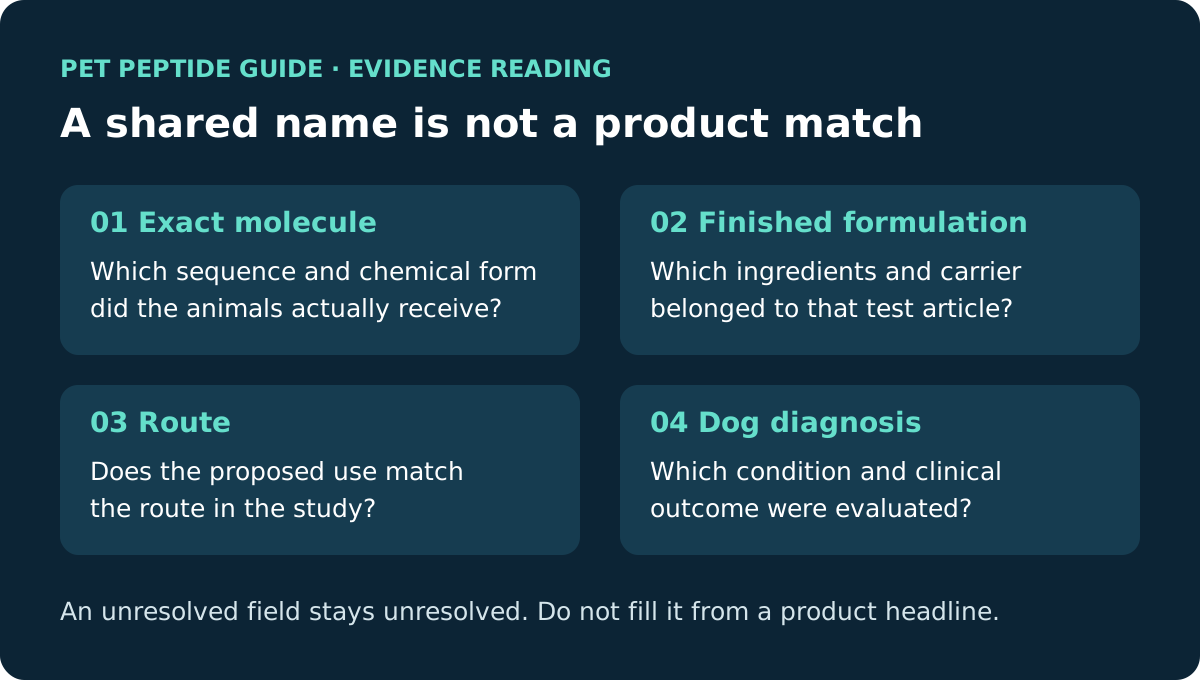
The study section names alpha-MSH and/or derivatives, not an unambiguous KPV-only test article. It does not describe a concurrent placebo group, random allocation or masking. These are limits of the report, not proof of what investigators did outside it. The original 2003 application, paragraphs 0163–0169, contains the corresponding account.
“Contains the KPV sequence” is not an exact product identity
KPV denotes lysine-proline-valine. The patent discusses that tripeptide, longer alpha-MSH-related sequences and dimers. Its broad list of proposed compositions does not identify which exact formulation each study dog received. We therefore do not assign the reported response to a modern KPV capsule, vial, blend or shampoo.
This distinction is useful when reading a citation list. A document may contain a named ingredient in its claims section, several experiments elsewhere and many possible formulations. The reader still needs the method that connects this ingredient in this preparation to these animals and these outcomes. An ingredient search result cannot make that connection for you.
What a controlled itch study reports differently
For a study-design comparison, Van Brussel and colleagues' 2021 trial tested lokivetmab, a canine anti-IL-31 monoclonal antibody, not KPV. It enrolled 123 client-owned dogs with presumptive allergic dermatitis. The paper identifies the commercial injectable formulation, random assignment to subcutaneous lokivetmab or saline, masked assessments and 28-day follow-up. Owners rated itch and investigators rated skin disease; adverse health events were collected. Zoetis funded the study and employed all authors.
The paper reports greater itch-score improvement with lokivetmab than saline. It is included to illustrate a comparator and documented methods, not to recommend treatment or rank two products. Its results cannot supply KPV efficacy or safety, and its presumptive diagnoses and limited follow-up still constrain interpretation.
| Comparison | Question it can address | Question still to ask |
|---|---|---|
| Before versus after | Did recorded scores change? | What else changed during that interval? |
| Treatment versus concurrent control | Did the groups differ under the study conditions? | Were allocation, masking, missing data and background care handled adequately? |
| Study preparation versus proposed product | Do the identities, formulation and route match? | Does the evidence concern the same diagnosis and intended use? |
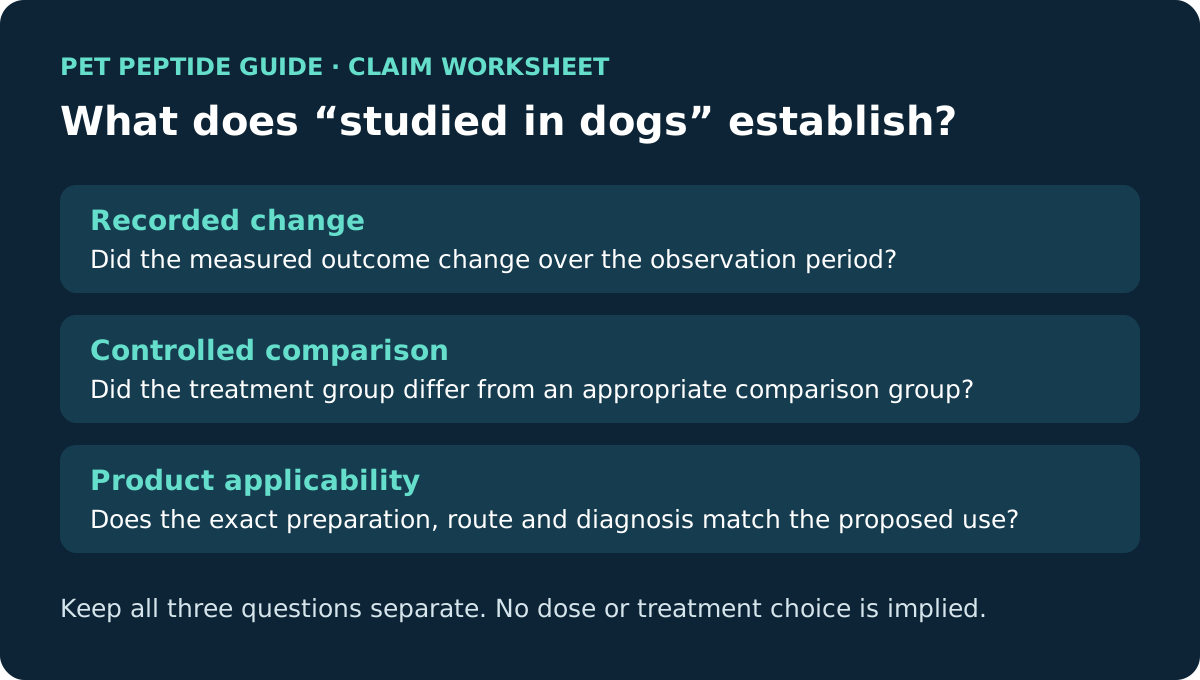
Our interpretation: these are separate tests of a claim. Passing one does not answer the others. Do not compare percentages from unrelated studies as if the preparations were tested head to head. For more detail, see randomization and masking and missing study data.
A worked claim check
Fictional example: “Clinically studied in dogs, so this KPV oral blend resolves allergies.” This is an invented teaching example, not a quotation from a named seller.
Break it into three requests. First, ask for the original report and the exact test article, rather than a list of ingredients mentioned somewhere in the document. Second, ask where the oral blend itself was compared with an appropriate control. Third, ask how the researchers diagnosed allergy and measured resolution rather than a temporary change in a score.
If the reply only provides the same citation again, the unanswered fields remain blank. That does not prove the product can never work. It means the proposed conclusion is stronger than the verified evidence. A sensible evidence worksheet records “not established,” not a guessed formulation or a confident product ranking.
Does a patent or compounded preparation establish approval?
No veterinary approval is established by the patent or these research comparisons. Under the current U.S. FDA animal-drug framework, review concerns intended-use safety and effectiveness, manufacturing, labeling and packaging. We have not verified an approved KPV product for canine allergy in this review; that is not an exhaustive regulatory-database search.
FDA's compounding guidance distinguishes bulk-compounded animal drugs from approved products and recognizes circumstances in which compounded drugs can be medically necessary. A veterinarian must assess the actual patient and preparation. Neither a patent citation nor a “research use” label settles those questions.
There is no KPV seller or affiliate offer on this page. The separate dog collagen buying guide concerns oral supplement comparisons, not an alternative allergy treatment or evidence for KPV.
What should you bring to your veterinary visit?

Bring a short history of when scratching began, affected areas, seasonal changes, current flea prevention, diet, medicines and previous responses. Those details support the diagnostic discussion described by AAHA. Also bring the complete proposed product label and the original research link.
Use the printable checklist to ask:
- Which diagnosis and owner-noticeable outcome are we trying to address?
- Is the exact administered preparation identifiable in the source?
- Does the comparison isolate the proposed treatment from other changes?
- What follow-up and adverse-event information applies to this patient?
- Which established care and monitoring should remain in place?
Do not stop prescribed care or use a human regimen to fill missing study details. This page supplies no dose, mixing instructions or injection procedure. The site's calculators cannot establish a suitable product, amount or route.
Frequently asked questions
Is this proof that there is no canine KPV research?
No. The dog-related patent report is precisely why a blanket absence claim would be misleading. The narrower conclusion is that the verified account does not resolve the exact-product and controlled-evidence questions needed for the proposed claim.
Is lokivetmab another name for KPV?
No. The comparison uses a different molecule to demonstrate reporting and study design, not an alias, interchangeable treatment or evidence transfer.
Does itch relief prove an allergy is cured?
A score change and a diagnosis-specific claim are different endpoints. Ask the veterinarian what outcome is being monitored and how the underlying condition is being evaluated.
Bottom line: A dog-related citation deserves inspection, not dismissal or automatic acceptance. Match the test article, comparator and diagnosis before turning it into a claim about a product for your dog.
Sources and scope
This is an introductory guide or original comparison framework, not a systematic review or a product recommendation.
- US6969590B2 (2005): Use of a polypeptide for treatment of pruritus in animals — Primary patent text, Example XII and table. Seven dog completers; topical alpha-MSH and/or derivatives, exact administered formulation unresolved. Not a controlled KPV-only trial or approval.
- US20030223949A1 (2003): Original patent application text — Reproduction of original primary application, paragraphs 0163–0169. Corresponding report, not an independent replication.
- Van Brussel et al. (2021): Masked randomized canine allergic-dermatitis trial — Publisher methods, results and disclosures reviewed. Subcutaneous lokivetmab versus saline, 123 dogs, 28 days; a design comparator, not KPV evidence. Zoetis-funded; authors employees.
- AAHA: 2023 Management of Allergic Skin Diseases guidelines — Official diagnostic overview checked October 19, 2026; history, examination and atopy as diagnosis of exclusion. Not evidence of KPV efficacy.
- FDA: Animal Drug Development and Approval Process — Current product and intended-use review framework, not approval inferred from a patent.
- FDA: Animal Drug Compounding — Bulk compounding is not FDA approval; medically necessary context retained without recommending a product.
Source checked October 19, 2026. A general context source does not establish a named product’s benefit.