
Peptide Studies: Missing Data, Exclusions and the Final Denominator
Follow missing observations in peptide research with a fictional worked example, group-by-group worksheet and clear limits on safety and pet applicability.
Before interpreting a peptide-study result, follow the participants and measurements that are missing from it. A graph may describe only the observations that remained available. Ask what entered the study, what reached each analysis, why anything disappeared, and whether the authors explain how that affects the conclusion.
Prepared by Pet Peptide Guide with AI assistance. Sources checked October 12, 2026. Not reviewed by a veterinarian or physician. All numbers in the worked exercise are fictional. This article makes no compound-specific safety assessment and provides no treatment recommendation. Human research and laboratory-animal findings do not establish safety or effectiveness in household dogs or cats.
Start with a participant trail
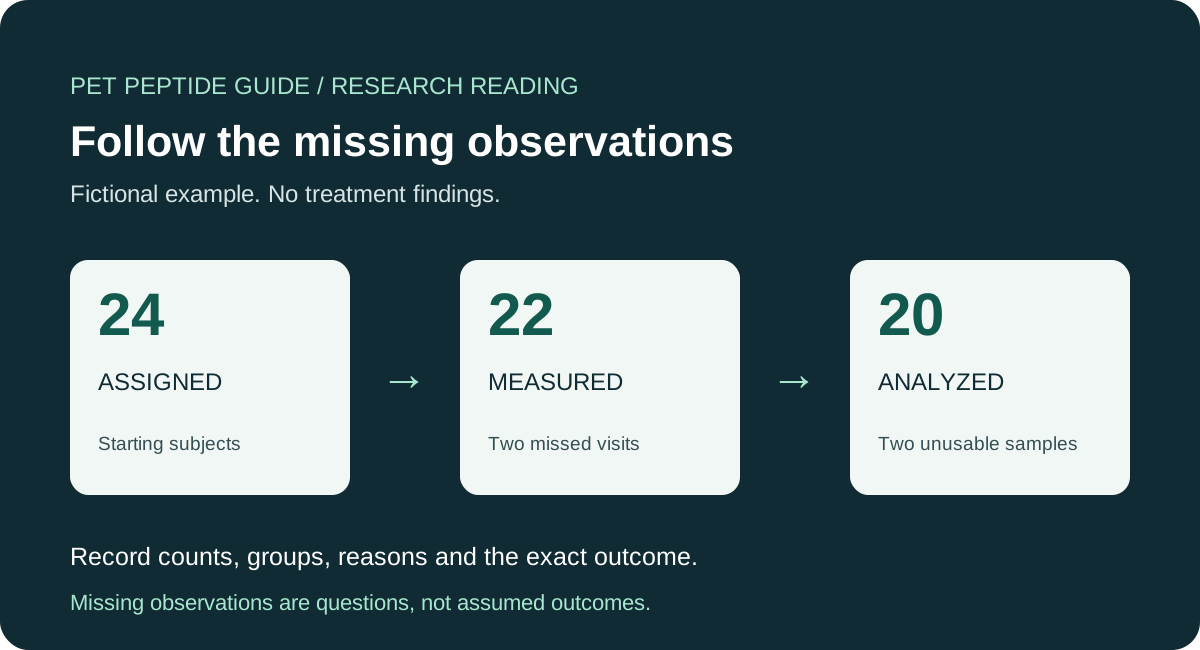
Open the methods, results, figure legends and supplement together. Make three headings in your notes: entered, measured and analyzed. Under each, record a count for every comparison group and the time or endpoint it refers to. Leave a blank when the report does not provide a count. Do not silently fill it from the abstract.
This turns a vague concern about “missing data” into a specific question that another reader can answer. Perhaps the final graph uses fewer subjects because one measurement was optional. Perhaps a visit was missed. Perhaps an observation failed a quality check. These situations need different explanations even when they produce the same final sample size.
For the broader sequence of finding a source and identifying what it actually tested, start with the general peptide research guide. This page focuses on a later step: reconciling the people, animals or measurements behind a particular result.
Separate an exclusion rule from an exclusion decision
ARRIVE item 3a asks animal-study authors to explain inclusion and exclusion criteria and whether these were set in advance. A documented rule can concern an experimental unit or a measurement. Technical quality checks and welfare-related circumstances are among the reasons a study may need such rules. The timing of the rule matters when reading the methods.
In your own worksheet, keep “rule described” and “rule applied” on separate lines. An author might describe a laboratory quality threshold without reporting how many samples failed it. Another report might list removed samples but leave the threshold unclear. Neither entry supplies the missing information in the other.
Fictional exercise: the attractive graph with an incomplete caption
Imagine an invented report with 24 subjects assigned to two groups of 12. Its headline says that the intervention group had a better average score at the last visit. This is a made-up reading exercise. It is not evidence about any peptide, species or clinical condition.
A first reader sees “24 subjects” in the abstract and writes that number beside the final comparison. A second reader checks the last-visit table. It contains 10 analyzed observations in each group. The second reader records 20 for that analysis, then asks where the remaining four observations went.
A supplement explains that one subject in each group missed the visit and that one collected sample in each group could not be processed. The sample-processing problem and the missed visit are different events. The report still needs to explain the relevant circumstances and how the analysis handled the resulting gaps. Equal totals do not make the reasons interchangeable.
Now change one detail in this fictional exercise. Suppose the two missed visits occurred in one group and both unusable samples occurred in the other. The final counts remain identical, but the group-by-group trail is different. A total such as “four observations unavailable” would hide that distinction. The reader should preserve the two separate explanations instead of compressing them into one reassuring sentence.
Reasons matter more than a tidy flowchart
ARRIVE item 3b calls for reporting exclusions and their reasons by group. It recognizes legitimate losses while warning that inappropriate data cleaning can distort results. Missingness can remove information and introduce bias; the reasons and analytical handling therefore deserve attention. A report should also identify whether exclusion decisions were made with group assignments known.
Our fictional reader should avoid two shortcuts: calling every omission misconduct, or treating every omission as harmless. Instead, a useful note says exactly what the accessible report establishes. For example: “The supplement accounts for four unavailable observations, but does not explain the missed visits.” That is an evidence boundary rather than an accusation.
A reusable reading worksheet
| Question | Write down | Keep separate |
|---|---|---|
| Who entered? | Starting count for each group | Screened, eligible and assigned subjects |
| Who was measured? | Available observations at the stated visit | A missed visit and a collected but unusable sample |
| Who was analyzed? | Count supporting this specific comparison | Subjects and repeated readings from one subject |
| What was left out? | Reason, group, timing and source location | Reported absence and information you cannot access |
| What is still unknown? | One precise question for further review | A missing detail and a proven methodological error |
Attach a page, table or supplement reference to each entry. If a later version supplies an explanation, update the entry and retain the version date. Our paper-version guide helps distinguish an updated report from a genuinely independent study.
Match the denominator to the exact outcome
ARRIVE item 3c asks for the exact number of experimental units in each analysis. Numbers may differ across outcomes and time points. Reporting absolute counts helps readers track those differences. One overall enrollment number cannot substitute for all the figure-specific counts.
Suppose our fictional study also has an earlier questionnaire completed by all 24 subjects. The questionnaire and final laboratory comparison would then have different denominators. That does not necessarily make either calculation wrong. It means the reader must identify which observations support each claim. For repeated measurements and independent units, use the separate sample-size worksheet.
A missing outcome cannot certify safety
“No problem reported” is a description of the material you read. It is not a record of what happened to a subject whose follow-up is unavailable. Do not invent a favorable or unfavorable outcome to fill that gap. A safety question should remain a safety question until the appropriate evidence addresses it. The adverse-event reporting guide explains another reason that counting recorded reports alone cannot establish a risk rate.
These reading habits do not turn human research into veterinary evidence. FDA's animal-drug approval process separately evaluates a particular product and intended use. A transparent methods section is valuable, but is not product approval or proof that a pet should receive an intervention.
Leave with a narrower, more useful question
A careful summary of the fictional exercise might read: “The final comparison includes 20 of the 24 assigned subjects. Four observations are accounted for, but the missed-visit explanation remains incomplete in the material reviewed.” This is more useful than “the study is reliable” or “the study is worthless.” It tells a clinician or another reader exactly what you checked and what remains open.
For a real pet, bring the original paper and your notes to the veterinarian using the pet-owner discussion checklist. Individual diagnosis and care require the animal's clinical circumstances. For human health decisions, use an appropriately qualified clinician. Neither a worksheet nor a peptide headline can replace that assessment.
Sources and scope
This is an introductory guide or original comparison framework, not a systematic review or a product recommendation.
- ARRIVE: Prespecified inclusion and exclusion criteria — Timing and reporting of rules.
- ARRIVE: Excluded observations and reasons — Attrition, data cleaning and group-specific explanation.
- ARRIVE: Numbers in each analysis — Outcome-specific experimental-unit counts.
- FDA: Animal Drug Development and Approval — Separate product-specific approval pathway.
Source checked October 12, 2026. A general context source does not establish a named product’s benefit.