
Peptide Research: Randomization, Blinding and the Missing Methods
Read peptide study methods with a practical worksheet separating random assignment, allocation concealment, masked assessment and human-to-pet evidence limits.
“Randomized” and “blinded” answer different questions. In peptide research, first ask how subjects entered comparison groups, then who knew each assignment while care, measurements and analysis took place. A favorable result deserves a readable methods trail, not just reassuring labels.
Prepared by Pet Peptide Guide with AI assistance. Sources checked October 11, 2026. Not reviewed by a veterinarian or physician. The worked example is fictional and reports no peptide treatment result. Human findings and laboratory-animal methods do not establish effectiveness or safety for dogs or cats.
Three questions to write beside a paper
Start a reading note with three separate lines: assignment, knowledge and relevance. Assignment asks how the comparison groups were formed. Knowledge asks which people could identify the treatment while making decisions. Relevance asks whether the population and outcome actually match the claim you are evaluating. A strong answer on one line cannot fill a blank on another.
This is especially useful when a headline compresses an entire methods section into “a controlled peptide study.” Keep the paper open beside the headline. Copy the exact population and measured outcome into your note before deciding what the headline means. For help locating the underlying research, start with our general peptide research guide.
Randomization concerns how groups are formed
ARRIVE's randomization guidance asks authors to identify the method and what was randomized. Choosing subjects casually is not equivalent to a documented random sequence. Random assignment helps reduce selection bias, but small groups can still differ by chance. Blocking or stratification may be used to account for important characteristics; the actual approach should be reported.
For your note, prefer a concrete description such as “computer-generated assignment of individual animals” over the label alone. If the method is missing, write “method not reported in the material reviewed.” That describes an information gap without claiming that the researchers did or did not use a sound method.
Concealment and masking operate at different moments
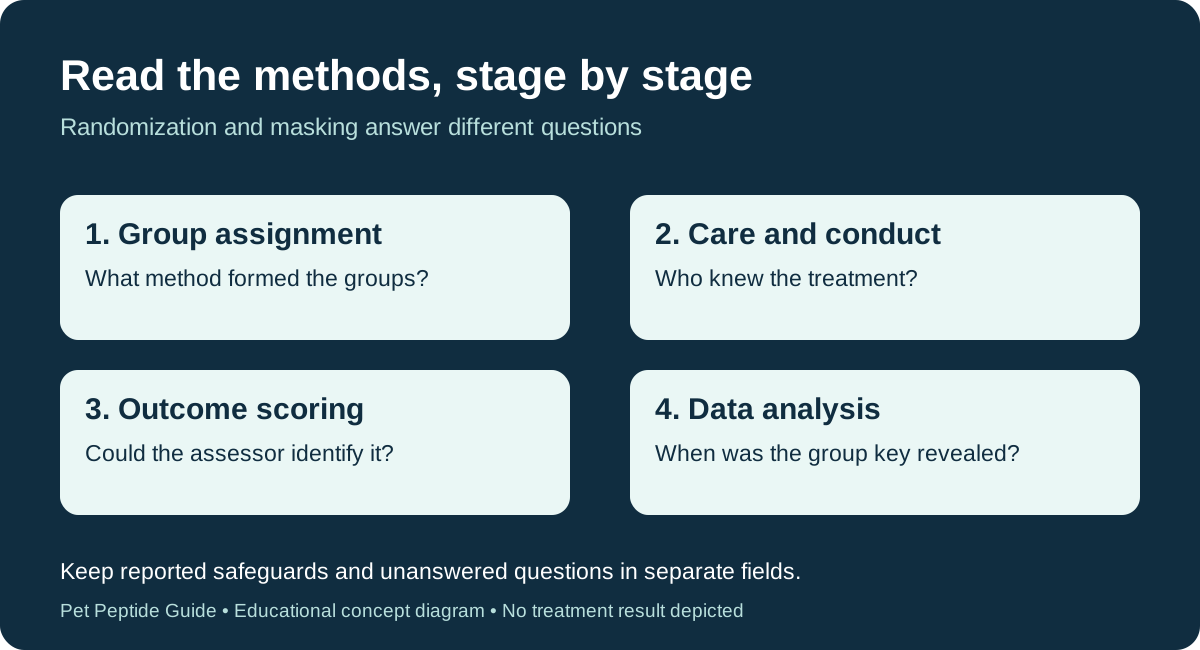
ARRIVE's masking guidance separates allocation, study conduct, outcome assessment and analysis. Concealing the upcoming assignment helps prevent selection decisions from being influenced before a subject enters a group. Masking later stages limits opportunities for knowledge of treatment to influence care, scoring or analytical choices. Authors should identify who knew what, rather than relying solely on “double blind.”
Some stages cannot be masked for practical or welfare reasons. That limitation should be stated, together with the safeguards that remain possible. It does not automatically invalidate every finding. It also does not justify assuming that the outcome assessor was masked when the paper never says so.
A fictional two-team reading exercise
Imagine two students reading an invented peptide-study report. The report says subjects were assigned by a computer-generated list. It also says image files were renamed before a separate assessor scored them. Neither student is being asked to judge a real product, and these details do not describe a published experiment.
Student A writes, “Everything was blinded, so the result must be reliable.” Student B writes, “The assignment method and masked image scoring are described. Knowledge during care and analysis is not described in the excerpt.” Student B's note is more useful because it preserves both the reported safeguards and the unresolved questions.
Now suppose a supplementary document explains that the analyst saw groups labeled A and B but did not receive the treatment key until the analysis was finished. Student B can update the analysis line and record where the information came from. The care line remains unanswered. Evidence reading improves one field at a time; it need not swing between complete trust and complete dismissal.
Finally, imagine the headline describes pain relief, while the invented report measured a laboratory signal. Neither the random list nor the masked images settles that mismatch. The reader must still ask what the signal means. Our biomarker and surrogate-endpoint guide explains how to keep that additional question visible.
Use a compact methods worksheet
| Field | Record | Avoid assuming |
|---|---|---|
| Assignment | Unit and stated allocation method | A casual selection was randomized |
| Upcoming assignment | Whether the next allocation could be known | A random list was necessarily concealed |
| Care and measurement | Who knew the treatment during each stage | One masked assessor means everyone was masked |
| Analysis | Group coding and when the key became available | An objective-looking graph proves masked analysis |
| Claim boundary | Species, product and endpoint actually studied | Design safeguards establish pet benefit |
Attach a page, figure or supplement reference to each completed field. Use “not reported,” “not accessible” and “reported as not used” distinctly. Those phrases have different meanings. Keeping them separate lets another reader follow your work without treating an access problem as a scientific finding.
Methods are part of the evidence, not a safety certificate
NIH's rigor and reproducibility resources treat masking and randomization alongside transparency, sample size, exclusions and biological versus technical replicates. These are complementary checks. A methods label cannot replace a review of missing observations, analysis choices or replication.
Read our sample-size worksheet when several readings come from the same subject. Use the publication-version check if you are comparing a preprint with a later paper. Neither link provides a shortcut to a treatment decision; each helps resolve a specific reading question.
This article makes no compound-specific safety assessment. It cannot tell you that an unapproved peptide is safe, that a laboratory result will translate to a pet, or that a product should be used. FDA's animal-drug approval process separately evaluates intended use, safety, effectiveness, manufacturing and labeling. Research design terminology is not regulatory approval.
Bring a question rather than a conclusion
A useful final note might read: “This report describes randomized assignment and masked scoring, but I have not established whether its endpoint predicts the outcome relevant to my pet.” That is a clearer starting point for a veterinary conversation than “the study proves it works.” Bring the original source using our pet-owner discussion checklist; leave diagnosis and individual care decisions to the veterinarian.
For human health decisions, discuss the specific evidence with a qualified clinician. The same reading habits can help organize questions across fields, while the evidence needed to answer those questions remains specific to the species, condition and product.
Sources and scope
This is an introductory guide or original comparison framework, not a systematic review or a product recommendation.
- ARRIVE: Randomisation — Assignment methods and reporting limitations.
- ARRIVE: Blinding / Masking — Stage-specific masking and allocation concealment.
- NIH: Rigor and Reproducibility Training — Complementary research-design checks and training resources.
- FDA: Animal Drug Development & Approval — Product approval is separate from study-method terminology.
Source checked October 11, 2026. A general context source does not establish a named product’s benefit.