
Peptide Adverse-Event Reports: Signals, Causes and Safety Claims
Learn why peptide adverse-event reports cannot establish causation or risk rates, how to read missing safety data, and why human and veterinary findings stay separate.
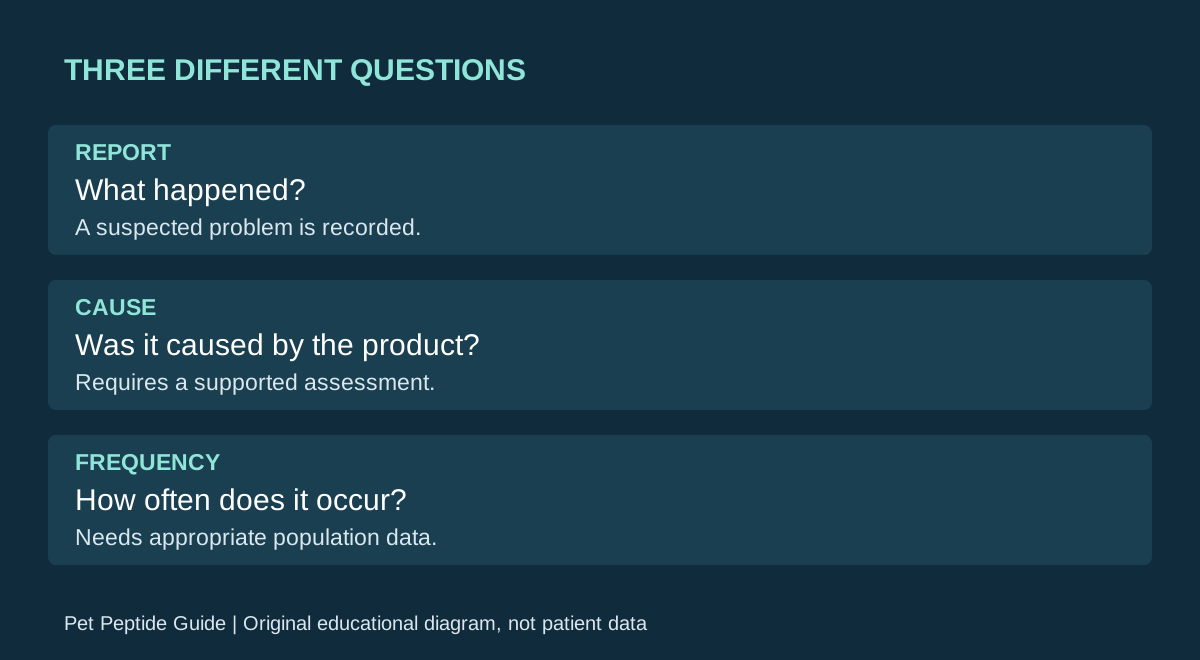
Does an adverse-event report prove a peptide caused harm? No. It records a suspected problem that deserves attention. It does not, by itself, establish the cause or tell you how often that problem happens. The reverse is equally important: few reports, or no events mentioned in a short paper, do not prove safety.

Prepared by Pet Peptide Guide with AI assistance; source-checked October 8, 2026. Not reviewed by a veterinarian. This general-science companion explains how to read safety information. It offers no product recommendation, treatment instructions or individual medical or veterinary advice.
Peptide discussions often jump from a report count to a verdict: “dangerous” or “safe.” This guide offers a more useful reading method. Keep three questions separate: what happened, whether the product caused it, and how frequently it occurs in a defined population. Start with our general research-reading pillar if you need help matching a claim to the population and outcome actually studied.
First identify the kind of record
A spontaneous safety report, a controlled trial and a laboratory toxicology study are different evidence sources. They should not be merged into one total. A clinical trial can systematically observe a defined group over a stated period. A spontaneous-report database collects reports made through a reporting system. An animal toxicology experiment can investigate particular measurements under controlled conditions, without establishing a treatment outcome for household pets.
For each claim, write the source type beside it. “Reported after exposure” is a starting description. “Caused by exposure” requires a supported causal assessment. “Occurs in a specified percentage of users” additionally needs an appropriate population and denominator. If the source cannot answer the last two questions, leave them unanswered.
What an FDA reporting dashboard can and cannot tell you
FDA's current Adverse Event Monitoring System information explains that report information may be incomplete or unverified. A report does not establish causation: illness, another medicine or another explanation may be involved. The reports cannot establish occurrence rates. These limitations are reasons to interpret the data carefully, not reasons to dismiss a suspected problem.
The agency's human-drug surveillance page identifies AEMS as the system formerly called FAERS. Older papers may therefore use FAERS terminology. Check the date and scope of the dataset rather than assuming two differently named screenshots represent independent evidence.
Our practical reading rule: save the database name, query terms, date range and access date with a screenshot. A bare number without those details is difficult to interpret or reproduce. This article does not run a peptide-specific database query or claim any current peptide event count.
An invented example: why report counts are not a safety ranking
Fictional reading exercise, not data about any peptide: a screenshot lists 80 reports for Product A and 8 for Product B. A caption calls B “ten times safer.” Neither the number of people exposed nor how consistently they reported problems is shown. The products may also have been used for different conditions or for different lengths of time.
The responsible summary is simply that the screenshot shows different report counts. It cannot supply a tenfold risk comparison. Your next question is what evidence would support a fair comparison with comparable populations, observation and outcomes. Do not repair the missing denominator by using social-media followers, bottles sold or website visits: those are not a verified count of independently observed exposed patients.
FDA's veterinary adverse-event summary cover memo specifically warns against comparing product safety using accumulated report totals. Exposure counts are not accurately known, underreporting occurs, and publicity can affect reporting. This is a veterinary reporting limitation, not a measured result for an experimental peptide.
“Not observed” and “not recorded” are different findings
ARRIVE's animal-research reporting guidance asks researchers to describe expected and unexpected adverse events and explicitly distinguish no observed events from events that were not recorded. It also asks for the signs monitored and monitoring frequency. A paper that does not describe a measurement cannot establish that the measurement was normal.
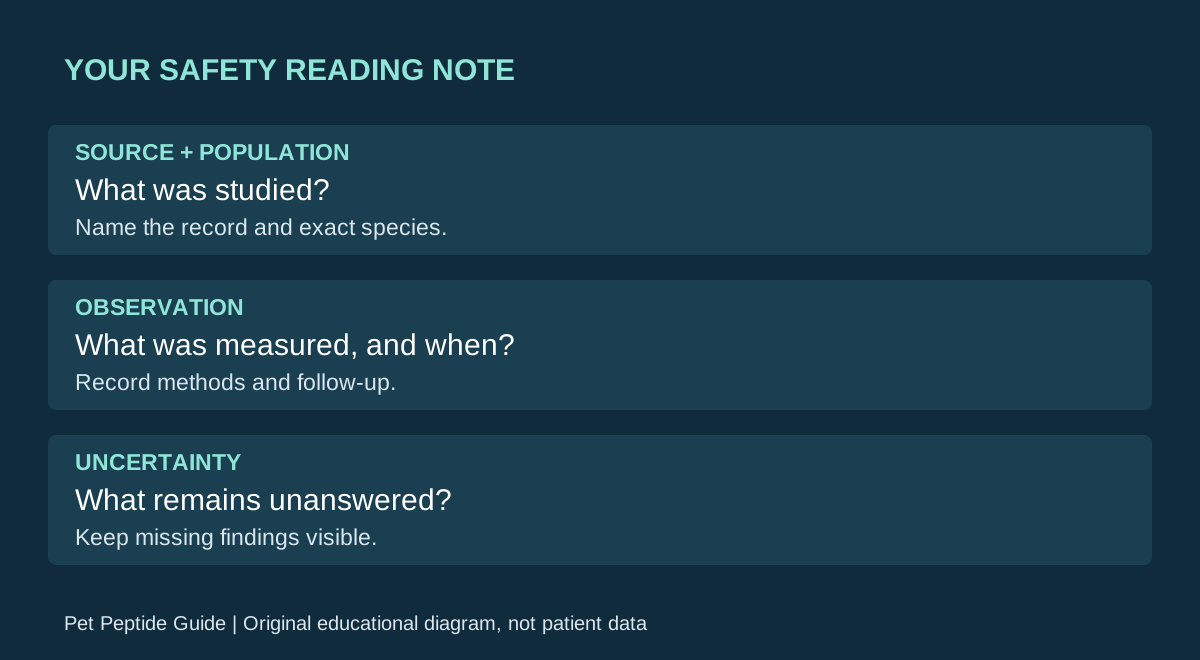
Use this original three-line reading note:
- Observed: what checks were performed, on whom and when?
- Reported: which findings, withdrawals or missing observations appear in the results?
- Unresolved: which outcomes or follow-up periods were outside the study?
For example, a short observation of outward behavior and a longer investigation with laboratory measurements answer different questions. Avoid rewriting either as “comprehensive safety testing.” This is a way to evaluate reporting, not a request to order tests or establish a monitoring regimen yourself.
A real source-checking example: BPC-157
FDA's July 2026 BPC-157 briefing, in its nonclinical safety summary (printed page 39), discusses clotting-related and liver-associated signals in repeat-dose animal studies. It describes shortened aPTT in rats and prolonged aPTT in dogs, alongside liver-associated laboratory signals, and identifies important limits in duration and available studies.
This is a human-compounding advisory review, not veterinary approval. Those findings should not become a numerical prediction of harm in pet dogs or cats. They also should not disappear behind an abstract-only statement that the animal evidence showed no concerns. Preserve both the signals and their limits. Our BPC-157 dog safety evidence guide provides more context.
The lesson is about source completeness: an abstract, full paper and later regulatory review may supply different levels of detail. A safety summary should identify which was actually read and the date checked. Do not substitute a favorable headline for the underlying assessment.
Keep human and veterinary records separate
FDA's animal-drug and device reporting page describes a veterinary early-warning system. It cautions that a reported event may have other causes and that query results cannot establish risk or compare products. These reports should not be the sole basis for clinical decisions.
A human report is not a canine or feline event. A dog laboratory observation is not a cat finding. If a summary changes species without saying so, return to the original record. For regulatory distinctions, use our human approval and pets guide; for one specific potential mechanism of harm, read the separate immunogenicity explainer. Neither replaces assessment of an exact formulation and intended use.
What to take away from a safety headline
Before sharing it, write one sentence that the source actually supports, one sentence about its limits, and one question the source leaves open. That keeps legitimate safety signals visible without inventing causation or a rate. If you are concerned about an actual health problem, speak with the appropriate clinician or veterinarian rather than diagnosing it from a report count. Bring the product information and source using our veterinary conversation checklist.
Bottom line: treat an adverse-event report as information to investigate. Treat missing safety information as uncertainty. Neither is a shortcut to declaring an experimental peptide safe, effective or appropriate for people or pets.
Sources and scope
This is an introductory guide or original comparison framework, not a systematic review or a product recommendation.
- FDA: Adverse Event Monitoring System — Report limitations; causation and incidence cannot be inferred.
- FDA: Human-drug AEMS information — Current naming, formerly FAERS.
- FDA CVM adverse-event summary cover memo — Veterinary denominator, reporting and comparison limitations.
- ARRIVE 2.0: Animal care and monitoring, 16b — Distinguishing events not observed from events not recorded.
- FDA July 2026 BPC-157 briefing — Printed page39 animal clotting and liver-associated signals; human-compounding review, not veterinary approval.
- FDA: Adverse Event Reports for Animal Drugs and Devices — Veterinary surveillance interpretation and limits.
Source checked October 08, 2026. A general context source does not establish a named product’s benefit.