
Peptide Supplements for Cats: What the Label Must Tell You
What is a peptide supplement for cats? Separate complete food, supplemental animal food, approved drugs, compounded medicine and research listings.
What is a peptide supplement for cats? In the United States, that phrase is not one legal or scientific product category. A listing may describe an animal food, a complementary feed, a complete diet containing hydrolyzed proteins, an approved animal drug, a compounded medicine or a research chemical. Before comparing ingredients or prices, match the exact label, intended use and finished product to the evidence. A paper about one collagen chew or therapeutic diet does not validate every product marketed with the words peptide or supplement.
Start with the product category, then evaluate the claim
The useful buying question is not whether a product contains amino acids. It is whether the product is accurately identified, intended for cats, supported for the proposed purpose and sold through a pathway that supplies the information needed for safe use.
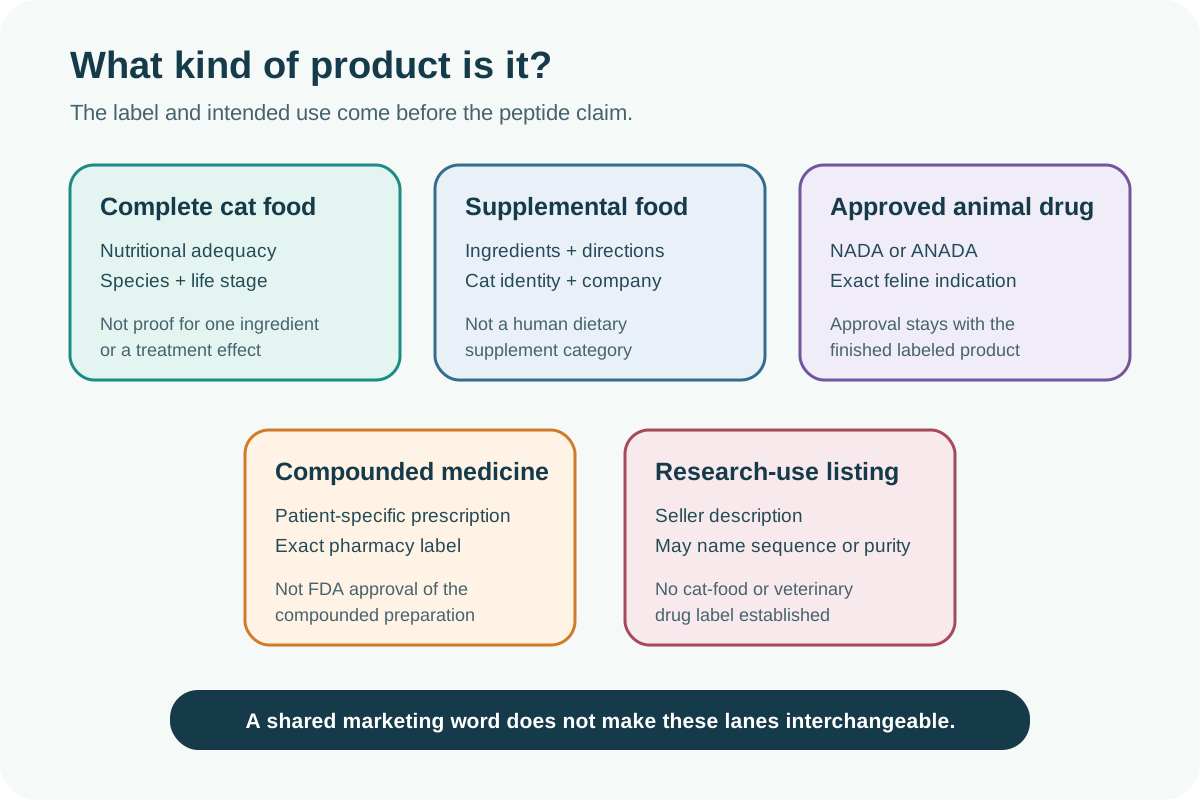
Five product lanes that should not be merged
FDA explains that the human Dietary Supplement Health and Education Act does not create a separate dietary-supplement category for animal products. Depending on composition and intended use, a product promoted as an animal supplement can be regulated as animal food or as an animal drug. That distinction matters because the word supplement on a web page does not tell you which label rules, ingredient pathway, claims or evidence apply.
| Product lane | Label or record to find | What it can support | What does not transfer |
|---|---|---|---|
| Complete and balanced cat food | Species and life stage, ingredient list, feeding directions and a nutritional adequacy statement | Use as a sole diet for the stated life stage when the complete-and-balanced statement applies | A treatment claim, proof for one ingredient or equivalence to a chew |
| Supplemental animal food or complementary feed | Cat identity, ingredient list, net quantity, manufacturer or distributor and directions; nutrition guarantees when applicable | The identity and intended nutritional role of that finished food product | Human supplement status, a disease-treatment claim or evidence for every similarly named product |
| Approved animal drug | Current label plus NADA or ANADA number, species, indication, dosage form and route | The specific reviewed finished product and labeled feline use | Approval of an ingredient class, food product, compounded version or research peptide |
| Compounded medicine | Patient-specific prescription, pharmacy label, exact active ingredient, concentration, storage and prescriber instructions | A preparation made for a veterinary need under its applicable compounding context | FDA approval of that compounded product or proof that a bulk-substance listing is suitable |
| Research-use listing | A listing may supply a claimed sequence or purity document, but no cat-food or veterinary-drug label | At most, the seller's description of the material offered | Suitability for a cat, lawful consumer use, sterility, stability, clinical benefit or monitored safety |
A supplement claim begins with intended use
FDA's animal-food labeling page requires animal foods to identify the product, state net quantity, name the manufacturer or distributor and list ingredients by their common or usual names. Claims also matter. Language that says a product will diagnose, cure, mitigate, treat or prevent disease can establish an intended use as an animal drug rather than ordinary animal food.
This means two products with similar ingredients can present different regulatory questions. A food that supplies nutrition is not automatically a drug. A product promoted to repair joints, treat inflammatory bowel disease or heal wounds may raise a drug-intended-use question even if the package calls it a supplement. A disclaimer does not make the underlying claim or product evidence disappear.
AAFCO's consumer guidance makes the practical point that animal feed supplements are not the same as human dietary supplements. It also warns that adding nutrients to a complete and balanced diet can create excesses. That is why a shopping page should not turn a generic ingredient name into a feeding instruction. The cat's full diet, condition and concurrent products belong in the veterinary conversation.
Complete food and supplemental product answer different questions
FDA's nutritional-adequacy guidance explains that a complete-and-balanced statement means a product is intended to provide the required nutrition as the pet's sole diet for the stated life stage. Treats, snacks and supplements are usually not intended to be a sole diet and often are not complete and balanced. The presence or absence of this statement therefore helps define the product's role. It does not prove a special therapeutic benefit.
Hydrolyzed-protein diets illustrate the distinction. A 2022 feline chronic-enteropathy study evaluated a specific hydrolyzed diet in 36 cats with chronic enteropathy and compared their microbiota with 14 controls. Fifteen treated cats were classified as clinical responders and 18 as non-responders after six weeks. The intervention was a full diet, not an isolated peptide supplement. Microbiome changes also did not guarantee resolution of gastrointestinal signs.
A buyer should therefore avoid shortening “cats ate a hydrolyzed diet in a defined study” to “peptide supplements heal cat gut disease.” The finished diet, diagnosis, feeding context, duration and outcomes must remain attached. The cat gut-health evidence guide examines those diet and research-peptide lanes in detail.
Two feline collagen studies tested different products
A 2026 randomized, double-blind, placebo-controlled crossover study enrolled 20 client-owned cats with mild to moderate degenerative joint disease. Fourteen completed all visits. The paper tested a complementary-feed chew containing undenatured type II collagen and used caregiver-reported mobility, pain and quality-of-life instruments. That is evidence about the studied chew and population. It is not evidence for hydrolyzed collagen powder, a mixed online product or a research peptide.
A separate 2024 randomized study enrolled 30 cats with naturally occurring osteoarthritis and evaluated a therapeutic diet containing marine-source EPA and DHA, turmeric extract and hydrolyzed collagen. Because several components changed together, the reported mobility and function outcomes cannot be assigned to hydrolyzed collagen alone. A complete diet containing hydrolyzed collagen is also a different product from the undenatured type II collagen chew.
| Study | Finished intervention | Cats and outcome | Shopping limit |
|---|---|---|---|
| Piemontese et al., 2026 | Complementary-feed chew with undenatured type II collagen versus placebo chew | 20 client-owned cats entered; 14 completed all visits; caregiver-reported mobility, pain and quality of life | Does not establish equivalence to hydrolyzed collagen, another chew, a powder or an unlabeled blend |
| Lefort-Holguin et al., 2024 | Therapeutic diet with EPA, DHA, turmeric extract and hydrolyzed collagen versus control diet | 30 cats randomized; weight-bearing, stairs, activity and clinical metrology outcomes | Cannot isolate the effect of collagen and does not validate a standalone collagen supplement |
| Kathrani et al., 2022 | Hydrolyzed-protein diet for cats with chronic enteropathy | Clinical responder classification plus microbiome measurements | A full diet and gut study do not support a joint claim or an isolated research peptide |
The collagen peptides for cats guide compares the two joint studies and their outcome limits. This page asks the different shopping question: what category and label does the proposed product actually have?
Use a six-field label audit before comparing prices
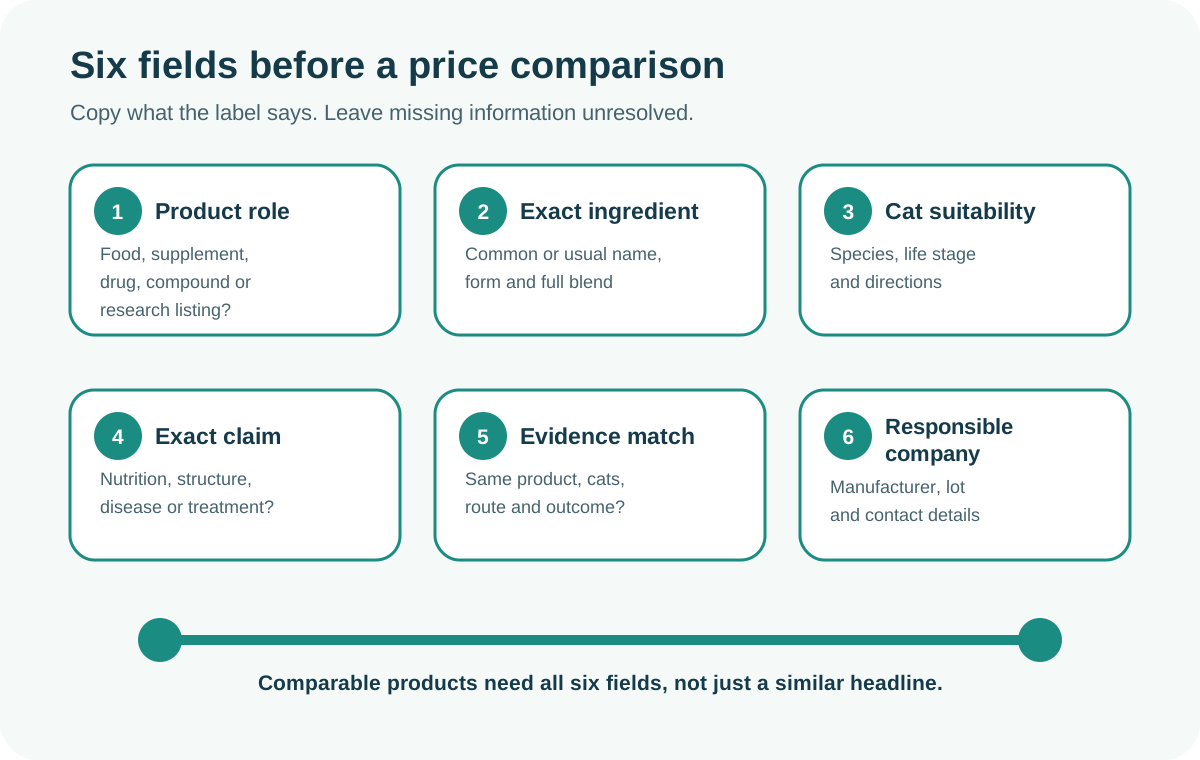
- Product role: Is this a complete food, supplemental animal food, treat, approved drug, compounded preparation or research-use material?
- Exact ingredient: Copy the common or usual ingredient name. Distinguish hydrolyzed collagen, undenatured type II collagen, a named small peptide, a protein and a blend.
- Cat suitability: Look for the intended species, life stage and directions. A dog label or human supplement is not a cat label.
- Claim: Write the exact promised outcome. Separate nutrition, taste and ordinary structure from language about diagnosing, treating or preventing disease.
- Evidence match: Check whether the paper tested this finished product, comparable cats, the same route and the same outcome. An ingredient citation alone is not a finished-product trial.
- Responsible company: Record the manufacturer or distributor, lot and contact information. Keep the package if a product problem or suspected adverse event needs review.
Only after these fields match does a price comparison become meaningful. Two containers are not comparable if one is a complete food and the other is a chew, if their active forms differ, or if one does not identify the amount or intended species. The free daily-cost calculator can compare suitable products using confirmed label information. It does not decide suitability or invent a serving schedule.
Approved drugs and compounded preparations stay separate
FDA states that most currently marketed approved animal-drug labels carry an NADA or ANADA number. That record identifies a specific finished product. An approved cat drug containing a peptide or polypeptide does not make a food supplement equivalent, and it does not approve a different peptide for a different condition.
Compounded preparations are another lane. FDA explains that animal drugs compounded from bulk drug substances are not FDA approved and have not received the same product-specific review for safety, effectiveness, manufacturing, labeling and packaging. Compounding can still serve a medically necessary patient-specific role under veterinary oversight. The practical check is the exact prescription and pharmacy label, not a research-chemical storefront.
The feline therapy guide compares approved drugs, proteins, receptor agonists and experimental fragments. The cat safety guide shows why safety stays attached to the exact formulation, population, duration and monitoring.
Questions to bring to a veterinary visit
- What nutrition or clinical problem are we trying to address?
- Is this product a complete food, supplemental food, approved drug or compounded preparation?
- What exact ingredient form and finished formulation were studied?
- Were cats with a comparable condition included, and what outcome was measured?
- Could this duplicate or interact with the cat's complete diet, medicines or other supplements?
- What current label, monitoring and stop criteria apply to this individual cat?
Open the free veterinary-visit checklist
Frequently asked questions
Are pet supplements regulated like human dietary supplements?
No. FDA states that the human dietary-supplement framework does not apply to animal products. Depending on composition and intended use, a product for animals can be regulated as animal food or as an animal drug.
Does “complete and balanced” prove a peptide benefit?
No. It describes nutritional adequacy for the stated species and life stage. It does not isolate one ingredient or establish a disease-treatment effect.
Does a feline collagen study apply to every collagen product?
No. Undenatured type II collagen, hydrolyzed collagen and multi-ingredient diets are different interventions. Match the finished product, cats, duration and outcome before applying a study.
Can a certificate of analysis replace a cat study?
No. A certificate may address specified attributes for a tested sample or lot. It does not establish cat suitability, lawful intended use, clinical benefit or an adverse-event rate.
Does this page recommend a peptide supplement for my cat?
No. It provides a label and evidence worksheet. It names no preferred seller or product and provides no dose, feeding schedule or treatment protocol.
The bottom line
“Peptide supplement for cats” is a shopping phrase that can hide several product categories. Identify the role and label first. Then match the exact ingredient form, finished product, feline population and measured outcome to the evidence. If those fields do not match, a shared marketing word does not make the products interchangeable.
Sources and scope
This is an introductory guide or original comparison framework, not a systematic review or a product recommendation.
- FDA's Regulation of Pet Food — Current official U.S. context: the human dietary-supplement framework does not apply to animal products; intended use and composition can place a product in animal-food or animal-drug regulation.
- FDA: Animal Food Labeling and Pet Food Claims — Current official label requirements, common or usual ingredient naming and drug-claim context. Used for the label audit, not a legal conclusion about an unnamed product.
- FDA: Complete and Balanced Pet Food — Official explanation of nutritional adequacy statements and the difference between sole-diet foods and products such as treats, snacks and supplements.
- FDA: Animal Foods & Feeds — Current official animal-food ingredient, adulteration and misbranding context; no product-specific safety or effectiveness inference is made.
- AAFCO: Supplements — Consumer guidance distinguishing animal feed supplements from human dietary supplements and warning that unnecessary additions can duplicate nutrients in complete diets.
- AAFCO: Reading Labels — Consumer label-reading context for nutritional adequacy, ingredients and products not intended as complete diets.
- Piemontese et al. (2026): undenatured type II collagen crossover study in cats — Primary abstract: 20 client-owned cats entered, 14 completed all visits, and one complementary-feed chew was compared with placebo. The result does not establish equivalence to another collagen form or product.
- Lefort-Holguin et al. (2024): multi-ingredient therapeutic diet in cats — Primary randomized study of a diet containing EPA, DHA, turmeric extract and hydrolyzed collagen. Multiple changed ingredients prevent attribution to collagen alone.
- Kathrani et al. (2022): hydrolyzed-protein diet in feline chronic enteropathy — Primary feline diet and microbiome study. A complete hydrolyzed diet and clinical responder classification are kept separate from isolated-peptide supplement claims.
- FDA: How can I tell if a drug is legally marketed for animals? — Current official guide to NADA and ANADA label statements and Animal Drugs at FDA checks for finished animal drugs.
- FDA: Animal Drug Compounding — Current official context distinguishing patient-specific compounding from FDA approval of a finished animal drug, including the limits of bulk-substance compounded products.
Source checked November 01, 2026. A general context source does not establish a named product’s benefit.