
TB-500 for Cats: Detection Is Not Treatment Evidence
Does feline thymosin research show TB-500 helps cats? Separate endogenous detection from an administered fragment, exact identity and clinical outcomes.
Does feline thymosin research show that TB-500 helps cats? No. The feline records reviewed here detect or compare naturally occurring beta-thymosins in cat tissue and serum. They do not administer TB-500 to cats or measure a TB-500 treatment effect. TB-500 is the acetylated seven-residue fragment Ac-LKKTETQ, while the cat kidney study measured TMSB4X and TMSB10 expression and localized endogenous thymosin beta-4.
Sources checked October 24, 2026. This AI-assisted article has not been reviewed by a veterinarian. It is a focused evidence-reading guide, not a systematic review, treatment recommendation or clinical protocol. The feline kidney record is a conference abstract that was not peer reviewed before publication. The older tissue paper and TB-500 papers were assessed from their original abstracts; full methods were not available for every source.
Three names that should not share one evidence row
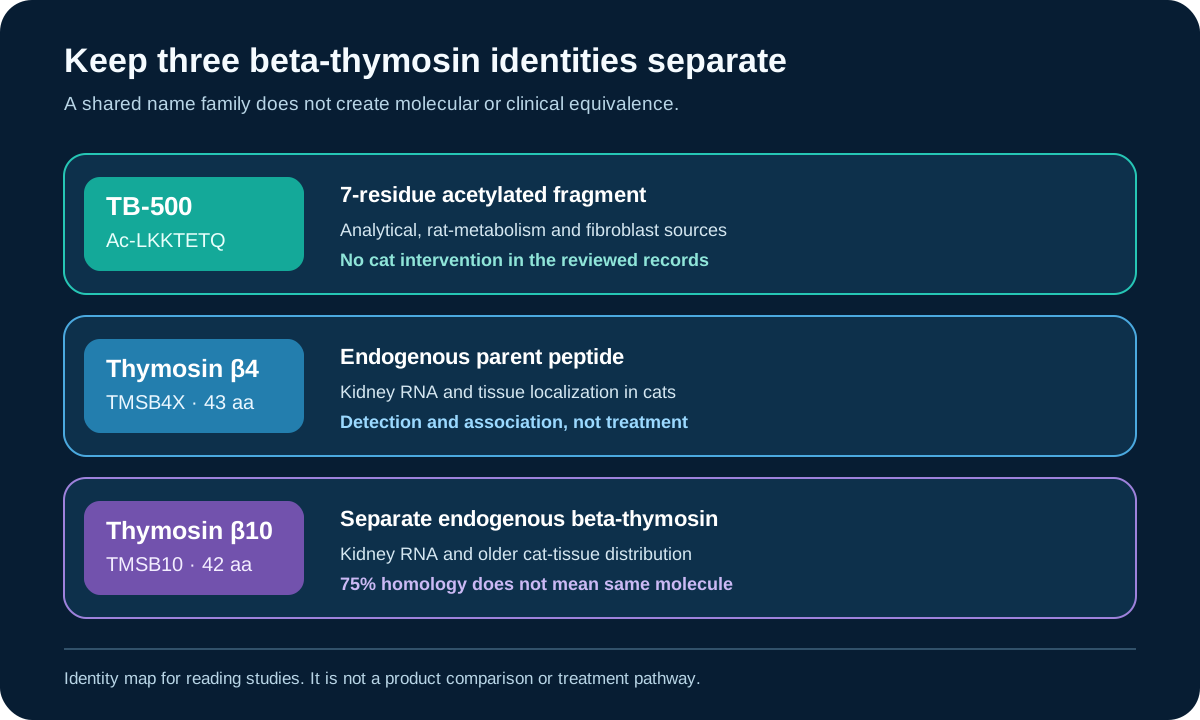
A search for “TB-500 for cats” can lead to papers about thymosin beta-4, thymosin beta-10 or genes with similar names. That shared language does not make the molecules interchangeable.
- TB-500: FDA's substance registry identifies the seven-residue sequence LKKTETQ. The analytical literature identifies TB-500 as the N-terminally acetylated form, Ac-LKKTETQ, corresponding to residues 17 through 23 of thymosin beta-4.
- Thymosin beta-4: a longer endogenous 43-amino-acid peptide encoded by TMSB4X. A paper measuring its RNA or localizing it in tissue is not automatically testing the shorter TB-500 fragment.
- Thymosin beta-10: a separate 42-amino-acid beta-thymosin encoded by TMSB10. The 1983 isolation paper reported 75% sequence homology with thymosin beta-4. Similarity is not identity.
The canonical TB-500 identity guide explains the fragment-versus-parent distinction in detail. This page applies that distinction to feline sources and asks a narrower question: what does finding beta-thymosins in cats actually establish?
What the feline kidney abstract measured
A 2024 research communication by Man and colleagues examined post-mortem kidney tissue from three groups: 16 non-azotemic cats, 23 cats with stable chronic kidney disease and 11 cats with progressive chronic kidney disease. The researchers measured TMSB4X and TMSB10 messenger RNA with RT-qPCR, scored renal histology and used immunohistochemistry to localize thymosin beta-4.
The abstract reports higher kidney TMSB4X and TMSB10 expression in the progressive group than in the non-azotemic group. TMSB4X expression was also higher in progressive than stable disease. The reported expression measures correlated with selected fibrosis, inflammation or creatinine measures. Thymosin beta-4 staining was localized to several cell types, including podocytes, macrophages, T cells and fibroblasts.
These findings are associations in tissue collected after death. No cat received TB-500, thymosin beta-4 or thymosin beta-10 as an intervention. The abstract cannot show that higher expression caused progression, that expression is a deficiency signal, or that adding a related peptide changes kidney function. It also cannot establish an administered route, formulation, safety profile or clinical outcome.
The conference collection states that its abstracts were not peer reviewed before publication and that the organizers were not responsible for their content. The authors disclosed institutional, charitable and industry relationships across the abstract. Those facts do not invalidate the observations, but they matter when deciding how much weight to place on a preliminary record.
| Source | Exact subject | What researchers did | What the source cannot establish |
|---|---|---|---|
| 2024 feline kidney abstract | Endogenous TMSB4X, TMSB10 and thymosin beta-4 in cat kidneys | Compared post-mortem expression, histology and localization across disease groups | TB-500 treatment benefit, route, safety or causal effect in living cats |
| 1983 tissue paper | Thymosin beta-10 and beta-4 in mammalian tissues, including cat spleen | Isolated and characterized endogenous peptides and reported tissue distribution | A feline deficiency, replacement target or clinical response |
| 2020 feline heart-failure proteomics | Serum proteins in cats with heart failure, preclinical cardiomyopathy and healthy controls | Compared serum proteomes and clinical associations | A TB-500 intervention effect; the abstract does not name TB-500 as a tested treatment |
| 2024 TB-500 analysis | Ac-LKKTETQ and metabolites | Used human serum, enzyme systems, urine from treated rats and fibroblast assays | Any cat clinical outcome or product-specific veterinary use |
Natural presence does not create a replacement target
The 1983 paper by Erickson-Viitanen and colleagues isolated thymosin beta-10 from mammalian tissues. Its abstract describes a 42-amino-acid peptide occurring with thymosin beta-4 and reports that beta-10 accounted for about 0.02% by weight of total protein in spleen from rat, mouse, cat and human samples.
That source establishes tissue presence and molecular distinction. It does not diagnose a low level in a household cat. It does not establish that more is better, that a circulating amount should match a tissue amount, or that the shorter TB-500 fragment reproduces either full-length peptide's behavior. A naturally occurring compound can be a marker, participant, bystander or response to disease. The source design has to distinguish among those possibilities before a treatment claim is made.
What the feline serum study adds, and what it does not
Liu and colleagues' 2020 proteomics study compared serum from 15 cats with congestive heart failure caused by primary cardiomyopathy, five cats with preclinical cardiomyopathy and 15 healthy controls. The researchers used tandem-mass-tag labeling and mass spectrometry, then related altered proteins to clinical variables. Sixteen serum proteins differed between the heart-failure and healthy groups.
This is useful feline biomarker research, but the original abstract does not describe administration of TB-500. A later paper cites it in a discussion of thymosin beta-4, yet a citation trail is not enough to assign a thymosin-specific result that is not visible in the original abstract. This page therefore uses the study only as an example of observational feline proteomics. It does not claim that the paper tested TB-500 or proved a thymosin treatment effect.
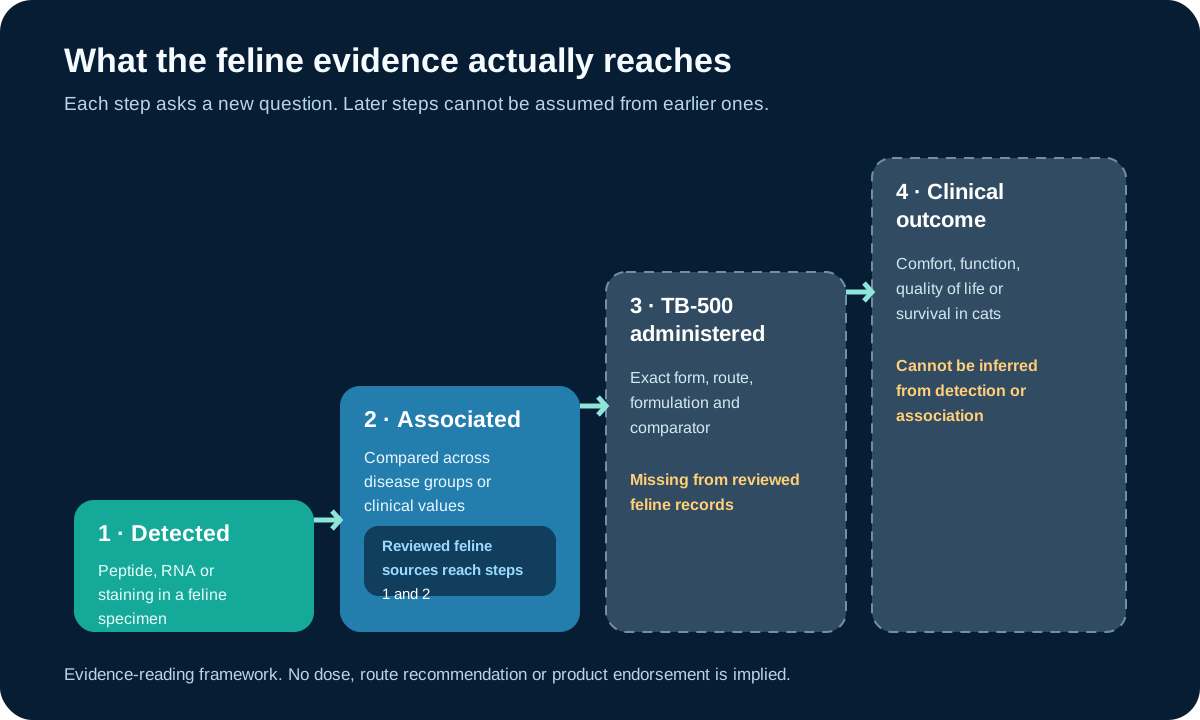
This restraint matters because “found in serum” and “administered as a treatment” are different actions. Even a verified disease-group difference would require independent validation and an intervention study before showing that changing the signal improves how a cat feels, functions or survives.
The TB-500 paper is a different experiment
Rahaman and colleagues' 2024 paper identifies TB-500 as Ac-LKKTETQ and examines its metabolism. The experiments used human serum, laboratory enzyme systems, urine from rats treated with TB-500 and fibroblast assays. The researchers developed an analytical method, identified metabolites and compared activity in a laboratory wound-healing assay.
No cats were participants. The fibroblast assay was not a feline wound trial, and urine detection in rats was not a cat kidney-disease outcome. The authors also reported that the biological effects of TB-500 itself had not been documented in the prior literature they assessed. Their work provides a useful identity and metabolism source, but it cannot be joined to the feline kidney abstract to create an unperformed cat treatment study.
An earlier 2012 analytical paper by Esposito and colleagues identified the N-terminally acetylated 17 through 23 fragment of thymosin beta-4 in material sold as TB-500. That helps resolve the name. It does not verify every current product, a veterinary indication or a cat-specific formulation.
A worked claim check
- Check identity. The cat abstract measured endogenous TMSB4X and TMSB10 expression and localized thymosin beta-4. It did not administer Ac-LKKTETQ.
- Check direction. Higher expression in a more severe group does not show a deficiency or tell us whether increasing, decreasing or leaving the signal alone would help.
- Check time. Cross-sectional post-mortem tissue cannot establish that the expression change came before disease progression.
- Check intervention. There was no randomized cat treatment, comparator, route or finished product.
- Check outcome. Gene expression and tissue staining are not the same as appetite, comfort, kidney function, quality of life or survival.
A source-matched summary would be: “A conference abstract found differences in endogenous beta-thymosin expression among post-mortem cat kidney groups.” That sentence keeps the species, specimen, design and measurement attached to the result.
Approval records answer a separate question
FDA's animal-drug framework evaluates an intended use together with safety, effectiveness, manufacturing, labeling and packaging. A substance registry entry provides identity information; it is not an approved animal-drug label. A publication about a biological signal is also not a product approval.
FDA's animal-compounding page explains that drugs compounded from bulk substances have not undergone the agency's animal-drug approval process, while recognizing limited circumstances in which a veterinarian may identify a medical need. That context does not turn a research vial or a nickname on a label into a suitable feline product.
This bounded review did not identify an FDA-approved TB-500 product for use in cats. It also does not make a worldwide absence claim. Product status, formulation and legal context can change and should be checked for the exact item and intended use.
Questions to take to a veterinarian
- What exact condition and patient outcome are we trying to address?
- Is the proposed material Ac-LKKTETQ, full-length thymosin beta-4, thymosin beta-10 or something else?
- Does the cited source administer that exact material to cats with the relevant diagnosis?
- Is the paper measuring tissue presence, gene expression, a biomarker, a laboratory assay or a patient outcome?
- What finished product, route, quality information, adverse-event evidence and monitoring would apply?
- Which established diagnostic and treatment steps should remain in place?
Open the free veterinary-visit checklist
For kidney-specific outcome matching, use the cat kidney-disease evidence guide. For the broader distinction between a measured signal and patient benefit, see the biomarker and surrogate-endpoint guide. Neither page supplies a dose or treatment protocol.
Frequently asked questions
Was TB-500 given to cats in the kidney study?
No. The abstract describes post-mortem cat kidneys and measurements of endogenous gene expression, histology and thymosin beta-4 localization. It reports no administered TB-500 intervention.
Is thymosin beta-10 another name for TB-500?
No. The 1983 source describes thymosin beta-10 as a separate 42-amino-acid peptide with 75% sequence homology to thymosin beta-4. TB-500 is the much shorter acetylated seven-residue fragment Ac-LKKTETQ.
Does higher thymosin expression in progressive kidney disease mean cats need more?
No. A cross-sectional association does not establish deficiency, cause or the direction of a useful intervention. An administered treatment study with relevant outcomes would be needed to test benefit.
Does natural thymosin in cat tissue show that an added product is safe?
No. Natural presence does not establish the safety of an administered molecular form, formulation, route or exposure. Those questions require product- and patient-relevant evidence.
Can rat metabolism or fibroblast results be used as a cat protocol?
No. The 2024 TB-500 paper answers analytical, rat-metabolism and laboratory-assay questions. It does not provide a feline clinical protocol, and this page does not reproduce experimental quantities as instructions.
Do you rank TB-500 sellers or earn a commission here?
No. This article includes no research-chemical seller links, product ranking or affiliate offer.
The bottom line
The feline evidence reviewed here is about endogenous beta-thymosin detection and disease-group association. It is not a TB-500 treatment record. Keep Ac-LKKTETQ, full-length thymosin beta-4 and thymosin beta-10 in separate rows, then ask whether the exact proposed material was administered to cats and improved a meaningful outcome. In these sources, that final step is missing.
Sources and scope
This is an introductory guide or original comparison framework, not a systematic review or a product recommendation.
- Man et al. (2024): beta-thymosin expression in cat kidneys and CKD — Primary conference abstract: post-mortem kidneys from 16 non-azotemic, 23 stable-CKD and 11 progressive-CKD cats; TMSB4X/TMSB10 expression, histology and thymosin beta-4 localization. No administered TB-500 or treatment outcome; abstracts were not peer reviewed before publication.
- Erickson-Viitanen et al. (1983): thymosin beta-10 in mammalian tissues — Original abstract: thymosin beta-10 is a separate 42-amino-acid peptide with 75% sequence homology to thymosin beta-4 and was identified in tissues including cat spleen. Tissue presence is not a treatment experiment.
- Liu et al. (2020): serum proteomics in feline congestive heart failure — Primary observational proteomics record: 15 cats with CHF, five with preclinical cardiomyopathy and 15 healthy controls. The abstract reports serum-protein differences and does not describe TB-500 administration.
- FDA GSRS: TB-500 substance identity — Current official identity record: seven-residue LKKTETQ sequence and UNII QHK6Z47GTG. A substance record is not animal-drug approval, current product verification or feline treatment evidence.
- Esposito et al. (2012): acetylated fragment identified in TB-500 — Original analytical abstract identifying N-terminally acetylated LKKTETQ, residues 17 through 23 of thymosin beta-4, in TB-500 material. No feline clinical outcome.
- Rahaman et al. (2024): TB-500 and metabolite analysis — Identifies TB-500 as Ac-LKKTETQ and reports human-serum, enzyme-system, treated-rat-urine and fibroblast experiments. No cat intervention or clinical outcome.
- FDA: Animal drug development and approval process — Current official U.S. framework for intended-use safety, effectiveness, manufacturing, labeling and packaging. Identity records and published observations are separate from finished-product approval.
- FDA: Animal drug compounding — Current official context: drugs compounded from bulk drug substances have not undergone FDA's animal-drug approval process; medically necessary circumstances remain veterinarian- and patient-specific.
Source checked October 24, 2026. A general context source does not establish a named product’s benefit.