
Peptides for Cat Skin Health: Diagnosis, Product and Evidence
Do peptides help cat skin? Compare an approved cyclic polypeptide drug, cat-origin antimicrobial research and unmatched supplement claims by diagnosis and outcome.
Do peptides help a cat's skin? Some peptide-related products are relevant to a specific feline skin diagnosis, but there is no interchangeable "skin peptide" category. Cyclosporine is an 11-amino-acid cyclic polypeptide and a prescription drug with product-specific FDA approval for feline allergic dermatitis. That approval does not validate collagen powders, copper-peptide cosmetics, antimicrobial extracts, or research compounds. A useful comparison starts with the skin problem, then matches the exact intervention, route, cat population, endpoint, and current safety information.
Start with the diagnosis, not the word peptide
Itching, overgrooming, hair loss, crusts, plaques, ulcers, wounds, and infection are not one condition. Evidence for controlling allergic dermatitis cannot be copied into a wound, cosmetic, or antimicrobial claim.
What "skin health" can hide in a cat
A skin-health search can begin with a cat scratching the head and neck, licking hair from the abdomen, developing crusts, or showing a sore that will not heal. Those observations matter, but they do not identify a cause. The 2023 AAHA allergic-skin-disease guideline describes four feline reaction patterns: miliary dermatitis, head and neck pruritus, self-induced alopecia, and eosinophilic lesions. It also explains that none of those patterns identifies one disease by itself.
The same appearance can sit downstream of fleas or mites, food allergy, feline atopic skin syndrome, dermatophytosis, secondary bacterial or yeast infection, another inflammatory disorder, or a nonallergic problem. AAHA therefore places history, dermatologic examination, cytology and other diagnosis-specific testing before long-term therapy. A supplement label or peptide name cannot replace that workup.
This is the first distinction a broad "peptides for cat skin health" headline should make. The relevant question is not whether a molecule sounds regenerative or antimicrobial. It is whether an exact intervention was studied in cats with the same diagnosis and whether it changed an outcome that matters.
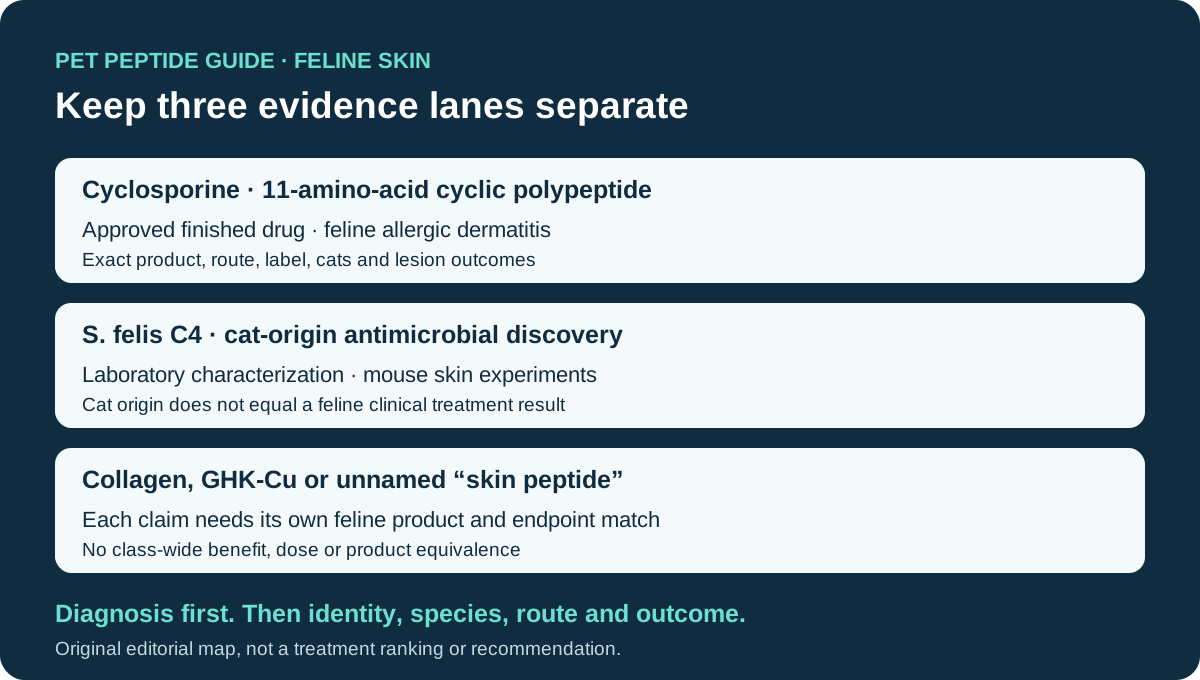
Three evidence lanes that should remain separate
| Evidence lane | Exact identity and setting | What was measured | What it does not establish |
|---|---|---|---|
| Approved cyclic polypeptide drug | Cyclosporine oral solution is a finished prescription product. FDA labeling describes cyclosporine as an immune-modulating cyclic polypeptide made of 11 amino acids. | Controlled feline allergic-dermatitis studies measured lesion scores, itching assessments, affected body regions, owner or investigator improvement, adverse events, and body weight. | General skin wellness, wound repair, antimicrobial treatment, cosmetic benefit, or equivalence of another product or route. |
| Cat-origin antimicrobial research | A 2021 study isolated a Staphylococcus felis strain from healthy feline skin and characterized secreted antimicrobial compounds, including peptide-related molecules. | Laboratory bacterial activity and mouse skin colonization, scaling, redness, bacterial counts, and infected-lesion size. | A clinical treatment result in cats, an approved feline product, safe owner preparation, or equivalence to a purified retail peptide. |
| Supplement or cosmetic claim | Collagen peptides, GHK-Cu, and unnamed "skin peptides" have different structures, sources, formulations, and proposed uses. | The reviewed cat-specific sources do not supply one matched clinical skin outcome that can be assigned to this whole category. | A class-wide feline benefit, product interchangeability, dose, route, seller recommendation, or approval. |
The rows are not a treatment ranking. They prevent category drift. Cyclosporine is relevant because its exact finished products and feline indication have regulatory and clinical records. The S. felis study is relevant because it shows how a cat-origin antimicrobial discovery can still be tested in cells and mice rather than in feline patients. Collagen and copper-peptide claims must stand on their own finished-product evidence instead of borrowing from either row.
Cyclosporine is peptide-related, but the approval is product-specific
The FDA-hosted Atopica for Cats label identifies cyclosporine as a cyclic polypeptide consisting of 11 amino acids. It also identifies the finished product, oral route, prescription status, age and body-weight restrictions, contraindications, precautions, and a narrow indication: control of feline allergic dermatitis manifested by excoriations, miliary dermatitis, eosinophilic plaques, and self-induced alopecia.
That wording matters. It does not say the product is a general skin-health supplement. It does not cover every source of itching, hair loss, wound, infection, or crust. It also does not make any cyclosporine listing, compounded preparation, capsule, or product intended for another species automatically equivalent to the reviewed oral solution.
FDA approved the first generic cyclosporine oral solution for cats, Modulis for Cats, in March 2023. A generic approval is still tied to an exact application, formulation, labeling, manufacturing record, and reference product. It is not permission to treat the ingredient name as a universal shopping category.
What the controlled feline records measured
The original FDA Freedom of Information summary describes a randomized, masked, controlled field study conducted at 24 veterinary clinics in the United States and Canada. It enrolled 217 client-owned cats and randomized them two to one between the final-market cyclosporine solution and its vehicle control. Safety was evaluated in all 217 cats. After protocol-based exclusions, the effectiveness analysis included 181 cats.
The study did not use the vague endpoint "better skin." Investigators recorded a total lesion score combining excoriations, miliary dermatitis, eosinophilic plaques, and self-induced alopecia. Owners and investigators also assessed itching and overall improvement, and the study counted body regions with lesions. At the final visit, mean total lesion score improved more in the active group than in the vehicle group. Owner-classified success was 78.6% in the active group and 26.2% in the control group. Lack-of-effectiveness withdrawals were also more common in the control group.
Those percentages should stay attached to this protocol and analysis. Thirty-six enrolled cats were excluded from the effectiveness set because of deviations that could compromise the results. Some cats withdrew before the planned final visit and were evaluated at their last visit. The sponsor's record also reports concurrent antiparasitic, antimicrobial, and otic products in subsets of cats. These details do not erase the treatment comparison, but they limit how far one can simplify it.
A separate 2012 randomized double-blind trial enrolled 100 client-owned cats with hypersensitivity dermatitis. It compared two cyclosporine exposure groups with placebo for six weeks and measured lesion and pruritus scores. The higher studied exposure group showed larger improvements than the lower-exposure and placebo groups. The study was funded by Novartis Animal Health, and several authors were employees or reported financial relationships. This was a dose-characterization study for cyclosporine, not proof for other peptides. No clinical quantities from that trial are reproduced here.
Safety information is part of the identity match
The FDA-hosted label describes cyclosporine as a systemic immunosuppressant. It lists contraindications involving suspected malignancy, FeLV, FIV, and hypersensitivity, and it warns about susceptibility to infection and neoplasia. The owner information also emphasizes appetite, body-weight monitoring, digestive effects, other medicines and supplements, and regular veterinary assessment.
The approval field study provides a denominator for reported events under defined conditions. Vomiting or related gastrointestinal signs, decreased appetite, diarrhea, behavioral changes, lethargy, hypersalivation, and weight loss were among the recorded adverse reactions. Product labeling, the cat's diagnosis, infection risks, test results, other treatments, and follow-up all belong in the decision. A broad "natural peptide" or "skin support" label does not remove those product-specific questions.
This article intentionally does not reproduce a dose or administration schedule. The label itself tells owners to follow the veterinarian's instructions and includes product-handling information. Converting clinical-study quantities into a do-it-yourself protocol would be both unnecessary and outside the evidence question addressed here.
Why a peptide found on cat skin is not yet a cat treatment
O'Neill and colleagues isolated Staphylococcus felis C4 from healthy feline skin. Genome sequencing and mass spectrometry identified secreted antimicrobials, including the thiopeptide bacteriocin micrococcin P1 and phenol-soluble modulin beta peptides. The team tested bacterial inhibition in laboratory systems and then moved to mouse skin models.
In mice, live S. felis C4 or its antimicrobial extract reduced colonization by methicillin-resistant Staphylococcus pseudintermedius under the study conditions. The extract also reduced infected lesion size in a separate mouse experiment. That is interesting translational research, but the species receiving the intervention was mouse, not cat. The intervention was a live bacterial strain or laboratory extract, not a named feline commercial peptide product.
Calling the bacterium feline because it was isolated from cat skin does not turn the mouse experiment into a feline clinical trial. It also does not establish whether a future product would use live bacteria, an extract, one purified molecule, or a different formulation. Each step would need its own identity, manufacturing, safety, route, dose, and clinical-outcome evidence.
Where collagen and GHK-Cu claims fit
The existing collagen peptides for cats guide reviews two feline joint-mobility studies. Those studies concern an undenatured type II collagen chew and a multi-ingredient diet containing hydrolyzed collagen. They do not provide a matched feline dermatology outcome, so their results should not be repackaged as evidence for coat shine, skin hydration, allergy control, or wound repair.
The GHK-Cu formulation guide separates exact copper-peptide identities, vehicles, species, routes, and wound models. Rat, rabbit, or historical canine wound findings can help define research questions. They do not establish benefit for a cat with allergic dermatitis, overgrooming, dermatophytosis, bacterial infection, or an unexplained lesion.
The bounded source set reviewed for this article did not identify a matched feline clinical skin trial for a finished collagen-peptide or GHK-Cu product. That is not a claim that no record could exist anywhere. It means a seller or article making a feline skin claim should provide the exact study and product match rather than asking readers to infer one from human cosmetics, another species, or a different endpoint.
Use an outcome ledger instead of "skin health"
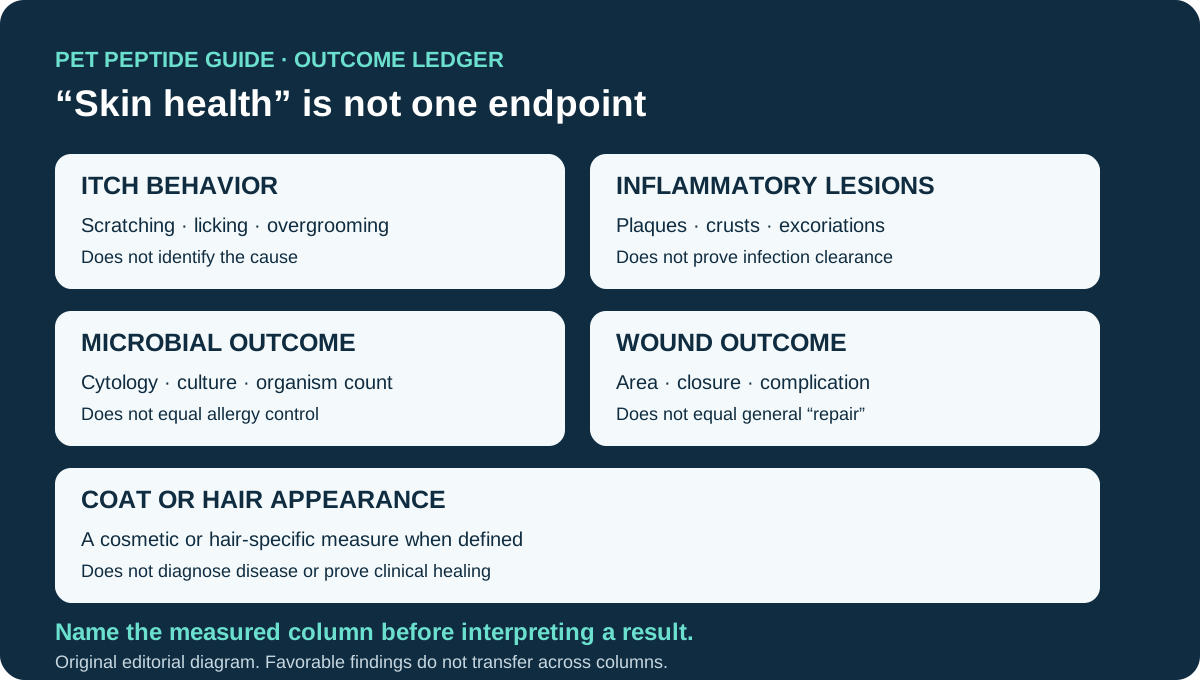
| Outcome | Example measure | Useful interpretation | Does not establish alone |
|---|---|---|---|
| Itch behavior | Validated owner score for scratching, licking, biting, or overgrooming | Whether pruritic behavior changed over a defined period | The cause of itch, infection clearance, or wound healing |
| Inflammatory lesions | Defined scores for plaques, excoriations, miliary lesions, or alopecia | Whether specified clinical signs changed | Microbial eradication, hair regrowth mechanism, or cosmetic benefit |
| Microbial outcome | Culture, cytology, organism count, or susceptibility result | Whether a named organism or laboratory measure changed | Comfort, allergy control, or effectiveness in a different species |
| Wound outcome | Area, closure time, complication, tissue score, or recurrence | Whether a defined wound changed under a protocol | Control of allergic dermatitis or a general "repair" claim |
| Coat appearance | Standardized image, hair measure, or owner-reported appearance | A cosmetic or hair-specific observation if measured prospectively | Diagnosis, reduced itching, infection control, or clinical healing |
A claim-check exercise
- Name the intervention. Was it a prescription cyclosporine solution, live S. felis, a laboratory extract, one purified antimicrobial, collagen, GHK-Cu, or an unnamed blend?
- Name the diagnosis. Allergic dermatitis, secondary infection, ringworm, a traumatic wound, and unexplained hair loss require different evidence.
- Name the treated species. A bacterium isolated from a cat but administered to mice is still mouse intervention evidence.
- Name the route and formulation. Oral solution, topical live bacteria, injected extract, food ingredient, and cosmetic serum are not interchangeable.
- Name the endpoint. Bacterial counts, lesion score, itch, wound size, hair growth, and owner impression answer different questions.
- Check the current product record. For a prescription drug, use FDA-hosted labeling and veterinary instructions. For a consumer product, inspect the complete label and the finished-product study.
The corrected statement might be: "One cat-skin bacterial isolate produced antimicrobials that were characterized in the laboratory and tested in mouse skin models." That statement is narrower than the fictional claim because it preserves the actual organism, intervention, species, and endpoint.
Questions to bring to the veterinary visit
- Which reaction pattern is present, and what diagnoses still need to be ruled in or out?
- Could fleas, mites, food, infection, dermatophytosis, pain, stress, or another disease explain the signs?
- Which baseline should we record: itch behavior, lesion score, cytology, culture, wound size, hair change, or quality of life?
- Is the proposed option an approved prescription drug, generic animal drug, food ingredient, supplement, compounded preparation, cosmetic, or experimental material?
- Does the cited study test this exact product, route, diagnosis, and cat population?
- What contraindications, infection risks, medicines, supplements, laboratory findings, and monitoring apply to this cat?
- When should response be reassessed, and which signs require earlier contact?
Open the free veterinary-visit checklist
For broader product questions, use the cat peptide safety guide and the study-to-product evidence checklist. Neither supplies a diagnosis or dose.
Frequently asked questions
Is cyclosporine a peptide?
FDA labeling describes cyclosporine as an immune-modulating cyclic polypeptide consisting of 11 amino acids. Its approved feline use belongs to exact prescription products and labeling, not to a general peptide-supplement category.
Does FDA approval of Atopica prove that peptides improve cat skin?
No. The approval concerns a finished cyclosporine oral solution for control of specified manifestations of feline allergic dermatitis. It does not validate unrelated peptides, supplements, cosmetics, routes, or diagnoses.
Was the Staphylococcus felis antimicrobial study performed in cats?
The bacterial strain was isolated from healthy feline skin, but the intervention experiments described here used laboratory systems and mouse skin models. That distinction prevents cat-origin discovery from being presented as feline clinical treatment evidence.
Do collagen peptides improve a cat's coat or skin?
The feline collagen studies reviewed elsewhere on this site measured joint and mobility-related outcomes for exact products. They do not establish a finished-product feline dermatology outcome. A skin or coat claim needs its own product-matched study.
Is GHK-Cu proven for cat wounds or dermatitis?
The reviewed evidence map does not provide a matched feline clinical trial for a finished GHK-Cu product. Other-species wound models cannot supply a feline allergy, infection, or wound-treatment conclusion.
Why does diagnosis come before a peptide comparison?
Feline itching, overgrooming, crusting, plaques, alopecia, and wounds can have different causes. AAHA notes that feline reaction patterns are not diagnostic by themselves. Product evidence becomes useful only after the clinical question is defined.
Do you rank products or earn a commission here?
No. This page has no affiliate offers, product ranking, or research-chemical seller links. If an approved commercial relationship is added later, it will be identified beside the relevant link.
The bottom line
"Peptides for cat skin health" is not one treatment category. Cyclosporine is an 11-amino-acid cyclic polypeptide with product-specific feline allergic-dermatitis evidence and FDA labeling. Cat-origin antimicrobial peptide research currently answers laboratory and mouse-model questions in the study reviewed here. Collagen, GHK-Cu, and other skin claims require their own feline diagnosis, finished product, route, and clinical endpoint match.
The most useful next step is to name the skin pattern, establish the diagnosis, record a meaningful baseline, and compare the exact proposed product with evidence from the same species and condition. That is more reliable than choosing from a list of molecules that happen to share peptide-related language.
Sources and scope
This is an introductory guide or original comparison framework, not a systematic review or a product recommendation.
- FDA labeling: Atopica for Cats, NADA 141-329 — FDA-hosted product label: cyclosporine is an 11-amino-acid cyclic polypeptide; exact feline allergic-dermatitis indication, oral route, prescription status, contraindications, precautions and owner information. No dosing instructions reproduced.
- FDA FOI Summary: Atopica for Cats original approval, NADA 141-329 — Primary approval record: 217-cat randomized masked controlled field study, 181-cat effectiveness set, exact lesion and pruritus outcomes, withdrawals, adverse reactions and product-specific limits.
- King et al. (2012): randomized cyclosporine trial in feline hypersensitivity dermatitis — One hundred client-owned cats, randomized double-blind two-exposure-group and placebo study; lesion and pruritus outcomes. Sponsor funding and author relationships retained; no clinical quantities reproduced.
- Roberts et al. (2016): confirmatory feline cyclosporine field study — Published report corresponding to the confirmatory product-development evidence. It is not counted as an independent replication of the FDA field study.
- FDA: First generic cyclosporine oral solution for cats — Official March 29, 2023 generic approval context for Modulis for Cats. Generic approval remains exact-product and application specific.
- AAHA: 2023 Management of Allergic Skin Diseases in Dogs and Cats Guidelines — Official feline reaction-pattern, diagnostic-workup and management context. Guideline synthesis rather than a peptide experiment; sponsor support disclosed.
- O'Neill et al. (2021): antimicrobials from a feline commensal bacterium — Primary full paper: S. felis C4 isolated from feline skin, antimicrobial molecules characterized in the laboratory, and intervention tested in mouse skin models. Cat origin is not feline clinical efficacy.
Source checked October 23, 2026. A general context source does not establish a named product’s benefit.