
Peptides for Cat Wound Healing: What Did Feline Studies Test?
Do peptides help cat wounds heal? Compare feline PRF and extracellular-vesicle studies with rat GHK-Cu and cat growth-factor evidence.
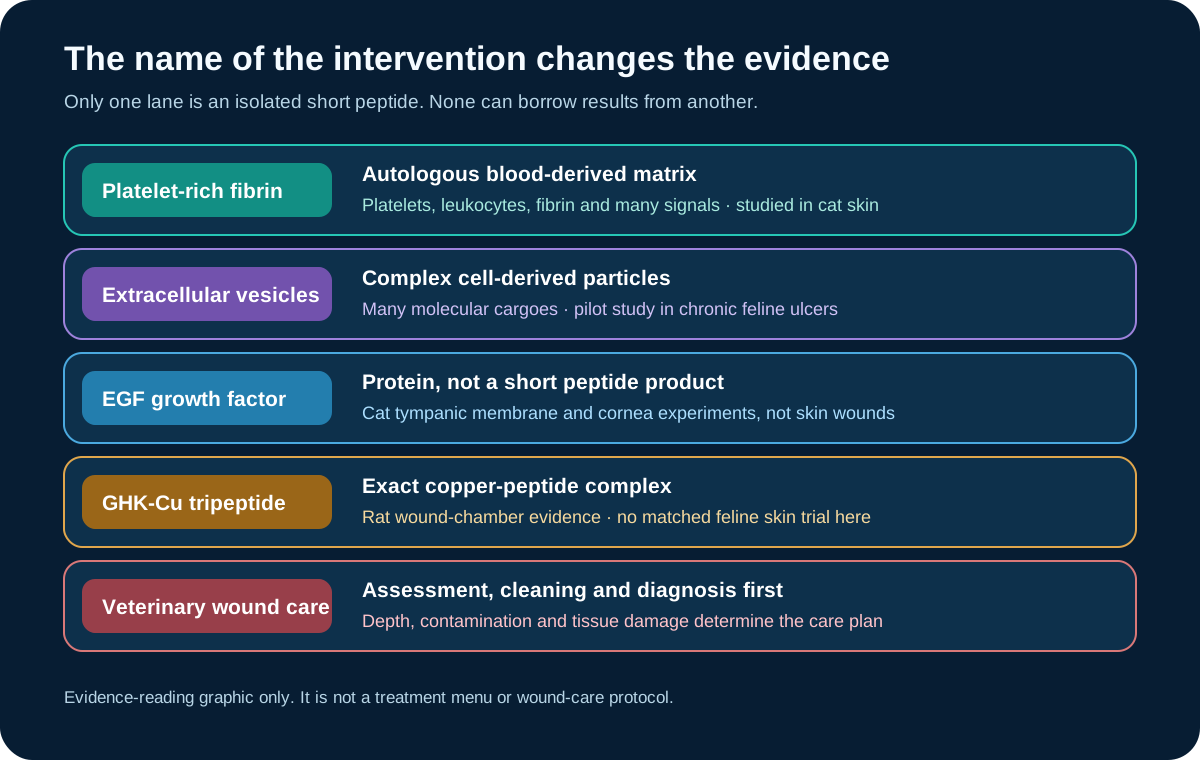
Do peptides help cat wounds heal? The feline skin-wound studies reviewed here did not test an isolated peptide product. They tested autologous platelet-rich fibrin, which is a blood-derived matrix containing platelets, leukocytes and many signaling molecules, or extracellular vesicles, which are complex cell-derived particles. The exact short peptide GHK-Cu has wound-model evidence in rats, not a matched feline skin-wound trial in this source set. These results do not establish a general peptide treatment for cat wounds.
A wound headline can hide three different questions. Was the material an exact peptide, a protein, a blood-derived matrix, or a cell-derived product? Was the wound naturally occurring or created for an experiment? Did the study measure area, tissue markers, comfort, function, harms, or durable recovery?
This guide keeps those questions separate. It compares feline cutaneous-wound research with an exact GHK-Cu rat model and feline growth-factor experiments in other tissues. It supplies no wound-care recipe, dose, injection technique, product ranking, seller, or home protocol.
This is an AI-assisted evidence comparison, not veterinary advice or a systematic review. Primary studies, current veterinary wound guidance and FDA compounding context were checked October 28, 2026. The cited feline studies are not permission to copy their procedures at home.
A cat wound needs assessment before an ingredient comparison
Merck Veterinary Manual guidance starts with stabilization, control of active bleeding, protection from further contamination, and examination of the wound's extent. Debridement, infection control, pain relief, closure, drainage and open-wound management depend on the actual injury. Cat bites can look small at the surface while creating a deeper contaminated puncture and abscess risk.
Call a veterinarian promptly for a bite, puncture, uncontrolled bleeding, exposed deeper tissue, a wound over a joint, marked pain, swelling, discharge, odor, fever, lethargy, reduced eating, or any rapidly worsening injury. Do not delay assessment while looking for a peptide product. A study cannot determine the depth, contamination, blood supply, foreign material, tissue viability, infection status, or closure plan for an individual cat.
The useful evidence question comes later: did a study test the same intervention class in cats with a comparable wound, alongside appropriate care, and measure an outcome that matters?
“Peptides” can describe very different interventions
| Record | Exact intervention | Species and wound | What it can answer |
|---|---|---|---|
| 2023 natural-wound study | Autologous platelet-rich fibrin plus standard wound care. | 16 cats with naturally occurring, infected, full-thickness acute or subacute skin wounds. | Short-term wound-area change under that clinic protocol. PRF is a complex blood-derived matrix, not an isolated peptide. |
| 2024 trauma model | Autologous platelet-rich fibrin membrane compared with control and Manuka honey. | 18 healthy research cats with experimentally created full-thickness dorsal wounds. | Area, granulation, tissue and inflammatory outcomes in a controlled feline model. It does not reproduce a household cat's wound history. |
| 2026 chronic-ulcer pilot | Wharton's-jelly stromal-cell extracellular vesicles in a gel plus standard care. | 20 client-owned cats with ulcers lasting more than four weeks. | Short-term closure and tissue outcomes in a small, heterogeneous clinical pilot. Vesicles are complex particles, not peptide products. |
| 1993 GHK-Cu experiment | Exact glycyl-histidyl-lysine copper complex injected into implanted wound chambers. | Rats with subcutaneous wire-mesh chambers. | Extracellular-matrix accumulation in that rat model. It does not establish feline clinical efficacy or a finished product match. |
| 1990 EGF experiment | Epidermal growth factor protein in selected topical vehicles. | Cats with experimentally perforated tympanic membranes. | Short-term ear-membrane response. It is not a skin-wound trial or evidence for an isolated peptide. |
The 2023 study used naturally occurring cat wounds
Changrani-Rastogi and colleagues enrolled 16 male cats at three sites in Mumbai. The cats had naturally occurring, infected, full-thickness acute or subacute cutaneous wounds that were not considered suitable for surgical closure. Cats with several conditions that could affect healing were excluded. Researchers randomly allocated the cats to standard wound care or platelet-rich fibrin plus the same standard care and followed them for two weeks.
Wound area was traced and calculated at five visits. By day 14, the paper reports mean contraction of 93.85% in the PRF group and 76.23% in the control group. The average remaining areas were 0.62 square centimeters and 2.17 square centimeters, respectively. Those are encouraging short-term results in cats with real wounds.
The limits still matter. The sample was small and all cats were male. Wound cause and location were not standardized. Every wound was infected, and the protocol included debridement, dressings, antimicrobial treatment, anti-inflammatory care and pain relief. Follow-up for the comparison was two weeks. The result cannot be separated from that care context or converted into an expected outcome for every feline wound.
Most important for the search term, PRF was not an isolated peptide. It was prepared from each cat's own blood and formed a three-dimensional fibrin matrix containing platelets, leukocytes, proteins, cytokines and growth factors. Individual signaling molecules may contribute to its biology, but that does not make PRF interchangeable with GHK-Cu, BPC-157, TB-500, a collagen powder, or a research vial.
The 2024 experiment created standardized feline wounds
Zhang and colleagues used 18 healthy, two-year-old male research cats. Each cat received four circular full-thickness dorsal excisions. The cats were randomized into three groups of six: control, autologous PRF membrane, or Manuka honey as a positive comparison. The study followed wound area, granulation, histology, collagen staining, inflammatory cytokines and selected growth-factor measurements over 28 days.
The article reports faster area reduction and favorable tissue findings with PRF, with PRF and Manuka honey outcomes described as comparable. The controlled design adds mechanistic detail, but it answers a different question from the 2023 clinic study. These were created wounds in healthy, similarly aged laboratory cats, not infected bite wounds, dehisced surgical incisions, pressure injuries, or chronic ulcers in cats with other illnesses.
Four wounds in one cat also do not create four independent cats. The number of animals, group assignment and repeated measurements all matter when interpreting apparent precision. A laboratory model can strengthen a research rationale without predicting the response of a specific patient.
The 2026 pilot tested extracellular vesicles, not a peptide
Kishta and colleagues studied 20 client-owned adult cats with chronic ulcers lasting longer than four weeks despite prior appropriate care. The prospective, randomized, double-blind controlled pilot compared a gel containing Wharton's-jelly mesenchymal-stromal-cell-derived extracellular vesicles plus standard care with the gel vehicle plus standard care.
The paper reports day-16 wound contraction of 92.4% in the extracellular-vesicle group and 58.3% in controls, with additional differences in epithelialization, collagen organization, vascular markers and laboratory cell-migration assays. All cats completed the study. The authors also identify the study's limits: a small sample, different ulcer causes and previous treatments, and limited external validity.
Extracellular vesicles are membrane-bound particles that carry a complex mixture of proteins, lipids and nucleic acids. They are not a short peptide. A result from one characterized vesicle preparation cannot validate another cell source, a purified peptide, or a seller's generic “regenerative” product.
GHK-Cu is an exact peptide, but the wound source is a rat model
Maquart and colleagues' 1993 primary study identifies GHK-Cu as a copper complex of the tripeptide glycyl-histidyl-lysine. Researchers implanted wire-mesh wound chambers under the skin of rats and injected GHK-Cu or saline into those chambers. They measured dry weight, protein, collagen, DNA, elastin, glycosaminoglycans and selected messenger RNA.
The study reported concentration-related increases in several extracellular-matrix measures. It did not enroll cats, test a naturally occurring skin injury, compare a finished feline topical product, or measure pain, function, durable closure, recurrence, infection, or quality of life. It supplies preclinical wound-biology evidence for one exact copper-peptide complex. It does not supply a feline treatment conclusion.
The canonical GHK-Cu guide covers this identity and formulation problem in more depth. A cosmetic ingredient list, compounded label, or research certificate still needs an exact material and finished-product match before the rat paper can even be considered relevant.
Cat growth-factor experiments used different tissues
A 1990 experiment applied epidermal growth factor to perforated cat tympanic membranes and reported epithelial and stromal hyperplasia with repeated treatment, plus smaller perforations at six days for selected single-treatment formulations. Other older cat experiments investigated corneal endothelial injury. These are genuine feline experiments, but they concern the ear membrane or the cornea, not a cutaneous wound.
Epidermal growth factor is also a protein growth factor, not a short peptide product. The formulation mattered: selected vehicles and experimental conditions produced different findings. A headline that keeps only “growth factor improved a cat wound” removes the tissue, molecule class, formulation and outcome that make the source interpretable.
Read wound outcomes as a set, not one number
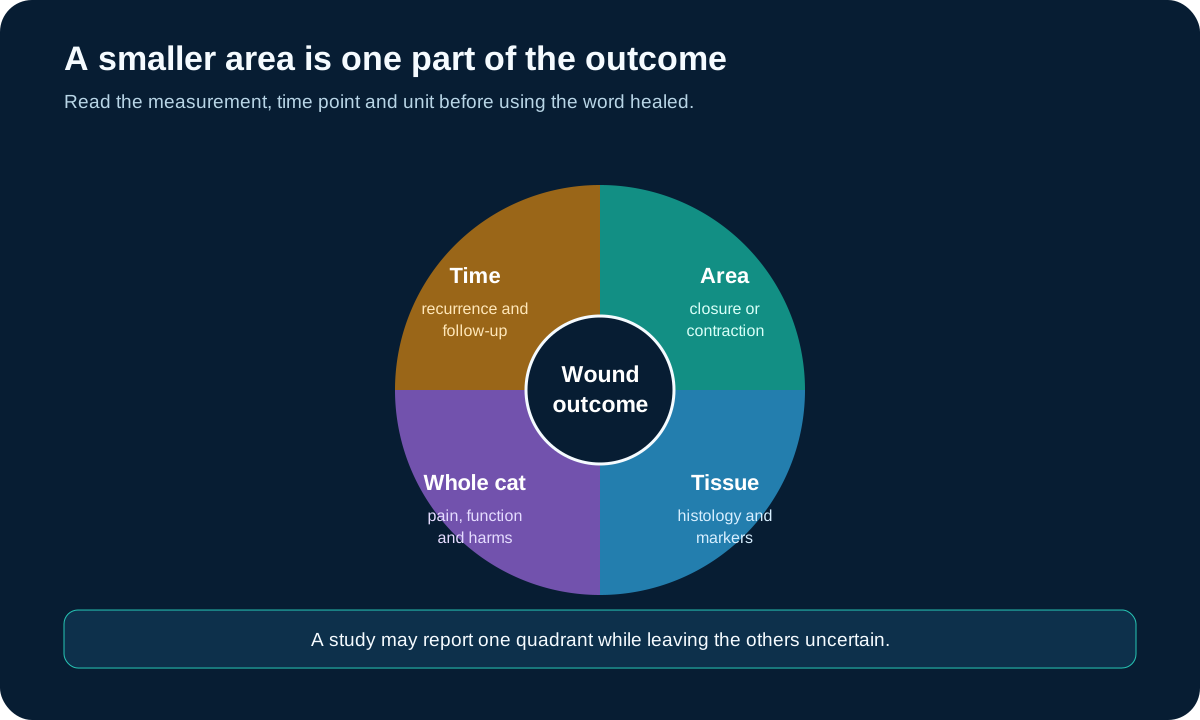
Area reduction can be useful, but it depends on how the edge is defined, photographed or traced, who performs the measurement and when. Histology and biomarkers show what sampled tissue looks like at a time point, not automatically how the cat feels. Whole-cat outcomes include pain, eating, movement, adverse events and ability to tolerate care. Durability requires follow-up for closure, recurrence, infection, scarring and function.
The 2023 PRF study centered on traced wound area over two weeks. The 2024 model added histology and molecular measurements over 28 days. The 2026 vesicle pilot combined closure with tissue analysis over a short inpatient period. None provides a universal timetable for another wound, and none compares all interventions on the same cats under the same protocol.
A 2020 systematic review of animal-origin peptides in wound models found heterogeneous protocols, high risk of bias and limited experimental characterization across 30 animal-model studies. That broader review supports caution when a mechanism or animal endpoint is translated into a precise clinical promise.
A practical evidence-matching worksheet
| Field | Question | Why it changes the conclusion |
|---|---|---|
| Wound | Natural or created? Acute, chronic, infected, puncture, dehiscence, ulcer, eye, ear, pad or skin? | Different tissues, causes and blood supply create different healing problems. |
| Intervention | Peptide, protein, blood matrix, cell-derived vesicle, dressing, drug or multi-ingredient product? | A shared “regenerative” label does not make products interchangeable. |
| Route and formulation | Local matrix, gel, membrane, injection, topical vehicle, oral product or another route? | Delivery changes exposure and cannot be inferred from the molecule name. |
| Care context | What cleaning, debridement, dressings, antimicrobials, pain relief or surgery accompanied it? | An adjunctive result cannot be assigned to one ingredient in isolation. |
| Outcome and time | Area, complete closure, tissue markers, pain, function, harms or recurrence, measured when? | One positive measurement does not fill every clinical outcome. |
Questions to take to the veterinarian
- What is the exact wound type and cause? Ask about depth, contamination, bite injury, foreign material, blood supply, infection, tissue loss and structures underneath.
- Which care cannot wait? Clarify stabilization, bleeding control, cleaning, debridement, pain relief, drainage, closure, bandaging and follow-up.
- What is the exact proposed intervention? Identify whether it is a peptide, protein, blood-derived preparation, extracellular-vesicle product, dressing, approved drug or compounded preparation.
- Were comparable cats studied? Match natural versus experimental wounds, acute versus chronic disease, infection, age, health status and concurrent care.
- Which outcome matters for this cat? Agree on pain, function, wound measurements, discharge, odor, swelling, temperature, appetite and an expected reassessment date.
- What would trigger urgent review? Ask about bleeding, increasing pain, spreading swelling, discharge, fever, lethargy, reduced eating, bandage problems or lack of progress.
- What is the regulatory status? FDA explains that animal drugs compounded from bulk drug substances are not FDA-approved and have not undergone animal-drug approval review. Compounding context does not establish a feline wound indication.
Open the free veterinary-visit checklist
The cat skin-health guide covers dermatology diagnosis and product-class matching. The collagen peptides for cats guide addresses narrow feline joint studies and why they do not establish wound healing. The amount-to-volume calculator performs arithmetic only after a veterinarian supplies an amount and the actual pharmacy label supplies a concentration. It does not determine whether a wound product should be used.
Frequently asked questions
Did the feline PRF studies test a peptide?
No. Platelet-rich fibrin is an autologous blood-derived fibrin matrix containing platelets, leukocytes, proteins and many signaling molecules. It is not an isolated peptide product.
Did the extracellular-vesicle study test a peptide gel?
No. It tested complex cell-derived vesicles carried in a gel. Vesicles can contain many kinds of molecular cargo, and their result cannot be assigned to one peptide.
Is GHK-Cu proven for cat skin wounds?
The primary GHK-Cu wound source reviewed here used implanted wound chambers in rats. It did not test a finished product in cats with natural skin wounds.
Does a cat ear or cornea experiment count as a skin-wound trial?
No. Tissue, route, formulation and outcome must stay attached. An ear-membrane or corneal experiment cannot automatically establish cutaneous-wound efficacy.
Can I copy the PRF or vesicle study protocol at home?
No. These were controlled veterinary or research procedures with patient selection, concurrent care and monitoring. This guide provides no preparation, application or dosing protocol.
Does this article recommend a peptide for a cat wound?
No. It explains what several studies tested and why none establishes a general peptide treatment class for cat wounds.
The bottom line
Direct feline skin-wound research exists, but the strongest retrieved studies tested platelet-rich fibrin or extracellular vesicles, not an isolated peptide product. GHK-Cu is an exact tripeptide-copper complex, yet the primary wound-chamber study reviewed here used rats. Feline EGF experiments used the ear membrane or cornea and a protein growth factor. Keep wound, intervention, route, concurrent care, outcome and time point attached. For an injured cat, veterinary assessment comes before any ingredient claim.
Sources and scope
This is an introductory guide or original comparison framework, not a systematic review or a product recommendation.
- Changrani-Rastogi et al. (2023): autologous PRF in naturally occurring feline wounds — Primary randomized 16-cat study of autologous platelet-rich fibrin plus standard care versus standard care for naturally occurring infected full-thickness cutaneous wounds. Exact wound eligibility, care context, two-week area outcomes and limits are retained.
- Zhang et al. (2024): autologous PRF in a feline trauma model — Primary randomized 18-cat laboratory study comparing autologous PRF membrane, control and Manuka honey after created full-thickness dorsal wounds. Species, model, group size, route, area, histology and molecular endpoints remain attached.
- Kishta et al. (2026): Wharton's-jelly extracellular vesicles for feline chronic ulcers — Primary prospective randomized double-blind controlled 20-cat pilot of stromal-cell-derived extracellular vesicles in gel plus standard care versus vehicle gel plus standard care. Chronic-ulcer population, short-term outcomes and external-validity limits are visible.
- Maquart et al. (1993): GHK-Cu in rat wound chambers — Primary rat wound-chamber study of the exact glycyl-histidyl-lysine copper complex. Matrix outcomes are retained without converting them into feline skin-wound efficacy.
- Dvorak et al. (1990): epidermal growth factor in cat tympanic membranes — Primary experimental cat tympanic-membrane study. Protein identity, tissue, formulation dependence and short follow-up remain attached; it is not a cutaneous-wound peptide trial.
- Merck Veterinary Manual: initial wound management in small animals — Current authoritative veterinary context for stabilization, assessment, contamination and infection control, debridement, pain relief and closure decisions. Guidance, not a peptide trial.
- Merck Veterinary Manual: management of specific wounds in small animals — Current authoritative context for the hidden depth and infection risk of bite wounds, including cat punctures. Supports prompt veterinary assessment rather than a home protocol.
- Lima et al. (2020): animal-origin peptides and skin wounds systematic review — Systematic review of 30 animal-model studies through August 2020, used only for heterogeneity, risk-of-bias and characterization context. It does not supply a feline clinical result.
- FDA: Animal drug compounding — Current official context that animal drugs compounded from bulk drug substances are not FDA-approved and have not undergone animal-drug approval review. This does not establish a feline wound indication.
Source checked October 28, 2026. A general context source does not establish a named product’s benefit.