
Peptides for Cats With Pancreatitis: Measurement Is Not Treatment
Do peptides treat feline pancreatitis? Separate cat biomarkers and tissue signals from rat BPC-157 intervention research and clinical care.
Do peptides treat pancreatitis in cats? The reviewed feline literature does not establish a peptide treatment for naturally occurring pancreatitis. In cats, investigators have measured pancreatic lipase immunoreactivity, trypsinogen activation peptide and neuropeptide signals. Those are biomarkers or tissue observations, not treatment trials. The BPC-157 pancreatitis paper reviewed here used bile-duct ligation in rats. Current feline guidance therefore remains diagnosis-led and predominantly supportive rather than a protocol for an experimental peptide.
“Peptide” can appear in a pancreatitis paper without being the treatment
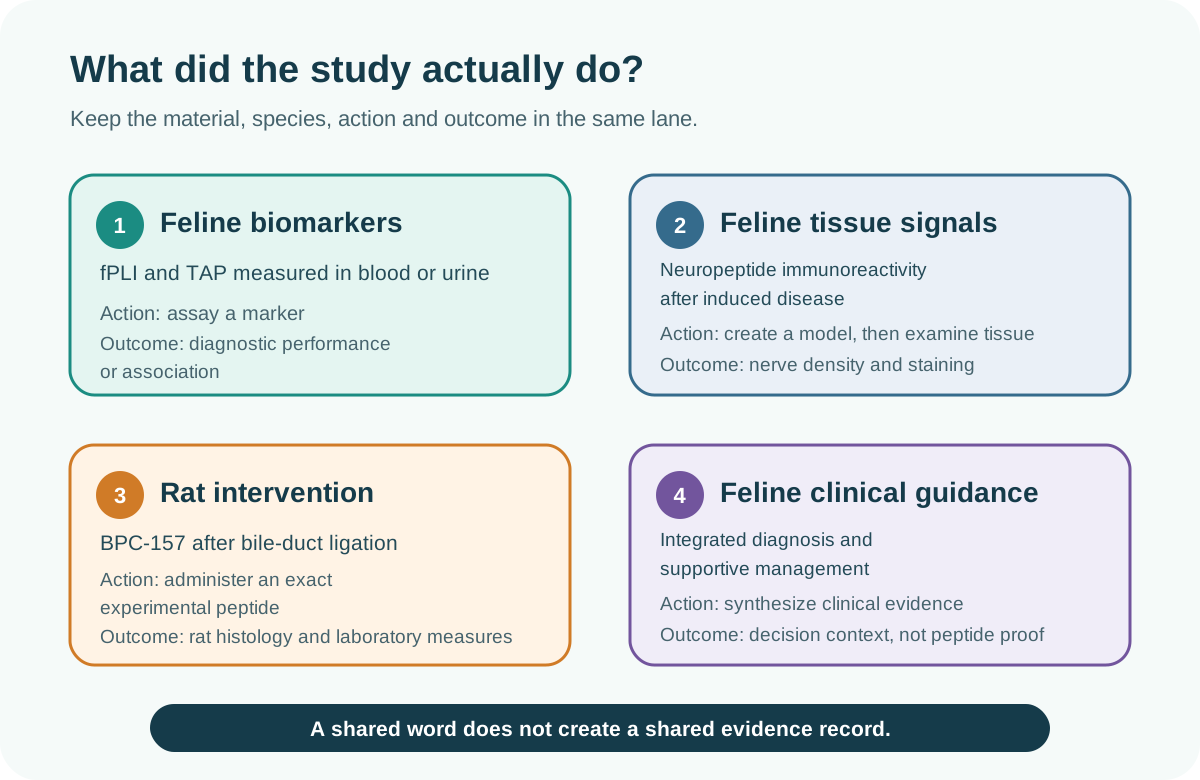
A useful reading starts with the study action. Did researchers measure a protein or peptide fragment in blood, urine or tissue? Did they induce disease in an experimental model? Or did they administer an intervention to cats with naturally occurring pancreatitis and measure clinical outcomes? These are different questions.
Four evidence lanes that should not be merged
The word peptide can describe a short amino-acid fragment that is measured after an enzyme activates, a naturally occurring signaling molecule detected in tissue, or an experimental compound given as an intervention. Pancreatitis research contains all three uses. The shared word does not make them interchangeable.
| Evidence lane | What researchers did | What the result can address | What it cannot establish |
|---|---|---|---|
| Pancreatic lipase immunoreactivity | Measured feline pancreatic lipase in blood and compared it with clinical classification, follow-up or pancreatic histopathology. | How one diagnostic marker behaves in the studied population and where false-positive or false-negative results occur. | A peptide treatment effect, the cause of every cat's signs or a stand-alone diagnosis. |
| Trypsinogen activation peptide | Measured a short fragment released during trypsinogen activation in cats with acute pancreatitis or in induced feline models. | Whether the measured fragment tracks pancreatic activation or tissue severity under the study conditions. | That administering the fragment treats disease or that a retail peptide product is equivalent. |
| Feline pancreatic neuropeptides | Measured tissue immunoreactivity after researchers narrowed the pancreatic duct to induce chronic pancreatitis. | How selected signaling molecules and nerve staining differed in experimental tissue. | A clinical benefit, safety profile or administration protocol for a cat with spontaneous disease. |
| BPC-157 intervention | Administered the exact 15-amino-acid experimental peptide in rats with bile-duct-ligation-induced pancreatitis. | Histologic and laboratory outcomes in that rat model and formulation context. | Feline effectiveness, feline adverse-event frequency, product equivalence or a cat treatment protocol. |
| Feline clinical consensus | Synthesized diagnosis and management evidence for naturally occurring feline pancreatitis. | Why clinical history, imaging, laboratory findings and response must be interpreted together. | Proof for a named experimental peptide that was not evaluated as a feline intervention. |
A pancreatic lipase result is one part of the diagnosis
The ACVIM consensus statement describes feline pancreatitis as difficult to diagnose and manage. Clinical signs can be nonspecific, and a definitive diagnosis may require several forms of evidence. The panel recommends integrating the history and examination with imaging and laboratory findings and, when appropriate, cytology or histopathology. It does not treat feline pancreatic lipase immunoreactivity as a complete answer by itself.
A retrospective study of 274 sick cats illustrates why. The authors classified 9 cats as definitely having pancreatitis, 49 as probably having it, 139 as possibly having it and 77 as unlikely to have it. Among the 58 cats in the definite or probable groups, 14 had a negative Spec fPL result. Among the 77 cats considered unlikely to have pancreatitis, 8 had a positive result. The marker added useful information, but both types of mismatch occurred.
A separate histopathology study evaluated pancreatic tissue from 80 cats. The groups included normal pancreata, nodular hyperplasia, mild pancreatitis, marked pancreatitis and pancreatic neoplasia. Feline pancreatic lipase immunoreactivity did not identify every inflammatory case, and elevations associated with neoplasia could occur when inflammation was also present. This design connects a blood measurement to examined tissue, yet it still does not turn one number into a stand-alone diagnosis.
A 2026 longitudinal study followed 21 client-owned cats for a median of six weeks and collected 71 measurements. Eighteen cats had concurrent disease, including 17 with chronic enteropathy. At the initial presentation, the clinical activity score did not correlate with the two lipase assays studied. A moderate correlation appeared during follow-up. The authors' practical issue is central to owners: a cat can have more than one disease, so the clinician must consider which condition explains the current illness.
Trypsinogen activation peptide is a measured fragment, not a therapy
Trypsinogen is an inactive enzyme precursor. When it is activated, a short N-terminal fragment called trypsinogen activation peptide, or TAP, is released. Feline trypsin research identifies the final eight amino-acid residues as TAP. In pancreatitis research, investigators can measure that fragment as a marker of activation. Measuring a fragment and administering a therapeutic peptide are opposite study actions.
One clinical diagnostic study compared 13 healthy cats with 10 cats diagnosed with acute pancreatitis. Plasma TAP and feline trypsin-like immunoreactivity were higher in the pancreatitis group, while urinary TAP and the urinary TAP-to-creatinine ratio did not differ significantly. The authors reported no diagnostic advantage for plasma TAP over feline trypsin-like immunoreactivity in that small comparison. This is a biomarker study with a limited sample, not evidence that TAP should be given to a cat.
An older experimental paper measured urinary TAP in induced feline models of acute edematous and hemorrhagic pancreatitis. Urinary TAP increased more in the model with greater histologic damage. That association can help investigate disease mechanisms and measurement performance under controlled conditions. It does not describe naturally occurring disease, home testing or a therapeutic product.
Feline neuropeptide staining describes tissue response
A 1993 experiment narrowed the main pancreatic duct in cats and examined tissue after chronic pancreatitis developed. Researchers measured immunoreactivity for calcitonin gene-related peptide, substance P, vasoactive intestinal polypeptide, neuropeptide Y and gastrin-releasing peptide. They reported changes in the density and staining intensity of selected peptide-containing nerves.
The intervention in that study was duct narrowing to create an experimental disease model. The named neuropeptides were detected in pancreatic tissue; they were not given as treatments. The outcome was nerve distribution and immunoreactivity, not appetite, pain, hospitalization, relapse, survival or quality of life in client-owned cats. A seller cannot convert tissue staining into evidence that a peptide vial treats feline pancreatitis.
BPC-157 pancreatitis research remains a rat-model result
The 1996 BPC-157 paper used bile-duct ligation to induce acute pancreatitis in rats. Researchers administered the exact experimental pentadecapeptide and evaluated pancreatic necrosis, edema, inflammation, serum amylase and gastroduodenal lesions. The study therefore belongs to a rat intervention lane, unlike the feline papers that measured naturally occurring biomarkers or experimental tissue signals.
A rat model can support a mechanistic or preclinical question, but it does not establish a cat indication. Species, induced cause, route, formulation, comparison conditions and outcome definitions all matter. It also does not show that a consumer vial contains the studied material or that its identity, purity, sterility and stability match the research preparation.
The regulatory question is product-specific. FDA explains that animal drugs compounded from bulk drug substances are not FDA-approved and have not undergone product-specific review for safety, effectiveness or manufacturing quality. A compounded label or a “research” listing is therefore not evidence that a finished product has been evaluated for feline pancreatitis.
Use the full claim chain before accepting a treatment headline
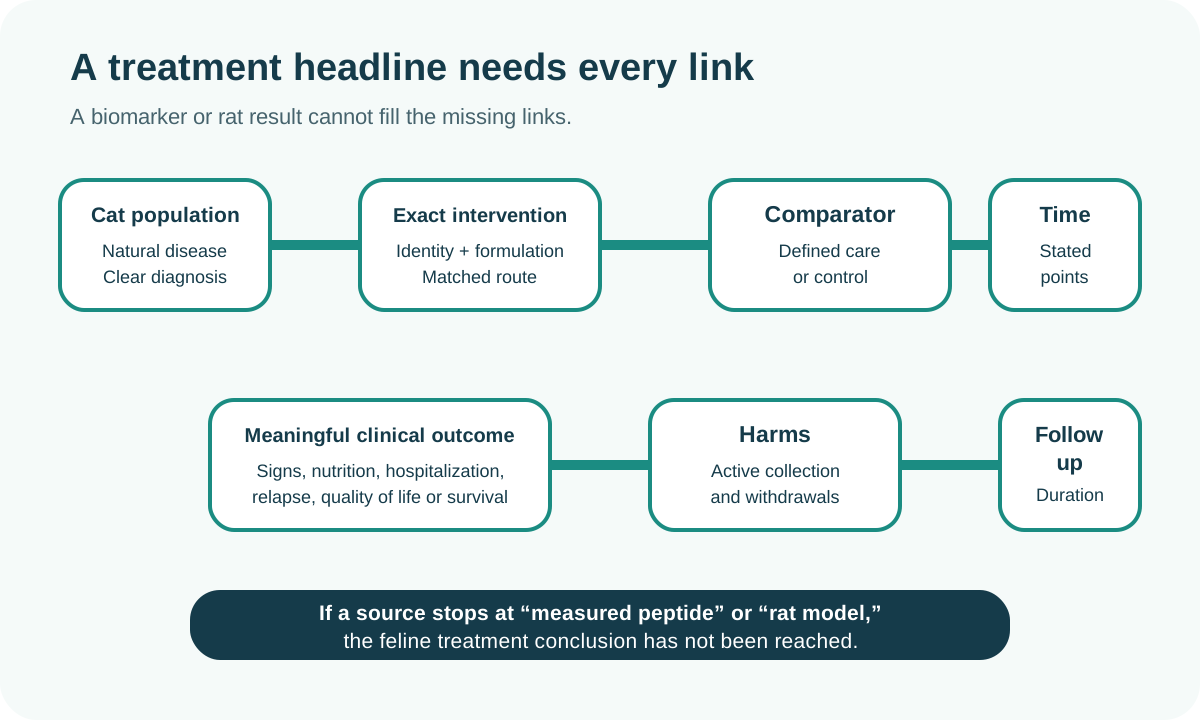
A strong treatment claim should connect a clearly defined feline population to an exact finished intervention, comparator and outcome. It should report how harms were collected and how long cats were followed. Missing links cannot be supplied by the word “peptide.”
| Claim link | What to look for | Why it matters |
|---|---|---|
| Population | Client-owned cats with naturally occurring disease, plus the diagnostic criteria and concurrent conditions. | An induced model or a cat with another diagnosis may answer a different question. |
| Exact intervention | Sequence or active ingredient, finished formulation, route, manufacturer and quality information. | A compound name alone does not prove that products are equivalent. |
| Comparator | Supportive care, another treatment, placebo or a clearly defined baseline. | Without a suitable comparison, improvement may reflect concurrent care, disease course or selection. |
| Meaningful outcome | Clinical signs, nutrition, hospitalization, relapse, quality of life or survival at stated time points. | A biomarker or tissue signal may not predict how the cat feels or functions. |
| Harms | Active adverse-event collection, withdrawals and laboratory monitoring. | No reported event is not the same as a measured zero event rate. |
| Follow-up | Duration, repeat assessment and handling of missing data. | A short observation cannot establish durable benefit or delayed harm. |
What current feline management evidence actually supports
The ACVIM consensus states that definitive treatments for feline pancreatitis are not available and that management is predominantly supportive and symptomatic. That statement does not mean every cat receives the same care. Severity, nutrition, pain, nausea, hydration, concurrent disease and the working diagnosis all influence the veterinary plan.
A retrospective series described nasogastric tube feeding in 55 cats with suspected acute pancreatitis. It recorded complications and 28-day survival, but it was not a randomized peptide trial and it used “suspected” disease criteria. The value of the record is clinical context for nutritional support, not proof for a peptide or a universal feeding protocol.
For an owner, the practical next step is to preserve observations rather than choose a compound. Record appetite, vomiting, stool, activity, weight change, medication and diet history, then bring the full product label for anything already being used. A veterinarian can decide which findings need urgent assessment and which tests fit the cat.

Questions to take to the veterinarian
- What findings support pancreatitis in this cat, and which other diagnoses or concurrent diseases could explain the signs?
- How should the pancreatic lipase result be interpreted alongside examination, imaging and other laboratory findings?
- Which clinical outcomes will show improvement, and when should they be reassessed?
- What nutrition, hydration, pain, nausea or other supportive needs are relevant to this individual cat?
- If a named peptide is proposed, is it a biomarker, a naturally occurring signal or an administered intervention in the cited paper?
- Does the source enroll cats with naturally occurring pancreatitis and use the same exact compound, formulation and route?
- What product-specific quality, adverse-event and follow-up information is available?
Open the free veterinary-visit checklist
The canonical BPC-157 guide separates rodent outcome studies from companion-animal evidence. The biomarker and surrogate-endpoint guide explains why a laboratory measure is not automatically a clinical benefit. The cat gut-health guide compares dietary fragments, exact research peptides and living-cell studies. The cat peptide safety guide shows why product identity and active harm collection matter. The feline product-class guide separates approved products, foods, compounded preparations and experimental materials.
Frequently asked questions
Is feline pancreatic lipase immunoreactivity a peptide treatment?
No. It is a measured pancreatic protein marker used as one part of diagnostic interpretation. The result does not administer a therapy or identify every cause of a cat's signs.
Is trypsinogen activation peptide a treatment?
In the reviewed feline papers, TAP was a short activation fragment measured in plasma or urine. Those studies evaluated it as a marker, not as an administered treatment.
Did the feline neuropeptide study treat cats with peptide injections?
No. Researchers induced chronic pancreatitis by narrowing the pancreatic duct and measured naturally occurring neuropeptide immunoreactivity in tissue.
Was BPC-157 tested in cats with pancreatitis?
The pancreatitis intervention paper reviewed here used a bile-duct-ligation model in rats. It cannot establish feline effectiveness, safety, product equivalence or a treatment protocol.
Does a positive fPL result prove pancreatitis?
No single result should be interpreted alone. The reviewed studies document both false-negative and false-positive patterns, and current consensus recommends integrating clinical, imaging and laboratory evidence.
Can a compounded peptide be treated as FDA-approved for cats?
No. FDA states that animal drugs compounded from bulk drug substances are not FDA-approved and have not undergone product-specific approval review for safety, effectiveness or manufacturing quality.
The bottom line
Feline pancreatitis papers can contain peptide-related language while answering very different questions. Pancreatic lipase and TAP are measured markers. Feline neuropeptides were tissue observations in an induced model. BPC-157 was administered in a rat model. None of those facts establishes a peptide treatment for a cat with naturally occurring pancreatitis. Keep the exact material, study action, species, diagnosis, route, outcome, harms and follow-up connected before accepting a claim.
Sources and scope
This is an introductory guide or original comparison framework, not a systematic review or a product recommendation.
- Forman et al.: ACVIM consensus statement on pancreatitis in cats — Current consensus source for diagnosis and management context. It describes the limits of single findings and predominantly supportive, symptomatic management; it does not establish an experimental peptide treatment.
- Lee et al.: Spec fPL diagnostic utility in 274 sick cats — Primary retrospective feline study. Clinical-likelihood groups and false-negative/false-positive patterns are retained to show why the marker is not a stand-alone diagnosis.
- Carney et al. (2026): longitudinal lipase measures and clinical signs — Primary longitudinal study of 21 client-owned cats and 71 measurements. Concurrent disease and different initial-versus-follow-up correlations remain visible.
- Oppliger et al.: histopathology and fPLI in 80 cats — Primary tissue-comparison study across normal, hyperplastic, inflammatory and neoplastic pancreatic groups. Marker limits are kept distinct from treatment evidence.
- Mansfield et al.: serum and urine TAP in cats — Primary diagnostic comparison of 13 healthy cats and 10 cats with acute pancreatitis. TAP is a measured activation fragment, not an administered therapy.
- Karanjia et al.: TAP in induced feline acute pancreatitis — Primary experimental feline model. Urinary TAP tracked greater histologic damage under controlled induced conditions; the result is not natural-disease treatment evidence.
- De Giorgio et al.: feline pancreatic neuropeptide immunoreactivity — Primary induced chronic-pancreatitis model. Selected neuropeptide signals were measured in pancreatic tissue after duct narrowing; they were not administered as treatments.
- Sikiric et al.: BPC-157 in rat acute pancreatitis — Primary bile-duct-ligation rat experiment. Species, induced model, exact intervention and histologic/laboratory outcomes remain visible; no feline transfer is made.
- Klaus et al.: nasogastric feeding in 55 cats with suspected acute pancreatitis — Retrospective feline case series used only as supportive-care context. It is not a peptide trial and does not establish a universal feeding protocol.
- FDA: Animal Drug Compounding — Current official product-status context checked October 31, 2026. FDA states that animal drugs compounded from bulk drug substances are not FDA-approved and lack product-specific approval review.
Source checked October 31, 2026. A general context source does not establish a named product’s benefit.