
TB-500 and BPC-157 for Dogs: Is the Combination Studied?
Have TB-500 and BPC-157 been studied together in dogs? Compare exact identities, separate animal research, FDA context, and the evidence a real combination trial needs.
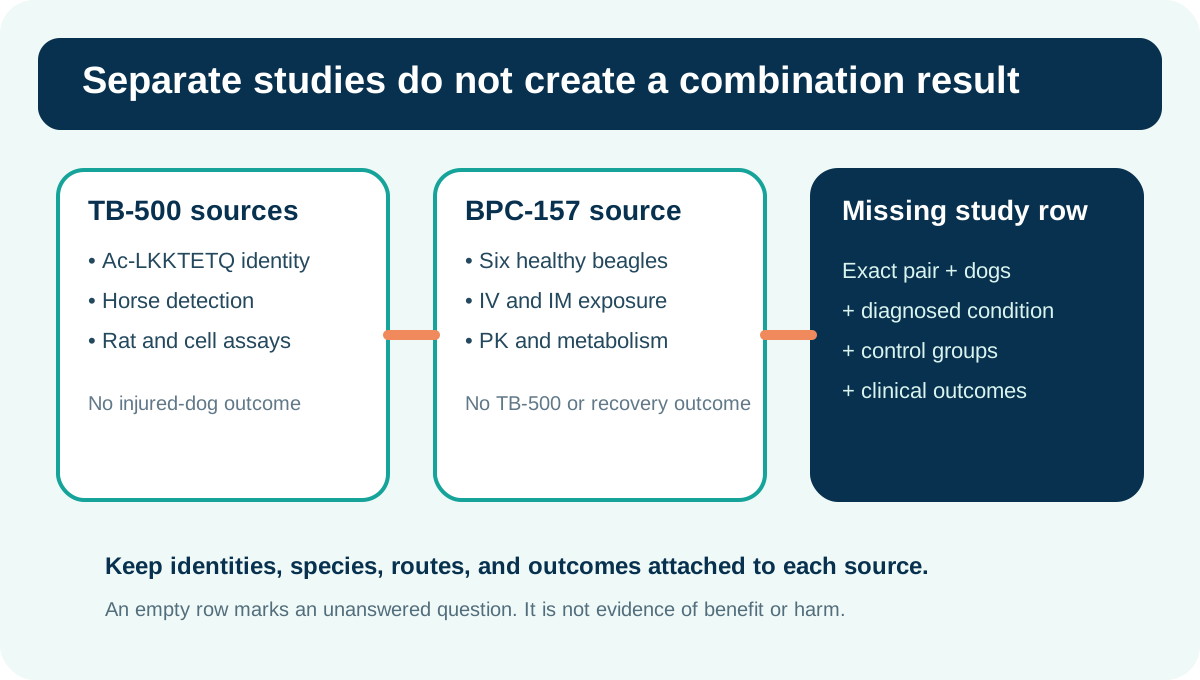
Have TB-500 and BPC-157 been proven together for dogs? Not in the sources reviewed for this guide. The dog BPC-157 paper measured exposure after laboratory-prepared BPC157 in six healthy beagles. TB-500 papers identified or tracked a seven-residue acetylated fragment in laboratory systems, rats, and horses. None of those studies administered both exact compounds together to dogs or measured recovery, pain, mobility, wound closure, or quality of life in canine patients.

Prepared by Pet Peptide Guide with AI assistance; source-checked October 7, 2026. This article has not been reviewed by a veterinarian. It explains how to evaluate a combination claim and does not recommend either compound, a blend, a seller, a dose, a route, or a treatment plan. “No reviewed study” describes this documented source set, not proof that no record exists anywhere.
Two names do not create combination evidence
“TB-500 and BPC-157 for dogs” sounds like one intervention, but it contains several unresolved questions. What exact substance does TB-500 mean? Is the BPC-157 material the free base, an acetate form, or another preparation? Are the two ingredients separate, mixed in one finished product, or merely mentioned on the same page? Which dogs, diagnosis, route, comparison, and outcome are being discussed?
A paper about one ingredient cannot establish the contribution of the other. Two separate positive-looking experiments also cannot establish that combining the ingredients preserves, adds to, or improves either result. The combination could behave like one ingredient, both ingredients, neither ingredient, or something different. Only a study that actually tests the combination can begin to answer that question.
The site’s TB-500 identity guide separates Ac-LKKTETQ, related LKKTETQ, and full-length thymosin beta-4. The BPC-157 evidence guide separately tracks BPC157 by species, route, formulation, and endpoint. Keep those identity rows intact before asking whether the two have ever been studied together.
What the reviewed sources actually tested
| Source | Exact research material | Species or system | Actual question | What it does not establish |
|---|---|---|---|---|
| Esposito et al. 2012 | Ac-LKKTETQ identified in a product called TB-500 | Analytical chemistry; suggested plasma and urine detection | Could the acetylated fragment be identified and characterized? | Dog recovery, safety, or a BPC-157 combination |
| Ho et al. 2012 | N-acetylated LKKTETQ and metabolites | Equine urine and plasma after administration; laboratory detection | Could prior TB-500 administration be detected in horses? | Healing benefit, household-dog outcomes, or a two-ingredient product |
| Rahaman et al. 2024 | TB-500, Ac-LKKTETQ, and shorter metabolites | Human serum and enzyme systems, rat urine, and fibroblast assays | How can the parent peptide and metabolites be quantified and compared? | A canine clinical outcome or a BPC-157 combination |
| He et al. 2022 | Laboratory-prepared BPC157 in saline | Rats and six healthy beagle dogs | What were the pharmacokinetic, metabolism, excretion, and distribution profiles? | Pain relief, tissue repair in injured dogs, TB-500, or a blend |
| FDA TB-500 review, May 2026 | TB-500 free base and TB-500 acetate reviewed separately | Human-compounding evaluation and literature/database review | Were the nominated bulk substances sufficiently characterized, effective, and safe for the reviewed context? | Veterinary approval or controlled canine combination evidence |
The source set contains relevant pieces, but no row contains both exact ingredients, a dog population with a diagnosed condition, and a clinical recovery outcome. Combining conclusions across rows would add an experiment that the papers did not perform.
Why the word “stack” can hide the missing comparison
A marketing page may assign BPC-157 a local-repair role and TB-500 a broader cell-migration role, then call the pairing complementary. That story is a proposed rationale, not a canine result. A mechanism can help generate a hypothesis, but it cannot predict the net effect of two finished preparations in a dog.
At least four possibilities need testing. The ingredients could have independent effects, one could account for any observed change, the combination could perform differently from either ingredient, or the apparent change could reflect natural recovery and other care. Without separate comparison groups, even a favorable before-and-after story cannot identify which explanation is correct.
Safety questions also combine. The exact materials may have different impurity, aggregation, immune-response, stability, and exposure profiles. The FDA’s 2026 TB-500 briefing noted that two reports referred to blended TB-500 and BPC-157 products, but the reports did not contain safety assessments. A report that merely names a blend is not a controlled interaction study, an adverse-event rate, or evidence of safety.
What a real combination study would need to show
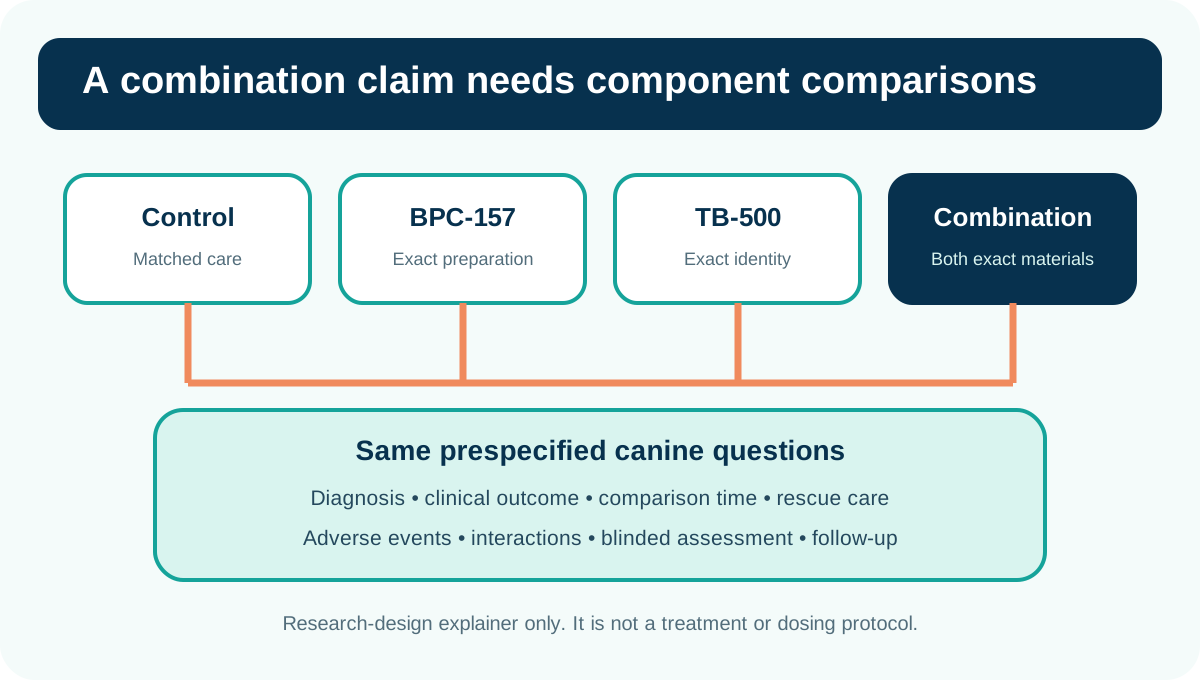
The cleanest design depends on the diagnosis and ethical veterinary oversight, but a combination claim needs more than a single treated group. A four-group comparison can help distinguish each ingredient’s contribution:
- Control or standard-care group: establishes the relevant comparison for the diagnosed condition.
- BPC-157 group: tests the exact BPC-157 preparation while other planned conditions remain matched.
- TB-500 group: tests the exact identified fragment or parent molecule, without changing the name mid-study.
- Combination group: tests both exact materials together in the same formulation and route described in the claim.
This is a research-design explanation, not a proposal to experiment on a pet. A valid study would also need adequate sample size, prospective registration, random allocation, blinded outcome assessment where feasible, prespecified analysis, and enough follow-up to assess both benefit and harm.
The dogs and the outcome must match the headline
A dog with a diagnosed cruciate-ligament injury, a surgical incision, osteoarthritis, inflammatory bowel disease, or unexplained limping presents a different clinical question. “Recovery” cannot serve as the diagnosis or the endpoint. A trial should define the condition, stage, concurrent care, and population before enrollment.
The outcome must also be measurable. Depending on the diagnosed problem, relevant endpoints might include a validated owner pain score, blinded gait or force-plate measures, activity data, wound dimensions assessed on a schedule, return to a defined function, rescue-medication use, or recurrence. Laboratory signals and exposure curves can be useful, but they do not silently become pain relief or healed tissue.
The BPC-157 dog joint-pain guide shows why the six-beagle exposure experiment cannot answer a pain question. The dog arthritis guide keeps product-specific outcomes separate. Use the same discipline for a combination headline.
A blend label creates additional identity questions
A product name or photograph cannot establish the contents of a blend. Record the complete label, exact sequences, terminal modifications, salt forms, excipients, concentration units, lot number, pharmacy or manufacturer, storage instructions, and the document that supports each claim. If “TB-500” appears without a sequence and modification, the identity match remains unresolved.
A certificate of analysis can answer bounded questions about the tested sample, analytes, methods, and reported results. It cannot establish that every vial matches the sample, that the product is suitable for a particular dog, or that the combination improves a clinical outcome. Our testing-report guide explains how to keep laboratory characterization separate from patient benefit.
The FDA’s July 2026 advisory materials evaluated BPC-157-related and TB-500-related bulk substances in separate human-compounding records. The committee process and briefing documents are not veterinary approvals, dog treatment labels, or evidence that a combined product has been reviewed. FDA also emphasized identity and manufacturing uncertainties within each name. Those uncertainties do not disappear when two names share one vial.
How to read a combination claim in six steps
- Copy both identities: record the full BPC-157 form and the TB-500 sequence, modification, and salt.
- Find the same-paper test: ask whether one primary study administered both exact materials together.
- Match the patient: confirm dogs, the diagnosed condition, and whether they resemble the animal in question.
- Match the product and route: keep finished formulation, route, schedule, storage, and concurrent care attached to the result without converting them into instructions.
- Name the outcome: separate exposure, chemical detection, cell migration, tissue measurements, pain, function, and quality of life.
- Inspect safety and attribution: look for active adverse-event collection, interactions, follow-up, and groups that reveal what each component contributes.
If a claim fails at step two, stop calling it combination evidence. You can still describe the separate papers accurately, but the conclusion must remain separate too.

Questions to take to a veterinarian
- What diagnosis and established treatment options should be addressed before discussing an experimental compound?
- What exact molecular identity does each label name represent?
- Is there one controlled study of this exact combination in dogs with this condition?
- Did the study compare the combination with each ingredient alone and an appropriate control?
- Which clinical outcomes and adverse events were collected, by whom, and for how long?
- What pharmacy, product-quality, interaction, or monitoring questions remain unresolved?
Use the free vet-visit checklist to bring the label and citations to an appointment. The sitewide calculators only check arithmetic from a veterinarian-provided amount and an actual pharmacy-label concentration. They do not choose a dose, blend, route, or treatment.
Frequently asked questions
Can TB-500 and BPC-157 be “stacked” for a dog?
This guide does not recommend combining them. The reviewed sources do not establish a canine clinical protocol, benefit, interaction profile, or safe dose for the pair. Discuss the dog’s diagnosis and established options with a veterinarian rather than converting separate experiments into a stack.
Does a BPC-157 dog study prove the combination works in dogs?
No. The reviewed dog paper studied BPC157 exposure in six healthy beagles. It did not include TB-500 or measure recovery in injured canine patients.
Does the horse TB-500 paper show healing?
No. Ho and colleagues developed a method to detect N-acetylated LKKTETQ and metabolites in equine urine and plasma after administration. That is an identity and detection study, not a controlled healing trial.
Is TB-500 simply another name for full-length thymosin beta-4?
Not reliably. The analytical sources and FDA review examined a seven-residue acetylated fragment, while full-length thymosin beta-4 is a larger parent molecule. Evidence should stay attached to the exact identity.
Did the FDA review a combined veterinary product?
No. The July 2026 materials concern separate human-compounding evaluations of BPC-157-related and TB-500-related bulk substances. They do not approve a combined product for dogs or establish canine efficacy.
Bottom line
TB-500 and BPC-157 for dogs is a combination claim, not a shortcut around combination research. The reviewed evidence identifies TB-500-related material in analytical and animal-detection settings and describes BPC157 exposure in healthy beagles. It does not test both exact ingredients together in dogs with a diagnosed condition. Until a matched study supplies that missing row, keep the ingredients, studies, outcomes, and uncertainties separate.
Sources and scope
This is an introductory guide or original comparison framework, not a systematic review or a product recommendation.
- Esposito et al. (2012): structural identification of TB-500 — Identifies N-terminally acetylated LKKTETQ in TB-500 material by chromatography and mass spectrometry; an analytical identity study, not a canine outcome trial.
- Ho et al. (2012): TB-500 detection in horse samples — Detects the acetylated fragment and metabolites in equine urine and plasma after administration; not a healing or dog study.
- Rahaman et al. (2024): TB-500 and metabolite analysis — Laboratory systems, rat urine and fibroblast assays involving TB-500-related material; no canine combination outcome.
- He et al. (2022): BPC157 pharmacokinetics in rats and dogs — Includes intravenous and intramuscular pharmacokinetics in six healthy beagles; no TB-500 and no clinical injury outcome.
- FDA: BPC-157-related bulk-substance briefing document — May 11, 2026 human-compounding review context; not an animal-drug approval or canine efficacy finding.
- FDA: TB-500-related bulk-substance briefing document — May 15, 2026 human-compounding review; notes two blended TB-500 and BPC-157 reports without safety assessments and provides no canine combination study.
- FDA: July 23-24, 2026 Pharmacy Compounding Advisory Committee meeting — Official meeting context for separate human-compounding evaluations; not veterinary approval.
Source checked October 07, 2026. A general context source does not establish a named product’s benefit.