
BPC-157 for Dog ACL Injury: Rat Ligament vs Canine Evidence
Does BPC-157 heal a dog’s torn ACL? Compare rat MCL research, beagle exposure and canine cruciate outcomes without confusing repair, stability and function.
Does BPC-157 heal a dog’s torn ACL? The sources reviewed here do not establish that BPC-157 repairs canine cranial cruciate ligament disease or replaces a stabilization plan. The original ligament experiment concerns a surgically cut medial collateral ligament in rats. The dog BPC157 paper measures drug exposure in research beagles, not recovery from a cruciate tear. Those are different tissues, populations and questions.

Sources checked October 16, 2026. This AI-assisted evidence comparison has not been reviewed by a veterinarian and is not a systematic review, surgical recommendation or treatment plan. Two studies below were assessed from their original abstracts, not complete methods. No dose, injection instructions, recovery timetable or research-product seller is provided.
“Dog ACL injury” usually means the cranial cruciate ligament
The American College of Veterinary Surgeons (ACVS) calls this structure the cranial cruciate ligament, or CrCL, inside the dog’s knee, also called the stifle. Owners often use the human term ACL. The ligament helps control excessive movement between the thigh and shin bones; associated meniscal damage is another concern. ACVS describes canine disease as commonly involving gradual degeneration rather than a single traumatic event in an otherwise healthy ligament.
A veterinary examination assesses the problem and joint instability, with imaging where appropriate. An owner’s label of “torn ACL” cannot establish the diagnosis, degree of tearing, meniscal involvement or best management. Persistent or new lameness warrants veterinary assessment, not an attempt to test the knee at home.
ACVS describes surgical and nonsurgical management and emphasizes individual factors such as activity, size, age and instability. Ask your veterinarian how these apply to your dog. This page compares evidence claims; it does not choose a procedure or advise delaying assessment while trying a peptide.
The key mismatch: rat MCL is not canine CrCL
Cerovecki and colleagues’ 2010 ligament paper identifies BPC 157, also called PL 14736, as the 15-amino-acid sequence GEPPPGKPADDAGLV. Its abstract describes rat medial collateral ligament (MCL) transection, observations through 90 days and intraperitoneal, oral drinking-water and topical cream administration. The authors report functional, biomechanical, gross-tissue and microscopic improvements under those experimental conditions.
This is ligament research, but not a dog cruciate trial. Do not substitute a different species, tissue or disease setting when naming a result.
Access limit: only the original abstract was accessible. Salt form, purity, complete methods, effect magnitude and safety collection remain unverified here. Product equivalence and study-quality judgments require more than the compound name.
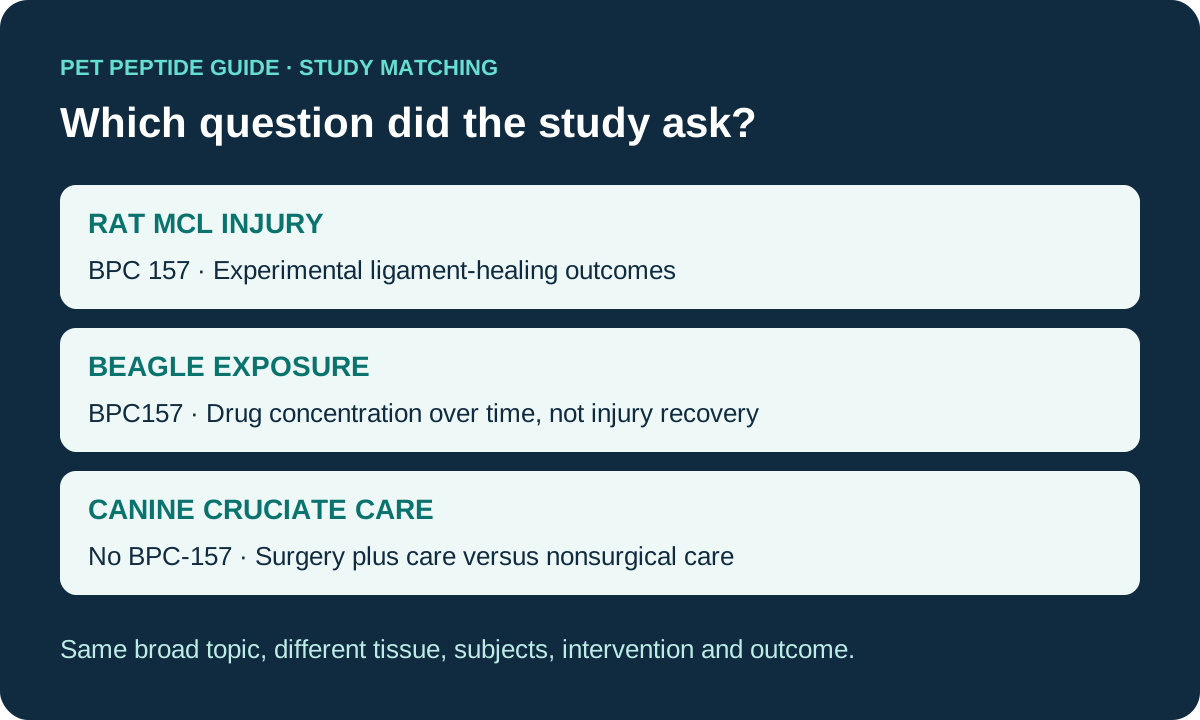
Three primary studies, three different questions
| Study and population | Intervention or preparation | What it measures | Boundary for a dog cruciate claim |
|---|---|---|---|
| Cerovecki et al., 2010 Rats after MCL transection; abstract reviewed | BPC 157 alone; intraperitoneal solution, drinking water or topical cream. | Experimental ligament healing, including mechanical and tissue findings. | Different species, ligament and disease setting; full methods not reviewed. |
| He et al., 2022 Six research beagles | Laboratory-synthesized BPC157 in saline; intravenous and intramuscular exposure, including a seven-day repeat arm. | Pharmacokinetics: concentrations and exposure over time. | No cruciate-injury treatment group, knee-stability outcome or return-to-function comparison. |
| Wucherer et al., 2013 40 client-owned overweight dogs with unilateral cruciate rupture; abstract reviewed | Randomized comparison of nonsurgical care alone versus tibial plateau leveling osteotomy (TPLO) plus the same nonsurgical care. | Gait, owner questionnaires and body composition, with follow-up through 52 weeks. | A relevant canine clinical-outcome example, not a BPC-157 study. |
The beagle paper’s dog methods describe repeated blood sampling, not dogs being followed after ligament repair. Demonstrating measurable exposure does not establish a successful clinical outcome or adequate long-term safety for an injured pet. See the canonical BPC-157 guide for the broader compound evidence and the joint-pain guide for the separate question of pain endpoints.
The Wucherer trial abstract reports improvement in both groups and generally better results with the combined surgical approach, including higher affected-limb peak vertical force at 24 and 52 weeks. Nonsurgical care included physical therapy, weight loss and anti-inflammatory medication in both groups. This was not surgery versus doing nothing. Its overweight, unilateral-injury population and combined care limit generalization. We could not retrieve full publisher methods, so we do not reproduce success percentages or turn its program into a home protocol.
Repair, stabilization and function need separate evidence
For a cruciate claim, write down which of three questions is being answered. Biological repair concerns what happens to injured tissue. Stabilization concerns control of unwanted joint movement. Function concerns how the dog uses the limb and manages daily life. They can be related without being interchangeable.
A tissue result does not, on its own, tell you whether an affected dog can bear weight comfortably or whether an unstable joint has become stable. Conversely, improvement after a stabilization procedure does not mean an experimental compound regenerated the original ligament. Naming the outcome precisely prevents “healing” from becoming a catch-all promise.
Ask how success was defined before results were collected. Were gait measurements standardized? Were pain and owner observations collected consistently? Were extra treatments, withdrawals, complications and later problems included? A good claim retains the comparison and follow-up, not just the most appealing result.
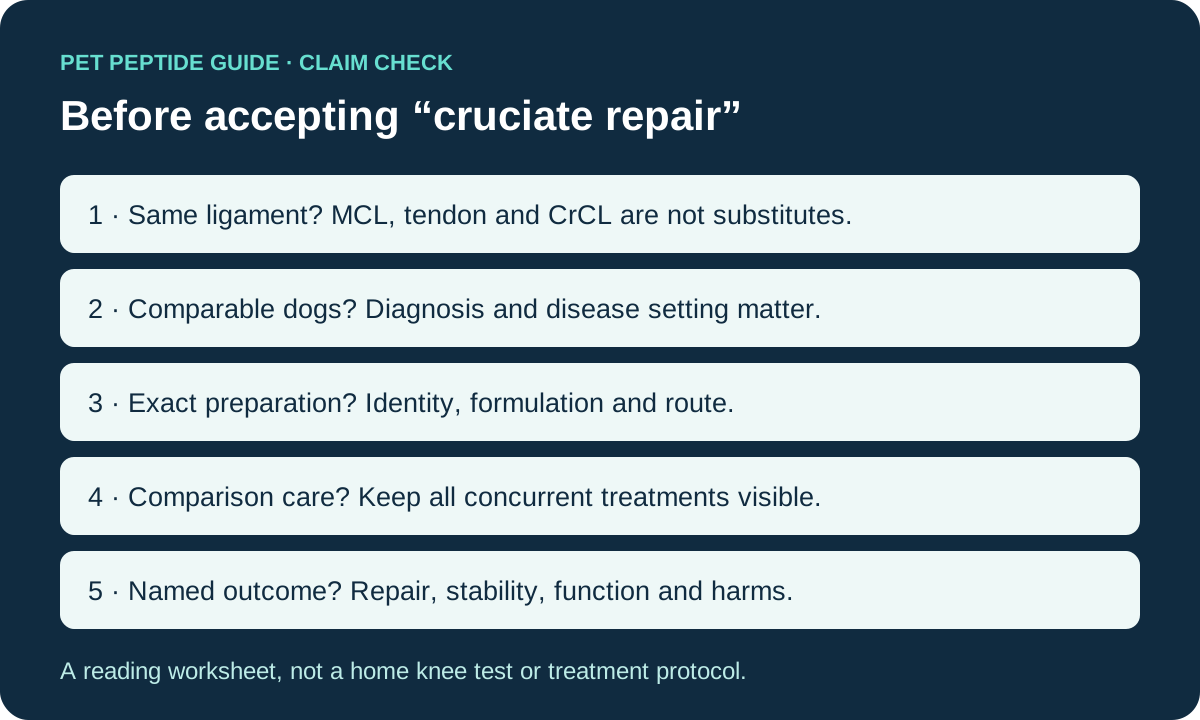
A fictional “avoid surgery” claim, checked against its citations
Fictional example: a product page promises that BPC-157 will let a dog with a cruciate tear avoid surgery. It cites the rat MCL experiment and the beagle exposure study. Neither citation tests that promise: one is a different injury model, while the other does not study an injured ligament.
The missing bridge is not another mechanism diagram. It is a relevant clinical comparison of the exact intervention in dogs with the stated diagnosis, with outcomes that address the promised benefit and its risks. Ask what care the comparison group received and how dogs needing additional treatment were counted. “Did not undergo surgery during follow-up” and “recovered adequate function” are also different outcomes.
A personal recovery story may be sincere but cannot isolate a peptide from changes in other care, activity or time. Do not stop prescribed care, remove restrictions or postpone follow-up to imitate a testimonial. Bring the claim and its original papers to the veterinary team instead.
Current U.S. approval context is not a ligament protocol
The FDA briefing for its July 23–24, 2026 compounding advisory meeting, retrieved October 16, evaluates BPC-157 free base and acetate as distinct bulk substances in a human-compounding context. It states that neither is a component of an FDA-approved drug at that evaluation. The document is advisory background, not a final determination or a canine cruciate indication. Do not relabel its human ulcerative-colitis evaluation as authorization for pet ligament treatment.
FDA’s current animal-compounding information explains that drugs compounded from bulk substances are not FDA-approved and have not undergone its approval review for safety, effectiveness or quality. It also recognizes medically necessary circumstances addressed by its guidance. A prescription, an ingredient identifier or a research vial is not itself proof of an approved finished product or of suitability for this dog. Ask the responsible veterinarian and pharmacy about the exact preparation and lawful pathway.
This focused review verifies no approved BPC-157 product for canine cruciate repair. It is not a comprehensive database audit or a claim that no further study can exist. The dog side-effect evidence guide addresses the separate safety question; uncertainty about benefit does not establish safety.
Take a ligament-specific question to the appointment

- What has been diagnosed, and what remains uncertain about the cruciate ligament or meniscus?
- What does the examination show about instability, and what does that mean for management?
- Is the proposed goal pain control, tissue repair, stabilization or daily function?
- Does the cited paper test that goal in comparable dogs, rather than a different ligament or species?
- What are the established options and their tradeoffs for this dog?
- What observations, follow-up and earlier-contact signs should our individual plan include?
Bring the full proposed label, the original citation and a list of medicines and supplements. Keep your dog’s records on your own device or paper; this site does not need them. There is no BPC-157 shopping list or affiliate offer here.
Open the veterinary-visit checklist
If the discussion turns to nutrition, the collagen buying and evidence guide addresses a different product question, not proof of cruciate regeneration. Compare costs only after suitability is settled; the cost-comparison tool cannot decide a treatment plan. Our calculators do not supply a BPC-157 amount or a recovery protocol.
Quick answers
Is there a ligament study, or only tendon research?
There is an original rat MCL study. It should be described accurately as ligament work, but it is not a canine cranial cruciate clinical trial.
Does “tested in dogs” mean tested for a torn cruciate ligament?
No. The reviewed dog paper measures BPC157 exposure in research beagles. The diagnosis and outcome must also match the claim.
Can this evidence decide whether my dog needs surgery?
No. That decision requires an individual veterinary assessment. The cited peptide studies do not compare a canine BPC-157 plan with established cruciate management.
What would justify revisiting the conclusion?
A retrievable controlled trial of a characterized BPC-157 preparation in dogs with confirmed cruciate disease, with relevant function, stability and harm outcomes, would merit review. It would still need critical assessment, not automatic acceptance.
Sources and scope
This is an introductory guide or original comparison framework, not a systematic review or a product recommendation.
- ACVS: Cranial Cruciate Ligament Disease — Official specialist-organization context for canine stifle terminology, degeneration, instability, diagnosis and individualized management.
- Cerovecki et al. (2010): Pentadecapeptide BPC 157 (PL 14736) improves ligament healing in the rat — Original publisher abstract only: sequence, rat MCL transection, routes and broad outcomes. Full methods not obtained; not a canine cruciate trial.
- He et al. (2022): BPC157 pharmacokinetics in rats and dogs — Full dog methods: laboratory preparation and six-beagle IV/IM exposure; no cruciate injury or clinical repair comparison.
- Wucherer et al. (2013): Surgical and nonsurgical outcomes in overweight dogs with cruciate rupture — Original abstract only: 40 client-owned overweight dogs, randomized comparison, common nonsurgical care and clinical outcomes through 52 weeks. Not BPC-157 evidence or a home protocol.
- FDA (July 2026): BPC-157 free-base and acetate briefing — Human-compounding advisory background, distinct substance identities and approval context at evaluation; not a final determination or canine indication.
- FDA: Animal Drug Compounding — Current bulk-compounding approval and review limits; medically necessary circumstances retained without seller-specific or individualized legal advice.
Source checked October 16, 2026. A general context source does not establish a named product’s benefit.