
Peptides for Dog Hip Dysplasia: Comfort vs Hip Repair
Can peptides fix canine hip dysplasia? Compare hip laxity, gait and collagen research, and learn why better movement does not establish structural repair.
Can peptides fix hip dysplasia in dogs? The studies reviewed here do not establish that a peptide product corrects canine hip dysplasia. Better comfort or movement is not the same result as reduced hip laxity, changed joint shape or slower structural deterioration. Before considering a product, ask which of those outcomes its evidence actually measured in dogs with the relevant diagnosis.
Sources checked October 15, 2026. This AI-assisted educational article has not been reviewed by a veterinarian and is not a systematic review or treatment plan. It provides no dose, injection instructions, product ranking or substitute for an orthopedic assessment. Its question is specifically hip structure versus clinical outcomes, not which arthritis product to buy.
Hip dysplasia is a diagnosis, not a synonym for stiffness
The American College of Veterinary Surgeons (ACVS) describes canine hip dysplasia as a developmental condition involving a loose or unstable hip joint. Abnormal joint movement can lead to cartilage loss and arthritic changes. Young dogs with laxity and older dogs with secondary hip arthritis are not interchangeable populations, and some affected dogs have no obvious symptoms. Diagnosis combines a veterinary examination with appropriately positioned imaging.
That distinction changes the research question. “Does this help an adult dog with hip-related discomfort?” is different from “Does this prevent a growing puppy’s dysplasia?” and from “Does this change the anatomy of an already abnormal joint?” A paper that answers one cannot be relabeled as answering all three.
ACVS also describes treatment choices that depend on age, joint changes and individual circumstances, including time-sensitive options for some growing dogs. Ask promptly whether specialist assessment is appropriate; do not postpone that conversation while trying to reproduce an online peptide claim. This page does not select a procedure, exercise program or medicine for your dog.
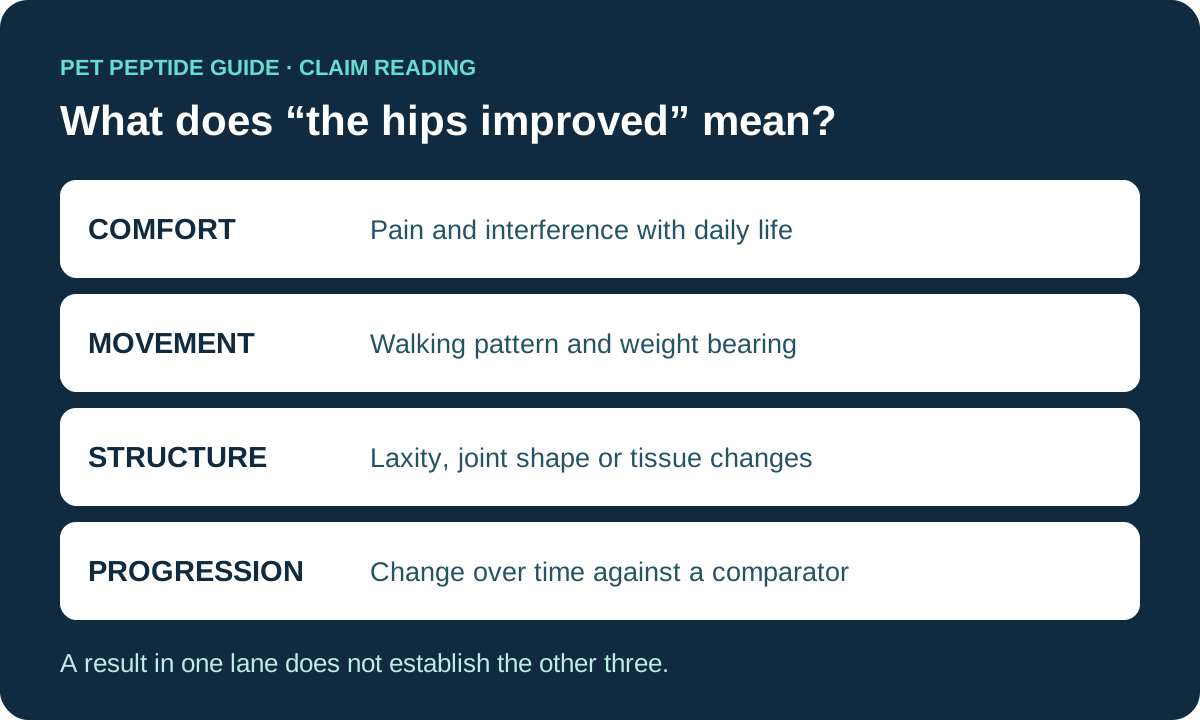
Four meanings of “the hips improved”
| Claim | Evidence to look for | What it does not automatically show |
|---|---|---|
| Less pain or interference with daily life | A defined clinical outcome, comparison group and follow-up. | A tighter joint or corrected hip shape. |
| Different walking or weight bearing | A specified gait measure under comparable conditions. | Cartilage regrowth or prevention of later disease. |
| Less laxity or changed structure | An appropriate structural measure assessed consistently over time. | That the dog necessarily feels better, unless clinical outcomes were also measured. |
| Slower progression | A prospectively defined progression outcome and a meaningful comparison over sufficient follow-up. | A conclusion available from one favorable snapshot. |
These are parallel questions, not a ranking that makes comfort unimportant. Pain relief can matter greatly to a dog and owner. The error is expanding a specific result into a stronger, unmeasured promise. Likewise, an imaging difference should not be presented as a complete account of daily life.
What hip-specific research actually measured
Santana and colleagues, 2022, followed 41 dogs, evaluating 82 hips. Early distraction radiographs at 4–12 months were compared with later radiographic hip grades after 12 months. The publisher abstract reports an association between early laxity measurements and later grades. This was a structural follow-up study, not a peptide intervention. We reviewed the publisher abstract for this example, not the complete methods PDF; it cannot supply a treatment effect or an individual prediction guarantee.
In a different primary study, Virag and colleagues, 2022, analyzed 49 young retrievers after two exclusions: 32 Labradors and 17 Golden Retrievers. They measured walking and trotting with a pressure plate at approximately 4, 8 and 12 months, then grouped hips by radiographs taken at or after 12 months. Center-of-pressure differences were detected even in non-lame dogs. Age, gait and breed influenced measurements. There was no peptide treatment arm. The study illustrates why an owner's impression of normal walking is not a substitute for structural assessment, and why gait comparisons need controlled conditions.
Reading these studies together does not create a treatment trial. One examines a relationship between early and later imaging; the other relates measured movement to radiographic categories. Neither tests whether a supplement changes a dysplastic hip. Keep the research design attached to the result.
Where collagen and BPC-157 fit, and where they do not
| Primary source | Subjects, preparation and route | What was assessed | Hip-specific limitation |
|---|---|---|---|
| Dobenecker et al., 2024 | Dogs with chronic osteoarthritis; oral PETAGILE collagen peptides derived predominantly from porcine type I collagen, compared with omega-3/vitamin E and placebo. | 12-week gait, owner questionnaire and activity measurements; 41 enrolled, 31 completed. | Not a hip-dysplasia correction trial. |
| He et al., 2022 | Six research beagles; laboratory-prepared BPC157 in saline, given intravenously and intramuscularly. | Pharmacokinetics: drug concentrations over time, including a seven-day repeat arm. | No hip-dysplasia efficacy comparison or structural repair outcome. |
The collagen paper reports improvements in selected gait and questionnaire outcomes, but no significant activity difference. It did not assess the primary causes of the dogs’ osteoarthritis at enrollment or demonstrate correction of hip laxity. GELITA funded the study; an author was its employee and another disclosed collagen-related patents. Its formulation-specific results should not become a promise that any collagen powder repairs hips. See the dog collagen buying and evidence guide for the separate product-comparison question.
BPC-157 is a different compound, not another name for collagen peptides. The dog exposure study cannot answer whether it relieves hip pain, changes joint structure or is suitable for long-term use in affected pets. The canonical BPC-157 guide and dog joint-pain evidence comparison cover those broader evidence boundaries. No head-to-head hip-dysplasia trial of these two interventions is presented here.
A fictional claim check: “moving better means repaired hips”
Fictional example: An advertisement shows a dog rising more easily after a product and calls this “hip repair.” Its linked paper reports a movement score, but the advertisement provides no matching structural outcome. Even if the movement finding is accurate, the repair claim adds a conclusion the stated evidence did not measure.
Use a two-column note: observed result on the left, extra claim on the right. “Different weight bearing” belongs on the left if that is what the study found. “Corrected socket shape,” “regrown cartilage” or “no future surgery” belongs on the right unless separately tested. Ask for the missing evidence rather than silently filling the gap.
A before-and-after account also needs context: did body weight, other treatment, activity restrictions or observation conditions change? An appealing video is not a controlled comparison. Do not ask your dog to repeat painful movements to create your own experiment, or change prescribed care to copy a study.
Approval and suitability still need their own checks
FDA’s animal-drug approval overview, checked October 15, 2026, explains that review addresses safety and effectiveness for an intended use, manufacturing, labeling and packaging. A published animal study is not that approval. Nor does the word “peptide” identify a common legal category or authorize a hip-dysplasia indication. This article verifies no approved peptide product for correcting canine hip dysplasia and recommends no research supplier.
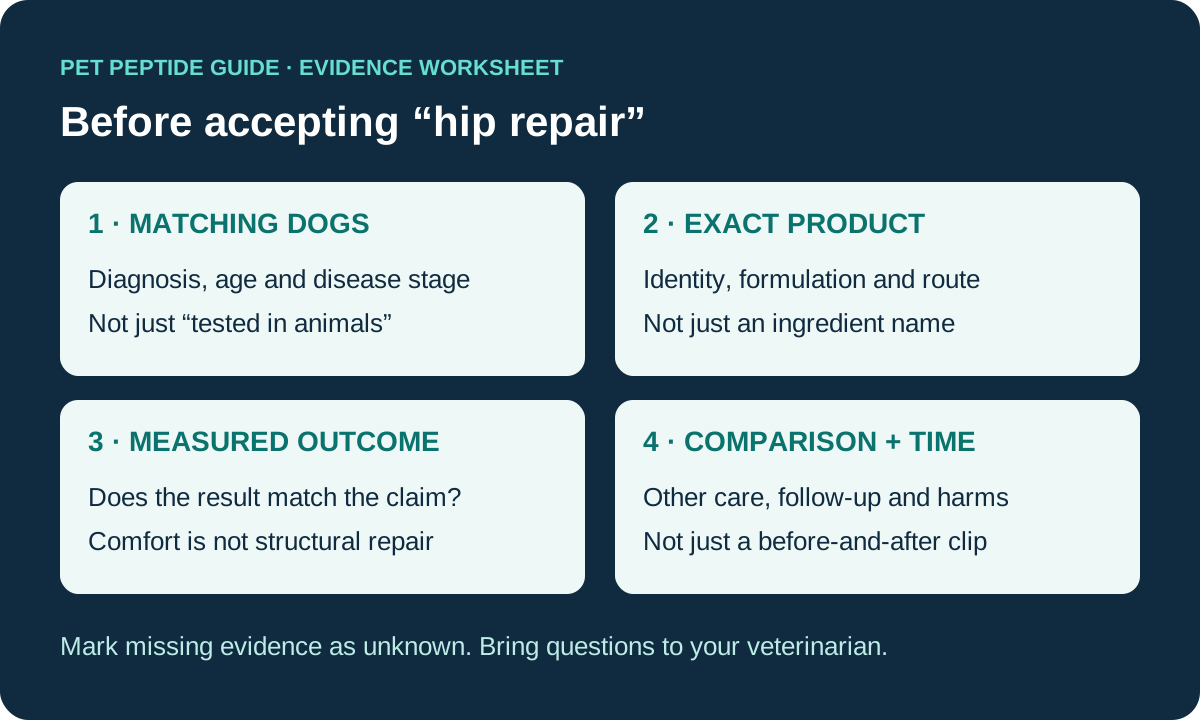
Ask for the exact product, label and proposed veterinary pathway, not a general assertion that an ingredient is “used in animals.” Evidence for a human preparation, a cell experiment or a rodent injury model does not replace a relevant canine comparison. If a prescription or compounded preparation is being discussed, the veterinary-pathway guide explains the separate questions to take to the responsible veterinarian and pharmacy, without teaching self-injection.
Questions that make the veterinary conversation more useful

- Diagnosis: Is hip dysplasia confirmed, and is it the likely source of the current problem?
- Timing: Does this dog’s age or joint status make any assessment or referral time-sensitive?
- Goal: Are we discussing comfort, daily function, structure or progression?
- Evidence: Does the cited paper include comparable dogs and the same preparation, with that outcome measured?
- Comparison: What other care was allowed, how long was follow-up, and were withdrawals and unwanted effects reported?
- Follow-up: What should we observe at home, when should we reassess, and which changes warrant earlier contact?
Bring the original paper and complete label, together with your current medicine and supplement list. Keep observations private on your own paper or device. For broader arthritis categories, use the dog arthritis evidence guide. For this appointment, keep the hip-specific goal written at the top of the page.
Open the veterinary-visit checklist
Quick answers
Does improved walking prove that hip dysplasia has reversed?
No. It supports only the measured movement result. A reversal claim needs appropriate structural evidence, and its clinical importance needs separate assessment.
Is a puppy study automatically relevant to an older dog with hip arthritis?
No. Match age, diagnosis, disease stage and intended outcome. A developmental screening study and a clinical treatment study answer different questions.
Why not rank the best peptide for hip dysplasia?
The reviewed sources do not provide a matching comparative evidence base for that ranking. A shopping order would suggest a level of suitability and certainty this article has not established.
What evidence would change this assessment?
A retrievable controlled study of an exact preparation in dogs with confirmed hip dysplasia, reporting the claimed clinical or structural outcomes and adequate safety follow-up, would merit review. This focused comparison does not claim that no other study exists anywhere.
Sources and scope
This is an introductory guide or original comparison framework, not a systematic review or a product recommendation.
- ACVS: Canine Hip Dysplasia — Official specialist-organization context for developmental laxity, diagnosis and individualized timing; not a peptide trial or a treatment plan.
- Santana et al. (2022): Early hip laxity screening and later canine hip dysplasia development — Publisher abstract reviewed, not complete methods PDF. Follow-up of 41 dogs and 82 hips; structural association, not treatment effect.
- Virag et al. (2022): Pressure and force measurements in young retrievers with and without hip dysplasia — Primary observational gait and radiographic study: 49 dogs analyzed after two exclusions. No peptide intervention; limited breeds and developmental context.
- Dobenecker et al. (2024): Specific collagen peptides in canine osteoarthritis — Exact oral collagen formulation, 12-week gait/questionnaire/activity study and industry interests; not evidence of corrected hip laxity.
- He et al. (2022): BPC157 pharmacokinetics in rats and dogs — Dog methods 4.4 and preparation 4.1; six-beagle intravenous/intramuscular exposure study, not a hip-dysplasia efficacy trial.
- FDA: Animal Drug Development and Approval Process — Current intended-use, product-quality and approval review context; publication of animal research is not product approval.
Source checked October 15, 2026. A general context source does not establish a named product’s benefit.