
Peptide Studies With Many Outcomes: Avoiding the Highlight Reel
Read peptide studies with multiple outcomes: find the primary question, complete result list and analysis plan before interpreting a favorable headline.
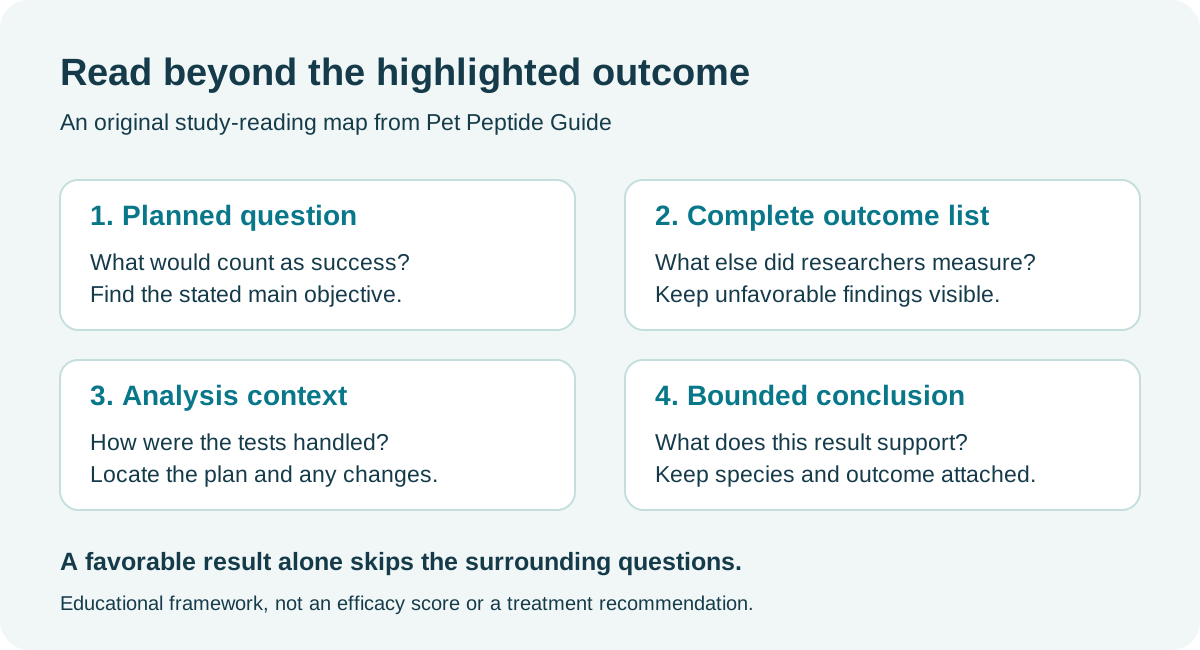
A favorable result is easier to interpret when you can see every outcome the study set out to test. Before accepting a peptide headline, ask which outcome defined success, what else was measured and how the analysis handled multiple chances to find a difference.
Prepared by Pet Peptide Guide with AI assistance. Sources checked October 14, 2026. Not reviewed by a veterinarian or physician. The worked example is fictional and describes no actual peptide result. This is an introductory reading framework, not a systematic review, safety assessment or treatment recommendation.

Read the question before the highlight
A summary can sound persuasive when it lists only favorable findings. Start with the paper's complete outcome list and analysis plan, rather than the most attractive sentence in its abstract. If the species, preparation or purpose is unclear, use our general peptide research framework first.
This guide addresses a specific question: did the highlighted result answer the question the study was designed to test? That is separate from whether the study enrolled enough independent subjects, retained its participants or measured something meaningful. Those checks still matter.
Why several outcomes need an analysis plan
FDA's multiple-endpoints guidance explains that testing several endpoints can increase the chance of a false positive conclusion unless the analysis appropriately manages multiplicity. It recommends planning endpoints and analyses in advance. Primary outcomes address the main study objective; secondary and exploratory outcomes have different roles. Exploratory findings can generate questions without establishing confirmatory conclusions.
The guidance discusses strategies such as ordered testing and statistical adjustments. There is no universal instruction to discard every study with several outcomes. The study's success rule matters: requiring success on all co-primary outcomes differs from allowing success on any one of several outcomes. Read the actual plan rather than applying a rule based only on the number of measurements. This FDA document concerns human drug and biologic trials; it is not veterinary approval or evidence for a named peptide.
Fictional exercise: two markers improved
Imagine a human peptide trial that measures a symptom score, walking performance and eight laboratory markers. A summary says, "Two markers improved." The primary symptom endpoint did not meet the study's stated success criterion. The summary omits that fact and gives no account of how the other tests were handled.
Your reading note could say: "The highlighted laboratory results need to be interpreted alongside the primary endpoint and the prespecified analysis. This excerpt does not establish that the trial met its objective."
Now imagine a second summary of the same fictional study: "The trial did not meet its primary symptom endpoint; two laboratory findings warrant further investigation." That wording gives the reader a clearer starting point. You would still need the full results and methods before judging either claim.
Neither version tells you whether the markers predict better health. Keep that separate question visible with our biomarker and surrogate-endpoint guide. Nor does this human example establish anything about benefit in a dog or cat.
Build a complete outcome inventory
ARRIVE's animal-research reporting guidance asks authors to define all assessed outcomes and explain how each was measured. Selectively reporting favorable outcomes can bias the literature. Even a label such as "activity" needs a definition: time moving and distance traveled are different measurements.
Use the following original worksheet to organize a report. It is a reading aid, not an independent statistical reanalysis.
| Record this | Question to answer |
|---|---|
| Exact outcome | What was measured, in which subjects and at what time? |
| Role in the plan | Was it identified as primary, secondary or exploratory? |
| Complete comparison | Which groups were compared, and where are the other results? |
| Analysis context | Where does the report explain the testing strategy and any changes? |
| Bounded conclusion | What does this particular finding support, and what remains unresolved? |
Keep unknowns visible. A missing explanation is a reason to seek the protocol, statistical analysis plan or full report. It is not a reason to invent an adjustment or accuse researchers of misconduct. Our trial-record guide helps readers compare public records with reports. If different outcomes use different participant counts, also consult the missing-data worksheet.
Keep human research and pet care separate
A statistical reading framework can help organize questions across studies. It cannot supply missing species-specific evidence, establish safety or select treatment. Keep human participants, laboratory animals and household pets explicitly identified. Do not turn a statistical finding into an approval claim or a recommendation for a different preparation.
If the claim concerns your pet, bring the complete paper and the exact claim to the veterinarian responsible for that animal. A useful question is: "Which outcome matters for this animal's condition, and did the cited study actually test that outcome in comparable animals?" Use the veterinary-visit checklist to keep that question beside the product and care context. No purchase or treatment decision follows automatically from a favorable headline.
Sources and scope
This is an introductory guide or original comparison framework, not a systematic review or a product recommendation.
- FDA: Multiple Endpoints in Clinical Trials (final guidance, October 2022) — Sections II.C and III.A explain multiplicity, advance planning and endpoint roles in human drug and biologic trials; not veterinary approval or peptide-specific evidence.
- ARRIVE Guidelines: Outcome measures, item 6a explanation — Official animal-study reporting guidance on defining all measured outcomes and selective reporting; not evidence of treatment benefit.
Source checked October 14, 2026. A general context source does not establish a named product’s benefit.