
Peptide Papers: Preprints, Corrections and Version Checks
A practical guide to peptide preprints, journal versions, corrections and retractions, with a citation worksheet and clear limits on human-to-pet claims.
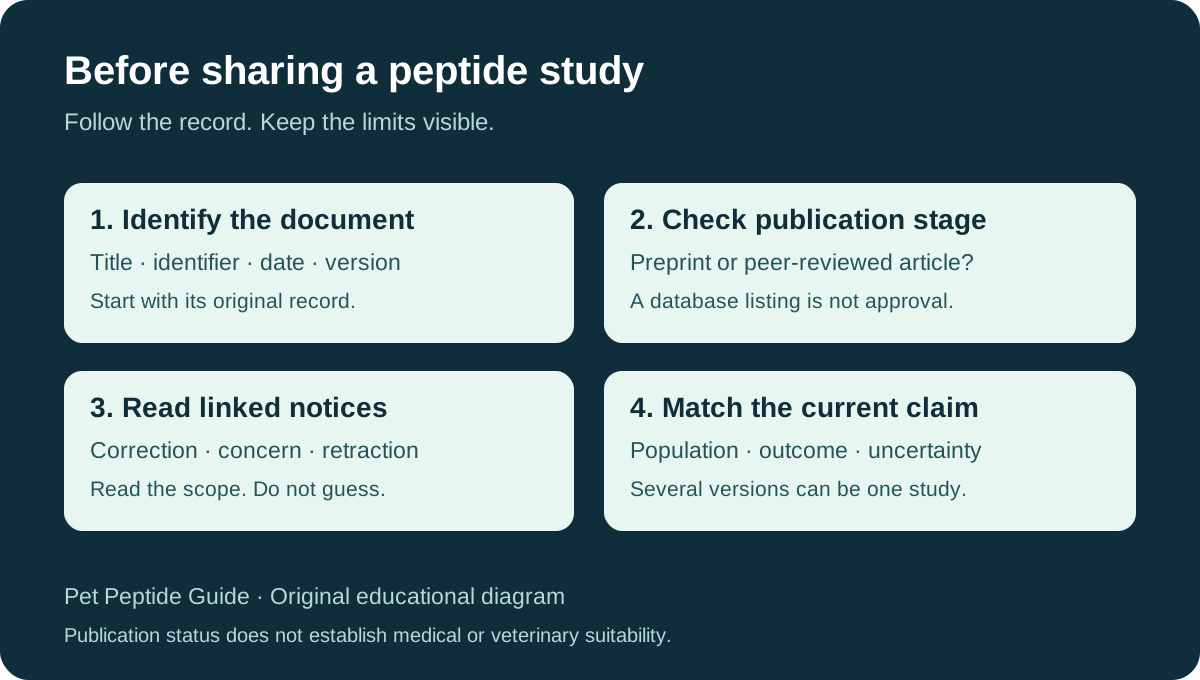
Before sharing a peptide study, check which version you are reading. A preprint, a journal article and a later correction may describe the same project but support different wording. Record the publication stage, open linked notices and compare the exact claim with the current source. A database listing is not product approval, and a newer date alone does not make evidence stronger.

Prepared by Pet Peptide Guide with AI assistance. Sources checked October 9, 2026. Not reviewed by a veterinarian or physician. This guide teaches publication-status checks, not treatment selection. All worked examples below are fictional and do not describe an actual peptide study.
Why a saved PDF can be an incomplete record
Imagine receiving an impressive graph in a message. The file may contain a genuine research result, yet omit the version history that changes its interpretation. Your first task is to identify the document, not decide whether the graph proves the headline. Copy its title, authors, identifier and date. Then locate the publisher or preprint-server record rather than relying only on a forwarded attachment.
This is especially useful when a peptide claim travels from a technical paper into a short social post. The post might remove the study population, describe an exploratory result as the main finding, or cite an early version after the authors revised their conclusion. The version check complements our study-to-claim reading framework; it does not replace reading the methods.
Separate preprints from accepted manuscripts
The National Library of Medicine describes a preprint as a public research draft that has not yet been certified by journal peer review. Authors may revise it, and results or conclusions may change. An accepted author manuscript has passed journal peer review even if it does not look like the publisher's formatted article. See the NIH Preprint Pilot explanation.
That same pilot makes eligible preprints discoverable in PMC and PubMed. Therefore, “I found it on PubMed” is not enough to establish that a particular record is peer reviewed. Read the record's publication-status panel and follow any link to a later version. A preprint is not automatically wrong, and a journal article is not automatically a dependable answer to every question.
For your notes, use a literal status label: preprint version 2, accepted manuscript, or journal article. Avoid replacing these with vague badges such as “scientifically proven.” If the stage cannot be established from the accessible record, write “publication stage not confirmed” and preserve that limit when sharing the claim.
Open the notice, not just the label
NLM links PubMed citations to corrections, retraction notices, expressions of concern and other associated records. Its linked-citation policy explains the distinctions. Corrections can involve text, tables or figures; the label alone does not tell you whether the point you want to cite has changed. An expression of concern flags an editorial concern, while a retraction notice identifies a withdrawn article. Read the notice's stated scope and reason.
Do not infer misconduct from a retraction label. NLM's indexing does not distinguish honest error from misconduct. Equally, do not dismiss a correction as cosmetic without opening it. A changed author affiliation and a changed outcome table have different consequences for a summary.
Practical rule: if a notice affects the result you planned to quote, revise the summary before using it. If you cannot resolve the notice's implications, do not present that result as settled evidence. Keep a link to the notice alongside the original citation so the next reader can inspect both.
Use status tools without turning them into seals of approval
Some publisher pages and PDFs include a Crossmark button. Crossref explains that it can expose status information, including corrections, retractions and updates supplied by participating publishers. This can help when a downloaded PDF is older than an online notice.
Crossref also states that the presence of Crossmark is not itself a guarantee. Treat the button as a route to information, not a certification that the research is correct or the product is safe. If a page lacks it, check the publisher record and associated citation notices directly; absence of a button is not evidence that a paper is invalid.
Record what you actually checked and when. “Publisher page and linked notice read on October 9” is more useful than “verified,” which can imply that you independently reproduced the research. A metadata check cannot establish whether an experiment was conducted as described.
A fictional version-history exercise
Consider an invented project, Study A, examining an unnamed peptide in a laboratory model. An early public draft describes a change in Marker X. A revised draft explains that the marker was exploratory. The later journal article retains that observation but reports an inconclusive primary outcome. A subsequent correction fixes a unit in a supplementary table. None of these documents describes a clinical benefit in household pets.
A poor summary would say, “Four papers prove this peptide works.” A better reading note would say, “One project has several publication records. The marker observation remains exploratory, the primary outcome is inconclusive, and the corrected supplementary unit must be used.” This example illustrates how to track a claim across records without counting document versions as independent replication.
The correction does not automatically erase every observation in the project. Nor does the presence of a journal publication transform an exploratory marker into proof of benefit. Our biomarker and surrogate-endpoint guide explains that separate question.
| Record | What to capture | What to avoid |
|---|---|---|
| Early draft | Version date and provisional claim | Calling it a confirmed clinical result |
| Journal article | Current outcomes and limitations | Counting it as a second independent experiment |
| Correction | Exact table, unit or statement affected | Ignoring it or assuming every result was reversed |
Keep publication status separate from approval and species
A peer-reviewed human study is still a human study. A corrected rodent paper is still a rodent paper. Neither becomes evidence of effectiveness in a dog or cat because its publication record is complete. Write the species and study setting next to the publication stage, rather than placing every citation in one undifferentiated pile.
FDA's animal-drug development and approval process separately evaluates safety, effectiveness and manufacturing quality for the intended use. Publication is not that decision. Our human approval and pet-use guide explains why the distinction matters.
This article makes no compound-specific safety finding. For safety claims, use the relevant current primary evidence and keep contrary observations visible. The adverse-event reading guide covers a different limitation: reports of suspected harm do not by themselves establish cause or the frequency of risk.
Make a reusable citation note
Use the following original template when saving a paper for discussion. It is deliberately short enough to attach to a bookmark or bring to an appointment.
- Identity: title, identifier, publisher or server and exact document link.
- Stage: preprint, accepted manuscript or journal article; version number and date where stated.
- Status: linked correction, concern or retraction notice, or “none found in the records checked.”
- Scope: exact substance, species, population, outcome and follow-up.
- Change: whether the statement you want to share changed across versions.
- Limit: inaccessible full text, unresolved notice or missing methods.
- Checked: date and sources opened, without claiming an independent scientific audit.
Keep the article and notice together. If a later version changes your saved summary, update the summary rather than silently replacing the link. For pet-care questions, bring this note to your veterinarian alongside the visit checklist. Human health decisions belong with a qualified clinician. A better citation trail improves a conversation; it does not justify self-experimentation.
Quick answers
Does a DOI prove a peptide treatment works?
No. An identifier helps you identify and locate a record. It does not establish that the claim matches the evidence, that the study applies to a pet, or that a product has regulatory approval.
Should I ignore every preprint?
No. Label its status accurately and check for revisions. Early findings can inform research questions without being a sufficient basis for treatment claims.
Is the newest document always the strongest study?
No. A recent record might be a correction, a commentary or another version of the same work. Determine its relationship to the original project before treating it as additional evidence.
What if I cannot open the correction?
State the access gap and avoid repeating an affected claim as settled. A visible notice is a reason to investigate, not a reason to guess what it says.
Sources and scope
This is an introductory guide or original comparison framework, not a systematic review or a product recommendation.
- NLM: NIH Preprint Pilot — Preprint definition, revisions and discoverability in PMC/PubMed.
- NLM: Errata, Retractions, and Other Linked Citations — Correction, concern and retraction links; reasons must not be inferred from labels.
- Crossref: Crossmark — Publisher-provided status updates and limitations of the badge.
- FDA: Animal Drug Development & Approval Process — Approval is a separate assessment of intended use, safety, effectiveness and manufacturing quality.
Source checked October 09, 2026. A general context source does not establish a named product’s benefit.