
Peptide Therapy for Dogs: Match the Diagnosis to the Evidence
Peptide therapy for dogs is not one treatment class. Match the diagnosis, exact product, canine population, clinical outcome and veterinary pathway.
Is peptide therapy an established treatment category for dogs? No. “Peptide therapy for dogs” is a marketing umbrella, not one diagnosis, product, or evidence class. A useful decision starts with the dog’s diagnosed condition, then matches one exact intervention, formulation, route, study population, clinical endpoint, and regulatory pathway. Product-specific evidence for veterinary insulin or a particular oral collagen preparation does not validate experimental BPC-157, TB-500, growth-hormone secretagogues, or an unnamed peptide blend.

Search results often begin with a molecule and work backward toward a problem. Veterinary reasoning goes the other direction. A dog with increased thirst, a dog limping after exercise, and a dog with chronic digestive signs do not share one “peptide therapy” question. They need different diagnoses, outcomes, alternatives, and monitoring. Even when two products contain amino-acid chains, their evidence and legal status may be unrelated.
This is an AI-assisted evidence map, not veterinary advice, a treatment ranking, or a systematic review. Primary papers and current FDA resources were checked October 11, 2026. The article provides no dose, administration instructions, reconstitution steps, seller, or recommendation to use an experimental compound.
Therapy is a complete claim, not an ingredient nickname
Calling something a therapy implies more than biological activity. It implies that a defined intervention is intended to improve a defined clinical problem in a defined patient group, with benefits and harms evaluated using outcomes that matter. Each part must be visible.
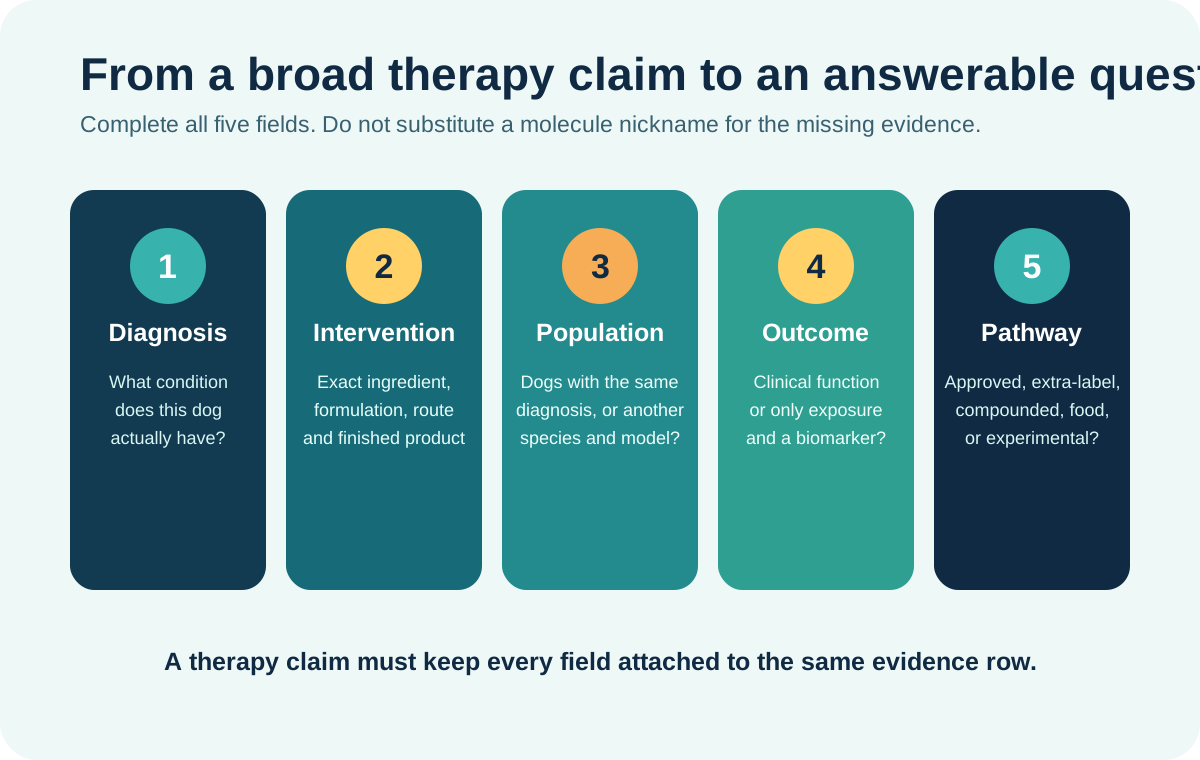
| Field | Question to answer | Why it changes the conclusion |
|---|---|---|
| Diagnosis | What condition has a veterinarian identified, and what else could explain the signs? | A wound model, osteoarthritis trial, and diabetes label answer different clinical questions. |
| Exact intervention | Which active ingredient, molecular form, finished formulation, route, and manufacturer or pharmacy are involved? | A nickname or ingredient family cannot establish that a retail or compounded product matches a study. |
| Comparable dogs | Were client-owned dogs with the same condition studied, or healthy laboratory dogs, another species, cells, or tissue? | Species alone is insufficient. The population and reason for enrollment determine relevance. |
| Meaningful outcome | Did the study measure clinical signs, function, quality of life, or only exposure, biomarkers, or laboratory changes? | Drug exposure can support development work without demonstrating that a dog feels or functions better. |
| Care pathway | Is this an approved animal drug, veterinarian-directed extra-label use, a patient-specific compound, a food or supplement-style product, or experimental material? | Labels, manufacturing review, prescribing rules, quality controls, and monitoring differ by pathway. |
If one field is missing, record it as “not established.” Do not fill the gap with a testimonial, an influencer’s protocol, a purity percentage, or results from a different molecule.
Start with the diagnosis and the outcome that matters
A phrase such as “healing,” “recovery,” or “wellness” is not a study endpoint. Translate it into something observable and diagnosis-specific. For diabetes, the question might concern glucose control and clinical signs under a veterinary monitoring plan. For osteoarthritis, relevant outcomes may include validated pain scores, force-plate measurements, daily activity, and adverse events. For a wound, the design would need a defined wound type, closure or complication outcomes, and follow-up.
This prevents an endpoint switch. A seller may cite a paper showing that a compound entered the bloodstream and then describe mobility, gut health, or tissue repair as if those outcomes were measured. They were not. Pharmacokinetics answers what happened to a studied preparation in the body under studied conditions. It does not by itself establish treatment benefit.
It also prevents a diagnosis switch. Hip dysplasia, osteoarthritis, cranial cruciate ligament injury, muscle strain, neurologic disease, paw pain, and unexplained lameness can overlap in what an owner observes. Evidence for one population cannot silently move into the others. The site’s dog arthritis guide shows how diagnosis and outcome measures change an evidence comparison.
Example one: veterinary insulin is a product-specific therapy
Insulin is a peptide hormone, but that fact alone is not the reason a product qualifies as therapy. FDA’s current Vetsulin label identifies a sterile porcine insulin zinc suspension approved under NADA 141-236 for reduction of hyperglycemia and associated clinical signs in dogs and cats with diabetes mellitus. The label specifies the finished formulation, species, disease, route, prescription status, precautions, adverse reactions, and monitoring context.
That is a complete, bounded claim about one product and one condition. It does not support “peptides improve dog health” as a class statement. It does not transfer to an insulin analogue with a different label, a compounded preparation, a growth-hormone secretagogue, or BPC-157. It also does not make the phrase “peptide injection” sufficient. The dog injection-pathway guide explains the separate approved, extra-label, compounded, and experimental lanes without teaching administration.
Example two: one collagen study does not rank every peptide
A 2024 PLOS ONE study offers a different kind of evidence. It evaluated one specific oral bioactive collagen peptide preparation over 12 weeks in dogs with naturally occurring osteoarthritis. Thirty-one dogs completed the double-blind, placebo-controlled study. The authors reported improvements in several force-plate kinetic measures and a quality-of-life component, while accelerometer-measured activity was unaffected.
This research is closer to a clinical canine outcome question than a healthy-dog exposure study. It still remains product- and design-specific. The finished preparation, oral route, diagnosed population, comparator, duration, measured outcomes, completion count, and disclosed funding or patent interests all belong with the result. It cannot establish that every hydrolyzed collagen powder, chew, blend, or serving has the same effect.
The paper also does not convert collagen peptides into evidence for unrelated research compounds. A positive result for one intervention cannot be used to rank BPC-157, TB-500, ipamorelin, CJC-1295, GHK-Cu, or a mixed vial. Readers evaluating a collagen product can use the collagen peptides for dogs buying guide to compare label identity, formulation, research match, and cost without assuming equivalence.
Example three: a dog exposure study is not canine therapy evidence
The accessible 2022 BPC157 paper included three male and three female research beagles. Investigators administered laboratory-prepared BPC157 intravenously and intramuscularly in pharmacokinetic experiments and measured plasma concentration, exposure, bioavailability, and elimination. The dogs were healthy research animals, not client-owned patients enrolled for arthritis, ligament injury, inflammatory bowel disease, wounds, or muscle recovery.
The paper is useful for the narrow questions it actually studied. It establishes that researchers measured the disposition of their preparation under those routes and conditions. It does not establish a clinical benefit, a finished veterinary product, a safe household-dog regimen, or a product match to an online vial.
That distinction is especially important because the paper’s authors discuss future drug development. Development intent is not approval, and a preclinical pharmacokinetic result is not a canine treatment trial. The canonical BPC-157 evidence guide separates this dog experiment from induced rodent outcome models and current regulatory context.
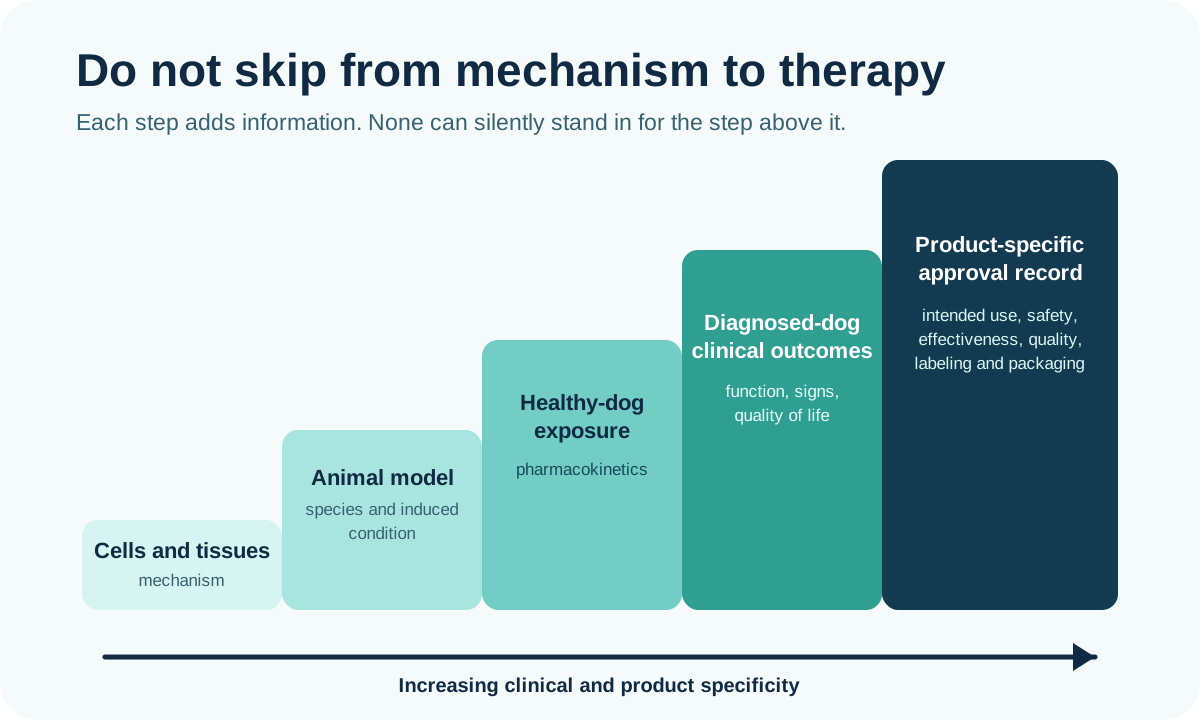
Use an endpoint ladder without skipping steps
| Study level | Useful question | Still missing for a dog therapy claim |
|---|---|---|
| Cells, tissues, or biochemical assays | Does a mechanism, binding interaction, or laboratory response occur under the tested conditions? | Whole-animal exposure, clinical benefit, safety, finished-product quality, and relevance to a diagnosed dog. |
| Rodent or other animal model | What happened in this species, induced model, preparation, route, and time frame? | Evidence in dogs with naturally occurring disease and a matching product. |
| Healthy-dog pharmacokinetics | How was the studied material absorbed, distributed, or eliminated under experimental conditions? | Improvement in pain, mobility, wound healing, gastrointestinal signs, or quality of life. |
| Diagnosed-dog clinical study | Did a defined intervention change meaningful outcomes versus a suitable comparison in relevant dogs? | Automatic equivalence to other products, routes, populations, durations, or uses. |
| Product-specific approval record | What safety, effectiveness, manufacturing, labeling, and packaging evidence was reviewed for the intended use? | Approval of another ingredient, compounded version, off-label use, or broad molecule class. |
FDA’s animal-drug development page explains that, in most cases, an animal drug must be approved before a sponsor can legally sell it and that premarket review is tied to intended use, safety, effectiveness, manufacturing, labeling, and packaging. Approval is therefore not a general reward for having any animal study. It is tied to the exact product and use submitted.
Compounding can meet a veterinary need without creating approval
FDA’s current animal-drug compounding overview says animal drugs compounded from bulk drug substances are not FDA-approved and have not undergone the agency’s product-specific review for safety, effectiveness, proper manufacturing, accurate labeling, and adequate packaging. The same page also recognizes that a bulk-substance preparation may be medically necessary when no medically appropriate approved, conditionally approved, indexed, or approved-source option can treat the animal under applicable circumstances.
Those statements belong together. “Compounded” is not an approval badge, but “unapproved” does not prove there is no legitimate patient-specific veterinary reason. The relevant questions are why the preparation is needed for this dog, what approved options were considered, what exact ingredient and formulation the pharmacy will produce, how quality and stability are addressed, and what monitoring follows.
A research-chemical listing is not the same as a veterinarian-issued compounded prescription. A purity claim does not establish sterility, endotoxin control, concentration, identity after preparation, stability during storage, or effectiveness for the diagnosis. This site does not link to research-chemical sellers.

A diagnosis-to-evidence worksheet for the veterinary visit
- Describe the observed change. Record when it began, what makes it better or worse, and any urgent signs. Do not name the treatment as the diagnosis.
- Confirm the clinical problem. Ask what diagnosis is most likely, what alternatives remain, and whether examination or testing should come first.
- Name the exact intervention. Capture the ingredient, molecular form, finished product, formulation, route, manufacturer or pharmacy, lot, and current label.
- Find the closest evidence row. Match species, health status, diagnosis, route, duration, comparator, and endpoint. Mark every mismatch.
- Classify the pathway. Separate approved labeled use, veterinarian-directed extra-label use, patient-specific compounding, food or supplement-style product, and experimental material.
- Agree on a measurable goal and stopping rule. Ask what improvement would count, when it will be reassessed, what adverse signs matter, and what would end or change the plan.
Open the free veterinary-visit checklist
The amount-to-volume calculator performs generic arithmetic only after a veterinarian supplies an amount and the actual pharmacy label supplies a concentration. It does not select a therapy, compound, route, dose, or diagnosis.
Frequently asked questions
What is peptide therapy for dogs?
There is no single clinical category with that name. The phrase may refer to an approved peptide-hormone drug, a collagen ingredient, a monoclonal-antibody biologic, a compounded preparation, or an experimental compound. Each needs its own diagnosis, product, evidence, and regulatory assessment.
What are the best peptides for dogs?
No universal ranking is supported. The useful comparison asks which exact intervention has evidence for this diagnosed condition in comparable dogs, using meaningful outcomes and a lawful monitored product pathway. See the dog evidence comparison for a category-level framework.
Does a study in beagle dogs prove a peptide is a therapy?
No. Species is only one field. The BPC157 beagle paper measured pharmacokinetics in six healthy research dogs. It did not test clinical benefit in dogs with a diagnosed condition.
Are collagen peptides a drug therapy?
Not as a class. One specific oral collagen peptide preparation has a small controlled canine osteoarthritis study with favorable and neutral outcomes. That paper does not establish every collagen product, serving, or claim, and it does not approve collagen as a veterinary drug class.
Does FDA approval of veterinary insulin validate other peptides?
No. Vetsulin’s approval is tied to its exact porcine insulin zinc suspension, canine and feline diabetes indication, label, route, manufacturing, and monitoring. It is not class evidence for unrelated compounds.
Can I buy an experimental peptide and ask a veterinarian to monitor it?
Monitoring does not convert an unverified research listing into an approved or suitable veterinary product. Ask the veterinarian to identify the lawful product pathway, exact finished preparation, supporting evidence, alternatives, quality controls, and monitoring before any purchase.
The bottom line
Peptide therapy for dogs is too broad to be a treatment conclusion. Begin with the diagnosis, not the molecule. Then require a matching intervention, comparable canine population, clinically meaningful endpoint, product-specific quality information, lawful pathway, and monitoring plan.
Veterinary insulin demonstrates what product-specific approval looks like. The collagen study demonstrates how a defined oral preparation can produce a bounded canine clinical result without validating a whole class. The BPC157 beagle study demonstrates why exposure is not the same as therapy. Keeping these examples separate turns a vague marketing phrase into questions a veterinarian can actually answer.
Sources and scope
This is an introductory guide or original comparison framework, not a systematic review or a product recommendation.
- FDA-approved label: Vetsulin (porcine insulin zinc suspension), NADA 141-236 — Product-specific identity, canine and feline diabetes indication, approved label, prescription status, safety record and monitoring context. The article does not reproduce dosing instructions.
- FDA: Animal Drug Development and Approval Process — Current product-specific review context for intended use, safety, effectiveness, manufacturing, labeling and packaging.
- Dobenecker et al. (2024): specific collagen peptides in canine osteoarthritis — Twelve-week double-blind, placebo-controlled study in dogs with naturally occurring osteoarthritis; favorable kinetic and quality-of-life findings, neutral accelerometry result and funding context retained.
- He et al. (2022): BPC157 pharmacokinetics in rats and dogs — Three male and three female healthy research beagles received laboratory-prepared BPC157 in intravenous and intramuscular pharmacokinetic experiments; no canine clinical benefit or finished-product conclusion.
- FDA: Animal Drug Compounding — Current approval and quality-review limits for animal drugs compounded from bulk substances, plus medically necessary veterinary context.
Source checked October 11, 2026. A general context source does not establish a named product’s benefit.