
Peptides for Dog Muscle Recovery: Size, Strength and Evidence
Do peptides improve dog muscle recovery? Compare rat BPC-157 research and canine supplement studies by preparation, function, recovery time and evidence limits.
Do peptides help dogs recover muscle strength? The studies reviewed here do not establish that BPC-157 or a general “peptide recovery” product restores strength in injured household dogs. Rat muscle-repair experiments, canine supplement trials and blood-marker studies answer different questions. Before accepting a recovery claim, check whether the exact preparation improved a relevant functional outcome against a comparator in dogs with the same problem.
This AI-assisted article has not been reviewed by a veterinarian. It is a focused evidence comparison, not a systematic review, diagnosis, rehabilitation plan or product recommendation. The BPC-157 source was available as an original publisher abstract; both canine supplement papers were accessible in full. No dose or administration instructions are supplied.
First define what “muscle recovery” means
An owner may mean getting up more easily, regaining use of a leg after surgery, returning to comfortable walks, or preventing further loss of muscle. Those are not automatically the same research question. Write down the change you have noticed and the activity you want the dog to regain, then ask your veterinarian which diagnosis and assessment fit it.
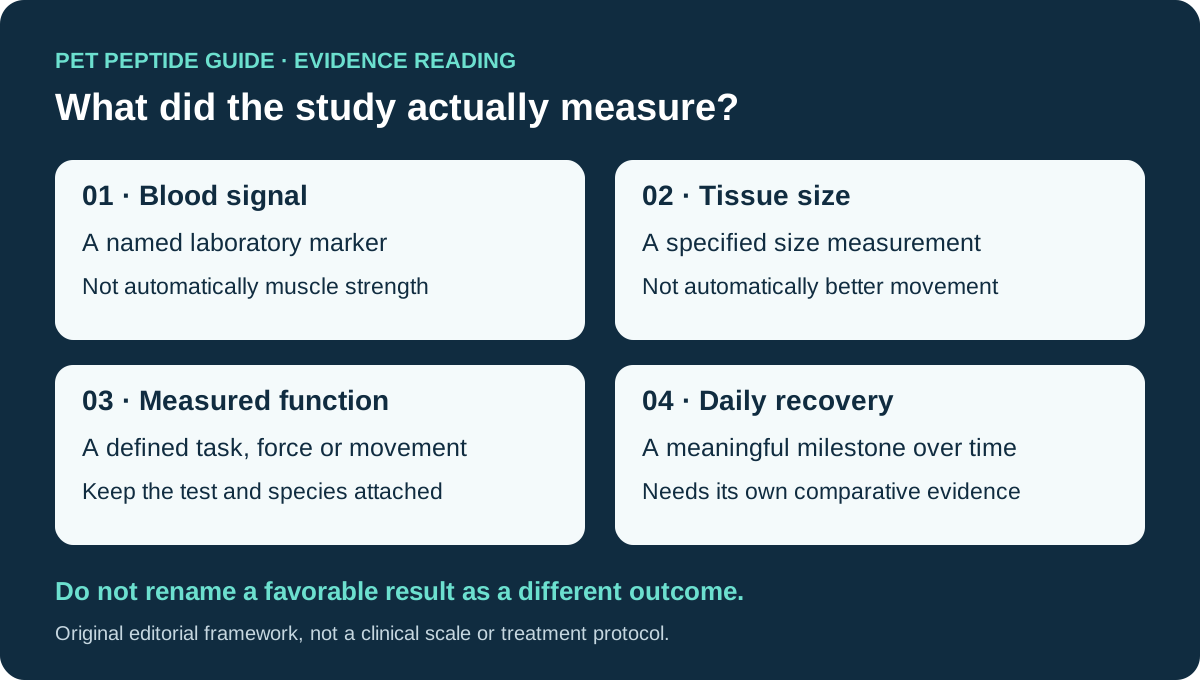
Keep three questions separate: what happened to the muscle, what the study measured, and what the dog can do. A change in a tissue image might matter scientifically without demonstrating a better everyday activity. Conversely, an activity score may be useful without proving that a particular tissue regenerated. Evidence should retain the name of its actual outcome.
This guide focuses on that outcome match. For a diagnosed cruciate problem, see the separate BPC-157 and canine cruciate-injury guide. For age-related context, use the senior-dog guide. Neither diagnosis nor age should be inferred from the word “recovery.”
What the BPC-157 rat muscle experiment reports
Staresinic and colleagues' 2006 original abstract describes BPC-157, a 15-amino-acid peptide, given intraperitoneally in rats after complete quadriceps transection. Over a 72-day observation period, the authors reported improvements in mechanical failure load, walking and motor measures, and tissue findings. This was not merely a blood-marker experiment: it included functional measurements, but in a surgically created rat injury.
That distinction matters. It would be inaccurate to dismiss the paper as having no function data, or to translate it into proof of recovery in dogs. We could not verify the full methods, group sizes, allocation safeguards or complete adverse-event reporting from the accessible abstract. A publisher PDF link returned the same abstract. The historical abstract's broad safety and development statements are not current veterinary labeling. See the canonical BPC-157 evidence guide for wider context.
A dog supplement trial is not a BPC-157 trial
White and colleagues' 2020 trial randomized 100 client-owned dogs undergoing tibial plateau leveling osteotomy to oral Fortetropin or cheese-powder placebo, with owners and investigators masked. Fortetropin was an egg-yolk-derived preparation, not isolated BPC-157. The study followed dogs for 12 weeks. Complete stance/muscle-measurement datasets covered 77 dogs; complete myostatin datasets covered 69.
The authors interpreted thigh-circumference findings as supporting reduced disuse atrophy, but ultrasound findings were not consistent with circumference. Both groups improved weight bearing; the between-group weight-bearing difference was not statistically significant (P = 0.10). Manufacturer MYOS RENS funded the study; the authors reported no funder role in design, analysis or publication decisions.
This is relevant canine research, not a reason to claim every muscle supplement works or that peptides accelerate return to activity. Its measurements do not support an unqualified “faster recovery” promise. The trial also cannot validate a different ingredient or retail blend. It is included as a comparison of evidence, not an endorsed purchase.
Why a second dog study can ask a different question
Nugent Britt and colleagues' 2021 study used randomized, double-blind, placebo-controlled crossover testing of single oral administrations of Fortetropin in healthy adult dogs. Twelve entered and ten completed. Serum myostatin was not significantly lower than placebo over 72 hours. One withdrawal followed vomiting the test agent; another followed discovery of a clotting disorder. No advance power calculation was performed. MYOS supplied study materials and laboratory-testing funding.
Healthy dogs, short observation and a blood endpoint differ from postoperative dogs followed for weeks. This study does not settle long-term recovery after injury. Equally, a postoperative finding cannot erase a negative short-term result. The correct comparison keeps population, exposure schedule and endpoint attached to each finding, rather than treating the papers as interchangeable votes for or against a product.
Use an outcome ledger, not a single “works” score
The following is an editorial reading worksheet, not a validated clinical instrument. Fill a row only when the source actually measures it. Leave unknown fields blank rather than supplying a plausible answer.
| Claim in front of you | Evidence to look for | Do not substitute |
|---|---|---|
| Changes a biological signal | The named marker, sample timing, comparator and uncertainty | A claim about strength merely because a laboratory value changed |
| Preserves muscle size | The actual size measurement and how consistently it was obtained | A favorable photograph or one selected measurement |
| Improves function | A specified task, force or movement measure, assessed comparably between groups | A tissue-staining result renamed as better mobility |
| Speeds recovery | A defined recovery milestone, time to reach it, follow-up and setbacks | An end-of-study difference that never measured recovery time |
A statistically significant change within a treated group is not the same test as a difference between treated and control groups. A nonsignificant comparison also does not prove equivalence. Ask for the effect estimate and its uncertainty, not just which side of a threshold a P value falls on. Our multiple-outcomes guide explains why selecting a favorable endpoint can distort the overall account.
A fictional recovery claim, checked line by line
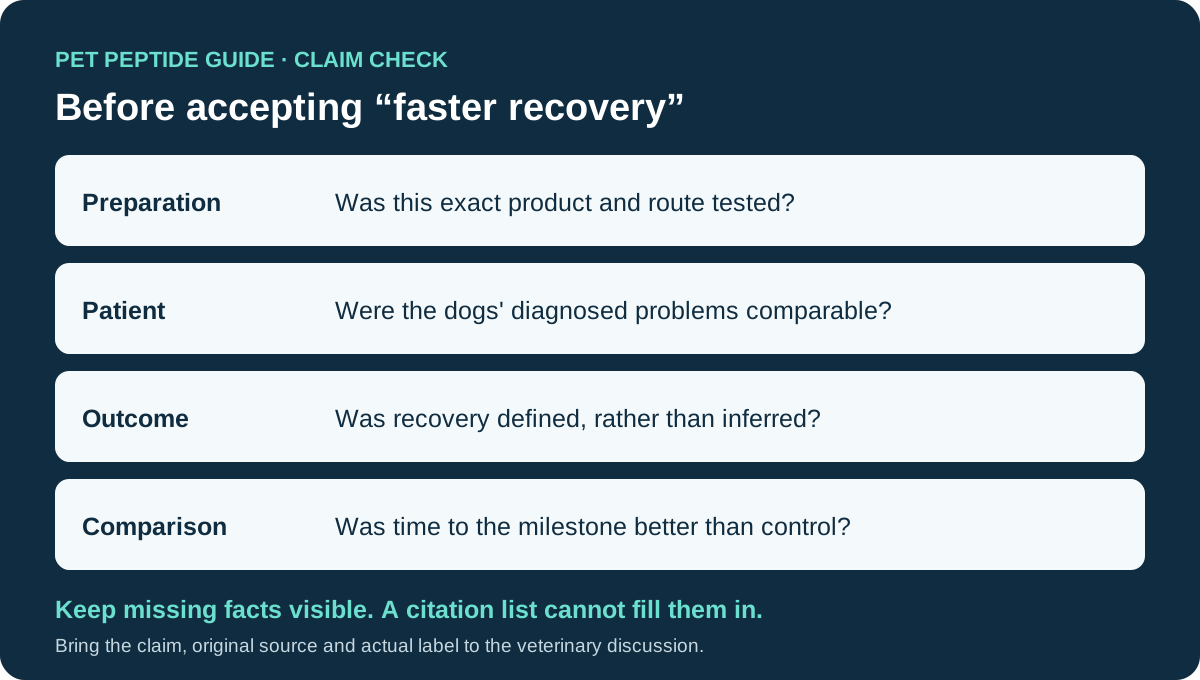
Fictional example: an advertisement says, “Muscle research proves this peptide blend gets dogs back to normal faster.” It links a rat injury paper and a canine nutrition study. There are at least four unresolved connections:
- Preparation: Did either paper test the advertised blend, not just a named ingredient or a different preparation?
- Patient: Did the animals have the same diagnosed problem as the intended dog?
- Endpoint: Was “back to normal” defined and measured, rather than inferred from size or a marker?
- Comparison: Was time to recovery better than the relevant control, with losses to follow-up and harms accounted for?
The useful response is a request for those missing connections, not a guessed dose or a choice based on the more impressive headline. Separate ingredient names in a blend need separate identification; evidence for one does not supply evidence for their combination.
Product status needs its own check
Under the current U.S. FDA animal-drug framework, approval concerns an intended use and includes manufacturing and labeling review. A research publication is not an approval notice. This article has not verified an approved BPC-157 product for canine muscle recovery; that is a scoped verification limit, not an exhaustive search of every jurisdiction.
FDA's compounding guidance distinguishes preparations made from approved finished drugs from those made using bulk substances. Bulk-compounded animal drugs are not FDA-approved. Veterinary access under a particular policy should not be relabeled as proof of efficacy or product approval. Bring the actual label and source to your veterinarian rather than using a research supplier's description as a substitute.
If your separate question is about oral collagen labels, use our collagen peptides for dogs buying guide. It is not a substitute for a muscle-recovery assessment and does not make collagen equivalent to BPC-157 or the egg-derived preparation discussed here. No affiliate purchase link or current-price comparison is offered on this page.
Five questions for the veterinary visit

- What diagnosis explains the loss of function, and is a muscle problem actually established?
- Which baseline observation and repeat assessment will describe progress meaningfully?
- Does the proposed product have evidence in comparable dogs with the same condition?
- What benefits, harms and unresolved uncertainties should be weighed against other options?
- What should prompt a recheck, and who determines when activity can change?
Bring the claim, original citation, product label and a short record of what changed. Use the printable evidence checklist to keep the discussion organized. Do not turn a research observation period into a home recovery schedule or change a prescribed rehabilitation plan based on this article.
Common questions
Does a bigger muscle necessarily mean better recovery?
Size, measured function and a return-to-activity milestone are different claims. Ask which was tested and whether the study's comparison supports the claim being made.
Can a study of a supplement validate a peptide injection?
No. Matching an intended goal does not match the ingredient, preparation, route or tested population. Keep each source attached to the product it actually studied.
Why not rank the best peptides for muscle recovery?
A ranking would imply comparable evidence for the same dog population and outcome. That comparison was not established by the sources reviewed here. The practical next step is a diagnosis-specific evidence discussion, not a universal winner.
Sources and scope
This is an introductory guide or original comparison framework, not a systematic review or a product recommendation.
- Staresinic et al. (2006): BPC-157 and transected rat quadriceps — Original abstract only; functional rat injury findings are not a canine recovery protocol. Full methods remain unverified.
- White et al. (2020): Fortetropin after canine TPLO — Original controlled canine nutrition study; conflicting size measures and no significant weight-bearing advantage constrain interpretation.
- Nugent Britt et al. (2021): Fortetropin and serum myostatin — Original short-term crossover study in healthy dogs, not a test of post-injury recovery.
- FDA: Animal Drug Development and Approval Process — Current U.S. product-specific approval framework, not confirmation of a named recovery product.
- FDA: Animal Drug Compounding — Current distinctions for approved-drug and bulk-substance compounding; access is not approval.
Source checked October 20, 2026. A general context source does not establish a named product’s benefit.