
Peptides for Dog Wound Healing: What Was Actually Tested?
Compare copper-peptide rat research, experimental canine pad wounds and clinical dog dressings. Separate tissue collagen, area reduction and recovery claims.
Do peptides help dog wounds heal? Some original research concerns peptide-copper preparations and experimental dog wounds, so “there is no dog wound research” is too broad. But those experiments do not establish that any product sold as a healing peptide is suitable for a dog’s current wound. Match the exact preparation, route, wound type and outcome before turning a paper into a treatment claim.

Sources checked October 17, 2026. This AI-assisted educational comparison has not been reviewed by a veterinarian and is not a systematic review or wound-care protocol. Two older experiments were assessed from their original abstracts; their complete methods and formulation details remain unverified here. No dose, injection technique, dressing recipe, product endorsement or home treatment schedule is supplied.
Start with the wound, not the ingredient
A paw-pad defect, a poorly perfused skin wound, an accidental injury and a surgical incision are not interchangeable research settings. A study’s title may say “wound healing,” but the specific injury determines what was actually tested. Write down the wound type before looking at the ingredient name.
The American Veterinary Medical Association’s pet first-aid guidance emphasizes that first aid does not replace veterinary care and advises calling a veterinarian or emergency hospital in an emergency. Do not delay assessment of a concerning wound while trying an online peptide claim. This article cannot determine depth, contamination, tissue viability or the care your dog needs.
A useful question is: “Does this study test this preparation in dogs with this kind of wound, alongside appropriate care, and measure the outcome we need?” If the evidence answers a different question, keep the mismatch visible rather than interpreting a plausible mechanism as a completed clinical trial.
One veterinary-journal paper is actually a rat study
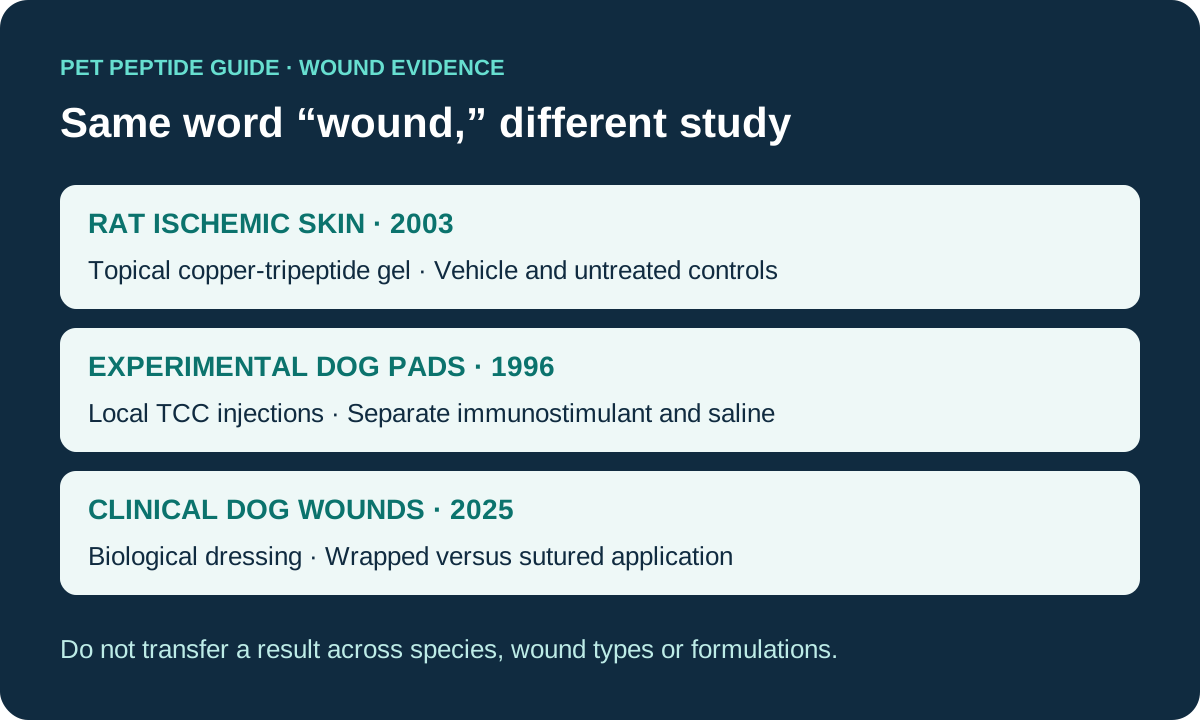
Canapp and colleagues’ 2003 paper in Veterinary Surgery studied 24 adult male Sprague-Dawley rats, not dogs. The original abstract identifies a topical glycyl-L-histidyl-L-lysine tripeptide-copper complex, named Iamin gel, compared with its vehicle and no treatment. Researchers created full-thickness wounds within a skin flap with impaired blood supply and followed wound area and selected tissue markers over 13 days. They reported faster area reduction and changes in inflammatory or tissue-remodeling markers under those conditions.
The journal name does not identify the study species. Nor does a veterinary affiliation make every paper a companion-animal clinical trial. The canonical GHK-Cu guide explains the copper-complex identity question; here the important additional check is the wound model and finished formulation.
There is also an experimental canine pad-wound study
Swaim and colleagues, 1996, studied 12 mature English Pointers. The abstract describes experimentally created full-thickness pad wounds, local injections of a tripeptide-copper complex (TCC) or a separate immunostimulant, and saline controls. Researchers assessed wound measurements and tissue collagen. They reported increased type-I collagen in TCC-treated wounds at selected observations; the best first-week healing-rate and hydroxyproline effects were attributed to the immunostimulant, not simply to every tested preparation.
This is genuine dog evidence, but the abstract’s abbreviation TCC does not fully establish the exact sequence, formulation quality or equivalence to a modern GHK-Cu product. We have not reviewed the complete paper and do not infer those missing details. A local experimental injection is also not evidence for an oral supplement, topical cosmetic or owner-administered preparation.
Compare the actual interventions, not just the word collagen
| Source and subjects | Preparation and route | Question measured | What cannot be assumed |
|---|---|---|---|
| Canapp 2003 24 rats; abstract reviewed | Topical copper-tripeptide gel versus vehicle or no treatment. | Area change and tissue markers in ischemic skin wounds. | A dog clinical outcome or equivalence to another cream. |
| Swaim 1996 12 dogs; abstract reviewed | Locally injected TCC, separate immunostimulant and saline comparison. | Experimental pad-wound measurements and collagen findings. | That all findings belong to TCC, or that TCC identifies any current finished product. |
| Khan et al., 2025 10 clinical canine cases; full text reviewed | Tilapia-skin biological dressing, sutured versus wrapped application. | Wound size, contraction and tissue findings through 14 days. | An isolated peptide effect, oral-collagen benefit or comparison with no biological dressing. |
The 2025 canine dressing study divided ten dogs into two groups of five. Both received fish-skin dressings and veterinary care; the comparison concerned application technique. The authors favored wrapping over suturing in their observations. The small sample, different clinical wounds and short follow-up limit what this can establish. The paper reports no specific funding or competing interests.
A collagen-containing dressing is a material placed at a wound, not a dose of isolated copper peptide and not a food. If your question is about a nutritional product, use the dog collagen buying and evidence guide. Do not borrow a dressing result as proof that a powder or chew closes skin wounds.
More collagen, a smaller wound and complete recovery are different outcomes
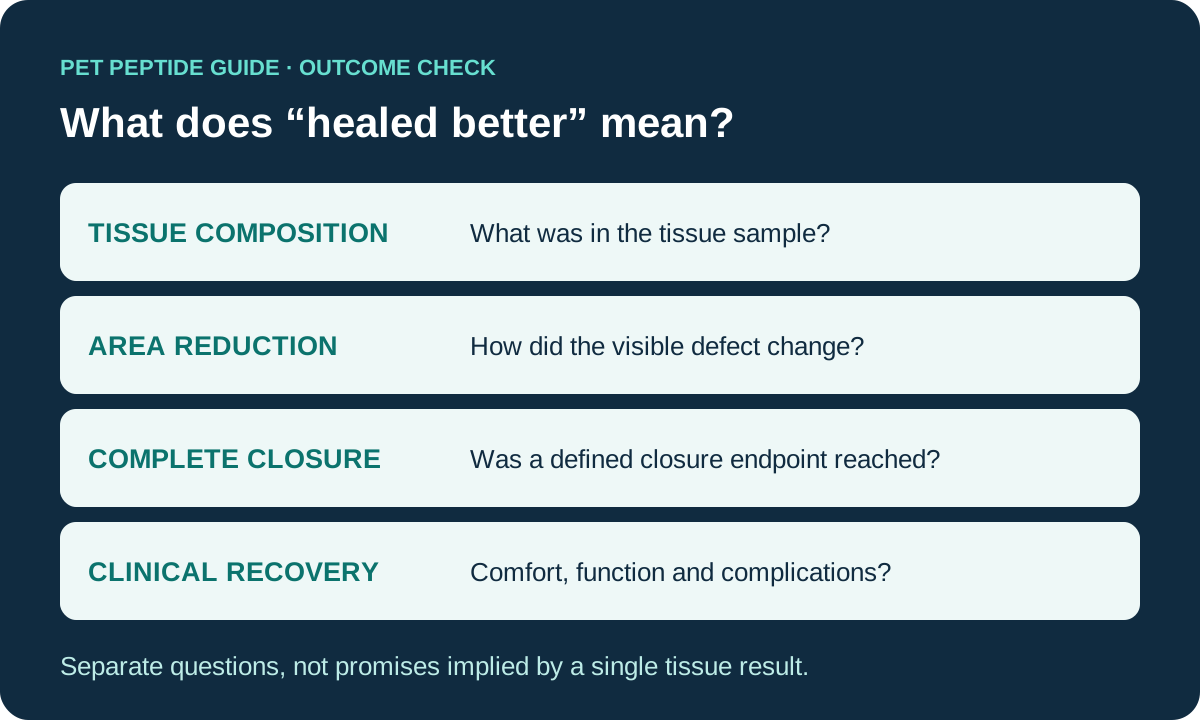
Separate the claim into fields. Tissue composition asks what is present in a sampled piece of tissue. Area reduction asks how the visible defect changes. Complete closure asks whether a defined closure endpoint was reached. Clinical recovery may also require comfort, useful function and follow-up for complications. A result in one field does not fill the others.
This matters particularly when a headline compresses several measurements into “healed faster.” Ask what success meant, when it was measured and whether the comparison was between groups or only a change within one group. A study can contain encouraging biology without establishing a reliable time-to-recovery estimate for household dogs.
Likewise, multiple wounds or tissue samples from one animal are not automatically independent animals. Before trusting a precise-looking percentage, look for the number of animals, the unit used in analysis, withdrawals, concurrent care and follow-up. Our sample-size guide explains that reading problem without assigning a treatment.
A fictional claim check: “collagen increased, so this closes wounds”
Fictional example: a product page cites the canine pad experiment, highlights a tissue-collagen finding and promises faster closure with its own topical product. To evaluate that claim, keep two sentences separate: “The paper reports a tissue finding in its experiment” and “This finished product improves clinical closure in comparable dogs.” The second sentence needs its own support.
- Identify the intervention: was it TCC, the separate immunostimulant or a combined treatment? Do not assign one arm’s result to another.
- Match route and formulation: local injection, topical gel, dressing and oral product are different interventions.
- Name the endpoint: tissue collagen is not automatically complete closure, comfort or normal paw function.
- Keep the care context: account for the wound model, comparison treatment and other veterinary care.
- Mark the unknown: if the full methods or finished-product match are missing, do not replace them with a numerical evidence score.
This exercise does not prove that a proposed product cannot work. It shows what the cited evidence does and does not establish. A testimonial or before-and-after photograph cannot supply a missing controlled comparison, even when the owner’s experience is sincere.
Research status and current product status are separate checks
FDA’s current animal-drug approval overview, checked October 17, 2026, describes review of safety and effectiveness for an intended use, manufacture, labeling and packaging. Publication of a wound experiment is not that review. Neither the word peptide nor an ingredient’s presence in a veterinary journal establishes approval for a particular canine wound product.
The FDA animal-compounding page explains that drugs compounded from bulk substances are not FDA-approved and have not undergone its approval review. It also recognizes medically necessary circumstances under its guidance. Ask the responsible veterinarian and pharmacy about the exact preparation and pathway. This article verifies no approved product for the uses discussed and is not an exhaustive approval-database audit.
It also establishes no wound indication for BPC-157, TB-500 or a blend by association with a copper-complex paper. Use the separate BPC-157 and TB-500 identity guides rather than treating peptide names as substitutes.
Bring a precise question to your veterinarian

- What kind of wound is this, and what factors may be delaying recovery?
- Does the cited study involve that wound type in comparable dogs?
- What is the exact preparation, and does the original source identify the same ingredients and route?
- Which outcome matters most, and how will we judge progress?
- What other care, monitoring and follow-up does this dog need?
- Which changes should prompt contact before the next planned review?
Bring the original citation and complete proposed label, including the base and other ingredients. Keep your dog’s records private on your own device or paper. Do not experiment with a research vial or copy the methods of a wound experiment.
Open the veterinary-visit checklist
Quick answers
Was the 2003 Veterinary Surgery copper-peptide study done in dogs?
No. Its original abstract identifies rats. A journal title and author affiliation do not establish the subjects.
Does that mean no copper-complex wound study involved dogs?
No. The 1996 pad-wound experiment did involve dogs. Its model, route and incomplete formulation information still limit transfer to a current product.
Does oral collagen have the same evidence as a biological dressing?
No. A wound dressing, a topical preparation, an injection and an oral product need their own evidence. Sharing a broad ingredient category does not make them equivalent.
What would strengthen a treatment claim?
A clearly characterized finished product tested in comparable clinical canine wounds, against appropriate care, with predefined meaningful outcomes and adequate harms and follow-up reporting. New evidence would still require critical review.
Sources and scope
This is an introductory guide or original comparison framework, not a systematic review or a product recommendation.
- Canapp et al. (2003): Topical tripeptide-copper complex in ischemic open wounds — Original abstract: 24 rats, topical glycyl-histidyl-lysine copper gel, vehicle and untreated controls; not dogs despite the veterinary journal. Full methods not reviewed.
- Swaim et al. (1996): Locally injected medications and canine pad wounds — Original abstract: 12 English Pointers, experimental pad wounds, local TCC/immunostimulant versus saline, wound and collagen outcomes; exact TCC formulation equivalence unresolved.
- Khan et al. (2025): Nile tilapia skin as biological dressing in dogs — Publisher full text: ten clinical dogs, sutured versus wrapped dressing and short follow-up; not isolated peptide or oral collagen research.
- AVMA (2025): Pet First Aid — Official veterinary-care and emergency-contact context only; no first-aid or wound-treatment procedure reproduced.
- FDA: Animal Drug Development and Approval Process — Current intended-use, safety/effectiveness and product-quality review framework, separate from research publication.
- FDA: Animal Drug Compounding — Bulk-compounded drugs not FDA-approved; medically necessary guidance context preserved without seller or individual suitability conclusions.
Source checked October 17, 2026. A general context source does not establish a named product’s benefit.