
Thymosin Alpha-1 for Cats: Which Thymosin Did Studies Test?
Was thymosin alpha-1 studied in cats? Separate the exact 28-amino-acid peptide from thymosin fraction 5 and older feline records.
Has thymosin alpha-1 been studied as a treatment in cats? The feline records retrieved for this review did not administer the exact 28-amino-acid peptide thymosin alpha-1 to cats with a clinical disease outcome. One older cat paper is indexed only as “thymosin,” another explicitly used thymosin fraction 5, a mixture of many peptides, and a review of fading syndromes discussed limited puppy work while proposing that kitten research was still needed. Those records cannot establish thymosin alpha-1 treatment, safety, or effectiveness in cats.
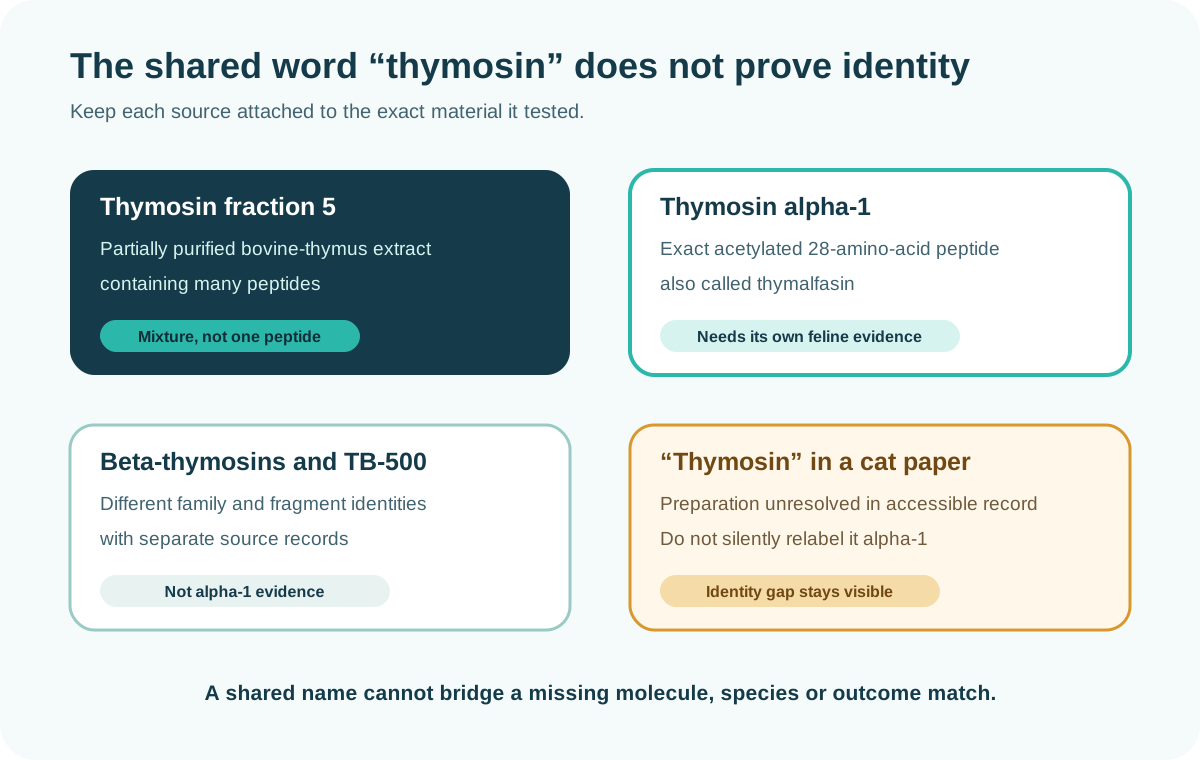
The shared name is not the same intervention
Thymosin alpha-1, thymosin fraction 5, thymosin beta-4, TB-500 and a paper indexed only as thymosin have different identities. Keep the exact material attached to the species, route and outcome.
Start with the exact identity
Thymosin alpha-1 is also called thymalfasin. The original isolation paper describes it as one component separated from thymosin fraction 5, a partially purified calf-thymus preparation. Later chemical descriptions identify thymosin alpha-1 as an N-terminally acetylated peptide of 28 amino acids. FDA's substance record maps thymalfasin, thymosin alpha-1 and Zadaxin as names for the same ingredient identity, while warning that a substance identifier does not mean a product has been reviewed or approved.
Thymosin fraction 5 is different. A primary laboratory paper describes it as a partially purified bovine-thymus extract containing roughly 40 to 60 peptides. A result produced by that mixture cannot be assigned to thymosin alpha-1 alone. It also cannot be assigned to thymosin beta-4, thymosin beta-10 or the acetylated seven-residue material commonly called TB-500.
| Name in a source or listing | What it identifies | What remains unresolved |
|---|---|---|
| Thymosin alpha-1 or thymalfasin | An exact acetylated 28-amino-acid peptide originally isolated from thymosin fraction 5 and now produced synthetically for human research and use in some countries. | Whether an exact preparation was administered to cats with a comparable diagnosis and measured clinical outcome. |
| Thymosin fraction 5 | A partially purified bovine-thymus extract containing many peptides. | Which component caused an observed effect, and whether an isolated component would reproduce it. |
| Thymosin beta-4 or TB-500 | A different thymosin family and, for TB-500, a specifically discussed acetylated fragment identity. | Nothing in a thymosin alpha-1 source establishes equivalence to these materials. |
| “Thymosin” without a resolved preparation | An index or article term that may refer to a historical preparation or another thymosin material. | Exact sequence, purity, formulation, source and comparability to thymosin alpha-1. |
What did the retrieved cat records actually test?
The cat-specific search did find older thymosin records, but their intervention identity and outcomes do not answer the modern product question. Two records are available through bibliographic indexing without an accessible abstract or full methods in the sources reviewed here. That limit belongs in the conclusion rather than being filled with assumptions.
| Record | Species and intervention | Outcome or purpose | Why it is not feline thymosin alpha-1 treatment evidence |
|---|---|---|---|
| 1984 blood-pressure paper | Male and female cats received an intravenous material indexed as thymosin. | Arterial blood pressure was the indexed outcome. | The accessible record does not resolve the preparation as exact thymosin alpha-1, expose the design or report a companion-animal disease outcome. |
| 1993 cortex paper | Male cats received thymosin fraction 5 in an experimental somatosensory-cortex setting. | Neuronal electrical activity and membrane-potential measures were indexed. | The intervention was a multi-peptide extract, the setting was experimental neurophysiology, and the record does not test immune disease or clinical recovery. |
| 1987 fading-syndrome review | The article discussed puppies and kittens, but the limited treatment reports it described concerned immunodeficient dwarf puppies given thymosin fraction 5 or bovine growth hormone. | It proposed a possible thymus-dysfunction hypothesis and called for more basic and clinical research. | It did not report a thymosin alpha-1 kitten trial. Mentioning that thymosin alpha-1 was commercially available did not turn the puppy reports into feline evidence. |
| Current feline disease guidance | FIP and FeLV/FIV guidance evaluates disease-specific diagnosis, antivirals, supportive care and monitoring. | Clinical response, survival, viral disease management and patient-specific outcomes. | Guidance is not a thymosin alpha-1 trial, and an immune-support label cannot replace the diagnosis or evidence for the disease being treated. |
The 1984 paper establishes that a material called thymosin was administered intravenously to cats in a blood-pressure experiment. It does not establish that the material was isolated thymosin alpha-1. The source record is only two journal pages and supplies no accessible abstract in the retrieval path used for this review. Without the full article, exact preparation, sample size, comparator, measurements and results remain unresolved.
The 1993 paper is more specific about the intervention: thymosin fraction 5. Its title and indexing describe electrical activity in the cat somatosensory cortex, with microelectrode and membrane-potential terms. It is not a study of naturally occurring infection, immune deficiency, cancer or chronic inflammatory disease in household cats. Because fraction 5 is a mixture, the record cannot be relabeled as an experiment with isolated thymosin alpha-1.
The 1987 fading-syndrome article is often vulnerable to a second kind of overreach. Its abstract says that limited clinical trials in one form of immunodeficient dwarfism involved puppies and thymosin fraction 5 or bovine growth hormone. It then asks whether thymus dysfunction could contribute to other fading syndromes in puppies and kittens and says more research is needed. The article lists thymosin alpha-1 among available thymus hormones. That list is not a report that kittens received it.
Why feline viral-disease claims need their own evidence
Searches for thymosin alpha-1 for cats commonly attach the peptide to broad phrases such as immune support, FIP, FeLV or FIV. Those are separate diseases with different diagnostic, antiviral, preventive and monitoring questions. A claim must identify the disease and the outcome rather than treating all immune activity as beneficial.
The 2026 ABCD FIP treatment update focuses on antiviral medicines, particularly nucleoside analogues, and disease-specific monitoring. It does not provide a thymosin alpha-1 cat trial. The 2020 AAFP feline retrovirus guidelines state that treatment data are sparse, especially for antiretroviral and immunomodulatory drugs, and emphasize preventive care plus prompt identification and treatment of illness. Those sources do not prove that thymosin alpha-1 could never be studied. They show why a general immune mechanism cannot substitute for evidence in cats with the exact diagnosis.
Immune outcomes can also point in different directions. A study might measure lymphocyte counts, cytokines, antibody response, viral load, fever, appetite, survival or adverse events. Improving one laboratory marker does not automatically improve comfort or recovery. Stimulating, suppressing or shifting an immune response may have different consequences depending on the disease and timing.
What exact human evidence can and cannot add
The canonical thymosin alpha-1 guide reviews an exact human randomized trial. That trial is useful for understanding how a plausible immune mechanism can be tested against a defined clinical outcome. It is not feline evidence. Human disease, background care, formulation, route, duration and adverse-event collection cannot be copied into a cat conclusion.
FDA's current human-compounding risk page says that compounded drugs containing thymosin alpha-1 may present immunogenicity and peptide-characterization concerns for certain routes and that the available safety information is inadequate for the agency to understand the extent of potential issues. That statement concerns human compounding review. It is not a feline adverse-event rate, but it does show why a seller's purity or “immune support” claim cannot fill missing product-quality and safety evidence.
For animals, FDA explains that drugs compounded from bulk drug substances are not FDA-approved and have not undergone product-specific review for safety, effectiveness, manufacturing, labeling or packaging. Compounding can have a medically necessary role under veterinary oversight, but that pathway does not create a cat indication or make every product with the same ingredient name equivalent.
A practical source check for cat owners
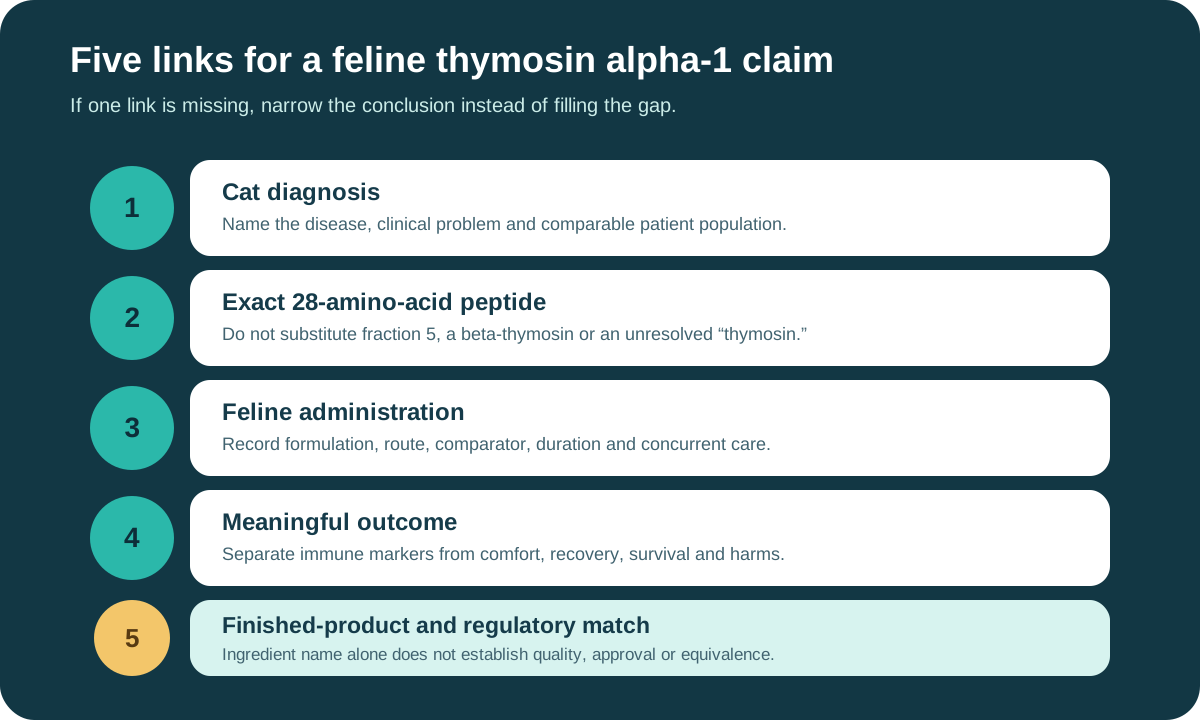
| Field | Question | Why it changes the conclusion |
|---|---|---|
| Diagnosis | What disease or clinical problem is actually being evaluated? | FIP, FeLV, FIV, cancer, fading syndrome and nonspecific illness are not interchangeable. |
| Exact intervention | Was it isolated thymosin alpha-1, thymosin fraction 5, another thymosin, a blend or an unresolved preparation? | A mixture cannot prove the effect of one component. |
| Species and population | Were cats enrolled, and were they healthy research cats or patients with the same diagnosis? | A human trial, puppy report or experimental cat physiology study answers a different question. |
| Outcome and time | Was the result a laboratory marker, blood pressure, neuronal signal, clinical response, survival, comfort or adverse event? | A positive marker does not automatically establish patient benefit. |
| Finished product | Does the proposed label match the study material, formulation, route, quality controls and regulatory context? | An ingredient name alone does not establish product equivalence. |
Questions to take to the veterinarian
- What diagnosis are we trying to address? Ask which examination, laboratory or imaging findings support it and which other causes remain possible.
- What exact material is proposed? Confirm whether the label identifies thymosin alpha-1 or thymalfasin, a mixture, a salt form or a multi-ingredient compounded product.
- Where is the matched feline study? Request the original source and check that cats with the same condition received the same intervention and route.
- Which outcome should improve? Define a meaningful clinical measure and a reassessment point instead of relying on “immune support.”
- What safety information exists for cats? Ask about formulation, route, duration, immunogenicity, interactions, monitoring and what would require stopping or urgent contact.
- What established options come first? Compare the proposed product with diagnosis-specific approved, guideline-supported or otherwise better-characterized care.
- What is the product's regulatory status? Distinguish an approved product, extralabel use of an approved drug, patient-specific compounding and a research-chemical listing.
Open the free veterinary-visit checklist
The cat peptide safety guide explains why exact formulation, duration and adverse-event collection matter. The feline product-class guide separates approved cat drugs from experimental claims. The TB-500 for cats guide covers a different thymosin family and shows why endogenous detection is not treatment evidence. The amount-to-volume calculator performs arithmetic only after a veterinarian supplies an amount and the pharmacy label supplies the actual concentration. It does not choose a peptide, dose, route or treatment.
Frequently asked questions
Is thymosin fraction 5 the same as thymosin alpha-1?
No. Fraction 5 is a partially purified thymus extract containing many peptides. Thymosin alpha-1 is one exact 28-amino-acid peptide originally isolated from that mixture.
Did the older cat blood-pressure paper prove thymosin alpha-1 works in cats?
No. The accessible bibliographic record identifies intravenous thymosin and a blood-pressure outcome but does not resolve the preparation as exact thymosin alpha-1 or provide a feline clinical disease result.
Did kittens receive thymosin alpha-1 in the fading-syndrome report?
The accessible abstract describes limited treatment reports in puppies involving thymosin fraction 5 or bovine growth hormone. It proposes further research in puppies and kittens and lists thymosin alpha-1 as an available hormone. It does not report a kitten thymosin alpha-1 trial.
Is thymosin alpha-1 the same as thymosin beta-4 or TB-500?
No. They are different molecular identities. A result for one cannot be assigned to another because the names share the word thymosin.
Does an immune mechanism prove benefit for FIP, FeLV or FIV?
No. Each disease requires its own feline population, exact intervention, comparator, clinically meaningful outcomes and safety monitoring. A mechanism or laboratory marker cannot substitute for that evidence.
Does this article recommend thymosin alpha-1 for a cat?
No. It explains the identity and source gaps so a claim can be checked without turning an older mixture study, puppy report or human trial into feline treatment evidence.
The bottom line
The retrieved cat records do not establish thymosin alpha-1 as a feline treatment. One older physiology paper leaves the thymosin preparation unresolved, another used the multi-peptide mixture thymosin fraction 5, and a fading-syndrome review discussed puppy reports while calling for further kitten research. Exact thymosin alpha-1 human evidence and compounding reviews answer different questions. For a cat claim, keep the diagnosis, exact 28-amino-acid peptide, feline population, route, meaningful outcome and finished-product status connected.
Sources and scope
This is an introductory guide or original comparison framework, not a systematic review or a product recommendation.
- Goldstein et al. (1979): isolation and characterization of thymosin alpha-1 — Primary identity paper. Establishes exact thymosin alpha-1 as a component isolated from thymosin fraction 5; it does not provide feline clinical evidence.
- Kemileva et al. (1984): thymosin and arterial blood pressure in cats — Primary bibliographic record for intravenous thymosin in male and female cats with a blood-pressure outcome. No abstract or full methods were retrieved, so exact preparation, design and results remain unresolved.
- Pravdivtsev et al. (1993): thymosin fraction 5 and cat cortical electrical activity — Primary Russian-language bibliographic record. Explicitly identifies thymosin fraction 5 and an experimental somatosensory-cortex neurophysiology setting, not isolated alpha-1 or a feline immune-disease outcome.
- Gengozian and Good (1987): thymus dysfunction and fading syndromes — Review and hypothesis paper. Limited treatment reports in the abstract concern puppies given thymosin fraction 5 or bovine growth hormone; kitten and exact alpha-1 research were proposed, not demonstrated.
- Thymosin fraction 5 composition study — Primary cell-study abstract describes thymosin fraction 5 as a partially purified bovine-thymus extract containing 40 to 60 peptides. Used for identity, not pet efficacy.
- NLM MeSH: thymalfasin identity and entry terms — Authoritative identity vocabulary connecting thymalfasin and thymosin alpha-1. A vocabulary record is not regulatory approval or clinical evidence.
- FDA GSRS: thymalfasin substance record — Current official substance record and synonyms. FDA states that UNII availability does not imply regulatory review or approval.
- Tasker et al. (2026): feline infectious peritonitis treatment update — Current ABCD guideline update used for disease-specific antiviral and monitoring context. It is not a thymosin alpha-1 cat trial.
- 2020 AAFP feline retrovirus testing and management guidelines — Authoritative feline FeLV/FIV context. Notes limited treatment data, especially for antiretroviral and immunomodulatory drugs; guidance, not alpha-1 efficacy evidence.
- FDA: bulk substances that may present significant compounding safety risks — Current human-compounding context for thymosin alpha-1 immunogenicity, peptide-characterization and inadequate safety information. It does not supply a feline event rate.
- FDA: Animal drug compounding — Current official context: animal drugs compounded from bulk substances are not FDA-approved and lack product-specific approval review and post-market controls.
- Yu et al. (2025): TESTS thymosin alpha-1 human sepsis trial — Exact-compound randomized human clinical comparator already covered by the canonical guide. Human population and outcomes cannot establish a feline indication.
Source checked October 29, 2026. A general context source does not establish a named product’s benefit.