
Thymosin Beta-4 for Dogs: Natural Presence vs Treatment Evidence
Compare thymosin beta-4 detection in dog saliva with mouse eye-drop research. Learn why natural presence, exact preparation and canine benefit are separate questions.
Does finding thymosin beta-4 in dogs mean giving it helps them heal? No. Detecting a naturally occurring peptide answers a different question from testing a treatment. Original research has identified thymosin beta-4 in dog saliva, while a separate eye-drop experiment tested a thymosin beta-4 preparation in mice. Neither finding, alone or combined, establishes a treatment benefit for a dog with an eye problem, skin wound or tendon injury.

Sources checked October 18, 2026. This AI-assisted article has not been reviewed by a veterinarian. It is a focused comparison, not a systematic review, treatment recommendation or product ranking. The saliva, canine tear-method and fragment-identification papers were assessed from their original abstracts; full methods remain unverified here. The mouse study's publisher methods, results and disclosures were accessible.
First separate the peptide from the claim
Owners searching for “thymosin beta 4 for dogs” may be investigating faster recovery or better eye comfort. Those are understandable goals, but the source needs to measure the specific result being promised. A paper can mention the right species without administering the compound, or administer the compound without studying dogs.
The full-length thymosin beta-4 discussed in the mouse paper is a 43-amino-acid peptide. Keep that separate from the shorter material identified in a 2012 analytical study of TB-500: Ac-LKKTETQ, the N-terminally acetylated fragment corresponding to residues 17–23. Esposito and colleagues identified that material using chromatography and mass spectrometry. They did not establish a canine healing outcome.
Our canonical TB-500 identity guide handles the detailed fragment-versus-parent comparison. This article addresses the next question: even when a molecule is correctly named, what kind of dog evidence does the cited paper actually contain?
What the dog saliva paper actually did
De Sousa-Pereira and colleagues' 2013 paper combined sequence comparisons with laboratory analysis of mammalian saliva. The original abstract reports collection of whole saliva, isolation of salivary peptides and LC-MS/MS analysis. It reports identification of thymosin beta-4 in dog saliva, among other species.
That is evidence of natural presence, not a trial in which dogs received a finished peptide preparation. There is no administered treatment route or therapeutic formulation to copy from this analysis. The abstract does not provide a dog treatment-benefit estimate or a clinically established replacement target. We have not verified the complete sampling methods or canine sample count from the full paper.
The important distinction is not whether the finding is interesting. It is which sentence it supports. “Detected in a dog sample” is a defensible description of this result. “Therefore adding more repairs an injured dog” adds a new intervention and a new outcome that this finding does not test.
What the eye-drop experiment tested instead
Kim and colleagues' 2018 study tested RGN-259, a thymosin beta-4 ophthalmic preparation, in NOD.B10.H2b mice with experimentally induced dry eye. It compared topical eye drops with vehicle and other preparations after removal of the inducing stress. The reported groups contained four or five mice; assessments involved blinded observers.
Researchers reported improvements in tear production, corneal-surface measurements and selected tissue findings under those conditions. Follow-up treatment assessment was ten days. Several authors disclosed company employment, consultancy, stock or stock-option relationships. The article provides research rationale, not evidence that an injectable fragment improves a dog's vision or repairs a skin wound.
Our interpretation: a useful translation would need to match both the preparation and the clinical problem. A topical ocular experiment cannot silently become evidence for another route, another tissue or another species. Nor should a comparison within this short mouse model be turned into a ranking of treatments for veterinary patients.
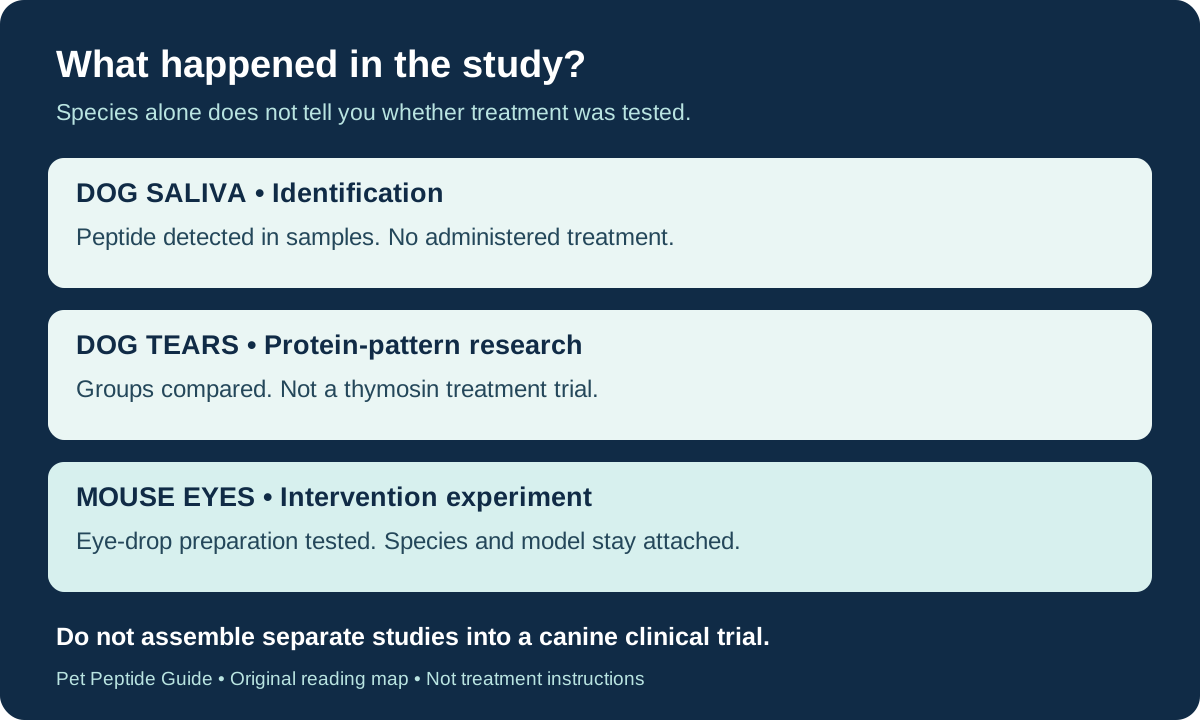
Dog eye research is not automatically a dog peptide trial
A separate Graham and colleagues canine tear study, published online in 2020 and in a 2021 issue, illustrates this distinction. Its abstract describes tear-protein characterization involving 19 dogs and 25 eyes; relative-expression analysis involved 15 dogs and 17 eyes. Dogs with different glaucoma states and healthy controls were compared. This was protein-pattern research, not administration of thymosin beta-4 as a treatment.
The authors called for further validation of candidate biomarkers. We could not retrieve the full protein tables from the original paper in this review, so we do not assign a thymosin-specific tear result from a secondary summary. The paper is included to show the study-design distinction, not as evidence that thymosin beta-4 treats glaucoma. Also, multiple eyes from a dog are not automatically independent patients; see our sample-size guide.
| Source question | What the researcher does | What is still needed for a treatment claim |
|---|---|---|
| Is the peptide present? | Identifies material in a biological sample. | A defined intervention, comparator and relevant clinical outcome. |
| Do protein patterns differ? | Compares samples across groups. | Validation and evidence that changing a target changes the intended outcome. |
| Does a preparation affect a model? | Administers a specified preparation in that model. | Evidence supporting transfer to the proposed patient, route and condition. |
These are complementary research questions, not interchangeable levels of a product endorsement. For the broader distinction between measured signals and patient benefit, use the biomarker and surrogate-endpoint guide.
A worked check of a “natural healing peptide” claim
Fictional example: an advertisement says, “Dogs naturally make thymosin beta-4, and eye research shows repair, so our TB-500 product restores damaged tissues.” No real merchant is being quoted. The claim makes three separate jumps:
- Presence to supplementation: detecting a substance does not show that a particular dog has too little of it or that adding it changes the problem.
- Study preparation to advertised material: a full-length ophthalmic preparation and an acetylated fragment are not automatically equivalent.
- Model to patient: a result from one species and tissue cannot establish every proposed recovery outcome.
The useful response is not a competing blanket claim that the molecule can never help. Ask for the exact source that closes each gap. If the seller supplies another identity test, it still answers an identity question. If the next paper is another model, keep that model named. A long bibliography does not fix a mismatch between its studies and the advertised result.
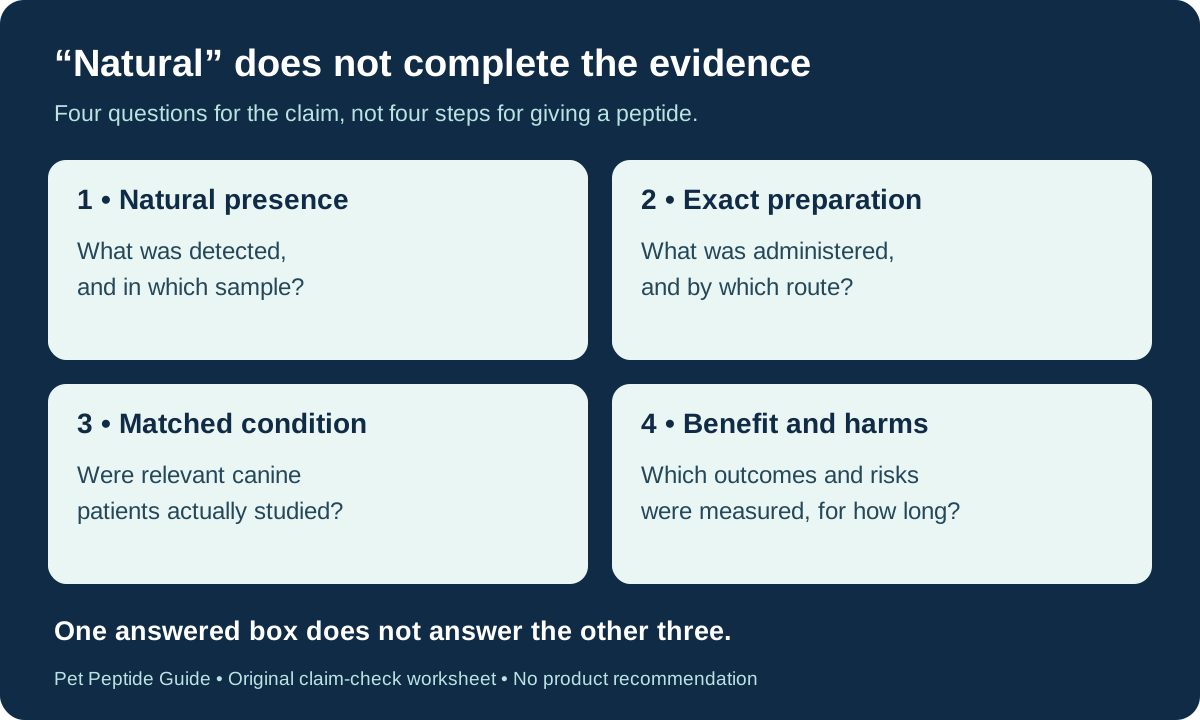
Publication, natural origin and approval are different things
The current U.S. FDA animal-drug framework evaluates intended-use safety and effectiveness together with manufacturing, labeling and packaging. A peptide's occurrence in a sample, a substance identifier or a published experiment is not itself a product approval. This source comparison does not verify a specific thymosin beta-4 or TB-500 product approved for the proposed canine use.
FDA's animal-compounding guidance also distinguishes bulk-compounded drugs from FDA-approved products. Bulk-compounded preparations have not undergone FDA's approval review; the agency recognizes circumstances in which such preparations can be medically necessary. That context requires a veterinarian's product-specific assessment, not an inference that an online vial is suitable because its ingredient has been studied.
No seller, affiliate offer or peptide administration route is recommended here. Our separate dog collagen buying guide addresses oral supplement-label comparisons; its products and evidence are not substitutes for an ocular preparation or evidence of thymosin-related healing.
What should you take to your veterinarian?

Bring the actual claim and its original citation, not just a screenshot of the conclusion. Use the printable veterinary checklist to record:
- What condition and outcome are we trying to address?
- Is the cited work a sample analysis, a model experiment or an intervention in dogs with the relevant diagnosis?
- What exact molecular form, finished preparation and route were studied?
- What is known about harms and follow-up for the proposed patient and preparation?
- What established care and monitoring should remain in place while we assess this claim?
This article cannot diagnose an eye problem or assess an injury. Do not change prescribed care based on an ingredient headline. For skin-injury research specifically, the dog wound-healing guide compares different preparations and wound settings rather than treating all repair research as the same evidence.
Frequently asked questions
Does “natural” mean an added peptide is safe?
Natural presence alone does not answer the safety question for an administered preparation. Ask for product-specific evidence in relevant patients, including the exposure period and how harms were collected. Do not infer an adverse-event rate from a sample-identification paper.
Did this review find a canine thymosin treatment protocol?
No protocol is established by the sources assessed here. Some full-text retrievals were unsuccessful, and this focused review cannot establish that no other research exists. Missing access is a limitation, not evidence for benefit or proof of no benefit.
Can these studies be combined to justify TB-500 with BPC-157?
They do not test that combination. The separate combination guide explains why adding two names or two bibliographies does not produce evidence for a combined preparation.
Bottom line: “Found in dogs,” “tested in an animal model” and “shown to help dogs with this condition” are different claims. Keep the action performed in the original study attached to every conclusion.
Sources and scope
This is an introductory guide or original comparison framework, not a systematic review or a product recommendation.
- de Sousa-Pereira et al. (2013): Thymosin beta-4 in mammalian saliva — Original abstract: endogenous dog-saliva identification; no administered preparation. Full sampling methods not reviewed.
- Kim et al. (2018): RGN-259 in a mouse dry-eye model — Publisher methods, results and disclosures reviewed. Topical ocular preparation in mice, not canine clinical treatment.
- Graham et al. (2021; online 2020): Canine tear proteomic method — Original abstract: canine sample characterization, not thymosin administration. Full protein tables unavailable; no thymosin-specific tear finding asserted.
- Esposito et al. (2012): Acetylated fragment identified in TB-500 — Original abstract: Ac-LKKTETQ material identification, not canine efficacy or full-length equivalence.
- FDA: Animal Drug Development and Approval Process — Current intended-use and product-review framework, not approval inferred from publication.
- FDA: Animal Drug Compounding — Bulk-compounded products distinguished from approval; medically necessary context retained.
Source checked October 18, 2026. A general context source does not establish a named product’s benefit.